
While the standard roulette grid offers a neat, numerical progression from 0 to 36, true veterans of the game know that the table layout is a distraction. The real game happens on the wheel. When the ball bounces, it doesn't care that 5 is next to 6 on the felt; it cares that 5 is sandwiched between 10 and 24 on the physical wheel.
To bridge the gap between the static table and the spinning wheel, experienced players utilize neighbor bets. This intermediate-level strategy moves beyond simple Red/Black predictions and allows you to target specific "hot zones" or sectors of the wheel.
In this guide, we will dissect the mechanics of neighbor bets, decode the racetrack interface common in modern crypto casinos, and develop strategies for efficient sector betting.
What Are Neighbor Bets in Roulette?
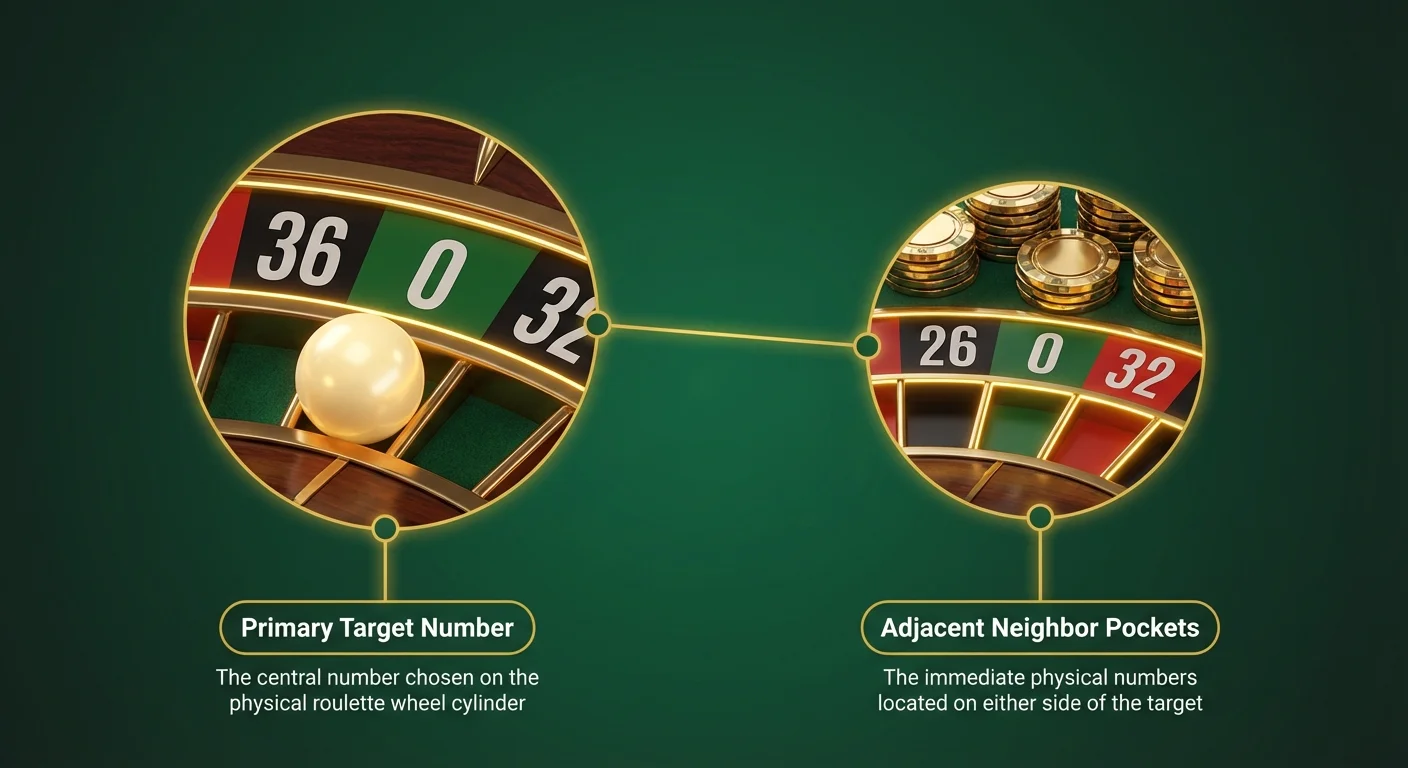
A neighbor bet is a wager placed on a specific number and the numbers immediately adjacent to it on the roulette wheel. Unlike Inside Bets (like Splits or Corners) which cover numbers adjacent on the betting grid, neighbor bets cover numbers adjacent on the physical cylinder.
The logic is rooted in the physics of the game (or the simulation thereof). If you believe the ball will land roughly in the area of the number 10, it is heartbreaking to see it land one pocket away on the number 23. On the betting felt, 10 and 23 are miles apart. On the wheel, they are right next to each other. Neighbor bets act as an insurance policy against near-misses.
The Standard "One Number and Two Neighbors"
The most common configuration for a neighbor bet is a 5-piece bet. This covers:
- The specific number you called.
- The two numbers to the immediate right.
- The two numbers to the immediate left.
For example, if you place a "Zero and its neighbors" bet on a European wheel, you are betting on: 3, 26, 0, 32, 15.
Why Play Neighbors?
- Sector Targeting: It allows you to bet on a physical area of the wheel rather than a random distribution of numbers.
- Volatility Management: While straight-up bets have high variance (1 in 37 chance), a standard neighbor bet covers 5 numbers, increasing your hit frequency to 13.5%.
- Speed: In live dealer crypto games where betting time is limited, placing a neighbor bet is significantly faster than trying to click five individual straight-up numbers.
Understanding the Racetrack Interface
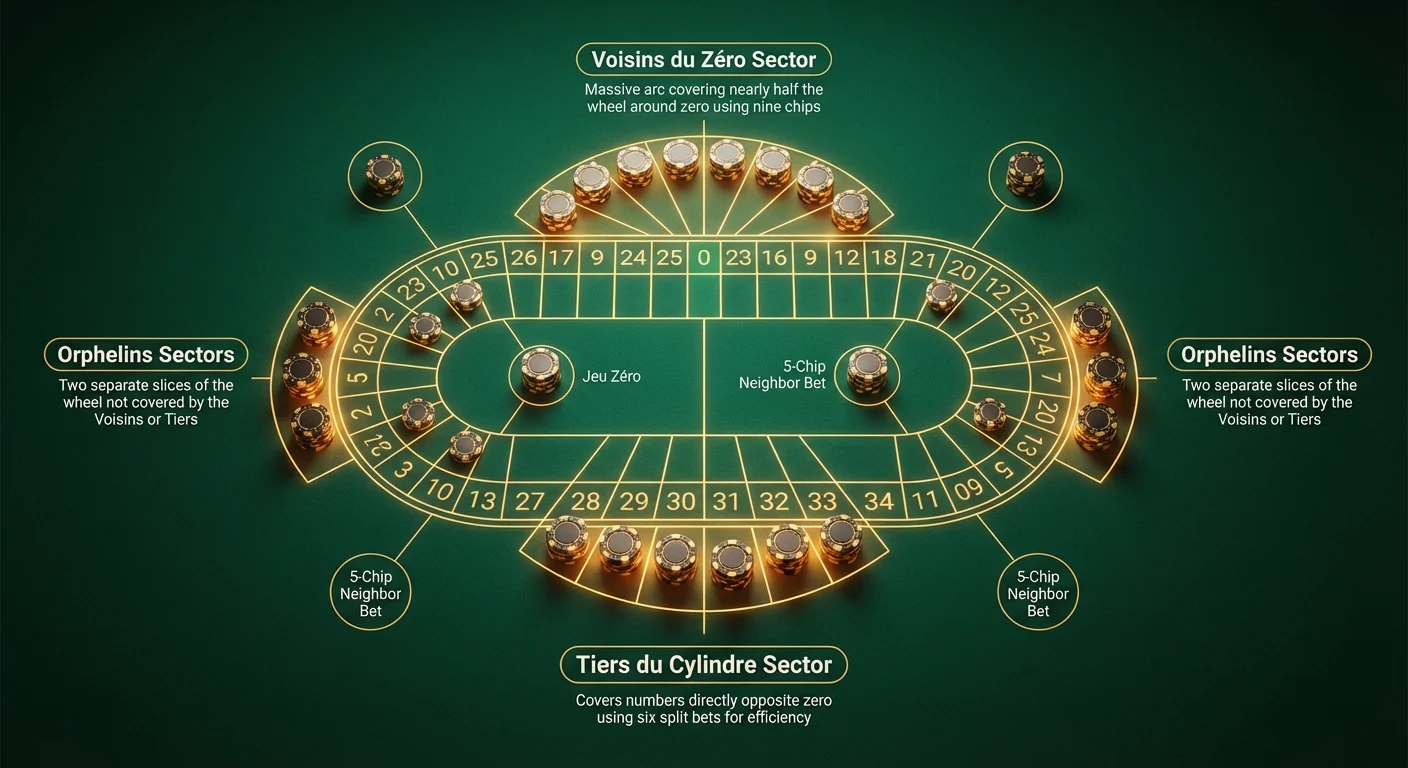
If you are playing at a high-end crypto casino, you will likely see an oval-shaped betting area situated above or near the standard rectangular grid. This is called the Racetrack.
The racetrack is a graphical representation of the actual sequence of numbers on the wheel. This is the primary tool for placing neighbor bets roulette wagers efficiently.
How to Read the Racetrack
The numbers on the racetrack match the European wheel sequence exactly:0, 32, 15, 19, 4, 21, 2, 25, 17, 34, 6, 27, 13, 36, 11, 30, 8, 23, 10, 5, 24, 16, 33, 1, 20, 14, 31, 9, 22, 18, 29, 7, 28, 12, 35, 3, 26
The "Neighbor" Selector
Most modern interfaces include +/- buttons near the racetrack. This controls how many neighbors you wish to include in your bet.
- Number set to 1: Bets on the number + 1 left + 1 right (3 chips total).
- Number set to 2 (Default): Bets on the number + 2 left + 2 right (5 chips total).
- Number set to 3: Bets on the number + 3 left + 3 right (7 chips total).
Pro Tip: Always check your neighbor count before clicking. A misclick with the selector set to "5" will instantly place 11 chips on the table, which can drain a bankroll unexpectedly.
The Mathematics of Neighbor Betting
To bet efficiently, you must understand the cost-to-coverage ratio. Neighbor bets are essentially a collection of "Straight Up" bets. This means if the ball lands on your primary number, you win 35:1 on that specific chip, but lose the chips placed on the neighbors.
Here is a breakdown of the coverage and cost for different neighbor configurations on a Single Zero (European) wheel.
| Configuration | Total Numbers Covered | Chips Required (Flat Bet) | Coverage Percentage | Probability of Winning (European) | Net Profit (if won) |
|---|---|---|---|---|---|
| Number + 1 Neighbor | 3 | 3 | 8.1% | 1 in 12.3 | 33 units |
| Number + 2 Neighbors | 5 | 5 | 13.5% | 1 in 7.4 | 31 units |
| Number + 3 Neighbors | 7 | 7 | 18.9% | 1 in 5.3 | 29 units |
| Number + 4 Neighbors | 9 | 9 | 24.3% | 1 in 4.1 | 27 units |
Note: Net Profit assumes a win on one number (35 payouts + keeping the original chip) minus the losing chips placed on the neighbors.
The Sweet Spot
Mathematically, the Number + 2 Neighbors (5 chips total) is widely considered the "sweet spot." It covers nearly 15% of the wheel, providing enough margin for error if the ball scatters slightly, without requiring an excessive wager that dilutes your profit margin too heavily.
Fixed Sector Bets (Call Bets)
While you can customize your neighbor bets, the Racetrack usually features fixed sections based on French Roulette rules. These are technically pre-packaged wheel sectors that act as massive neighbor bets. Learning these is vital for anyone looking to master racetrack betting.
1. Voisins du Zéro (Neighbors of Zero)
This is the massive arc covering almost half the wheel around the zero.
- Numbers Covered (17): 22, 18, 29, 7, 28, 12, 35, 3, 26, 0, 32, 15, 19, 4, 21, 2, 25.
- Cost: 9 Chips.
- Bet Type: A mix of splits, corners, and a trio.
- Strategy: Use this when the ball seems to be favoring the "upper" half of the wheel layout or when the dealer frequently lands near zero.
2. Tiers du Cylindre (Thirds of the Wheel)
This sector covers the numbers directly opposite the Zero.
- Numbers Covered (12): 27, 13, 36, 11, 30, 8, 23, 10, 5, 24, 16, 33.
- Cost: 6 Chips.
- Bet Type: 6 Splits.
- Strategy: This is a highly efficient bet. It covers 32.4% of the wheel for only 6 units. It is popular among grinders because the payouts are standardized (all splits pay 17:1), ensuring a consistent return of 12 units net profit.
3. Orphelins (Orphans)
These are the two slices of the wheel not covered by Voisins or Tiers.
- Numbers Covered (8): 17, 34, 6 (one side) and 1, 20, 14, 31, 9 (other side).
- Cost: 5 Chips.
- Bet Type: 4 Splits and 1 Straight Up (on number 1).
- Strategy: "Orphelins" is often played as a contrarian bet when the ball is avoiding the Zero and Tiers sectors. Because the number 1 is a straight-up bet, hitting it yields a higher ROI than the splits.
4. Jeu Zéro (Zero Game)
A more focused version of Voisins.
- Numbers Covered (7): 12, 35, 3, 26, 0, 32, 15.
- Cost: 4 Chips.
- Strategy: Used when you want to target the zero specifically but want a slight safety net on immediate neighbors.
Strategic Applications for Sector Betting
Now that you understand the mechanics, how do you apply this to actual gameplay, particularly in a crypto environment?
1. Identifying Biased Wheels (Live Casino)
In land-based casinos, wheels can develop slight imperfections (biases) over time, causing the ball to land in certain sectors more often. While rare in high-end Live Dealer crypto games (providers like Evolution Gaming swap wheels frequently), mechanical bias is still physically possible.
- The Play: Chart the last 50-100 spins. If a specific wedge of 5-7 numbers hits disproportionately, place a standard Neighbor bet on the center of that wedge.
2. Dealer Signatures
Some dealers develop a "rhythm" or muscle memory. They might pick up the ball from the number 5 and consistently spin it with the same velocity, causing it to land roughly opposite the pickup point.
- The Play: Watch the "pickup" number. If the ball lands consistently 15-20 pockets away from where it was picked up, use a neighbor bet to target that landing zone relative to the last winning number.
3. The "Scatter" Strategy
If you are playing a Provably Fair RNG (Random Number Generator) roulette game, physics do not apply. The spin is a visualization of a cryptographic hash. However, you can still use neighbor bets for Bankroll Velocity.
- The Logic: Betting on sectors (like Tiers) allows you to cover 33% of the outcomes with fewer clicks.
- The Play: If you want to play a "low volatility" session to clear a crypto deposit bonus, sticking to Tiers du Cylindre (6 chips covering 12 numbers) is often safer than random scatter betting because the payout (17:1) is substantial enough to recover from small losing streaks, unlike even-money bets which can be ground down by the Zero.
Crypto-Specific Considerations
When playing roulette with Bitcoin, Ethereum, or USDT, there are nuances to neighbor betting that differ from traditional fiat casinos.
Provably Fair and "Auto-Bet"
Many crypto-native casinos (like Stake or BC.Game) offer proprietary roulette games with "Provably Fair" technology. These games often lack the visual Racetrack.
- Tip: If the game lacks a racetrack, avoid neighbor betting. Trying to manually click 26, 0, 32, 15, 19 on a standard grid in under 10 seconds is prone to error. Stick to providers that offer a full European UI.
Bankroll Management with Cryptos
Because crypto allows for micro-betting (e.g., 0.00001 BTC), you can practice neighbor betting strategies with very low risk.
- Strategy: Since a standard neighbor bet requires 5 units minimum, ensure your total bankroll is at least 200 units (40 spins). If you are betting $1 chips, you need $200. If you only have $50, scale your chip size down to $0.25.
- Volatility Warning: Neighbor bets are binary. You either win big or lose everything on the table. Unlike betting Red/Black where you win frequently, you can go 10-15 spins without hitting a specific 5-number sector.
Common Mistakes to Avoid
1. Overlapping Neighbors
If you place a neighbor bet on 0, and another on 1, you are wasting chips.
- 0 Neighbors: 3, 26, 0, 32, 15
- 1 Neighbors: 16, 33, 1, 20, 14
- Wait, these don't overlap.
- Correction: If you bet neighbors on 0 and neighbors on 26, you are double-betting the number 26 and its surroundings. While this increases the payout if 26 hits, it drastically increases the cost of the spin for marginal gain.
2. Betting Against the Wheel
If you bet on the Voisins (High/Right side) and then hedge with a bet on Tiers (Low/Left side), you are effectively betting against yourself. You are covering 29 numbers (17 + 12) costing 15 chips.
- If you win Tiers: You win 18 chips, minus 15 cost = +3 chips.
- If you lose (ball hits Orphelins): You lose 15 chips.
- The Math: Risking 15 to win 3 is a poor risk/reward ratio. Pick a sector and stick to it; don't try to cover the whole wheel.
3. Using American Wheels
Never play neighbor bets on an American Wheel.The American wheel adds a "00". This not only increases the House Edge to 5.26%, but it also completely scrambles the number sequence. The neighbor of Zero on a European wheel is 32. On an American wheel, the neighbor of Zero is 2.
- Most Racetrack interfaces are designed for European sequencing. Playing an American wheel renders the standard French bets (Voisins/Tiers) invalid and confusing.
Step-by-Step: How to Place a Neighbor Bet
- Select a European/French Table: Ensure there is only a single Zero (0).
- Locate the Racetrack: Look for the oval overlay. If hidden, check the settings or "advanced views" button.
- Adjust Neighbor Count: Look for the selector (usually labeled "Neighbors" or "+/-"). Set it to 2 for a standard 5-number bet.
- Identify Your Target: Choose the number you want to center your bet on.
- Click: Click the number on the Racetrack (not the main grid). The software will automatically place chips on that number and the two on either side.
- Verify: Check the "Total Bet" amount. It should be 5x your chip denomination.
Summary
Neighbor bets represent the graduation from "guessing numbers" to "playing the wheel." By understanding the racetrack and utilizing sections like Voisins and Tiers, you can cover significant portions of the wheel efficiently.
Key Takeaways:
- Neighbor bets cover a physical sector, not a table grid line.
- The Racetrack is your primary tool; do not try to place these manually on the main grid.
- The Number + 2 Neighbors (5 chips) is the standard, balanced bet.
- Tiers du Cylindre is the most bankroll-friendly sector bet for meeting wagering requirements in crypto casinos.
- Always play on European (Single Zero) wheels to ensure the neighbor sequence is correct and the house edge is minimized (2.7%).
Next time you log into your favorite crypto casino, open the Racetrack view. Stop chasing random numbers and start hunting sectors. Good luck!