
Walking into a keno lounge or loading up a crypto keno interface for the first time can feel like stepping into a foreign country. You see a grid of 80 numbers, and suddenly people are talking about "spots," "catches," "ways," and "kings."
While keno is fundamentally one of the simplest casino games - pick numbers and hope they appear - the terminology surrounding it is rich and specific. Mastering this language isn't just about sounding like a pro; it is about understanding how to structure your bets to maximize your bankroll and navigate the odds.
Whether you are playing at a traditional land-based casino or enjoying the anonymity and speed of a modern crypto gambling site, this glossary will serve as your ultimate roadmap. We have broken down the jargon into categories, ranging from basic gameplay to advanced betting structures and the specific tech behind crypto keno.
The Essentials: Core Gameplay Terms
Before you can place a bet, you need to understand the fundamental components of the game. These are the terms you will encounter in every single round, regardless of the variation.
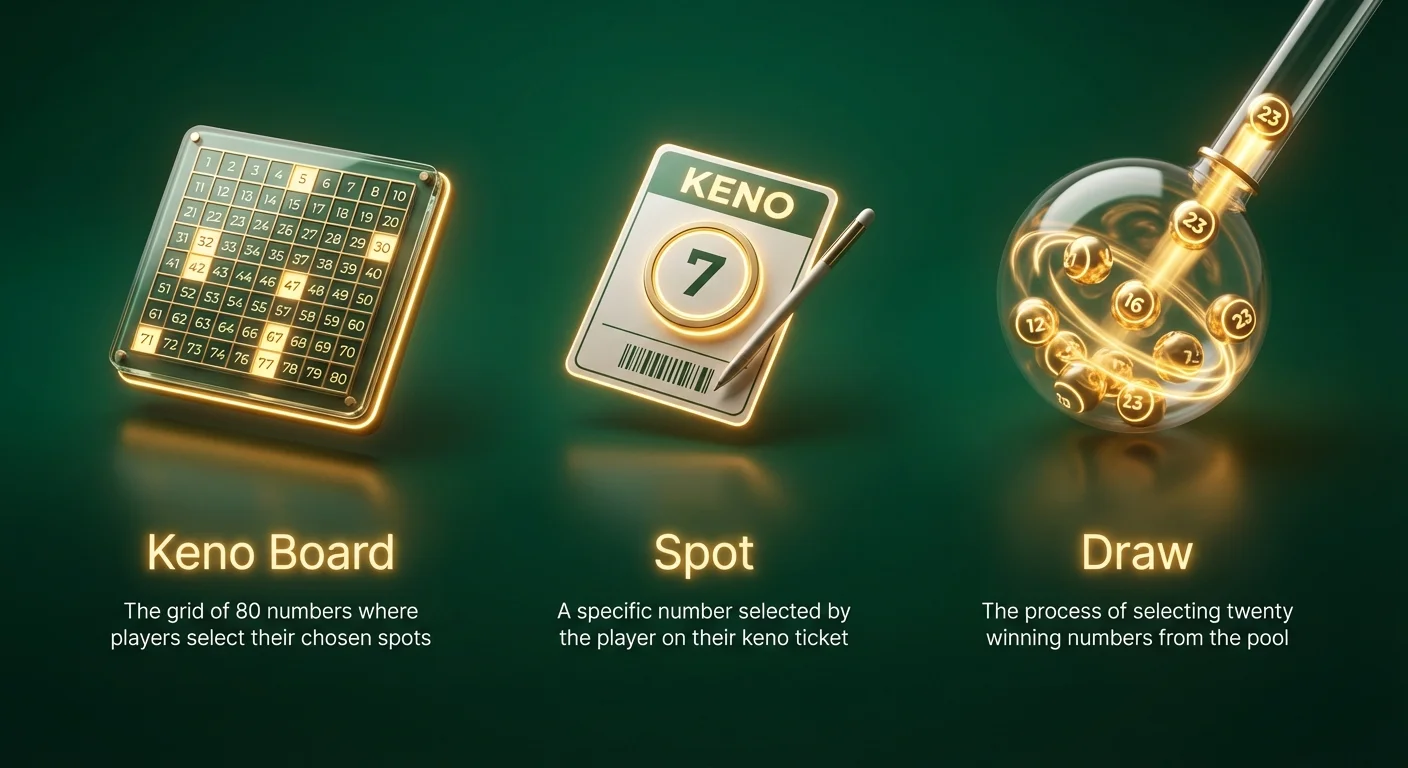
1. Keno Board (or Grid)
The layout of the numbers. A standard keno board consists of numbers 1 through 80. In online versions, this is the digital interface where you select your numbers. Traditionally, the board is split into a top half (1-40) and a bottom half (41-80).
2. Spot
This is perhaps the most important term to learn. A "spot" refers to the numbers you mark on your ticket. If you select five numbers, you are playing a "5-spot" game. If you select ten, it is a "10-spot."
- Usage: "I'm playing a 6-spot ticket this round."
3. Draw
The act of selecting the winning numbers. In a standard game, 20 numbers are drawn from the pool of 80.
- Note: In land-based casinos, this happens via a ball machine. In crypto casinos, this is done via an RNG (Random Number Generator).
4. Catch
When a number you marked (a spot) matches a number drawn by the game. If you mark 10 numbers and 6 of them appear in the draw, you have "caught" 6 numbers.
- Synonyms: Hit.
5. Ticket
The physical or digital card where you place your bets. On crypto sites, this is often just referred to as your "active bet" or "card."
The total amount of money (or cryptocurrency) you have set aside specifically for gambling. Proper bankroll management is vital in keno because the game moves fast.
7. Race
A specific round of keno. This term comes from the days when keno was disguised as "Racehorse Keno" to skirt gambling laws. You might hear, "I'm betting on the next five races."
Pro Tip: In online crypto keno, "Races" are often instantaneous. Be careful with "Auto-Play" features, as you can burn through dozens of races in a minute if you aren't watching your balance.
The Bets: Types of Keno Tickets
Beginners usually stick to picking numbers and hitting "play." However, experienced players know there are many ways to configure a ticket to alter the volatility and potential payout.
Straight Ticket
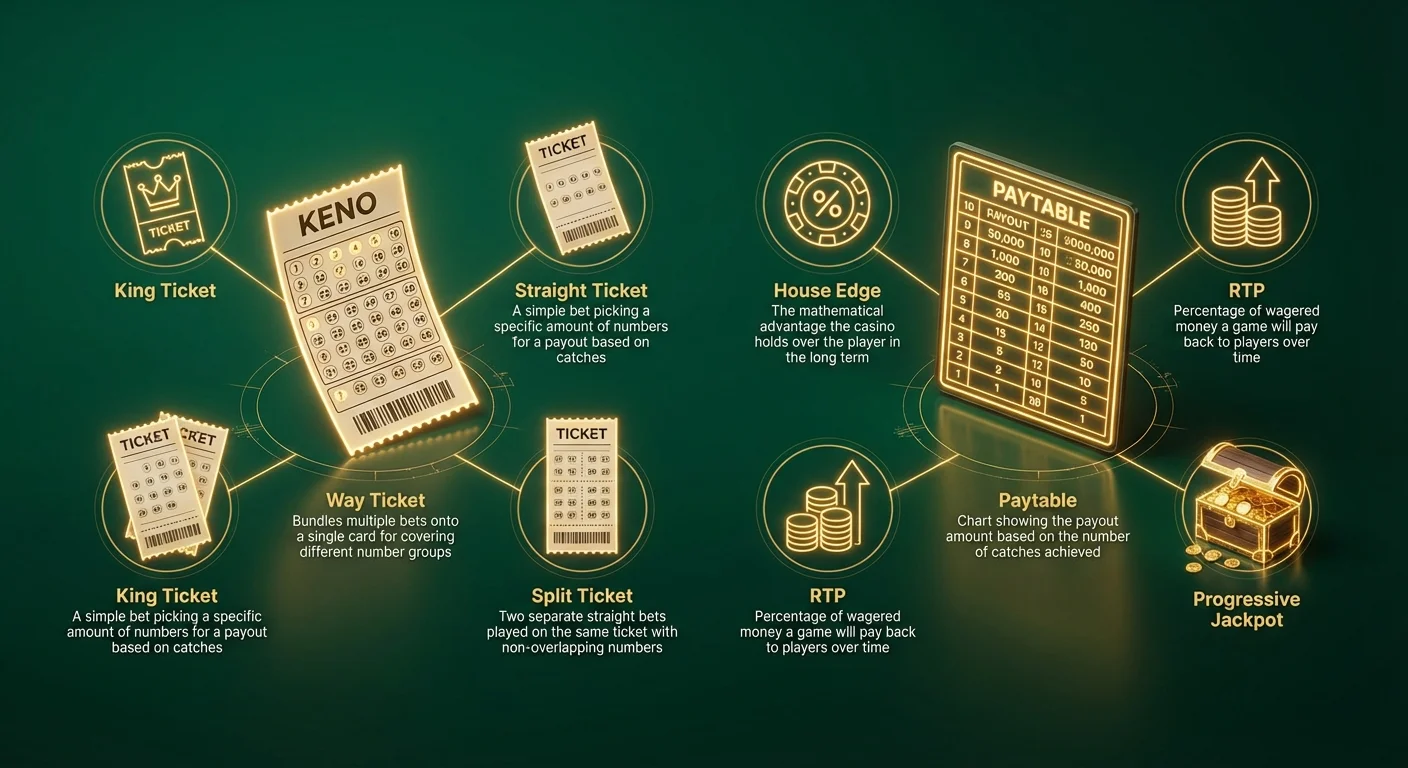
The most common and simplest bet. You pick a specific amount of numbers (spots), and you are paid based on how many you catch. There are no fancy combinations here - just a straight bet on a specific set of numbers.
Way Ticket
A ticket that allows you to bundle multiple bets onto a single card. This allows you to bet on different groups of numbers simultaneously.
- Example: You could pick three groups of numbers (Group A, Group B, and Group C). A way ticket allows you to bet on Group A+B, Group B+C, and Group A+C all at once. This effectively splits your wager into multiple smaller fractions.
Split Ticket
Two or more separate straight bets played on the very same ticket. You might circle a group of five numbers on the top of the card and a different group of five on the bottom.
- Rule: In most casinos, the numbers in a split ticket cannot overlap (you can't use the number 15 in both bets).
King Ticket
A variation of the Way Ticket where one specific number (The King) is included in every single combination you play.
- Strategy: Players choose a "King" number when they have a strong hunch or a "lucky number" they believe will hit, making it the anchor of their entire betting strategy.
Combination Ticket
A ticket that combines different betting styles. You might have a King number, some Way bets, and a Straight bet all on one complex ticket. These are rare in simplified online interfaces but common in dedicated keno software.
Multi-Race Ticket
A single ticket that applies to consecutive games. If you want to play your lucky numbers (e.g., 7, 11, 23) for the next 10 games without re-clicking them every time, you buy a Multi-Race ticket.
| Ticket Type | Complexity | Best For |
|---|---|---|
| Straight | Low | Beginners & casual players |
| Split | Medium | Playing two strategies at once |
| Way | High | Hedging bets & covering more numbers |
| King | High | Players with a specific "lucky" number |
The Money: Odds, Payouts, and Limits
Understanding the financial terms is the difference between blindly gambling and making informed decisions.
8. Paytable
The chart that tells you how much you win based on your catches.
- Critical: Paytables vary wildly between casinos. A 5-spot game might pay 3-to-1 for 3 catches at one casino, but 5-to-1 at another. Always check the paytable before playing.
9. House Edge
The mathematical advantage the casino holds over the player.
- Reality Check: Keno generally has a high house edge (often 20% to 35% in land-based casinos). However, Crypto Keno sites often offer significantly lower house edges (sometimes as low as 1-3%), making them much friendlier to the player.
10. RTP (Return to Player)
The opposite of the House Edge. It represents the percentage of wagered money a slot or keno game will pay back to players over time.
- Target: Look for online keno games with an RTP of 95% or higher.
11. Aggregate Limit
The maximum amount a casino will pay out in a single round, regardless of how many winners there are. If the aggregate limit is $50,000 and three people hit the jackpot, they have to split that $50,000. This is less common in crypto casinos, which often have higher liquidity, but always check the T&Cs.
12. Progressive Jackpot
A prize pool that increases every time a bet is made but not won. Hitting a specific high-difficulty pattern (like a 10-spot catch) usually triggers this massive payout.
The Mechanics: How the Numbers are Chosen
How do you know the game is fair? Understanding the mechanism behind the draw helps you choose trustworthy games.
13. RNG (Random Number Generator)
A software algorithm used by online and crypto casinos to ensure that every number drawn is completely random and unpredictable. It replaces the physical ball machine.
14. The Hopper (or Goose)
In traditional live keno, this is the machine (glass bubble) that mixes the ping-pong balls. It has a "throat" where the balls are forced up into a tube. You won't see this online, but you will hear the term in land-based terminology.
15. Seed
In software-based keno, the "seed" is the initial value fed into the RNG to create the random result.
- Crypto Context: In Provably Fair gaming, you (the player) often get to contribute a "Client Seed" that interacts with the casino's "Server Seed," ensuring the casino cannot pre-determine the outcome.
This is a cornerstone term for CryptoGambling.com readers. It refers to blockchain-based technology that allows players to verify the fairness of every single game round. You can check the hash (digital signature) of the game after the round ends to prove the casino didn't cheat.
17. Blockchain
The decentralized ledger where crypto transactions are recorded. In the context of keno, this guarantees that your deposit and withdrawal transactions are immutable and transparent.
Strategy & Patterns: Advanced Jargon
As you read strategy guides (like those found on our site), you will encounter terms describing how numbers interact on the board.
18. Hot Numbers
Numbers that have been drawn frequently in the last X amount of races.
- Myth vs. Reality: Many interfaces highlight hot numbers. While mathematically past results don't influence future RNG draws, many players swear by riding the "heat."
19. Cold Numbers
Numbers that have not been drawn for a long time. Players bet on these believing they are "due" to hit (a concept known as the Gambler's Fallacy).
20. Clusters
A betting pattern where a player selects numbers that are physically touching on the keno grid (e.g., a square of four numbers in the corner).
- 4x5 Corners: A specific strategy where players bet on groups of 5 numbers in the corners of the board.
21. Blocking
A strategy often used in Way tickets where you select blocks of numbers to create multiple overlapping winning possibilities.
22. Catch-All (or All-or-Nothing)
Some specialized keno variations offer a payout if you catch zero numbers. This is technically a strategy in itself - betting against the odds of hitting anything.
Variance (or Volatility)This describes the risk/reward ratio.
- High Variance: Betting on 10 spots. You win rarely, but when you do, the payout is massive.
- Low Variance: Betting on 1 or 2 spots. You win frequently, but the payouts are small.
Crypto-Specific Keno Glossary
If you are playing with Bitcoin, Ethereum, or USDT, there are specific terms that apply to your banking and gameplay experience.
24. Faucet
A feature on some crypto gambling sites that gives you tiny amounts of free cryptocurrency (Satoshis) to test games like keno without depositing.
25. Hash
A long string of alphanumeric characters generated by the Provably Fair algorithm. Before you bet, you receive a hashed version of the server seed. After the bet, the seed is revealed. If the two match mathematically, the game was fair.
26. Instant Withdrawal
One of the main benefits of crypto keno. Unlike bank transfers that take days, winnings are sent to your crypto wallet automatically or within minutes of the request.
27. Gas Fee
The transaction fee required to send cryptocurrency on the blockchain.
- Tip: If you are playing keno with small bets, avoid using Ethereum (ETH) during congested times as gas fees can be high. Use Litecoin (LTC), Ripple (XRP), or Dogecoin (DOGE) for cheaper deposits.
Practical Application: Reading a Crypto Keno Interface
To wrap up this dictionary, let's walk through a hypothetical scenario of loading up a game at a crypto casino so you can see these terms in action.
- Deposit: You send BTC to the casino. You wait for 1 Confirmation on the Blockchain.
- Selection: You open the Keno game. You decide to play a High Variance strategy, aiming for a big win.
- The Spots: You select a Cluster of 8 numbers (an 8-Spot ticket) in the top left corner.
- The Bet: You set your Wager to 0.0001 BTC.
- Fairness: You verify the Client Seed is set to random for Provably Fair integrity.
- The Draw: You hit "Play." The RNG selects 20 numbers.
- The Result: You see that 5 of your numbers light up. You have achieved 5 Catches.
- The Payout: You check the Paytable. For an 8-spot ticket, 5 catches might pay 3x your bet. The winnings are instantly added to your Bankroll.
Summary
Keno is a game of ancient origins that has adapted perfectly to the modern digital age. While the core mechanic is pure luck, the terminology represents the depth of strategy available to you.
Understanding the difference between a Way Ticket and a Straight Ticket can save you money. Knowing what RTP means ensures you only play games that give you a fair shot. And utilizing Provably Fair tools guarantees that your crypto gaming experience is legitimate.
Key Takeaways:
- Spot = Number picked. Catch = Number hit.
- Paytables dictate your strategy; always read them first.
- Way Tickets allow for complex, hedged betting.
- Crypto Keno offers lower house edges and verifiable fairness compared to traditional keno.
Now that you speak the language, you are ready to play the game. Good luck, and may your spots always be catches!