
If you have spent any time at the craps table - whether the felt surface of a Las Vegas casino or the digital interface of a top-tier crypto gambling site - you likely know the Pass Line. It is the bread and butter of the game, the wager that unites the table in a collective cheer when the shooter strikes gold. But for players looking to graduate from "beginner" to "intermediate," relying solely on the Pass Line can feel limiting. You are waiting for one number to hit while watching other numbers roll by, useless to your bankroll.
To truly capitalize on a hot shooter (or a cold table), you need to extend your position. You need to have action on multiple points simultaneously. This is where the Come and Don't Come bets shine. These wagers are essentially "games within a game," allowing you to establish new point numbers after the initial Come Out roll.
In this guide, we will move beyond the basics. We will dissect the mechanics of these advanced bets, explore the "Three Point Molly" strategy, and discuss how playing at crypto casinos offers unique advantages for these specific wager types.
The Logic of Extending Your Position
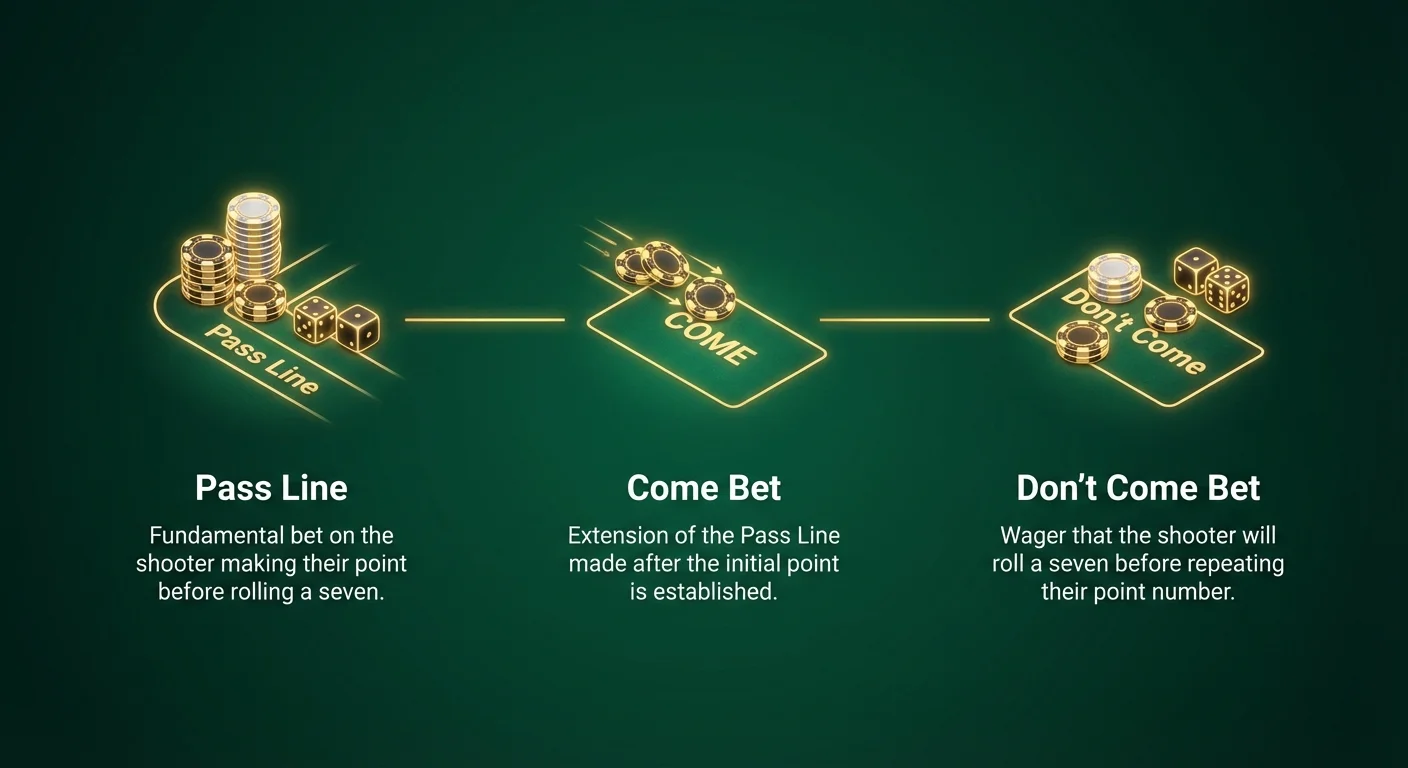
Why should you look beyond the Pass Line? Mathematically, the Pass Line is a solid bet with a low House Edge comparison of 1.41%. However, it has a volume problem. Once a point is established (say, a 5), you are effectively sitting on your hands until the shooter rolls a 5 or a 7. If the shooter rolls a 4, 6, 8, 9, or 10, you win nothing.
By utilizing Come bets, you can cover more numbers. If the shooter is on a streak, rolling number after number, you want money on those numbers to collect payouts. Conversely, if you believe the table is cold, the Don't Come bet allows you to bet against multiple numbers at once, stacking the odds in your favor that a 7 will appear before the point numbers repeat.
The Come Bet: The Game Within a Game
The Come bet is, in simplest terms, a Pass Line bet made after the point has already been established. It follows the exact same rules as the Pass Line, but it treats the next roll of the dice as its own personal Come Out roll.
How it Works
- The Setup: The shooter has already established a point (e.g., the point is 6).
- The Wager: You place chips in the "Come" area of the layout.
- The Roll: The shooter rolls the dice.
- 7 or 11: Your Come bet wins immediately (1:1 payout).
- 2, 3, or 12: Your Come bet loses immediately.
- Any Box Number (4, 5, 6, 8, 9, 10): Your Come bet travels.
If the shooter rolls a 4, the dealer (or the software in a crypto game) moves your chips from the "Come" box into the box marked "4." The number 4 is now the "point" for that specific wager. You now need the shooter to roll a 4 again before rolling a 7 to win that bet.
Key Distinction: If the shooter rolls the main table Point (the 6), the Pass Line wins, the puck turns "OFF," and a new game begins. However, your Come bet on the 4 remains there, waiting for a resolution. It is a "Contract Bet," meaning once it travels to a number, you cannot remove it until it wins or loses.
Backing It With Odds
Just like the Pass Line, the true power of the Come bet lies in the "Free Odds." Once your bet travels to a number (e.g., the 4), you can add more chips to it. In a land-based casino, you hand the chips to the dealer and say, "Odds on the 4." In a crypto casino, you typically click on your chip that is sitting on the 4 to add the odds.
These odds are paid at "true odds," meaning there is zero house edge on the additional portion of the bet.
| Point Number | Flat Bet Payout | True Odds Payout |
|---|---|---|
| 4 or 10 | 1:1 | 2:1 |
| 5 or 9 | 1:1 | 3:2 |
| 6 or 8 | 1:1 | 6:5 |
The Don't Come Bet: The Dark Side Equivalent
For every "Do" bettor cheering for the shooter, there is a "Don't" bettor quietly waiting for the Seven. The Don't Come bet is the mirror image of the Come bet. It is a Don't Pass bet made after the point is established.
How it Works
- The Wager: You place chips in the "Don't Come" area (often a smaller bar next to the Come area).
- The Roll:
- 2 or 3: You win immediately (1:1).
- 12: It is a push (your money is returned).
- 7 or 11: You lose immediately.
- Any Box Number: Your bet travels behind that number.
If the shooter rolls a 10, your Don't Come bet travels behind the 10. You are now betting that a 7 will roll before another 10. Since the 7 is the most statistically frequent number (6 ways to make a 7 vs. 3 ways to make a 10), you have the advantage.
Laying the Odds
Because you have the statistical advantage once the bet is established behind a number, you must "pay" for the privilege of backing it with odds. This is called "Laying Odds." You must bet more to win less, but the house edge remains at zero for this portion.
Example: If your Don't Come bet travels to the 4, you might lay $40 in odds to win $20. If a 7 rolls, you win your flat bet ($10) plus your odds win ($20).
Strategy 1: The Three-Point Molly
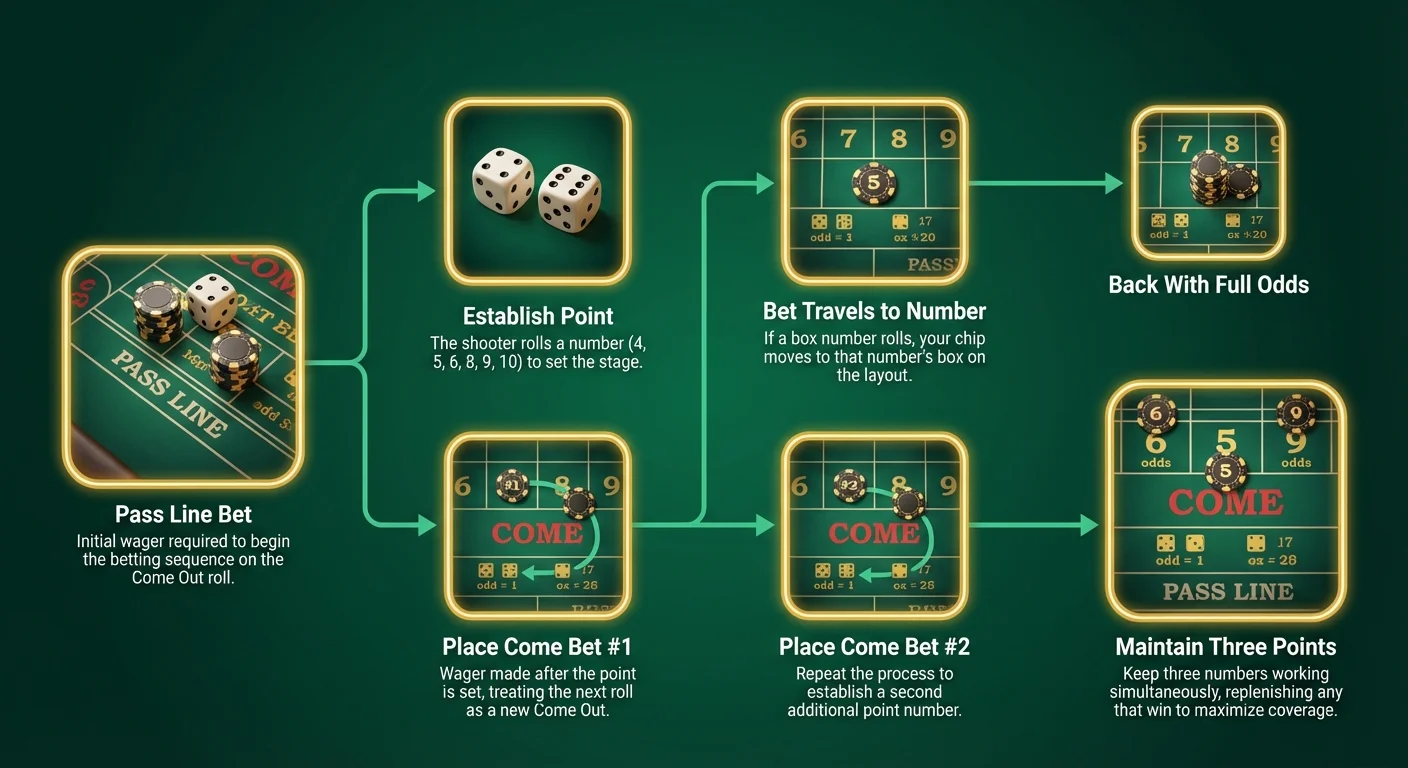
This is the gold standard for intermediate players who want to capitalize on a hot shooter while maintaining reasonable bankroll management. The goal is to have three numbers working for you at all times, backed by maximum odds.
The Setup:
- Pass Line: Place a Pass Line bet. Wait for a point to be established.
- Max Odds: Immediately take full odds on your Pass Line bet.
- Come Bet #1: Place a Come bet. Wait for the roll.
- If it moves to a number, add full odds to it.
- If it wins instantly (7/11), profit and re-bet.
- Come Bet #2: Place another Come bet. Wait for the roll.
- If it moves to a number, add full odds.
- Maintenance: You now have the Pass Line plus two Come bets established (covering three distinct numbers). Stop placing new bets.
- If one of your Come bets wins (the number repeats), collect your winnings and place a new Come bet to replace it.
- Always maintain exactly three active points.
Why it works: You have significant coverage of the board. On a "hot roll," you are constantly collecting payouts and reloading.
The Risk: If a 7 rolls, you lose the Pass Line, both Come bets, and all the odds attached. This is why we cap it at three points - to prevent over-exposure.
Strategy 2: The Continuous Don't
If the table is cold and the dice are chopping (Point-Seven-Out, Point-Seven-Out), the Don't Come strategy is superior.
- Don't Pass: Establish a Don't Pass wager. Lay your odds.
- Don't Come: Place a Don't Come wager.
- If a 7 rolls immediately, your Don't Pass wins, but your new Don't Come loses. They hedge each other slightly.
- If a number rolls, your bet travels behind it. Lay odds on it.
- Expansion: Continue placing Don't Come bets until you have 2 or 3 established "Don't" points.
Why it works: Once your bets are established behind numbers like 4, 5, 9, or 10, you are the favorite to win. You are sitting with multiple bets waiting for the inevitable 7 to clear the table and pay you out.
Come Bets vs. Place Bets: Which is Better?
Intermediate players often ask: "Why bother with a Come bet? Why not just Place the 6 and 8? It's faster and I control the bet."
This is a valid question. Here is the comparison:
| Feature | Come Bet (with Odds) | Place Bets |
|---|---|---|
| House Edge | Very Low (0.2% - 0.6% depending on odds) | Higher (1.52% on 6/8, 4% on 5/9) |
| Payouts | True Odds (fair math) | Casino Odds (shaved for house profit) |
| Flexibility | Contract Bet (Cannot remove) | Flexible (Can turn off or remove anytime) |
| Instant Action | Must wait for travel | Immediate action on next roll |
| Hit Difficulty | Must hit number twice (once to travel, once to win) | Must hit number once |
The Verdict:
- Use Place Bets if you are playing a short session, want to "hit and run," or want the ability to pull your bets down if you get a bad feeling.
- Use Come Bets if you have the bankroll to sustain variance and want the best mathematical chance of winning long-term due to the lower house edge provided by the Free Odds.
Crypto Casino Advantages for Come Betting
Playing Craps at a crypto casino offers distinct advantages when utilizing these strategies, particularly regarding mechanics and fairness.
1. Provably Fair Verification
When you are betting on streaks (Three-Point Molly) or against them (Don't Come), you can succumb to the Gambler's Fallacy, believing a number is "due." In traditional online casinos, you trust the black box. In crypto craps (specifically on dApps or Provably Fair specialized sites), you can verify the seed generation for every roll. You know that the "Seven Out" that wiped your three Come bets was a mathematical certainty of the seed, not a glitch in the software.
2. Instant Bankroll Management
Come betting requires a larger bankroll because you have multiple bets in limbo. Using cryptocurrencies like Bitcoin or USDT allows for instant deposits and withdrawals. If you are mid-strategy and need to top up to back a Come bet with max odds, crypto transactions clear faster than fiat bank transfers.
3. Automated "Odds" Features
In live dealer games, it can be tedious to tell the dealer "Odds on the 5, odds on the 9, odds on the 10." Many crypto-based software Craps games have "Auto-Max Odds" buttons or simplified interfaces where clicking the traveling chip automatically applies your pre-set odds multiplier. This speeds up the game significantly, allowing you to get more rolls per hour.
Practical Tips for the Intermediate Player
The "Off on the Come Out" Rule
This is the most confusing aspect for new Come bettors.
- Scenario: You have a Come bet established on the 5 with Odds. The shooter hits the main Pass Line point. The round is over.
- The Next Roll: The puck is "OFF." The shooter is rolling a new Come Out roll.
- The Rule: By standard casino rules, your Flat Come Bet on the 5 is working (active). Your Odds on the 5 are OFF (inactive).
- Why? If the shooter rolls a 7 on the Come Out (a winner for the Pass Line), your flat Come bet on the 5 loses. However, your Odds are returned to you safely.
- Pro Tip: You can tell the dealer "Working on the Come Out" if you want your odds to be active, but most players prefer the safety of having them off during the Come Out roll.
Don't Clog the Rail
If you are playing a "Don't Come" strategy, you will be racking up wins on the 7. Remember that the 7 resets the board. Don't get greedy. If you have 3 Don't Come bets established and the shooter has been rolling for 15 minutes without hitting a 7, do not keep adding more Don't bets. You are walking into a "sniper" situation where the shooter might pick off your numbers one by one. Stick to your 2-3 point limit.
Watch the Minimums
Come bets with full odds are expensive.
- $10 Flat bet + $50 Odds (5x) = $60 per point.
- 3 Points active = $180 at risk.
Ensure your crypto bankroll is at least 10x your total exposure (e.g., $1800) to weather the variance of a "cold" session where you can't get a point to repeat.
Summary
Moving from the Pass Line to Come and Don't Come bets is the moment a craps player begins to play the game properly. You are no longer a spectator waiting for a single result; you are building a portfolio of positions across the table.
- Come Bets allow you to ride the wave of a hot shooter with the lowest house edge in the casino, provided you take the free odds.
- Don't Come Bets allow you to align yourself with the math of the Seven, effectively hunting the shooter's failure across multiple numbers.
- Crypto Casinos facilitate this style of play with faster interfaces, provable fairness, and high betting limits suitable for odds-heavy strategies.
Remember, the goal isn't just to bet more - it's to bet smarter. By extending your position to multiple points, you ensure that when the dice go your way, the payout is worth the risk.