
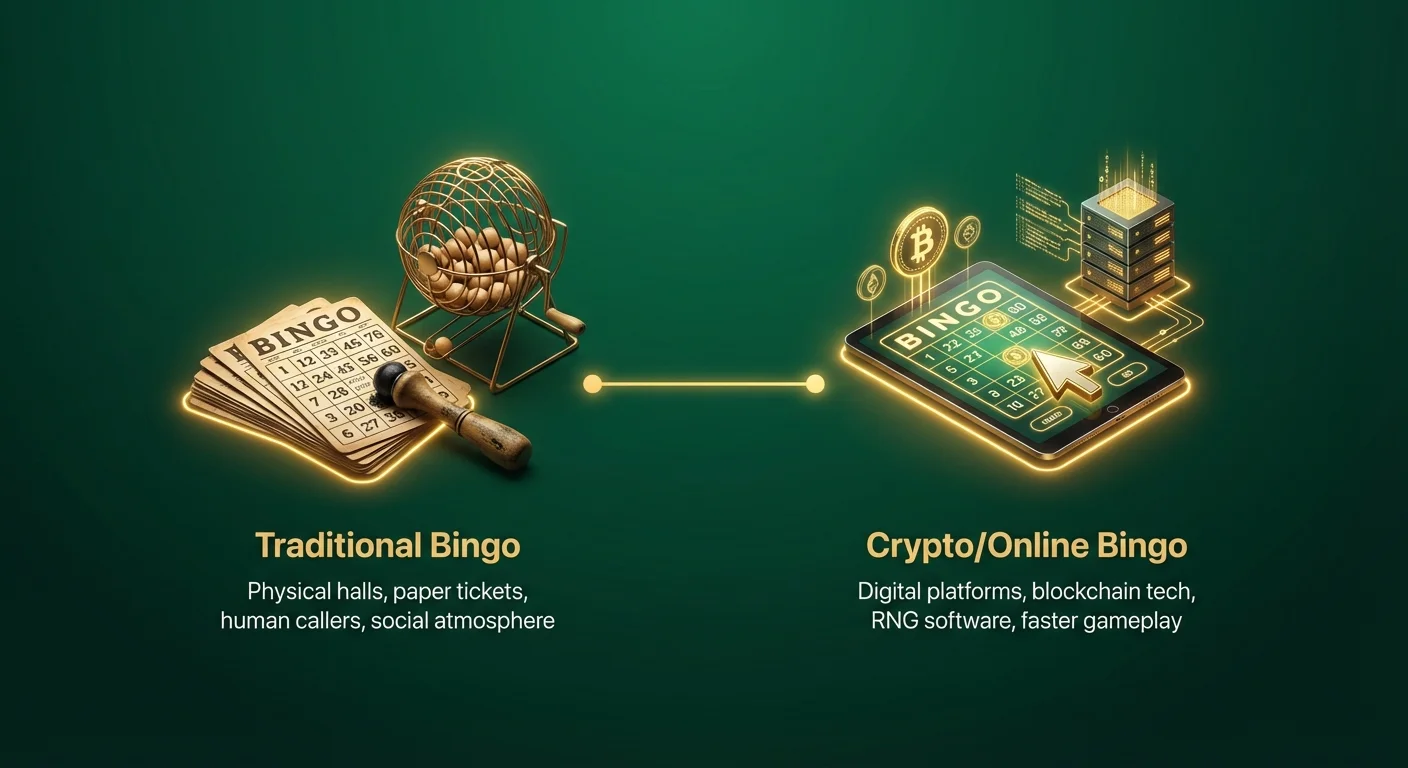
Entering a bingo room for the first time, whether it's a bustling local hall or a sleek, high-speed crypto casino, can feel like stepping into a foreign country. Everyone seems to speak a secret language. You hear shouts of "legs eleven," see chat messages flashing "1TG," and watch players frantically checking for a "coverall."
While the premise of bingo is beautifully simple - mark off numbers until you win - the culture surrounding it is rich and specific. As the game has migrated from church basements to the blockchain, the vocabulary has evolved. Today's player needs to know not only the traditional calls but also the mechanics of Provably Fair gaming and automated software.
This guide is designed to take you from a confused novice to a fluent bingo pro. We have categorized the terminology to follow the flow of the game, from buying your tickets to claiming your crypto jackpot.
The Essentials: Game Variants and Grid Mechanics
Before you can understand the slang, you must understand the battlefield. Bingo isn't just one game; it is a family of games, each with its own grid structure and rules.
75-Ball Bingo
The dominant version of the game in North America.
- The Grid: Played on a 5x5 grid containing 24 numbers and one central "Free Space."
- The Letters: The columns are headed by B-I-N-G-O.
- B: 1-15
- I: 16-30
- N: 31-45
- G: 46-60
- O: 61-75
- Gameplay: This variant is famous for its "patterns" (shapes made on the card) rather than just filling lines.
90-Ball Bingo
The standard version in the UK, Europe, and Australia.
- The Ticket: Played on a 9x3 strip. It contains 15 numbers (5 per row) and blank spaces.
- The Stages: Usually played for three distinct prizes in one game: 1 Line, 2 Lines, and Full House.
Speed Bingo (30-Ball)
A fast-paced variant popular in crypto casinos where speed is king.
- The Grid: A tiny 3x3 grid with only 9 numbers.
- The Goal: Usually, you must fill the entire card (Blackout) to win. Rounds can finish in under a minute.
5-Line Bingo (Swedish Bingo)
A hybrid variant played on a 75-ball grid but without the Free Space.
- The Goal: You can win on single lines (horizontal or vertical), but the ultimate goal is covering the card. It is faster and more aggressive than standard 75-ball.
The Setup: Buying In and Getting Ready
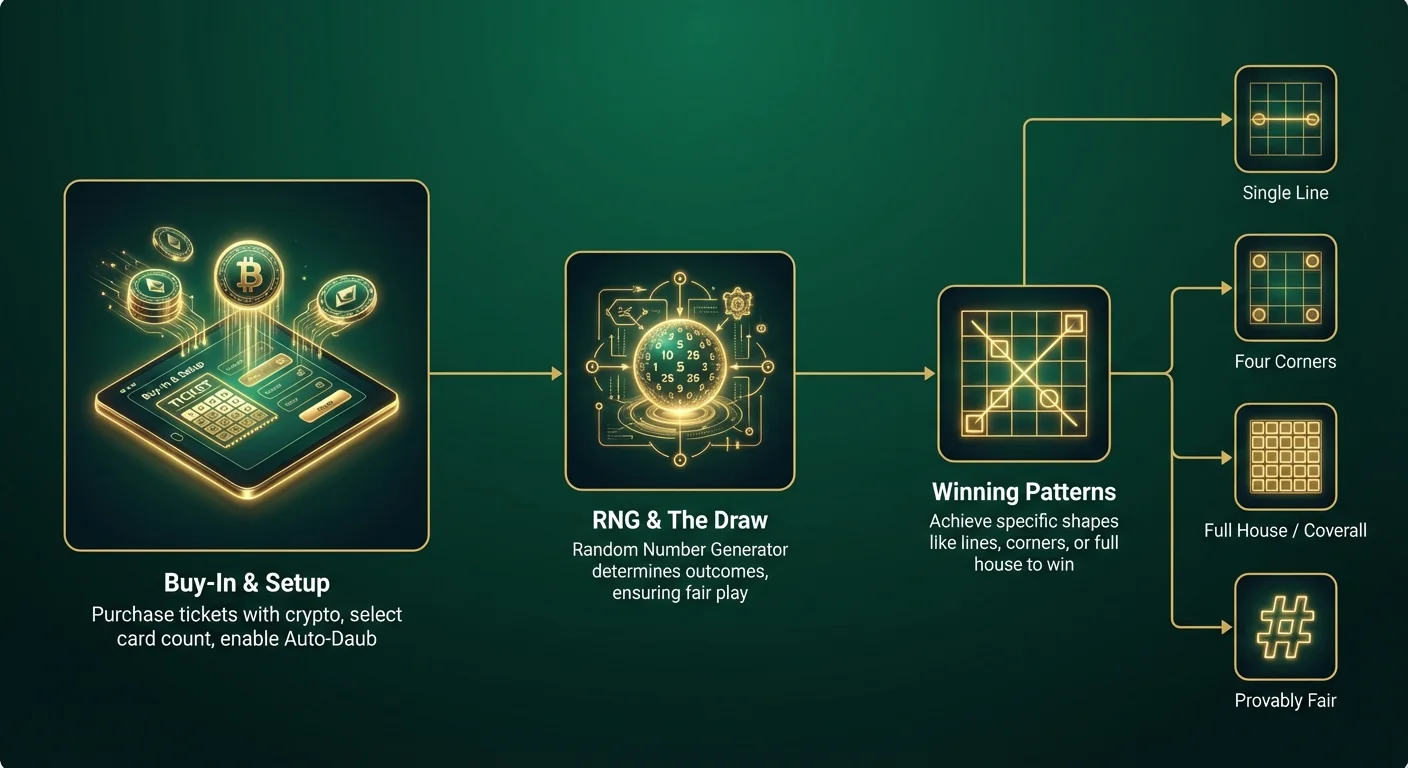
The game begins before the first number is called. Here are the terms related to acquiring your cards and managing your session.
Admission Packet
In land-based halls, this is the minimum number of cards you must purchase to participate in the session. In online crypto bingo, this is equivalent to the "Minimum Buy-in."
Buy-in
The cost to enter a game. In crypto bingo, this is denominated in your chosen currency (e.g., BTC, ETH, USDT). Higher buy-ins usually equate to larger jackpot pools.
Face / Card / Ticket
The individual grid containing your numbers. "Face" usually refers to the 5x5 grid in 75-ball bingo.
Free Space
The center square in a standard 75-ball card. It has no number and is considered automatically marked ("daubed") at the start of the game. Strategically, this is the most valuable spot on the board as it links four potential winning lines (vertical, horizontal, and two diagonals).
Max Buy
The maximum number of cards a player is allowed to purchase for a single game. Buying the "max" is a common strategy to increase the statistical probability of winning, though it drains the bankroll faster.
Pre-Buy
An online-specific feature that allows you to purchase tickets for upcoming games days or weeks in advance. This ensures you never miss a big jackpot game, even if you aren't online when it starts. The computer plays for you.
The Action: Gameplay Terminology
Once the game starts, the terminology shifts to the mechanics of play. If you are playing online, much of this is automated, but knowing the terms helps you follow the action.
Auto-Daub
A key feature in online and crypto bingo. The software automatically marks off your numbers as they are called. This allows players to manage dozens of cards simultaneously without the risk of missing a number due to human error.
Caller
In a physical hall, the person drawing balls and announcing numbers. In online bingo, the Caller is replaced by the RNG (Random Number Generator) software, though many games feature a recorded voice to simulate the experience.
Dauber (or Dabber)
The ink marker used to mark numbers on paper cards. In the digital world, your mouse cursor or the Auto-Daub feature acts as your virtual dauber.
RNG (Random Number Generator)The heart of online bingo. This is a complex algorithm that ensures every number drawn is completely random and unpredictable. In reputable crypto casinos, the RNG is audited by third-party testing agencies to ensure fair play.
Provably Fair
A term specific to blockchain gambling. It is a cryptographic technology that allows players to verify the fairness of every game result manually.
- How it works: The server creates a "seed" (result) before the game starts and hashes it (locks it). You are given a client seed. After the game, you can combine the seeds to prove the numbers weren't changed during the game.
Mixing
The process of shuffling the balls before a draw. In online bingo, this is the millisecond calculation the RNG performs before generating the next number.
Winning Conditions: Patterns and Payouts
In slots, you look for paylines. In bingo, you look for patterns. The complexity of these patterns dictates the difficulty of the game and the size of the prize.
Basic Patterns
| Pattern | Definition | Difficulty |
|---|---|---|
| Single Line | A straight line of 5 numbers. Can be horizontal, vertical, or diagonal (in 75-ball). | Low |
| Two Lines | Any two complete lines on the same ticket. | Medium |
| Four Corners | Marking only the four numbers in the extreme corners of the grid. | Medium |
| Full House | Marking every single number on the ticket. This usually ends the game. | High |
Advanced & Special Patterns
Coverall / Blackout
Another term for a Full House in 75-ball bingo. You must cover all 24 numbers and the free space. These games usually offer the largest jackpots.
Hardway
A bingo pattern that does not use the free space. For example, a "Hardway Line" would be a vertical or horizontal line that does not run through the center.
Postage Stamp
A 2x2 square of marked numbers in any of the four corners of the card.
The "X"
Forming an X shape on the card by completing both diagonal lines.
Frame (Inside/Outside)
- Outside Frame: Marking all numbers along the border of the card.
- Inside Frame: Marking the square of numbers surrounding the free space.
Consolation Prize
A smaller prize awarded in big jackpot games if no one wins the main prize within a certain number of ball calls.
Progressive JackpotA prize pool that grows with every ticket bought across the network. It is usually triggered by getting a Full House within a specific number of calls (e.g., "Full House in 45 calls or less"). If no one wins it, the pot rolls over to the next game, often reaching massive crypto sums.
Bingo Lingo: Chat Room Acronyms
Online bingo is inherently social. Unlike poker, where players are adversaries, bingo players often root for one another (until the final number, of course). The chat box moves fast, so you need to know the shorthand.
- 1TG / 2TG / 3TG: "One To Go," "Two To Go," etc. This announces to the room that you are very close to winning. It builds suspense.
- BLNT: "Better Luck Next Time." Used to console others when someone else wins.
- CM (Chat Monitor): The moderator of the chat room. They keep the conversation civil and often run "Chat Games" (side games) for small bonuses.
- GL / GLA: "Good Luck" or "Good Luck All." Standard etiquette at the start of a round.
- HB: "Hurry Back." Used when a regular player steps away for a moment.
- JK: "Just Kidding."
- LoL: "Laughing Out Loud."
- SYS: "See You Soon."
- TY / TYVM: "Thank You" / "Thank You Very Much."
- WB: "Welcome Back."
- WD / WTG: "Well Done" or "Way To Go." Polite congratulations to the winner.
The Old School: Traditional Calls
While crypto bingo is modern, it respects its roots. You may still see these terms or hear them in "Live Caller" games. These nicknames were originally developed in noisy bingo halls to clarify numbers that sound similar (like 15 and 50).
- Kelly's Eye: Number 1.
- One Little Duck: Number 2 (looks like a duck).
- Cup of Tea: Number 3 (rhymes with three).
- Knock at the Door: Number 4 (rhymes with four).
- Legs Eleven: Number 11 (the digits look like legs).
- Unlucky for Some: Number 13.
- Key of the Door: Number 21 (historically the age of adulthood/maturity).
- Two Little Ducks: Number 22.
- Half a Century: Number 50.
- Clickety Click: Number 66.
- Two Fat Ladies: Number 88 (the visuals of the circles).
- Top of the Shop: Number 90 (the highest number in 90-ball bingo).
Strategy and Probability Terms
Is bingo pure luck? Mostly. But seasoned players use specific strategies and theories to try and edge out the competition.
Granville's Theory
A strategy proposed by financial analyst Joseph Granville. He argued that in a truly random game of 75-ball bingo, numbers will eventually balance out. Therefore, a "perfect" card should have:
- An equal number of high and low numbers.
- An equal number of even and odd numbers.
- An equal number of numbers ending in 0, 1, 2, 3, 4, 5, 6, 7, 8, and 9.
Tip: When playing online games that let you swap cards before the game starts, some players look for this balance.
Tippett's Theory
Proposed by statistician L.H.C. Tippett. This theory suggests that the longer a 75-ball game goes on, the more likely the numbers drawn will gravitate toward the "median" number (38).
- Short games (Lines): Choose numbers closer to 1 and 75.
- Long games (Blackout): Choose numbers closer to 38.
Bankroll Management
The art of managing your gambling funds. In crypto bingo, this often involves setting a limit in mBTC or USDT. A common rule is never to spend more than 5% of your total bankroll on a single session.
Variance
This refers to the risk/reward factor.
- Low Variance: Games with low ticket prices and many small prizes. You win often, but small amounts.
- High Variance: Games with high ticket prices and massive jackpots, but infrequent wins.
Hybrid Games: The Slingo Dictionary
You cannot discuss modern online bingo without mentioning Slingo. A massive hit in the crypto gambling world, Slingo blends the mechanics of Slots and Bingo.
The Reel
Unlike standard bingo where numbers are drawn from a pool, in Slingo, a slot reel at the bottom of the grid spins to reveal numbers.
Joker / Wild
A symbol on the reel that allows you to mark off any number in the column above it. This adds a layer of skill and decision-making to the game.
Super Joker
A symbol that allows you to mark off any number anywhere on the entire grid.
Devil
A blocking symbol that appears on the reel. It yields no number and blocks a match for that spin.
Free Spin
A symbol that grants an extra spin of the reels without additional cost, giving you more chances to clear the board.
Slingo
The term for completing a line (horizontal, vertical, or diagonal) in the game. The more "Slingos" you get within the allotted spins, the higher you climb up the prize ladder.
5 Practical Tips for Beginners
Now that you speak the language, here is how to apply it to your first session on a crypto bingo site.
- Start with Auto-Daub: Never play manual daubing online unless you are playing a single card for nostalgia. The speed of crypto bingo is too fast, and missing a number means missing a payout.
- Look for "BOGOF" Deals: This stands for "Buy One Get One Free." Many sites offer these promotions during off-peak hours. It effectively doubles your odds for the same price.
- Play at Off-Peak Times: In bingo, you are playing against other players, not the house. Fewer players mean fewer cards in play, which statistically increases your chance of winning (though the pot size may be smaller).
- Use Chat Games: Don't ignore the chat moderator. They often run trivia or number-guessing games in the chat sidebar. The prizes are usually small bonuses, but they are essentially free money.
- Verify the RTP: Return to Player (RTP) percentages exist in bingo too. Look for rooms with an RTP of 95% or higher to ensure the game isn't taking too large of a cut.
Summary
From the "Caller" to the "Coverall," and from "Two Fat Ladies" to "Provably Fair," the language of bingo is a mix of tradition and technology.
If you are transitioning to crypto bingo, the most important terms to master are Auto-Daub (which saves your sanity), RNG (which ensures fairness), and Bankroll Management (which keeps you in the game).
Bingo remains one of the most accessible forms of gambling. It simply requires a ticket, a basic understanding of the patterns, and a bit of luck. Now that you have the glossary, you are ready to join the room, chat "GLA," and hope for that final number to flash on your screen.