
Imagine sitting in a digital bingo room. You've marked off the four corners, you've cleared two lines, and now you are waiting on a single number - B12 - to clear your card. In a standard game, hitting that number might net you $50 or $100. But in a Progressive Jackpot game, that single number could be worth 10, 50, or even 100 Bitcoin.
This is the allure of Progressive Jackpot Bingo. While the core mechanics of marking numbers remain the same, the stakes are elevated to life-changing levels. However, winning a progressive jackpot isn't just about luck; it is about understanding how prize pools accumulate, knowing the strict "ball count" constraints, and identifying the mathematical sweet spots where playing offers the best value.
For crypto gamblers, the appeal is twofold: the massive scaling potential of digital assets combined with the transparency of blockchain gaming. This guide will take you beyond the basics of daubing numbers and into the strategies required to hunt the biggest prizes in the bingo world.
The Mechanics of a Progressive Pool
To effectively chase a jackpot, you must first understand how it is built. Unlike a "Fixed Jackpot" (where the prize is a static amount, like 500 USDT, regardless of player count), a Progressive Jackpot is a dynamic, accumulating pool.
How the Pot Grows
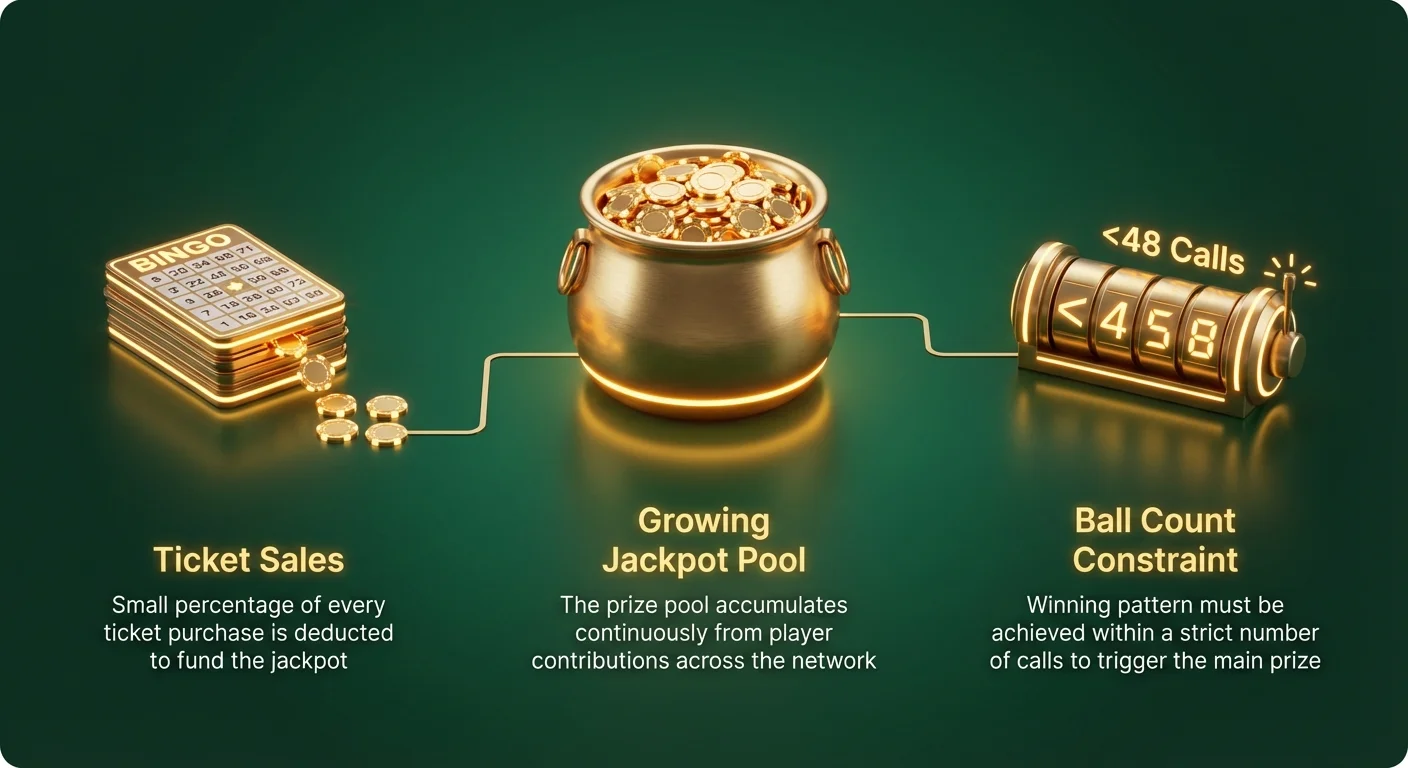
Every time a player purchases a bingo card in a progressive room, a percentage of that ticket price - usually between 1% and 5% - is deducted and added to the progressive pool. The remainder goes toward the standard game prizes and the operator's revenue.
Because online crypto bingo rooms operate 24/7 with thousands of players globally, these micro-contributions happen every second. This creates a "snowball effect."
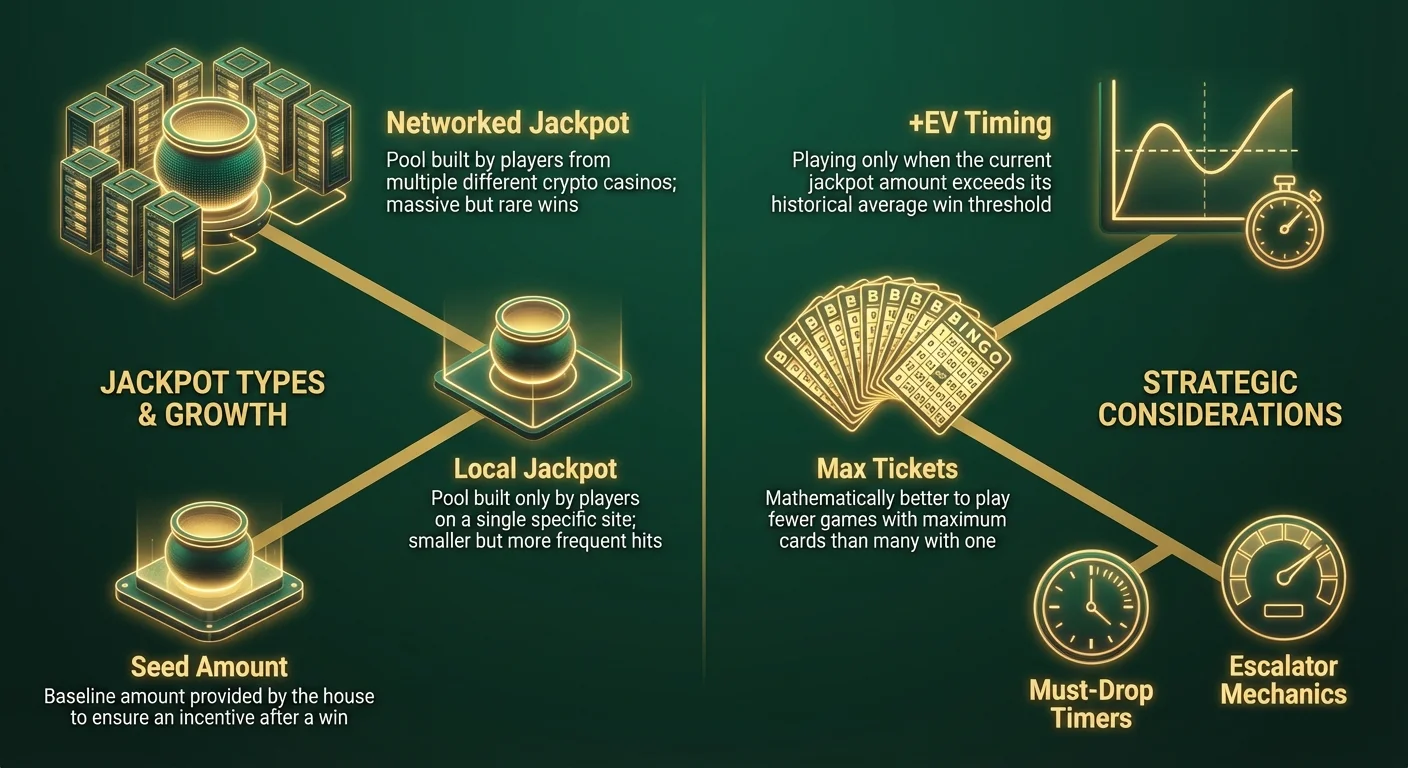
- Seed Amount: When a jackpot is won, it doesn't reset to zero. The "House" or the network provides a baseline amount (the Seed) to ensure there is always an incentive to play.
- The Climb: As more players join, the pot grows. In networked games, players from dozens of different crypto casinos might be contributing to the same pot, causing it to swell into the millions.
Local vs. Networked Jackpots
It is vital to distinguish which type of pool you are chasing, as this affects your win probability and the prize size.
| Feature | Local (Standalone) Jackpot | Networked (Wide Area) Jackpot |
|---|---|---|
| Prize Pool Size | Moderate (e.g., 1-5 BTC) | Massive (e.g., 50+ BTC or $1M+) |
| Competition | Low (Only players on that specific site) | High (Players from multiple sites) |
| Growth Rate | Slow to Medium | Rapid |
| Win Frequency | Hits more frequently | Rare, lottery-style odds |
| Best For | Consistent players looking for decent wins | High-variance hunters chasing the "dream" win |
The "Ball Count" Barrier
The most common confusion for intermediate players is why they didn't win the jackpot despite getting a Full House (Blackout).
In standard bingo, the game continues until someone calls Bingo, regardless of how many numbers have been called. In Progressive Jackpot Bingo, there is a Ball Count Constraint.
To win the progressive pot, you must achieve the winning pattern (usually a Full House) within a specific number of calls.
Example Scenario
- The Game: 75-Ball Bingo.
- The Constraint: Full House in 48 calls or fewer.
- The Reality: The average Full House in 75-ball bingo is usually hit around the 50th to 55th call.
- The Outcome: If you get Bingo on the 49th call, you win the standard game prize (perhaps $100), but the Progressive Jackpot rolls over to the next game.
This mechanism is what allows the jackpot to grow so large. The statistical probability of clearing a card in under 48 calls is low, meaning the pot can go unclaimed for weeks or months.
Escalator Jackpots
Some crypto bingo sites utilize "Escalator" or "Must-Go" mechanisms. If the jackpot isn't won by a certain date or time, the Ball Count constraint increases.
- Week 1: Win in 46 calls.
- Week 2: Win in 48 calls.
- Week 3: Win in 50 calls.
As the ball count requirement rises, the mathematical probability of a player hitting the jackpot increases drastically. This is the prime time for strategic players to enter the room.
Crypto Bingo Advantages: Speed and Verification
Why chase progressive jackpots on crypto platforms rather than traditional fiat sites? The advantages go beyond simple currency preference.
1. Provably Fair Algorithms
In a land-based hall or a standard online casino, you have to trust that the number caller (RNG) is truly random. In crypto gambling, many bingo games utilize Provably Fair technology. This allows you to verify the seed generation and the hash of the round, ensuring that the sequence of numbers wasn't manipulated to prevent a jackpot win just as the pot got high.
2. Instant Large Withdrawals
Imagine winning a $500,000 jackpot on a traditional fiat site. You would likely face monthly withdrawal limits, bank wire delays, and intrusive identity checks. If you hit a progressive jackpot in Bitcoin, Ethereum, or USDT, the payout is often processed within minutes to hours, with significantly higher withdrawal ceilings.
3. Anonymity and Access
Progressive pools are global. Crypto allows players from jurisdictions that might be restricted by traditional banking rails to participate in these massive global liquidity pools, increasing the overall size of the jackpot for everyone.
Strategy 1: Calculating Positive Expected Value (+EV)
Professional gamblers talk about "EV" (Expected Value). In simple terms, EV is the measure of what a bet is worth over time.
Most casino games have a negative EV (the house always wins). However, Progressive Bingo is unique. When the jackpot grows large enough, the game can flip to Positive EV.
How to Identify +EV
Let's say a bingo ticket costs $1. The average return (RTP) is usually around 85 cents. You are losing 15 cents per card in the long run.
However, if the Progressive Jackpot is $100,000 and the probability of winning it suggests it should have been won by now (often based on historical averages), the potential payout justifies the $1 cost.
The Strategy:
- Monitor the Seeds: Note the starting seed of the jackpot.
- Track the Average Win: Research (or ask support) what the average payout amount is for that specific room.
- Hold Your Fire: Do not play when the jackpot has just reset. The EV is at its lowest point.
- Strike Zone: Only begin buying tickets when the jackpot exceeds its historical average.
Strategy 2: Ticket Volume vs. Crowd Size
There is a delicate balance between buying enough tickets to compete and managing your bankroll against the crowd.
The "Max Tickets" Rule
In a game of pure probability like bingo, your odds of winning are directly proportional to the number of cards you hold relative to the total number of cards in play.
- Scenario: There are 100 cards in play.
- Player A: Buys 1 card. (1% chance).
- Player B: Buys 10 cards. (10% chance).
When chasing a progressive jackpot, you are fighting two battles:
- Against the RNG: You need a card capable of winning in under X calls.
- Against the Room: You need to hit that bingo before anyone else does.
Recommendation: If you have a budget of $20 per session, it is mathematically better to play fewer games with the maximum allowed number of cards than to play many games with just one card. You want to maximize your coverage during the rounds where you are active.
The Crowd Paradox
- Standard Bingo: You want fewer players. Fewer players mean less competition for the fixed pot.
- Progressive Bingo: You want more players to build the pot, but fewer players when you are trying to win it.
The Sweet Spot: Look for rooms where the jackpot is networked (built by thousands of players) but the current active room count is lower. However, keep in mind that with PJPs, the main enemy is the Ball Count. Even if you are the only person in the room, if you don't hit bingo in 48 balls, you don't win the jackpot. Therefore, in Progressive Bingo, crowd size is less important than it is in standard bingo, but you still want to avoid splitting the pot if possible.
Strategy 3: Timing the "Must-Drop" Jackpots
This is the most actionable strategy for intermediate players. Many crypto bingo sites feature "Must-Drop" or "Guaranteed" jackpots. These are programmed to pay out before reaching a certain monetary threshold or time.
Example:
- Jackpot Must Go By: $10,000.
- Current Jackpot: $9,850.
In this scenario, the volatility of the game has collapsed. The jackpot must trigger very soon. This creates a frenzy of activity, but it also guarantees a winner.
Action Plan:
- Locate the "Must-Drop" timers in the lobby.
- Wait until the pot is within 90-95% of the drop limit.
- Enter the room and purchase max tickets.
- The probability of the jackpot triggering in the next few games is exponentially higher than random chance.
Financial Discipline: The Bankroll for the Chase
Chasing progressive jackpots is a "high variance" activity. You will likely endure long streaks of losing or breaking even (winning small standard pots) before sniffing a big prize.
The 5% Rule
Never dedicate more than 5% of your total gambling bankroll to a single session of jackpot hunting. If you have 1 Bitcoin to play with, do not spend more than 0.05 BTC chasing a specific jackpot on a Tuesday night.
Auto-Daubing and Pattern Recognition
When playing max tickets (often 50+ cards on digital platforms), do not try to manually mark numbers. You will miss calls.
- Always use Auto-Daub.
- Sort cards by "Best to Worst." Most crypto bingo interfaces allow you to auto-sort your cards so the ones closest to winning appear at the top of the screen. This adds excitement and helps you track how close you really are to the ball count requirement.
Common Myths regarding Progressive Bingo
To play like a pro, you must unlearn the superstitions that plague land-based bingo halls.
Myth 1: "The Jackpot is Due"
Reality: In a standard progressive game (without a "Must-Drop" limit), the jackpot is never "due." The RNG has no memory. If the ball count requirement is 45, and the math says that happens once in 100,000 games, it is possible for it to happen twice in a row, or not for 500,000 games.
Exception: As mentioned, "Must-Drop" jackpots are the only time a jackpot is truly "due."
Myth 2: "Certain Numbers are Hot"
Reality: In a provably fair crypto game, every number (1-75 or 1-90) has an exactly equal probability of being called. Strategies like the Tippett Theory (which suggests numbers gravitate toward the median as the game goes on) are interesting theoretical concepts but hold little weight in modern RNG-based gameplay. Do not waste time selecting specific "lucky" numbers; focus on ticket volume instead.
Summary: Your PJP Checklist
Before you deposit your crypto and start buying cards, run through this mental checklist:
- Check the Rules: What is the "Ball Count" requirement for the main prize? Is it realistic?
- Check the Pot: Is the current jackpot amount significantly higher than the seed?
- Check the Format: Is it a standalone (easier to win, smaller prize) or networked (harder to win, massive prize) game?
- Check your Volume: Can your bankroll support buying max tickets for at least 10 rounds?
- Check the Tech: Is the site reputable? Does it offer Provably Fair verification?
Conclusion
Progressive Jackpot Bingo offers a thrill that standard bingo cannot match. It transforms a casual social game into a high-stakes hunt for prizes that rival lottery wins. While the odds are steep, they are not insurmountable.
By understanding the mechanics of the ball count, leveraging the speed and transparency of crypto platforms, and timing your play during "Escalator" or "Must-Drop" windows, you move from being a passive participant to an active hunter.
Remember, the goal of the progressive hunter isn't just to yell "Bingo" - it's to hit the perfect pattern at the perfect moment. Manage your bankroll, trust the math, and may the RNG be in your favor.