
If you walk into a high-stakes room in Macau or load up a live dealer table at your favorite crypto casino, you are immediately faced with a binary choice. It is one of the simplest decisions in the gambling world, yet it has sparked debate for centuries. Banker or Player?
To the untrained eye, Baccarat seems like a coin flip. Two hands are dealt, and you simply pick which one will end up with a value closer to nine. With a 1:1 payout on both sides (before commission), many beginners instinctively alternate their bets or look for patterns in the "roadmap" at the bottom of the screen.
However, Baccarat is not a 50/50 game. Beneath the surface of elegant cards and simple rules lies a complex mathematical engine driven by drawing rules. When you peel back the layers of probability, one fact becomes undeniable: The Banker bet is statistically superior.
In this guide, we will move beyond superstition and gut feelings. We will explore the hard mathematics behind the game, explain why the "Third Card Rule" gives the Banker a permanent advantage, and demonstrate why paying a 5% commission is actually a small price to pay for the best odds in the casino.
The Tale of Two Bets: Understanding the Basics
Before diving into the statistical deep end, you need to understand what you are actually betting on. Unlike Blackjack, where you are the master of your own destiny, Baccarat is a spectator sport. You are betting on the outcome of a contest between two entities: the "Banker" and the "Player."
In a standard game of Baccarat (Punto Banco), which is the standard version found at CryptoGambling.com recommended sites, the rules are rigid. The dealer follows a strict flowchart to determine when cards are drawn.
The Three Main Options
- The Player (Punto): You are betting the Player's hand will be closer to 9.
- The Banker (Banco): You are betting the Banker's hand will be closer to 9.
- The Tie: You are betting both hands will finish with the same total.
Note: While there are various side bets like Dragon 7 or Perfect Pair, these are distinct from the main game and generally carry a much higher house edge.
The Mathematics: Hard Numbers Don't Lie
In gambling, "House Edge" is the metric that matters most. It represents the mathematical advantage the casino holds over you on every single bet. The lower the house edge, the longer your bankroll lasts, and the better your chances of walking away a winner.
Let's look at the raw probabilities of a standard 8-deck shoe (the most common format in both land-based and online crypto casinos).
The Win Probability
If we ignore the Tie bet for a moment (we will explain why later). The breakdown of winning hands looks like this:
- Banker Wins: 50.68%
- Player Wins: 49.32%
If the game ended there, the casino would be broken. If you could bet on a proposition that wins 50.68% of the time and get paid 1:1, you would eventually bankrupt the house. This is why the 5% Commission exists on Banker wins.
The House Edge Comparison
Here is how the bets stack up when you factor in the payouts and the commission.
| Bet Type | Win Probability | Payout | House Edge |
|---|---|---|---|
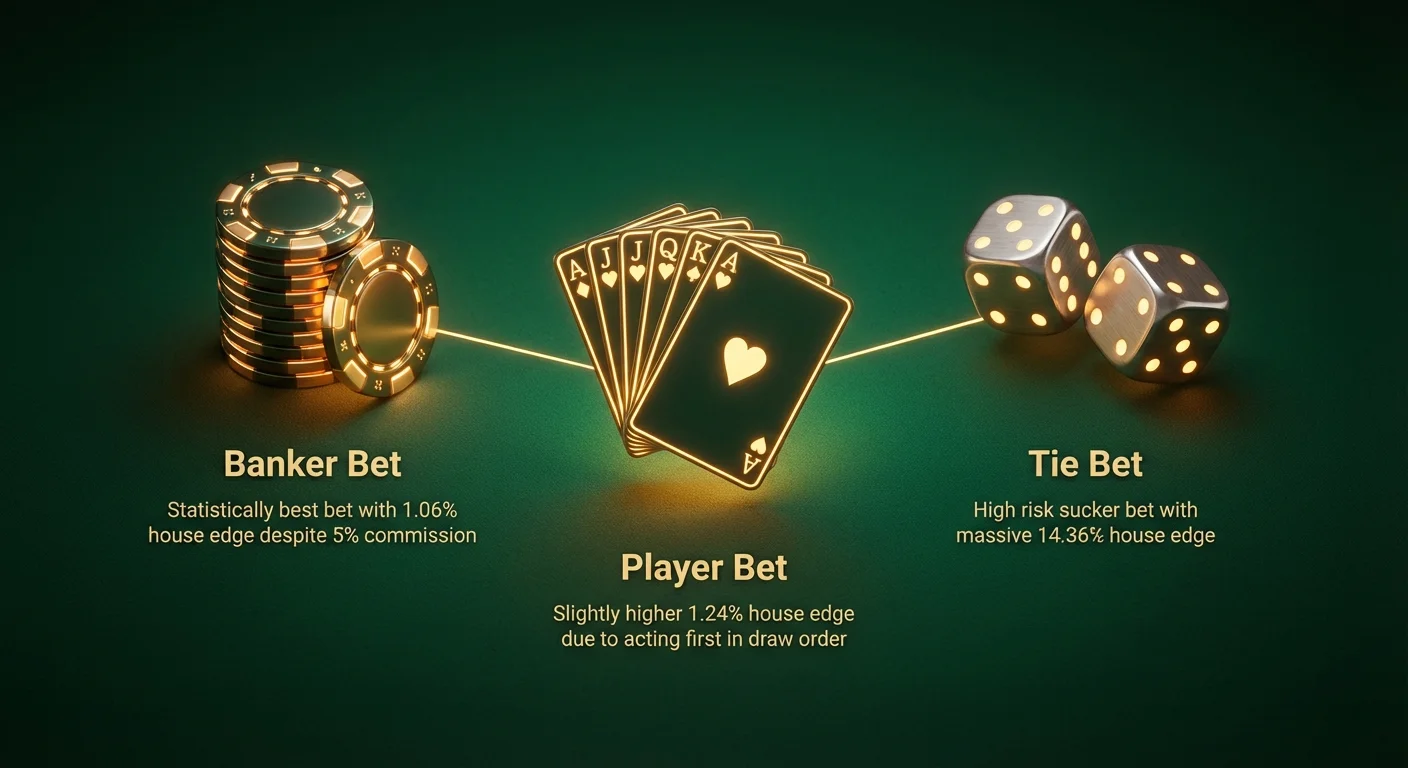
| Banker | 45.86% | 0.95 : 1 | 1.06% |
| Player | 44.62% | 1 : 1 | 1.24% |
| Tie | 9.52% | 8 : 1 | 14.36% |
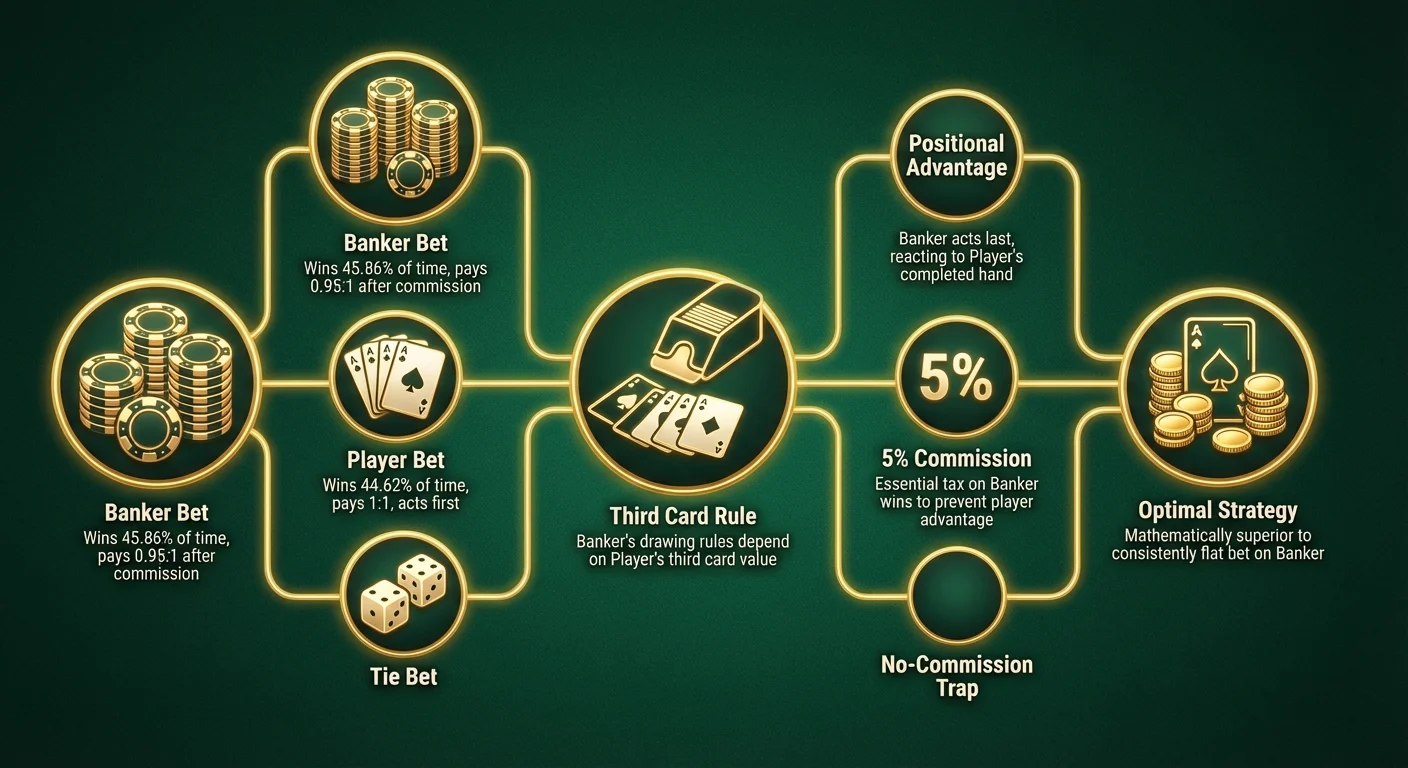
The Verdict: Even after the casino takes 5% of your winnings on the Banker bet, the house edge is still only 1.06%, compared to 1.24% for the Player.
In the world of casino gambling, a difference of 0.18% might seem small. But in the long run, or for high-volume players using Bitcoin or Ethereum for fast play, that difference adds up significantly. The Banker bet is objectively the mathematically safest wager on the table.
Why Does the Banker Win More Often?
This is the question that confuses most beginners. If both sides are dealt two cards randomly, why isn't it 50/50?
The answer lies in the Third Card Rule.
In Baccarat, the Player hand always acts first. If the Player's hand totals 0-5, they draw a third card. If it is 6 or 7, they stand.
The Banker, however, plays by a different set of rules. The Banker's action depends on two factors:
- The value of their own hand.
- The specific value of the third card drawn by the Player.
The Positional Advantage
Think of this like a simplified version of Blackjack. In Blackjack, the dealer acts last, which is a massive advantage (if you bust, they win without having to play). In Baccarat, the Banker acts last.
The rules are set up so that the Banker "reacts" to the Player's third card.
- If the Player draws a card that is likely to help them, the math dictates whether the Banker should also draw to defend their position or stand to preserve a win.
- The Banker's drawing rules are mathematically optimized to beat the Player's hand based on the new information (the third card).
This "informational advantage," seeing what the Player drew before finalizing their own hand, is what pushes the Banker's win rate above 50% (excluding ties).
The 5% Commission: A Mental Hurdle
Many novice players refuse to bet on the Banker because they hate the idea of paying a tax on their winnings.
- Player Bet: You bet 1 mBTC, you win 1 mBTC.
- Banker Bet: You bet 1 mBTC, you win 0.95 mBTC.
Psychologically, the Player bet feels cleaner. You get "full value" for your risk. However, this is a logic trap.
Think of it this way:
Would you rather buy a lottery ticket that costs $1.00 and wins 49% of the time, or a ticket that costs $1.05 but wins 51% of the time?
In Baccarat, the "cost" of the commission is already factored into the house edge calculation. The 1.06% house edge for Banker includes the commission. If the commission didn't exist, the Banker bet would have a player advantage (negative house edge), and casinos would cease to offer the game.
Crypto Casinos and No-Commission Baccarat
In the crypto gambling space, you may encounter tables labeled "No Commission Baccarat" or "EZ Baccarat."
In these games, Banker pays 1:1. It sounds perfect, right?
The Catch: To make up for the lost commission, the casino modifies the rules. Usually, if the Banker wins with a specific total (often a 3-card total of 7, or a total of 6), the payout is a "Push" (you get your money back but don't win) or 1:2.
- Standard Baccarat (with commission): 1.06% House Edge.
- No Commission Baccarat: Usually around 1.46% House Edge (depending on the specific variant).
Ironically, trying to avoid the 5% tax often leads players to a game with worse odds. Stick to the standard commission tables for the best mathematical return.
The Trap to Avoid: The Tie Bet
If the Banker is the hero of our mathematical story, the Tie bet is the villain.
The Tie bet typically pays 8:1 (sometimes 9:1 at generous crypto casinos). The allure of turning a small wager into a big win is tempting, especially for players used to the volatility of cryptocurrency markets.
However, the math is brutal.
- True Probability of a Tie: ~9.5%
- Implied Probability at 8:1: ~11.1%
The gap between those numbers results in a staggering 14.36% house edge.
To put this in perspective:
- For every $100 you bet on Banker, you expect to lose $1.06 long-term.
- For every $100 you bet on Tie, you expect to lose $14.36 long-term.
Betting the Tie is the quickest way to deplete your bankroll. Experienced players pretend the Tie circle on the table doesn't even exist.
Strategy: The "Always Banker" Approach
Is the best strategy really just to bet Banker every single time? Mathematically, yes.
If you were to program a bot to play 1,000,000 hands of Baccarat perfectly to minimize loss, it would bet on the Banker every single hand.
Coping with Streaks
Baccarat players are famous for being superstitious. They follow "shoe patterns" like the Big Eye Boy, the Small Road, and the Cockroach Pig. They believe that if the Player has won 4 times in a row, the Banker is "due," or conversely, that the Player is "hot."
This is known as the Gambler's Fallacy. In a standard crypto casino using a Random Number Generator (RNG) or a live dealer with a fresh shuffle, past results have zero influence on future outcomes.
- If the Player wins 5 times in a row, the odds of the Banker winning the 6th hand remain exactly the same: 45.86%.
Switching your bet to "catch" a streak adds variance but increases your theoretical loss because you are moving money from a 1.06% edge bet to a 1.24% edge bet.
The Strategy:
- Flat Bet on Banker: Do not change your bet size drastically.
- Ignore the Roadmap: The patterns are fun visualization tools, but they do not predict the future.
- Ride the Banker Streak: If you find it boring to bet Banker every time, a common modification is to bet Banker until it loses. When Player wins, wait one hand. If Banker wins again, jump back on Banker.
Why This Matters for Crypto Gamblers
If you are playing at a crypto casino, you are likely interested in efficiency, speed, and fairness.
- Speed of Play: Crypto Baccarat tables, especially RNG versions, can be played much faster than physical tables. You can get through hundreds of hands per hour. At this volume, the difference between a 1.06% and 1.24% house edge becomes very noticeable in your balance.
- Provably Fair: Many crypto-native Baccarat games offer "Provably Fair" technology. This allows you to verify that the shuffle wasn't rigged. Combined with the low house edge of the Banker bet, this offers one of the most transparent and fair gambling experiences available online.
- Bonus Wagering: If you are trying to clear a deposit bonus, Baccarat is often restricted or contributes a lower percentage because the house edge is so low. If it is allowed, spamming the Banker bet is the statistically best way to clear wagering requirements while preserving capital.
Practical Tips for Your Next Session
Ready to hit the tables? Here is your checklist for executing the Banker strategy effectively.
- Bankroll Management: Because Baccarat is an even-money game (mostly), it has low volatility. However, long losing streaks happen. Ensure you have at least 20-40 buy-ins (bets) to weather normal variance.
- Don't Count Cards: Unlike Blackjack, card counting in Baccarat offers a negligible advantage that is almost impossible to capitalize on without computer assistance (which is banned). Do not waste mental energy trying to track 8s and 9s.
- Watch the Minimums: On "Big Baccarat" tables, limits can be high. In crypto casinos, you can often find "Mini-Baccarat" tables with limits as low as $1 or 0.0001 BTC. This is ideal for testing the strategy.
- Ignore the "Commission Free" Trap: Unless you are betting the Tie (don't) or side bets (don't), standard commission Baccarat is mathematically superior to the "No Commission" variants that penalize specific Banker wins.
Summary
Baccarat is a game of elegance, but winning at it requires cold, hard logic. The atmosphere may be James Bond, but the strategy should be actuary.
- Player Bet: Decent odds (1.24% edge), but mathematically inferior.
- Tie Bet: A sucker's bet (14.36% edge). Avoid at all costs.
- Banker Bet: The gold standard (1.06% edge).
The Banker wins more often because the rules of the game, specifically the drawing of the third card, are rigged in its favor to react to the Player's hand. The casino charges a 5% commission to counterbalance this, but even with that fee, it remains the statistically best bet on the floor.
Next time you log into CryptoGambling.com to play a few hands, simplify your life. Ignore the patterns, forget the "feel" of the game, and back the Banker. The math is on your side.