
For the casual observer, Baccarat is the epitome of casino elegance - a game of pure chance where cards are dealt, numbers are tallied, and money changes hands with the sophistication of a James Bond film. To the novice player, it appears that the Dealer is simply flipping cards at random or perhaps making strategic decisions based on intuition.
However, seasoned players know that Baccarat is governed by a rigid, deterministic set of algorithms known as the Third Card Rule. There is no free will in Baccarat gameplay; the dealer cannot choose to hit or stand. Every move is dictated by a strict mathematical framework designed to balance the odds between the Player and the Banker.
For the modern crypto gambler playing high-stakes tables using Bitcoin or Ethereum, understanding these mechanics is not just about trivia - it is about game integrity. Whether you are verifying the results of a Provably Fair RNG algorithm or watching a live dealer in a studio in Riga, knowing exactly when a third card should be drawn allows you to spot errors, verify outcomes, and play with the confidence of a professional.
This advanced guide moves beyond the basic objective of "getting closest to nine" and dissects the intricate machinery of the Third Card Rule, demystifying the most complex aspect of Baccarat gameplay.
The Foundation: Point Values and Naturals
Before analyzing the complex drawing conditions, we must briefly solidify the foundational mathematics. The Third Card Rule only activates when specific conditions regarding the initial deal are met.
In Baccarat, the value of cards is distinct from other table games like Blackjack:
- Aces: 1 point
- 2 through 9: Face value
- 10, Jack, Queen, King: 0 points
The valuation relies on a modulo 10 system. If a hand's total exceeds 9, the first digit is dropped. For example, a hand consisting of a 7 and an 8 totals 15, which translates to a Baccarat value of 5.
The Override: The "Natural"
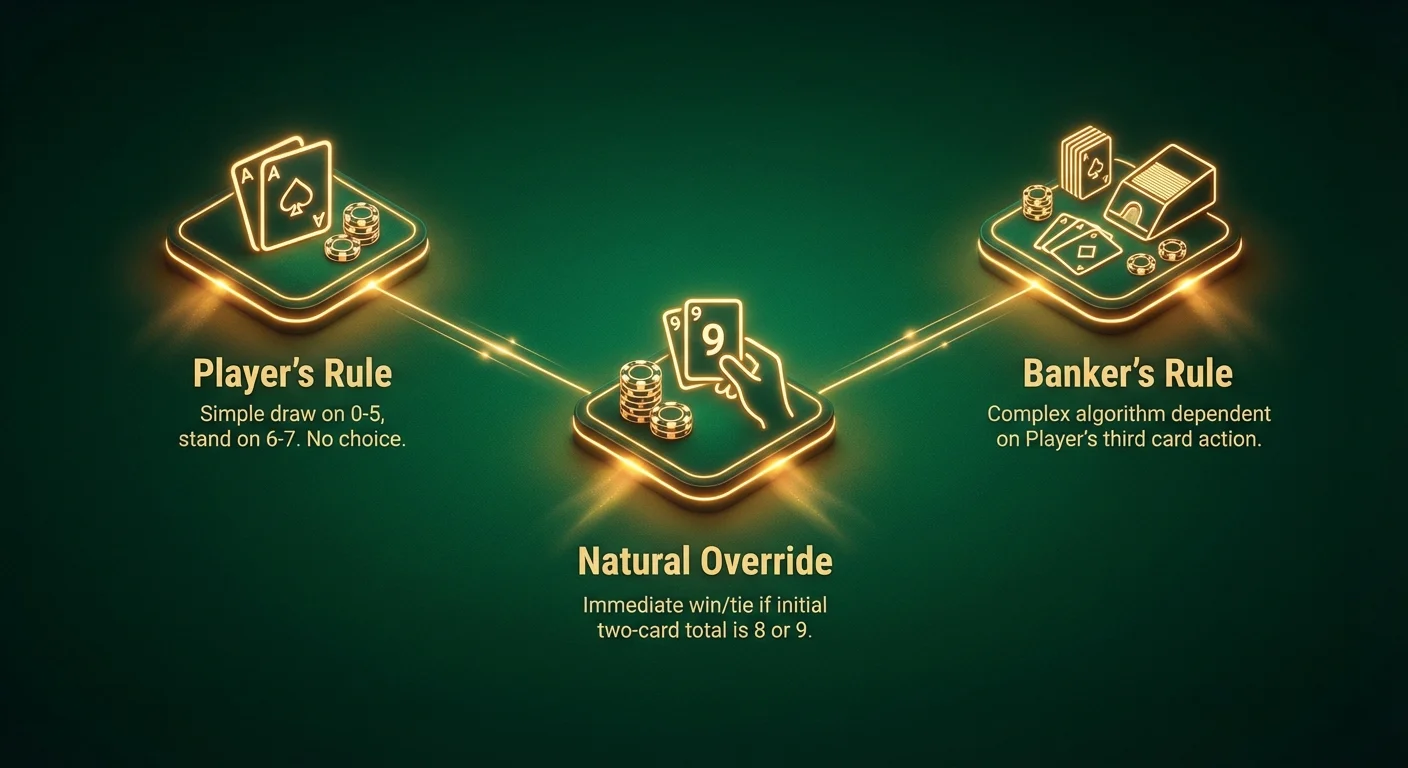
The Third Card Rule is immediately nullified if a "Natural" occurs.
- If either the Player or the Banker is dealt a total of 8 or 9 in the first two cards, the hand is over.
- No third cards are drawn for either side.
- The higher hand wins, or it is a Tie.
This is the absolute priority rule. Even if the other side has a total of 0, if you have a Natural 8 or 9, the game stops instantly.
The Player's Rule: The Simple Variable
The gameplay sequence always begins with the Player's hand. The decision made for the Player's hand dictates the flow of the rest of the game. Fortunately, the Player's rule is straightforward and easy to memorize.
When the Player looks at their first two cards:
| Player's Initial Total | Action |
|---|---|
| 0, 1, 2, 3, 4, 5 | Draw a Third Card |
| 6, 7 | Stand |
| 8, 9 | Natural (Both sides stand) |
Key Takeaway: The Player has no choice. Even if a player is betting thousands in USDT on the "Banker" side, if the "Player" hand holds a total of 5, it must receive a third card.
The Banker's Rule: The Complex Algorithm
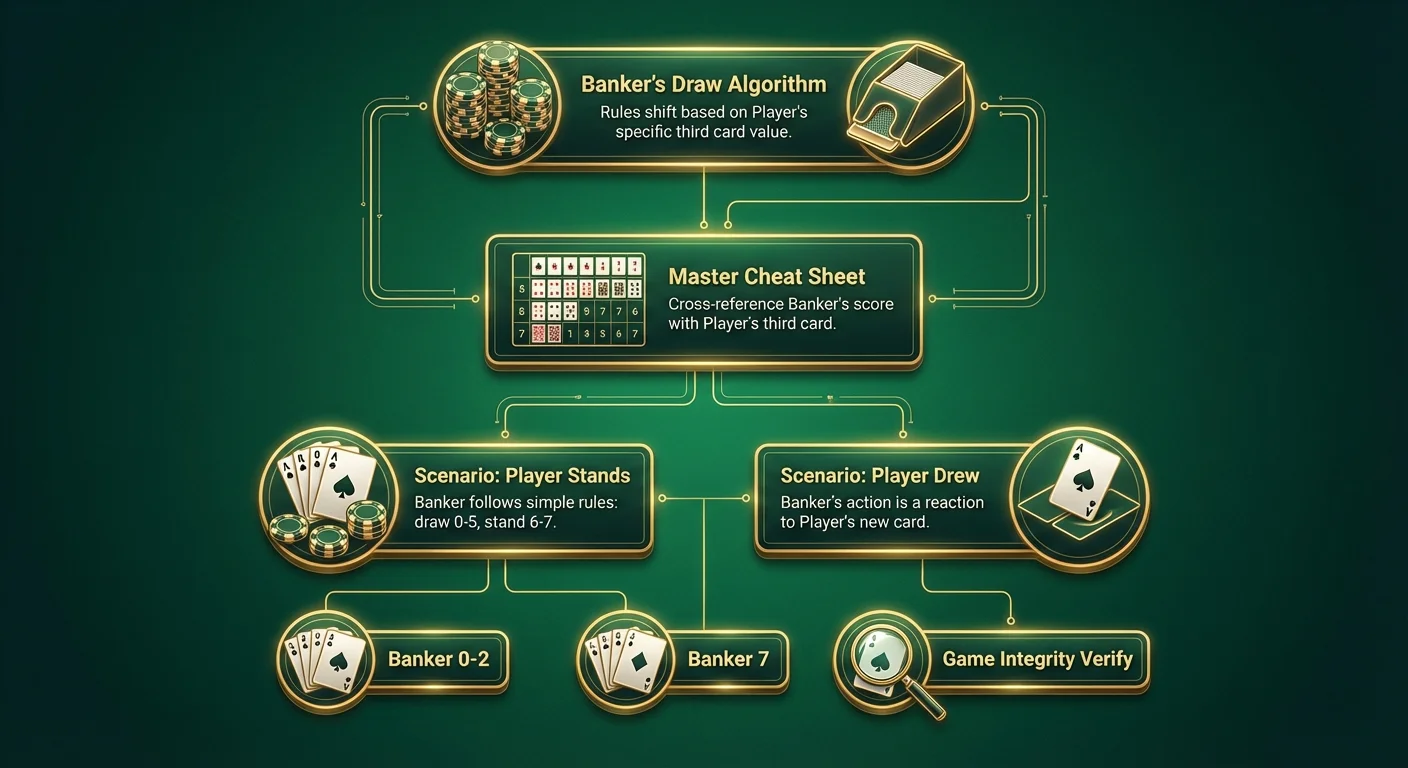
This is where confusion often arises for players transitioning from basic to advanced strategy. The Banker's action is dependent on two variables:
- The Banker's current two-card total.
- Whether the Player stood or drew a card.
Scenario A: The Player Stood
If the Player stood (meaning the Player had a 6 or 7), the Banker plays by the same simple rules as the Player:
- Banker 0-5: Draw
- Banker 6-7: Stand
Scenario B: The Player Drew a Third Card
If the Player drew a third card, the Banker's rules shift to a more complex chart. The Banker is no longer playing just against their own total; they are reacting to the specific value of the third card drawn by the Player (not the Player's total, but the specific card generated).
This positional advantage - acting last and having information about the Player's third card - is why the Banker bet has a slightly lower house edge (1.06%) compared to the Player bet (1.24%), and why casinos charge a 5% commission on winning Banker bets.
Here is the definitive logic for when the Banker draws against a Player's third card:
1. Banker Total: 0, 1, or 2
- Action: Always DRAW.
- Logic: Regardless of what the Player drew, a Banker holding 0-2 is mathematically too weak to stand.
2. Banker Total: 3
- Action: Draw against any Player card EXCEPT 8.
- Logic: If the Player draws an 8, the mathematical odds shift slightly in favor of standing. In all other cases, the Banker hits.
3. Banker Total: 4
- Action: Draw if Player's third card is 2, 3, 4, 5, 6, or 7.
- Stand: If Player's third card is 0, 1, 8, or 9.
4. Banker Total: 5
- Action: Draw if Player's third card is 4, 5, 6, or 7.
- Stand: If Player's third card is 0, 1, 2, 3, 8, or 9.
5. Banker Total: 6
- Action: Draw if Player's third card is 6 or 7.
- Stand: If Player's third card is 0, 1, 2, 3, 4, 5, 8, or 9.
- Note: This is often called the "6 vs. 6/7" rule and is a common source of dealer errors in lower-tier live casinos.
6. Banker Total: 7
- Action: Always STAND.
The Master Cheat Sheet
For quick reference during your live sessions, utilize this table. Locate the Banker's score on the left, and cross-reference it with the Player's Third Card across the top.
S = Stand | D = Draw
| Banker's Score (2 Cards) | Player Draws 0 or 1 | Player Draws 2 or 3 | Player Draws 4 or 5 | Player Draws 6 or 7 | Player Draws 8 | Player Draws 9 |
|---|---|---|---|---|---|---|
| 0 - 2 | D | D | D | D | D | D |
| 3 | D | D | D | D | S | D |
| 4 | S | D | D | D | S | S |
| 5 | S | S | D | D | S | S |
| 6 | S | S | S | D | S | S |
| 7 | S | S | S | S | S | S |
Why "Provably Fair" Gamers Need This Rule
In the world of crypto gambling, players often prioritize "Provably Fair" games. These are games where the outcome is determined by a server seed, a client seed, and a nonce, allowing the player to verify that the result was not manipulated after the bet was placed.
However, Provably Fair verification usually gives you the resulting deck order. It tells you which cards came out of the shoe. If you do not understand the Third Card Rule, you cannot verify if the software applied the rules correctly to that deck order.
Verifying Game Integrity
Imagine a scenario in a crypto-exclusive casino:
- Player Hand: 4 + K (Total 4) -> Draws a 5. Final Player Total: 9.
- Banker Hand: 3 + 2 (Total 5).
If the software - or a live dealer - fails to draw a card for the Banker here, the Player wins 9 to 5.
However, look at the rule for Banker 5: The Banker must draw if the Player's third card is a 5. The Banker should have received a card. If that card was a 4, the Banker would tie. If it was a 5, the Banker would win (0 vs 9).
By knowing the rules, you protect your bankroll from software glitches or human error in live studios. While rare, errors happen, and in the decentralized world of crypto, being your own auditor is essential.
Step-by-Step Gameplay Examples
To solidify this advanced knowledge, let's walk through three distinct hands.
Example 1: The "Cover"
- Player: King + 6 (Total 6)
- Banker: Jack + 5 (Total 5)
Analysis:
- Check for Natural: No (6 and 5).
- Player Action: Player has 6. Player Stands.
- Banker Action: Since Player stood, Banker follows basic rules. Banker has 5. Banker Draws.
- Outcome: Banker draws a 9 (Total 4). Player wins 6 vs 4.
Example 2: The "Complex Draw"
- Player: 2 + 3 (Total 5)
- Banker: 4 + Ace (Total 5)
Analysis:
- Check for Natural: No.
- Player Action: Player has 5. Player Draws.
- Player receives a 6. Final Player Total: 1 (5+6=11, drop the digit).
- Banker Action: Banker has 5. We look at the chart for "Banker 5 vs Player Third Card 6".
- Rule: Banker draws on 4-7. Since the card was a 6, the Banker Draws.
- Banker receives a Queen (0). Final Banker Total: 5.
- Outcome: Banker wins 5 vs 1.
Example 3: The "Banker 3 Trap"
- Player: 10 + 2 (Total 2)
- Banker: Ace + 2 (Total 3)
Analysis:
- Check for Natural: No.
- Player Action: Player has 2. Player Draws.
- Player receives an 8. Final Player Total: 0.
- Banker Action: Banker has 3. Usually, a Banker 3 draws against almost anything. However, the exception is when the Player's third card is an 8.
- Rule: Banker Stands.
- Outcome: Banker wins 3 vs 0.
Impact on Strategy and Bankroll Management
Does knowing the Third Card Rule change how you bet? Technically, no. Baccarat is not a game of skill like Poker or Blackjack; you cannot alter the odds during the hand. However, understanding the rules contributes significantly to your meta-strategy.
1. Understanding Volatility
The Third Card Rule explains why the Banker wins slightly more often (45.86%) than the Player (44.62%). The rules are rigged to help the Banker recover from a losing position when the Player draws a weak card. This knowledge reinforces why the Banker bet is mathematically superior over the long run, despite the commission.
2. Side Bets and Variance
Many crypto baccarat tables offer side bets like "Dragon 7" (EZ Baccarat) or "Panda 8". These bets pay out based on specific Third Card outcomes (e.g., Banker winning with a 3-card total of 7). Knowing the drawing rules helps you understand the sheer improbability of these events. You realize that for a Dragon 7 to occur, a specific sequence of "drawing rules" must align perfectly, reinforcing that these are high-house-edge sucker bets best avoided.
3. Pace of Play
In fast-paced crypto games like "Speed Baccarat," hands are dealt in seconds. If you don't understand the rules, the game is just a blur of colors. Understanding the Third Card Rule allows you to track the flow of the shoe (if you are card counting or trend tracking) without becoming overwhelmed.
Common Myths vs. Reality
Myth: "The Dealer makes a choice based on intuition."
Reality: There is zero choice. If a dealer hesitates, they are calculating the math, not making a strategic decision.
Myth: "The pattern of the shoe influences the draw."
Reality: The drawing rules are static. A streak of 10 Bankers in a row does not change the rule that a Banker with 6 stands against a Player 8.
Myth: "Online Crypto Baccarat is rigged because the Dealer draws too often."
Reality: This is a common complaint in forums. Players see the Banker draw on a 5 or 6 and assume the game is cheating to beat their hand. As we've demonstrated, drawing on 5 or 6 is standard procedure under specific conditions. Knowing the rules prevents "tilt" caused by false assumptions of cheating.
Expert Tips for Live Dealer Interaction
If you are playing at a high-limit live table (common in VIP crypto casinos), here is how to use this knowledge:
- Monitor the "Squeeze": In squeeze baccarat, dealers reveal cards slowly. If you know the Third Card Rule, you know exactly what card values will help or hurt you before they are fully revealed. This heightens the excitement.
- Polite Corrections: If you spot a genuine error (e.g., a dealer fails to draw a card when the chart dictates it), speak up immediately in the chat. Type "Check Rules" or "Dealer Error." Floor supervisors monitor these chats. Because the rules are absolute, the video can be reviewed, and the hand corrected.
- Don't Slow the Game: Do not argue for a draw if the rules dictate a stand. It marks you as an amateur and disrupts the flow for other players.
Conclusion
Baccarat is a paradox: it is the simplest game to play, but the most mathematically intricate to administer. The Third Card Rule is the engine that drives this complexity, creating a delicate balance that has kept the game popular for centuries.
For the crypto gambler, knowledge is power. You aren't just betting on a coin flip; you are engaging with a sophisticated algorithm. By mastering the conditions under which the Dealer draws, you elevate yourself from a passive participant to an informed player. You can verify the integrity of your crypto bets, understand the "why" behind every win and loss, and navigate the high-roller tables with the assurance of a true expert.
Next time you see the Banker turn over a total of 4 against your drawn 7, you won't just hope for a card - you'll know that the laws of Baccarat demand one. And when that card lands, you'll know exactly why.