
You've just hit a Straight in Jacks or Better. The machine chimes, the cards flash, and your balance is ready to tick upward. But before the credits hit your account, a button flashes on the screen, pulsing with temptation: GAMBLE or DOUBLE.
For new players at crypto casinos, this moment is the crossroads of strategy and psychology. Do you take the guaranteed win and move on? Or do you risk it all on the flip of a card for a chance to turn a decent win into a massive payout?
This feature, known as the "Double-Up," "Risk Game," or simply the "Gamble Feature," is a staple in video poker mechanics. While the base game of video poker relies on skill, hand rankings, and paytables, the Gamble feature is a different beast entirely. It strips away the complex poker hands and leaves you with a raw, mathematically pure decision.
In this guide, we will dissect the Double-Up feature. We will explore the math behind the proposition, why crypto casinos love offering it, and most importantly, when you should use it to boost your bankroll and when you should take the money and run.
What is the Video Poker Double-Up Feature?
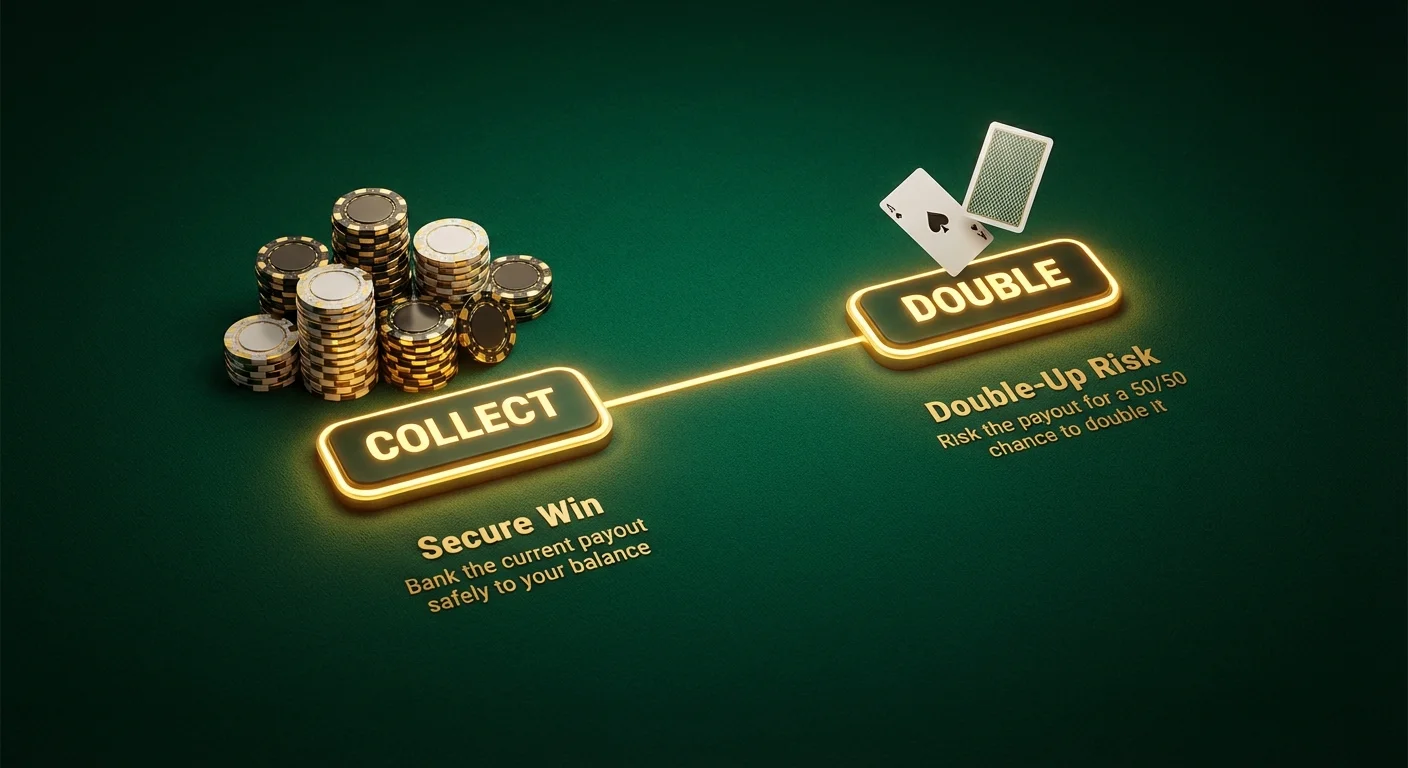
The Double-Up feature is a bonus round offered at the end of a winning hand. It is not mandatory; it is an option presented to the player after any payout is triggered. If you ignore it and hit "Collect," your winnings are added to your balance. If you click "Double," you enter a secondary game screen.
While there are visual variations depending on the software provider (e.g., Betsoft, BGaming, or proprietary crypto games), the mechanics generally fall into two categories:
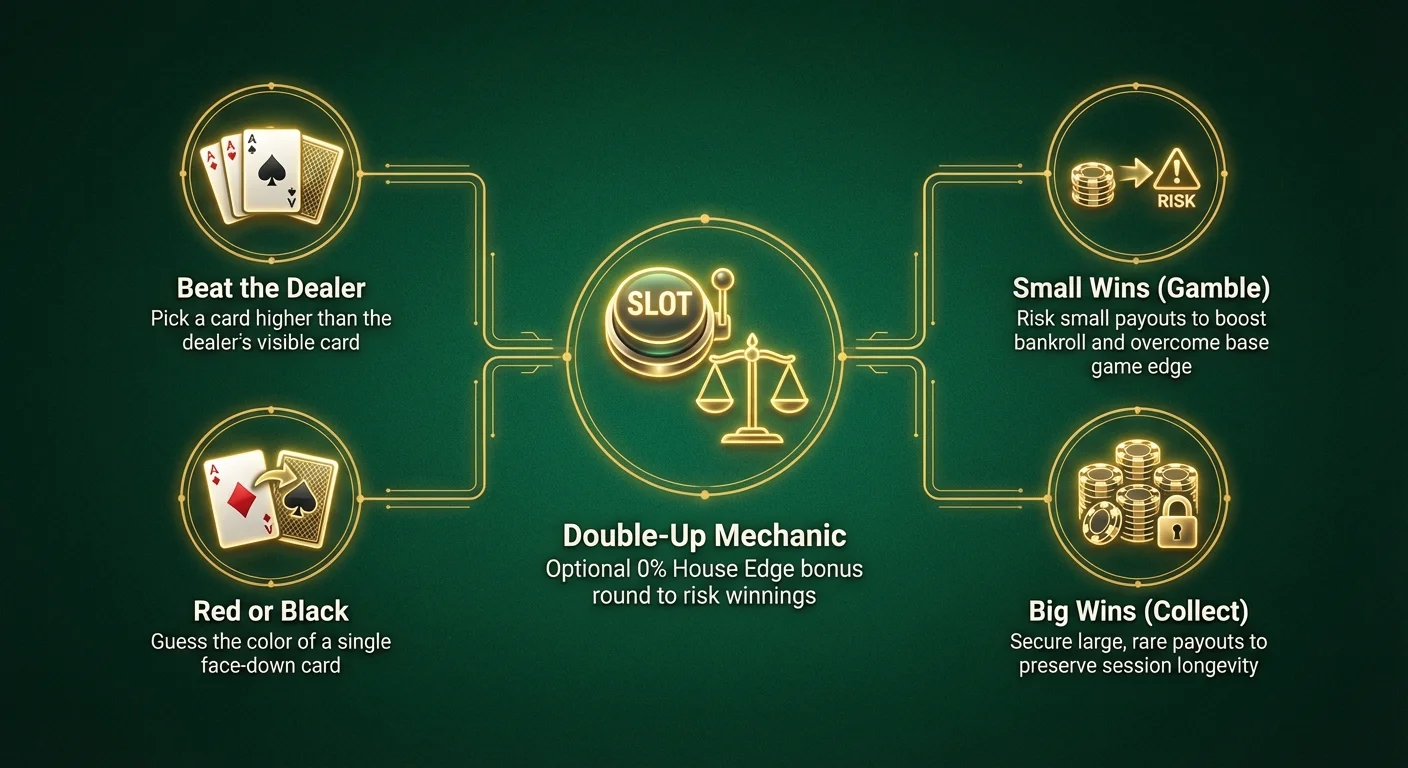
1. The "Beat the Dealer" (High Card)
This is the most common format in video poker.
- The Setup: Five cards are dealt. The first card (the Dealer's card) is face up. The other four are face down.
- The Goal: You must pick one of the four face-down cards.
- The Outcome: If your card is higher than the Dealer's card, you win, and your money is doubled. If it is lower, you lose the entire win. If it is a tie (Push), you usually get your original money back and can choose to try again or collect.
2. Red or Black (The Coin Flip)
This is simpler and often found in simplified crypto video poker games.
- The Setup: A single face-down card is displayed.
- The Goal: Guess if the card suit is Red (Hearts/Diamonds) or Black (Spades/Clubs).
- The Outcome: If you guess correctly, you double your money. If wrong, you lose it. Some variations allow you to guess the specific Suit (Heart, Diamond, Club, Spade) for a 4x payout.
The Mathematics of the Double-Up
To understand strategy, you must first understand the math. This is where the Gamble feature becomes fascinating, especially for players accustomed to the "House Edge."
In almost every casino game, the odds are tilted slightly in favor of the casino. In European Roulette, the house edge is 2.7%. In Blackjack, it's around 0.5% to 1% depending on rules.
The Double-Up feature typically has a 0% House Edge.
This is one of the only "fair" bets in a casino. Because a deck of cards is randomized, the odds of pulling a card higher or lower than the dealer (over an infinite number of hands) are statistically neutral.
- In Red/Black: The odds are exactly 50/50 (assuming no Jokers are in the deck).
- In High Card: The odds are dynamic based on the dealer's visible card, but over time, the probability balances out to a 50/50 return to player (RTP) of 100%.
Why Does the Casino Offer a 0% House Edge Bet?
If the casino doesn't make money on it, why is the button there?
- Volatility: It encourages players to risk guaranteed money. The casino knows that players often get greedy and lose winnings they had already secured.
- Speed: It increases the "churn" of the game.
- Psychology: It provides an adrenaline spike that the slow, strategic base game of video poker sometimes lacks.
The Variance Factor
While the House Edge is 0%, the Variance (or volatility) is extreme.
- Base Game: You win small amounts frequently (Pairs, Two Pairs).
- Double-Up: You either win double or nothing.
By using the feature, you are voluntarily increasing the volatility of your session. You are trading a steady, slow grind for a rollercoaster of big wins and zero-payout rounds.
Crypto Casinos and Provably Fair Gaming
One of the biggest anxieties for video poker players in land-based casinos or traditional online sites is trust. Is the Double-Up rigged? If the dealer shows a 3, will the machine force me to pick a 2?
This is where playing at CryptoGambling.com recommended sites changes the dynamic.
The Provably Fair Advantage
Many crypto-native video poker games use Provably Fair algorithms. This technology allows you to verify the fairness of every shuffle and card draw using blockchain hashes.
- Verification: Before you click "Double," the server has already generated a "seed" (the outcome).
- Transparency: After the hand, you can reveal the client and server seeds to verify that the cards were not switched after you made your selection.
If you are skeptical about the fairness of the Gamble feature, sticking to Provably Fair crypto video poker is the safest strategy.
Strategic Decision Making: When to Double
Just because the math is fair doesn't mean you should always take the bet. Strategy in the Double-Up feature is not about hand rankings; it is about Bankroll Management and Risk Tolerance.
Here is a breakdown of scenarios and whether you should Gamble or Collect.
Scenario 1: The Small Win (Low Variance)
You hit a pair of Jacks or Two Pair. The payout is 1x or 2x your bet.
- Verdict: GOOD TIME TO GAMBLE.
- Reasoning: These small wins barely keep your bankroll afloat. They are "churn" money. risking a 1x payout to turn it into 2x or 4x can help you get ahead of the house edge in the base game. If you lose, it doesn't devastate your session bankroll.
Scenario 2: The Medium Win
You hit a Flush or a Full House. The payout is significant (6x to 9x).
- Verdict: PROCEED WITH CAUTION.
- Reasoning: This depends on your session goal. If you are currently down money and need to catch up, a single double-up here can get you back to even. If you are already winning, it is often smarter to bank the profit to extend your playtime.
Scenario 3: The Big Win
You hit Four of a Kind or a Straight Flush.
- Verdict: COLLECT.
- Reasoning: Unless you have an massive bankroll, risking a payout that occurs rarely (like Four of a Kind) is statistically reckless for your longevity. The utility of that money is high - it funds hundreds of future hands. Losing it on a coin flip can induce "tilt" (emotional frustration leading to bad play).
Scenario 4: The Dealer Shows a High Card
In "Beat the Dealer" mode, sometimes the Dealer's card is revealed before you decide to commit to the double.
- Verdict: STRATEGY DEPENDENT.
- The Rule:
- If the Dealer shows a 2 through 8: You have a statistical advantage. Double.
- If the Dealer shows a 9 through Ace: The odds are against you. Collect.
- Note: Many modern machines hide the dealer card until after you agree to gamble to prevent this advantage.
The "Double Half" Option
Some advanced crypto video poker games offer a feature called Double Half.
- How it works: You win 10 chips. You choose "Double Half." 5 chips are added to your bankroll safely. You risk the other 5 chips on the gamble.
- Strategy: This is the optimal strategy for risk-averse players. It allows you to lock in some profit (guaranteeing you don't walk away empty-handed) while still taking a shot at a multiplier.
Risk Management: The "Stop-Win" Limit
The Double-Up feature usually allows you to chain wins. You can double once, then double the result again, and again (usually up to 5 or 10 times).
Example Chain:
- Win 5 coins.
- Double to 10.
- Double to 20.
- Double to 40.
The Trap: It is incredibly difficult to walk away during a streak. The "Greed Factor" kicks in.The Fix: Set a hard limit before you click the button. Tell yourself, "I will double this twice maximum." If you succeed twice, hit collect immediately. Do not let the software tempt you into a third round where you lose everything.
Comparison: To Double or Not to Double?
| Feature | Base Game Only (Collect) | Using Double-Up Feature |
|---|---|---|
| House Edge | ~0.5% to 5% (Game dependent) | 0% (Neutral) |
| Volatility | Low to Medium | High to Extreme |
| Session Length | Longer (Steady bankroll) | Shorter (Booms and Busts) |
| Best For | Grinding, clearing bonuses, beginners | High rollers, short sessions, recovering losses |
| Emotional Impact | Steady satisfaction | High adrenaline / High frustration |
Step-by-Step Guide: How to Use the Feature
If you decide to brave the risk, here is how the process works on most crypto gambling sites.
- Secure a Win: Play a standard hand of Video Poker (Jacks or Better, Deuces Wild, etc.) and form a winning hand.
- Locate the Button: Look for a flashing button labeled "Gamble," "Double," or "x2." This usually appears near the "Deal/Draw" button.
- Enter the Stage: The screen will change. You will see the dealer's card and 4 face-down cards.
- Make Your Choice: Click on one of the face-down cards.
- The Reveal: The card turns over.
- Higher? You win. The button now says "Double Again" or "Collect."
- Lower? You lose. The round ends, and you return to the base game with zero winnings for that hand.
- Tie? You push. You can usually choose to try again or leave.
- Cash Out: If you win, press "Collect" immediately to secure the funds to your crypto balance.
Common Myths and Misconceptions
There is plenty of superstition surrounding the Gamble feature. Let's debunk the most common myths.
Myth 1: " The game is rigged to make you lose after a big win."
Fact: In regulated and Provably Fair crypto casinos, the RNG (Random Number Generator) for the gamble feature is independent of the base game. The deck does not "know" you just won a Full House. It is a fresh shuffle.
Myth 2: "There is a pattern to the hidden cards."
Fact: Humans love finding patterns where none exist. "It's always the second card from the left" is a fallacy. The RNG ensures the distribution is random.
Myth 3: "Doubling helps clear deposit bonuses faster."
Fact: Be careful! Most casinos exclude the Double-Up feature from wagering requirements. If you have a bonus active, check the Terms and Conditions. Often, bets made in the gamble feature do not count toward your rollover, or worse, are considered "irregular play."
Practical Tips for Beginners
If you are new to Crypto Video Poker, follow these rules to keep your bankroll healthy while using the Double-Up:
- Rule of Thumb for Deuces Wild: Since Deuces Wild has high variance already, avoid the Double feature unless you are playing with very small bets.
- The "One-and-Done" Rule: If you are a beginner, agree to only double once per winning hand. Chaining doubles is where variance destroys bankrolls.
- Ignore the Past: If you lost the last 3 gambles, you are not "due" for a win. The odds remain 50/50 every single time.
- Check the Limits: Some games have a maximum double limit (e.g., you cannot double if the win exceeds 1 BTC). Know the cap before you start.
- Speed Play: If you are playing purely for profit and volume, using the Double feature slows down your hands-per-hour rate. If your goal is to maximize hands played, skip the feature.
Conclusion: The Double-Edged Sword
The Double-Up feature in video poker is a fascinating anomaly in the casino world. It is a fair fight - you against the dealer with no house edge. However, it is a tool that must be used with precision.
Used recklessly, it can deplete a healthy bankroll in minutes, turning a winning session into a losing one. Used strategically, it can turn small, meaningless payouts into substantial wins that boost your bottom line.
The Golden Rule: Only gamble winnings that you are comfortable losing. If seeing that "Four of a Kind" payout vanish would ruin your day, hit Collect. If you are playing with small stakes and want the thrill of the chase, hit Double.
As with all things in crypto gambling, knowledge is power. You now understand the math and the mechanics; the rest is up to the cards. Good luck!