
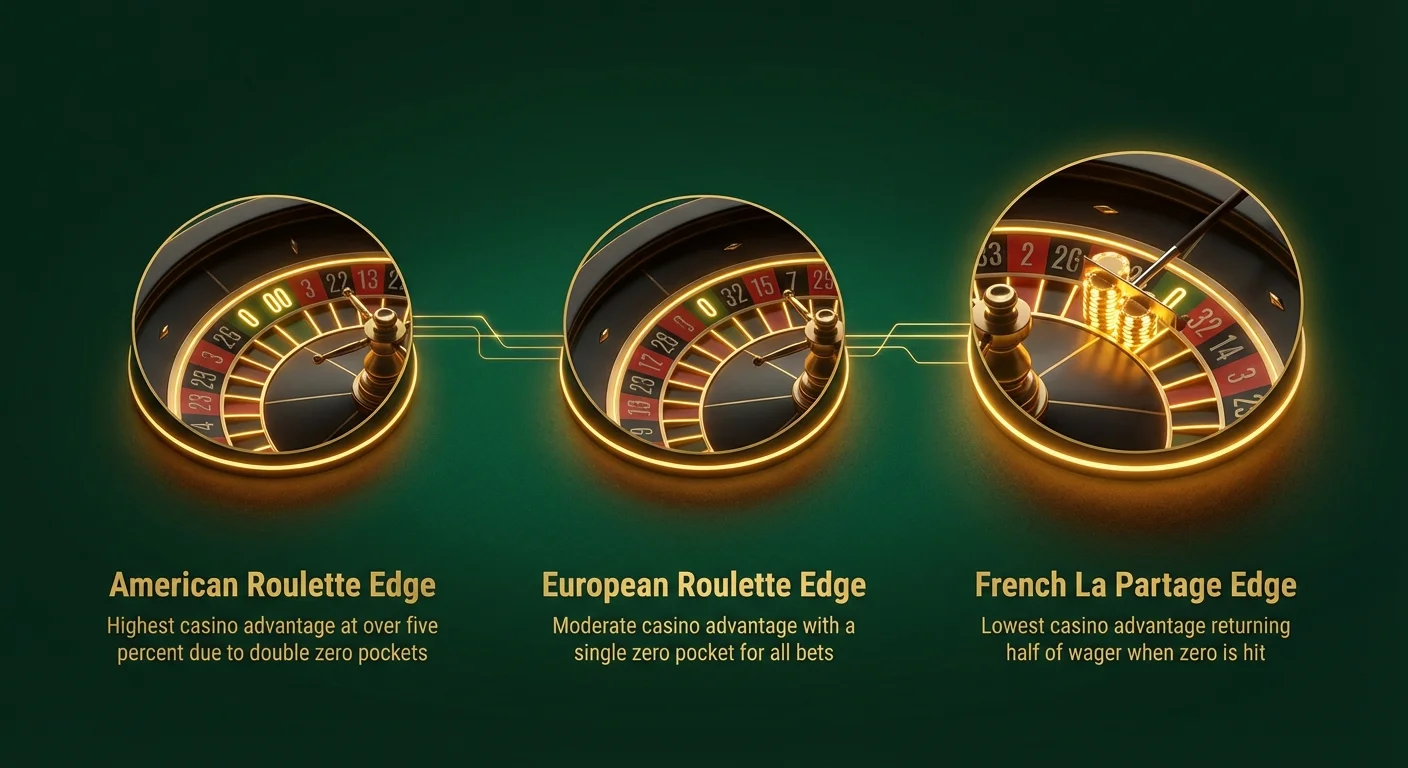
If you have spent any time at a roulette table, whether in a glitzy Monte Carlo resort or an online crypto casino, you likely know the golden rule of the game: the house always has an edge. In American Roulette, that edge is a punishing 5.26%. In European Roulette, it drops to a more manageable 2.70%. However, for the discerning gambler who understands the mathematics of the game, there is a superior option that cuts the casino's advantage in half, bringing it down to a remarkable 1.35%. comparing the house edge.
This is French Roulette.
While it is visually similar to its European counterpart, French Roulette is distinct because of two specific rules regarding the zero pocket: La Partage and En Prison. These rules act as a safety net for players wagering on even-money outcomes, dramatically altering the volatility and long-term return to player (RTP) of the game.
In this guide, we will move beyond the basics of how to place a chip. We will dissect the mechanics of these advanced rules, analyze how they affect betting systems like the Martingale, and explain why playing French Roulette with cryptocurrency is the smartest move for the modern player.
The Anatomy of the French Wheel
Before diving into the complex rule sets, it is vital to understand the physical and layout differences that define French Roulette.
The Wheel
The French Roulette wheel is identical to the European wheel. It features 37 pockets: numbers 1 through 36, colored alternately red and black, and a single green zero (0). This is the first step in its superiority over American Roulette, which includes a double zero (00). By removing the double zero, the game immediately eliminates one of the house's winning pockets.
The Table Layout
While the wheel is the same as the European version, the table layout often looks different. In a traditional land-based setting, the French table is wider, often staffed by multiple croupiers (stickmen) using rakes to manage chips. The betting grid is red, and the text is in French.
Key French Terms You Will Encounter:
- Rouge / Noir: Red / Black
- Pair / Impair: Even / Odd
- Manque / Passe: Low (1-18) / High (19-36)
However, the aesthetic differences are secondary. The true power of French Roulette lies in how the game handles the dreaded green zero.
The La Partage Rule Explained
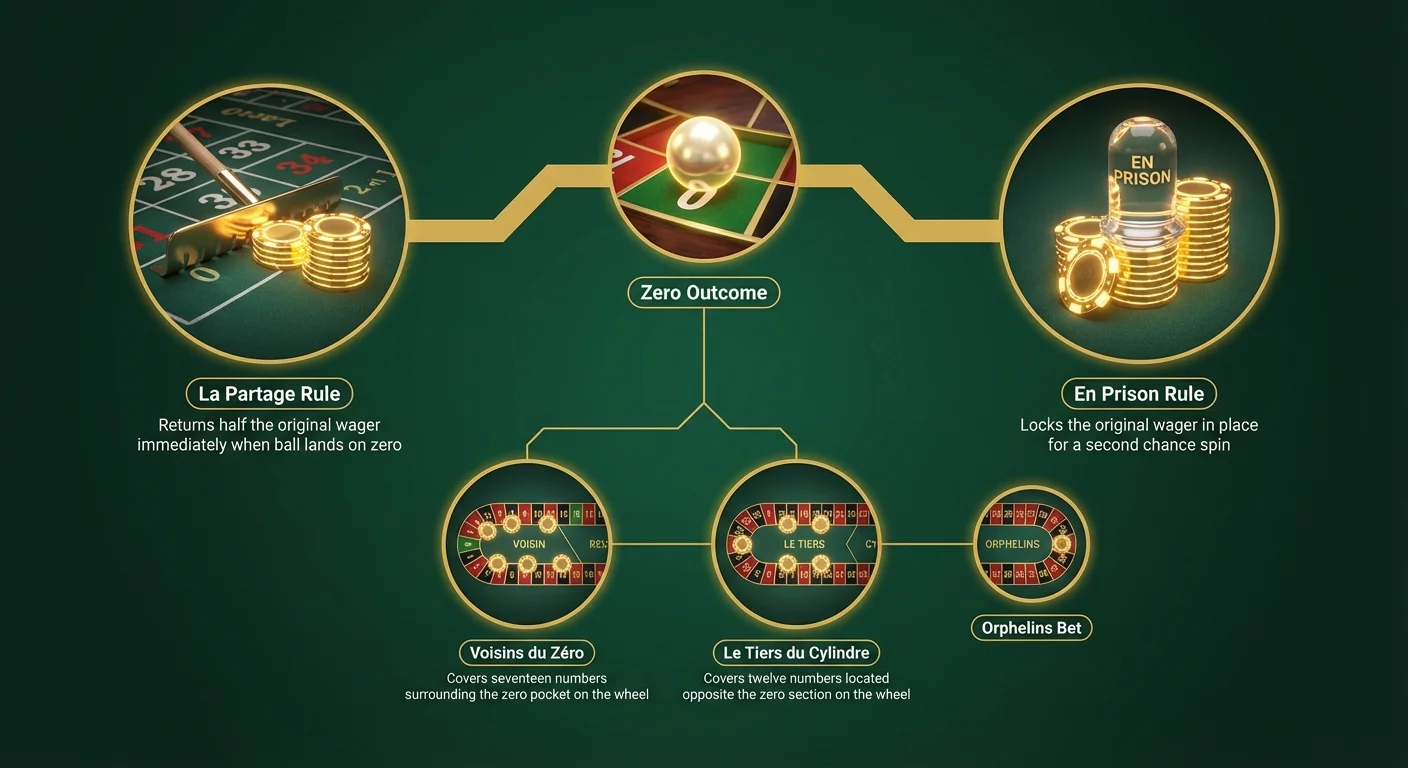
"La Partage" translates from French as "the sharing" or "the division." It is the most common variation of French Roulette found in online crypto casinos and is arguably the most beneficial rule for the player.
How It Works
In standard Roulette, if you bet on Red and the ball lands on Zero, you lose your entire stake. The zero is the house's number; it is neither red nor black, odd nor even.
Under the La Partage rule, if you place an even-money bet (Red/Black, High/Low, Odd/Even) and the ball lands on Zero, the dealer does not take your entire stack. Instead, the bet is divided in half:
- 50% of your bet is returned to you.
- 50% of your bet is kept by the house.
The Mathematical Impact
This might sound like a small consolation - losing half is still losing - but mathematically, it is massive. By refunding half the wager on the zero outcome, the rule effectively neutralizes half of the house edge on even-money bets.
- European House Edge: 1/37 = 2.70%
- French (La Partage) House Edge: 2.70% / 2 = 1.35%
Example Scenario:
You are playing at a high-stakes crypto table. You wager 10 mBTC on Noir (Black).
- Result: The ball lands on Green Zero.
- Standard Outcome: You lose 10 mBTC.
- La Partage Outcome: The dealer slides 5 mBTC back to you. You only lose 5 mBTC.
Over thousands of spins, this rebate saves a significant portion of your bankroll, extending your playtime and giving you more opportunities to hit winning streaks.
The En Prison Rule Explained
"En Prison" translates to "in prison." It is a slightly more complex variation of the rule, offering a gamble-within-a-gamble when the zero hits. It is less common online than La Partage but is a staple in high-end European land-based casinos.
How It Works
If you place an even-money bet and the ball lands on Zero, your chips are not returned, nor are they swept away. Instead, they are placed "En Prison" (in prison). The dealer places a marker on your bet, locking it in place for the next spin.
The fate of your bet depends on the next spin:
- If your original bet wins on the next spin: Your chips are released from prison and returned to you. You do not win profit on this spin; you simply get your original stake back fully intact.
- If your original bet loses on the next spin: The house takes the chips. The bet is lost.
- If Zero hits again: Rules vary by casino. In some, the bet loses. In others, it becomes "double imprisoned," requiring two consecutive wins to release.
La Partage vs. En Prison: Which is Better?
Mathematically, both rules result in the same statistical house edge of 1.35%.
- La Partage is better for cash flow. It gives you immediate liquidity. If you are risk-averse, take the half-loss and move on.
- En Prison is better for volatility variance. It offers a "free" second chance to save the entire bet, but risks losing it all on the next spin.
Most online live dealer games default to La Partage because the mechanics are easier to automate than tracking imprisoned bets across spins.
House Edge Comparison Table
To visualize why you should always hunt for French rules, compare the house advantage across the three main variants for even-money bets.
| Game Variation | Wheel Format | Zero Handling | House Edge | RTP (Return to Player) |
|---|---|---|---|---|
| American Roulette | Double Zero (0, 00) | Full Loss | 5.26% | 94.74% |
| European Roulette | Single Zero (0) | Full Loss | 2.70% | 97.30% |
| French Roulette | Single Zero (0) | La Partage / En Prison | 1.35% | 98.65% |
Note: This 1.35% edge applies ONLY to even-money bets (Red/Black, Odd/Even, High/Low). Inside bets (Straight up, Splits, Corners) still carry the standard European 2.70% house edge.
Advanced Strategy: Using Systems with French Rules
Many players use negative progression systems, such as the Martingale or D'Alembert, to manage their bankroll. These strategies are often criticized because the house edge eventually grinds the player down, or they hit table limits. However, French Roulette is the most hospitable environment for these strategies.
The Martingale on a French Table
The Martingale involves doubling your bet after every loss to recover previous losses plus a small profit. The "killer" in Martingale is usually the Zero, which acts as a loss and forces a double-up.
With La Partage, the Zero is less destructive:
- You bet $10 on Red. Zero hits.
- Instead of losing $10, you lose $5.
- Your next bet doesn't necessarily need to be a full double ($20) to recover, or if you do double, you are technically ahead of the mathematical curve compared to a European table.
While La Partage doesn't make the Martingale foolproof (table limits still exist), it significantly reduces the "bleed" rate of your bankroll during zero-heavy sessions.
The Safe Grind
For players looking to clear wagering requirements on crypto bonuses (where allowed), French Roulette offers the safest "grind." By betting on even-money options with La Partage active, you are engaging in a game that has a better payout percentage than many slot machines, with much lower volatility.
Announced Bets: The Racetrack
When playing French Roulette online, you will often see an oval-shaped betting area separaIt allows players to place "Call Bets" (or Announced Bets), which are specific to the French game's racetrack. Bets), which are specific to the French game. These bets cover sections of the wheel rather than the numerical grid.
Knowing these can help you cover the wheel effectively:
1. Voisins du Zéro (Neighbors of Zero)
This is a massive bet covering the 17 numbers surrounding the zero on the wheel (from 22 to 25).
- Cost: 9 chips.
- Coverage: 45.9% of the wheel.
- Strategy: Used by players who believe the dealer is aiming for a specific sector near the zero.
2. Le Tiers du Cylindre (Thirds of the Wheel)
This covers the 12 numbers opposite the zero (from 27 to 33).
- Cost: 6 chips (placed as splits).
- Coverage: 32.4% of the wheel.
- Strategy: A very popular coverage bet because it uses fewer chips than Voisins but pays out at 17:1 (Split odds) if hit.
3. Orphelins (Orphans)
These are the two small segments of the wheel not covered by Voisins or Tiers. It covers 8 numbers (1, 20, 14, 31, 9, 17, 34, 6).
- Cost: 5 chips.
- Strategy: A high-variance play. Since most chips are placed straight-up, the payout is 35:1 if an orphan number hits.
Why Crypto and French Roulette are a Perfect Match
Finding a genuine French Roulette table with La Partage rules in a brick-and-mortar casino is difficult. They are usually reserved for high-limit VIP rooms in Monte Carlo or Las Vegas. However, the crypto gambling world has democratized access to this game.
1. Provably Fair and Live Dealers
Top-tier crypto casinos host Live Dealer tables from providers like Evolution Gaming and Playtech. These providers offer "French Roulette Gold" or simply "French Roulette" tables that explicitly state the La Partage rule is active. Furthermore, pure crypto variations often utilize Provably Fair algorithms, allowing you to verify that the spin was not manipulated - a transparency land-based casinos cannot offer.
2. Micro to Macro Limits
In a physical VIP room, the minimum bet for French Roulette might be $50 or $100. At a crypto casino, you can often utilize these favorable rules with bets as low as 0.0001 BTC or a few cents in USDT. Conversely, crypto allows for massive whales to place bets that traditional fiat banks might block.
3. Instant Liquidity
If you are playing a strategy that relies on grinding out small profits over a long period (thanks to the 1.35% edge), you want instant access to your winnings. Crypto withdrawals ensure that once you decide to cash out your La Partage savings, the funds are in your wallet in minutes.
How to Find Genuine French Roulette Tables
Not every game labeled "French Roulette" actually has the La Partage rule. Some software providers simply change the table felt to red and call it French, while keeping the standard European rules.
Use this checklist before you bet:
- Check the Wheel: Verify there is only one Zero.
- Read the Info/Help File: Click the "?" or "i" icon in the game window. Search for "La Partage" or "Zero Rules." If it says "Bets on zero are lost," close the game - that is not true French Roulette.
- Look for the Layout: A true French table usually has the "Racetrack" visible and the betting distinctively split or labeled in French.
- Test with Minimum Bet: Place a minimum wager on Red. If the ball hits zero, see if you get half back.
Summary
Roulette is a game of chance, but the version you choose to play is a game of skill. By selecting French Roulette over American or European variations, you are making an immediate, mathematically sound decision to protect your bankroll.
Key Takeaways:
- Always avoid American Roulette: The 5.26% house edge is a bankroll killer.
- Seek out La Partage: This rule refunds half of your even-money bet when zero hits.
- Know the Edge: French Roulette has a house edge of 1.35% on even-money bets - the lowest of any roulette variant.
- Utilize the Racetrack: Use Voisins and Tiers to cover sections of the wheel based on ball prediction.
- Play with Crypto: Enjoy better access, wider table limits, and faster withdrawals.
Next time you log into your favorite crypto casino, bypass the standard tables. Look for the French layout. When that green zero inevitably hits, you will be thankful you did.