Walking up to a craps table - whether it is on the velvet floors of Las Vegas or a Live Dealer lobby at your favorite crypto casino - can feel like stepping onto a foreign stock exchange floor. The pace is frantic, chips are flying, and the players and dealers are speaking a language that sounds like absolute gibberish to the untrained ear.
You hear shouts of "Yo," "Boxcars," "Press it," and "Working." If you don't know the lingo, you aren't just missing out on the social atmosphere; you might be missing out on money. In craps, precise terminology is often required to place specific bets, call off wagers, or maximize your odds.
This guide is designed to take you from a confused spectator to a confident shooter. We will break down the essential glossary of craps, the colorful slang used by veterans, and the technical commands you need to manage your bankroll effectively.
The Table Layout and Personnel
Before we get into the slang of the dice, you need to understand the environment. In online crypto craps, you might not see all these people, but understanding their roles helps you understand the flow of the game.
The Crew
- The Boxman: The supervisor of the table. In live casinos, they sit in the middle, guarding the chips. In online play, this is essentially the software or the pit boss monitoring the game integrity.
- The Stickman: The dealer holding the long hooked stick (the "mop") used to push the dice to the shooter. They control the pace of the game and announce the outcomes.
- The Shooter: The player currently rolling the dice. In online RNG (Random Number Generator) versions, you are always the shooter. In Live Dealer versions, a designated person rolls, or a mechanical arm launches the dice.
The Gear
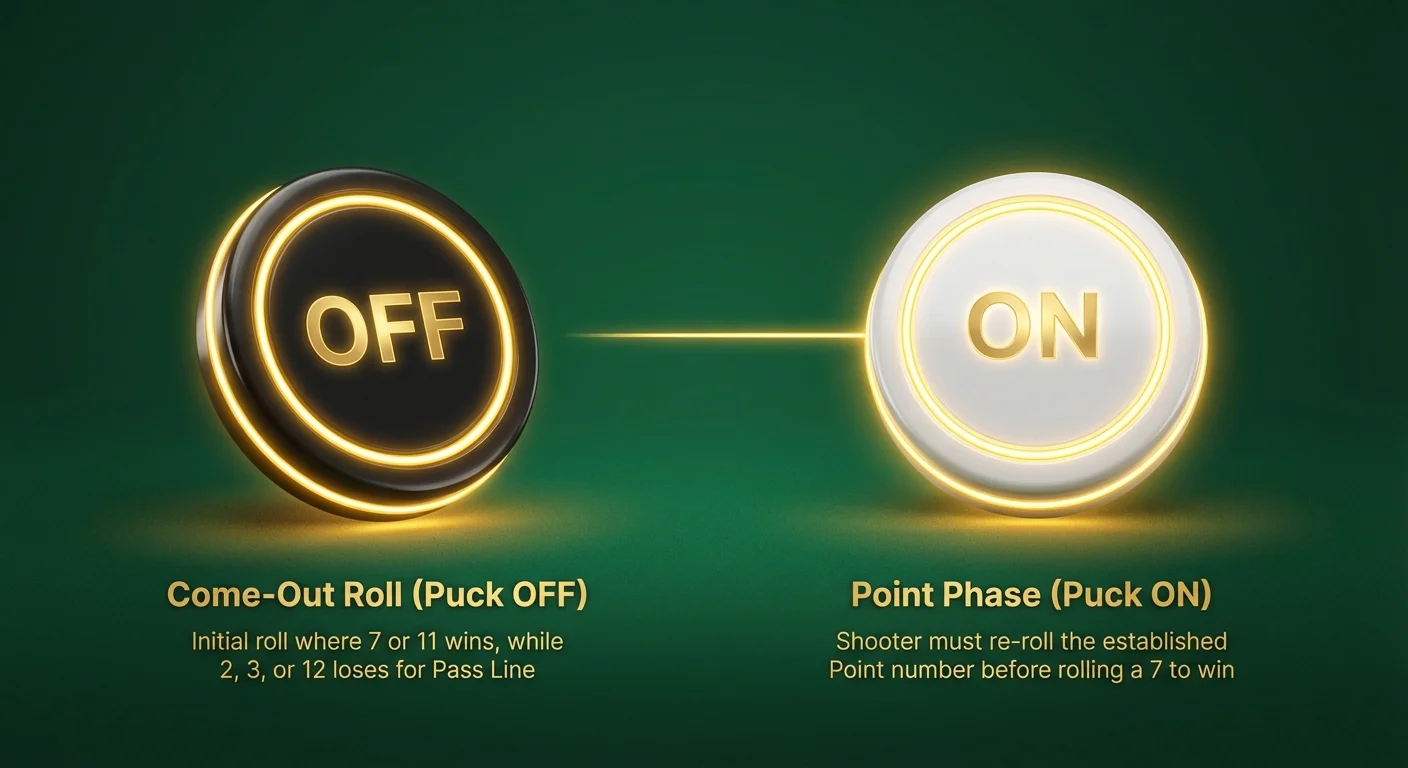
- The Puck: A round marker with two sides: a black side that says OFF and a white side that says ON. This is the most important visual indicator on the table. It tells you if the game is in the "Come Out" phase (OFF) or the "Point" phase (ON).
- The Bones: Slang for the dice themselves.
- The Bowl: The container where the Stickman keeps the extra dice that aren't currently in play.
Game Flow Terminology: The Engine of Craps
To play correctly, you must know what stage the game is in. Betting strategies shift entirely based on these terms.
The Come-Out Roll
This is the first roll of a new round. It happens when the Puck is "OFF."
- Natural: Rolling a 7 or 11 on the Come-Out roll. This is an instant win for Pass Line bettors.
- Craps: Rolling a 2, 3, or 12 on the Come-Out roll. This is an instant loss for Pass Line bettors (hence the name of the game).
The Point
If the shooter rolls a 4, 5, 6, 8, 9, or 10 on the Come-Out, that number becomes the "Point." The Puck is flipped to "ON" and placed on that number. The shooter must now roll that number again before rolling a 7 to win.
Seven Out
This is the roll that ends the round. If the Puck is "ON" (a Point is established) and the shooter rolls a 7, it is a "Seven Out." The Pass Line loses, the dice pass to the next shooter, and a new Come-Out roll begins.
Pro Tip: Do not confuse "Seven Out" with a "Natural." A 7 is a winner on the first roll, but a loser on subsequent rolls.
Betting Lingo: The "Smart" Money
These are the terms you will find in strategy guides. These bets generally offer the best mathematical odds (lowest House Edge).
Pass Line vs. Don't Pass
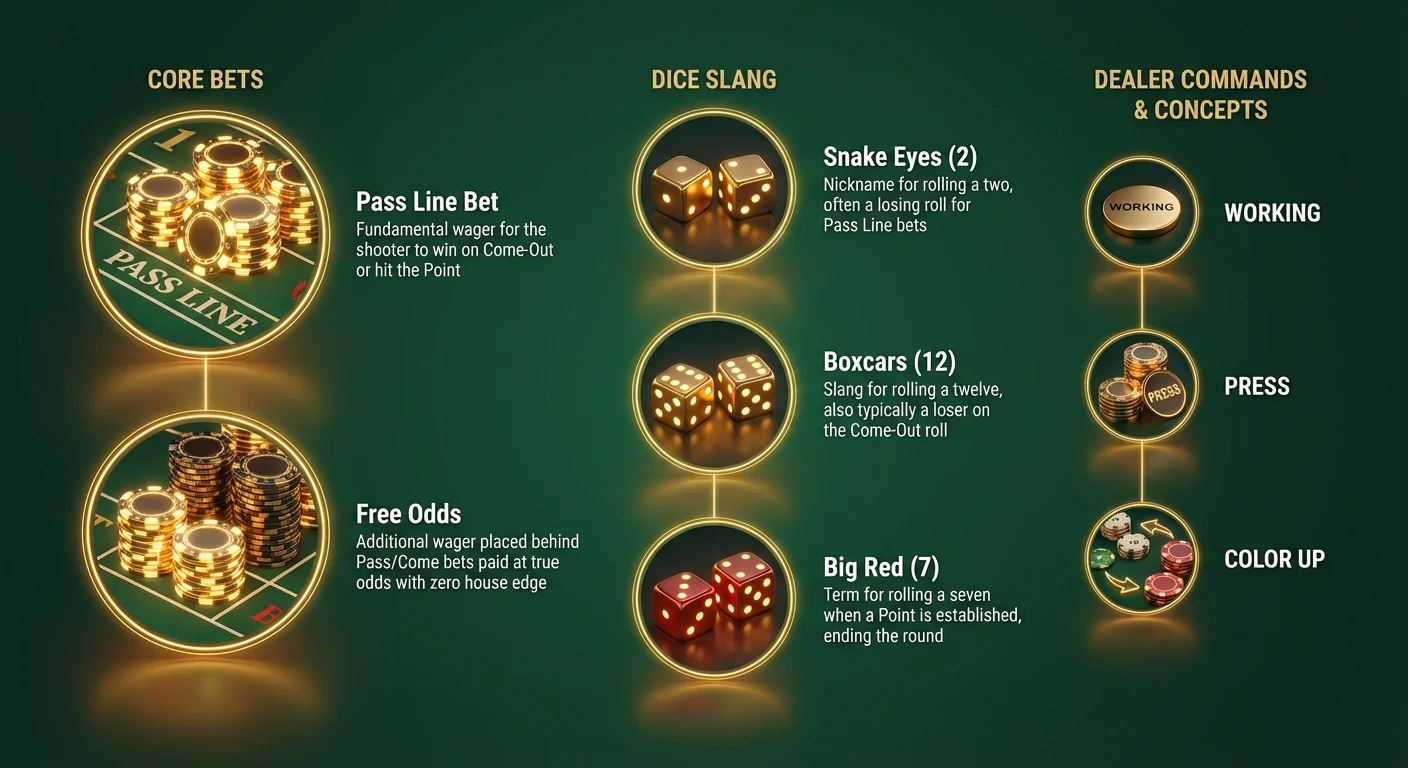
- Pass Line: The most common bet. You are betting with the shooter. You want a 7/11 on the first roll, or for the Point to be hit. The House Advantage (HA) is a low 1.41%.
- Don't Pass: Often called playing the "Dark Side." You are betting against the shooter. You want a 2 or 3 on the first roll, or for the shooter to Seven Out before hitting the Point. The HA is slightly better at roughly 1.36%, but you are betting against the rest of the table.
Free Odds (The Best Bet in the Casino)
Often simply called "Taking Odds" (for Pass Line) or "Laying Odds" (for Don't Pass). This is an additional bet placed behind your original wager after a Point is established.
- Why it matters: The casino pays this bet at True Odds, meaning there is 0.00% House Edge.
- Max Odds: Casinos limit how much you can bet here (e.g., 3x, 4x, 5x, or 10x your flat bet). Always maximize this bet if your bankroll allows.
Come and Don't Come
- Come Bet: Exactly like a Pass Line bet, but made after the Point is established. It effectively creates a new personal game within the main game.
- Contract Bet: A bet that cannot be removed once placed. Pass Line and Come Bets are contract bets - you must wait for them to win or lose.
The Numbers Game: Dice Slang
If you are typing in a live dealer chat room or listening to the Stickman, you won't hear "two" or "twelve." You'll hear colorful nicknames. Using these makes you sound like a seasoned pro.
| Number Rolled | Slang / Nickname | Context / Origin |
|---|---|---|
| 2 | Snake Eyes | Two ones look like eyes. Also "Aces." |
| 3 | Ace Deuce | A one (Ace) and a two (Deuce). Also "Three Craps Three." |
| 4 | Little Joe | Often called "Little Joe from Kokomo." |
| 5 | Fever | "Fever Five." A popular point number. |
| 6 | Jimmy Hicks | "Jimmy Hicks from the Sticks." |
| 7 | Big Red | NEVER say the word "Seven" at the table when the Point is ON. It is considered bad luck. Call it "Red" or just "It." |
| 8 | Eighter from Decatur | Also "Square Pair" (if rolled as 4-4). |
| 9 | Centerfield | On the table layout, the 9 is in the middle of the field numbers. Also "Nina." |
| 10 | Puppy Paws | Two fives look like paw prints. Also "The Big One" or "Ladies." |
| 11 | Yo | Short for "Yo-Leven." Used to distinguish the sound of "eleven" from "seven." |
| 12 | Boxcars | Two sixes look like train cars. Also "Midnight." |
Dealer Commands and Player Actions
In online crypto craps, you often have buttons for these, but in Live Dealer games, you may need to type these instructions or understand what the dealer is doing with your chips.
"Working" vs. "Off"
This is critical for Place Bets (betting on individual numbers like 6 or 8).
- Off: By default, Place bets and Hardways are "Off" (inactive) during the Come-Out roll. If a 7 is rolled, you don't lose them.
- Working: You can tell the dealer "Working on the Come-Out." This puts your bets at risk immediately but allows you to win if your number hits on the first roll.
"Press" vs. "Same Bet"
When you win a Place bet (e.g., you bet $6 on the 8 and won $7), the dealer will ask what you want to do.
- Same Bet: You take the profit and leave the original $6 bet.
- Press: You use the winnings to increase the bet. For example, "Press it to $12." This is an aggressive strategy to capitalize on a hot streak.
- Power Press: Aggressively increasing the bet by the maximum amount possible using the winnings.
"Parlay"
A bold move where you add all your winnings and your original stake to the next bet. If you hit a Hardway 4 and say "Parlay," you are betting everything on that Hard 4 hitting again.
"Buy" vs. "Lay"
- Buy Bet: Similar to a Place bet, but you pay a 5% commission (vig) to get paid at true odds. This is mathematically superior for the 4 and 10.
- Lay Bet: Betting a number won't roll before a 7. You pay a commission to get true odds on the "Dark Side."
"Color Up"
When you are done playing and have a stack of small denomination chips (red $5s or white $1s), you ask to "Color Up." The dealer exchanges them for larger denomination chips (green $25s or black $100s) for easier cashing out. In crypto casinos, this happens automatically when you leave the table.
The Fun (and Dangerous) Bets
The center of the table contains the "Proposition Bets" or "Props." These have high payouts but high House Edges.
Hardways
Betting that a number (4, 6, 8, or 10) will roll as a pair (e.g., 2-2, 3-3) before it rolls "easy" (e.g., 3-1) or before a 7 rolls.
- Hard: 4-4 is a "Hard 8."
- Easy: 5-3 is an "Easy 8."
The Field
A one-roll bet that the next number will be 2, 3, 4, 9, 10, 11, or 12.
- Iron Cross: A strategy combining a Field bet with Place bets on 5, 6, and 8 to cover every number except the 7.
Horn Bet
A one-roll split bet covering the 2, 3, 11, and 12. If you hear someone say "Horn High Yo," they want the bet with extra money on the 11.
World / Whirl
A Horn bet plus a bet on the Any Seven. This is essentially a hedge bet to protect against a 7 on the Come-Out, but generally carries a high house edge.
Sucker Bet Terminology: What to Avoid
To talk like a pro, you must know what the pros avoid.
Big 6 and Big 8
These are large bets located in the corners of the layout. They pay even money (1:1) if a 6 or 8 is rolled.
- Why it's a sucker bet: If you make a Place Bet on the 6 or 8, it pays 7:6. You are betting on the exact same outcome but getting paid less on the Big 6/8. Never play these.
Any Seven
A bet that the very next roll will be a 7. It usually pays 4:1 but the true odds are 5:1. The House Edge here is a brutal 16.67%.
Crypto & Online Craps Specifics
The transition to betting with Bitcoin, Ethereum, or USDT brings its own set of terms.
Provably Fair
In software-based (non-live) crypto craps, this is a cryptographic method that allows you to verify that the roll was truly random and not manipulated by the casino. You can check the "Server Seed" and "Client Seed" after the hand.
Auto-Roll / Turbo
Features in software craps that speed up the game. "Turbo" removes the animation of the dice roll, providing an instant result. Great for testing strategies like the Martingale or Three Point Molly, but drains your bankroll faster if you are losing.
Dynamic UI
In Live Dealer crypto games (like Evolution Gaming's Craps Live), the user interface is dynamic.
- My Numbers: A display showing exactly which numbers you have money on and how much you stand to win.
- Repeat: A button allowing you to place the exact same bets as the previous round with one click.
Practical Strategy: Putting the Lingo to Use
Now that you know the words, here is how a "Pro" conversation sounds in your head while playing:
- The Approach: You wait for the Puck to be OFF. You bet the Pass Line.
- The Come Out: The Shooter rolls a 4. The Puck moves to ON (4).
- The Strategy: You take Max Odds behind your Pass Line bet. You tell the dealer (or click the UI) to Place the Inside (5, 6, 8, 9).
- The Action: The shooter rolls a 6. The dealer pays you. You decide to Press the 6 (double your bet).
- The End: The shooter rolls Big Red (7). The dealer shouts Seven Out. The Puck turns OFF. You collect any remaining chips or prepare for the next round.
Summary Checklist
If you only remember five things from this guide, make it these:
- Puck OFF: Come-Out roll (7 is good).
- Puck ON: Point round (7 is bad).
- Free Odds: The bet with zero house edge; always take it.
- Snake Eyes/Boxcars: 2 and 12 (usually bad for Pass Line).
- Working: Your bets are active and at risk.
Craps is a game of community. Whether you are typing "Nice roll!" in a crypto casino chat or high-fiving strangers at a physical table, knowing the lingo changes you from an outsider to a member of the crew. So, wait for the shooter, watch the puck, and may you never see Big Red when your bets are pressed to the max.