
In the landscape of digital finance, the concept of ownership has undergone a radical transformation. Traditional banking systems operate on a custodial model, where institutions hold assets on behalf of the customer. This structure provides a safety net but ultimately retains control over the funds. Cryptocurrencies like Bitcoin and Ether introduce a paradigm of self-custody, placing absolute power and responsibility directly into the hands of the individual. This shift eliminates third-party risk but introduces a critical requirement for personal security management.
At the heart of this security model lies the seed phrase, also known as a recovery phrase or secret passphrase. This sequence of words acts as the master key to a digital vault. If a user loses access to their hardware device or mobile phone, the seed phrase is the only mechanism capable of restoring access to the funds. Conversely, if this phrase falls into the wrong hands, the assets can be drained remotely without any recourse.
Mastering the management of this phrase is not merely a technical step. It is the most significant action a crypto investor takes to secure their wealth. Unlike a password for a social media account, a seed phrase cannot be reset by clicking a "forgot password" link. The decentralized nature of blockchain technology means there is no customer support help desk to call if the key is lost.
The responsibility is absolute. Understanding the mechanics of how these keys function, how they must be stored, and how to recover them is essential for anyone serious about preserving their digital wealth. This guide explores advanced strategies for securing these vital data points, moving beyond basic advice to robust, comprehensive security protocols.
The Architecture of Private Keys and Seed Phrases
To properly secure a wallet, one must first understand what is actually being protected. A common misconception is that a cryptocurrency wallet stores digital coins. In reality, the wallet stores cryptographic keys. The assets themselves reside on the blockchain, a public ledger that tracks ownership. The wallet simply contains the tool required to sign transactions and authorize the movement of those assets.
From 256-Bit Integers to Human Language
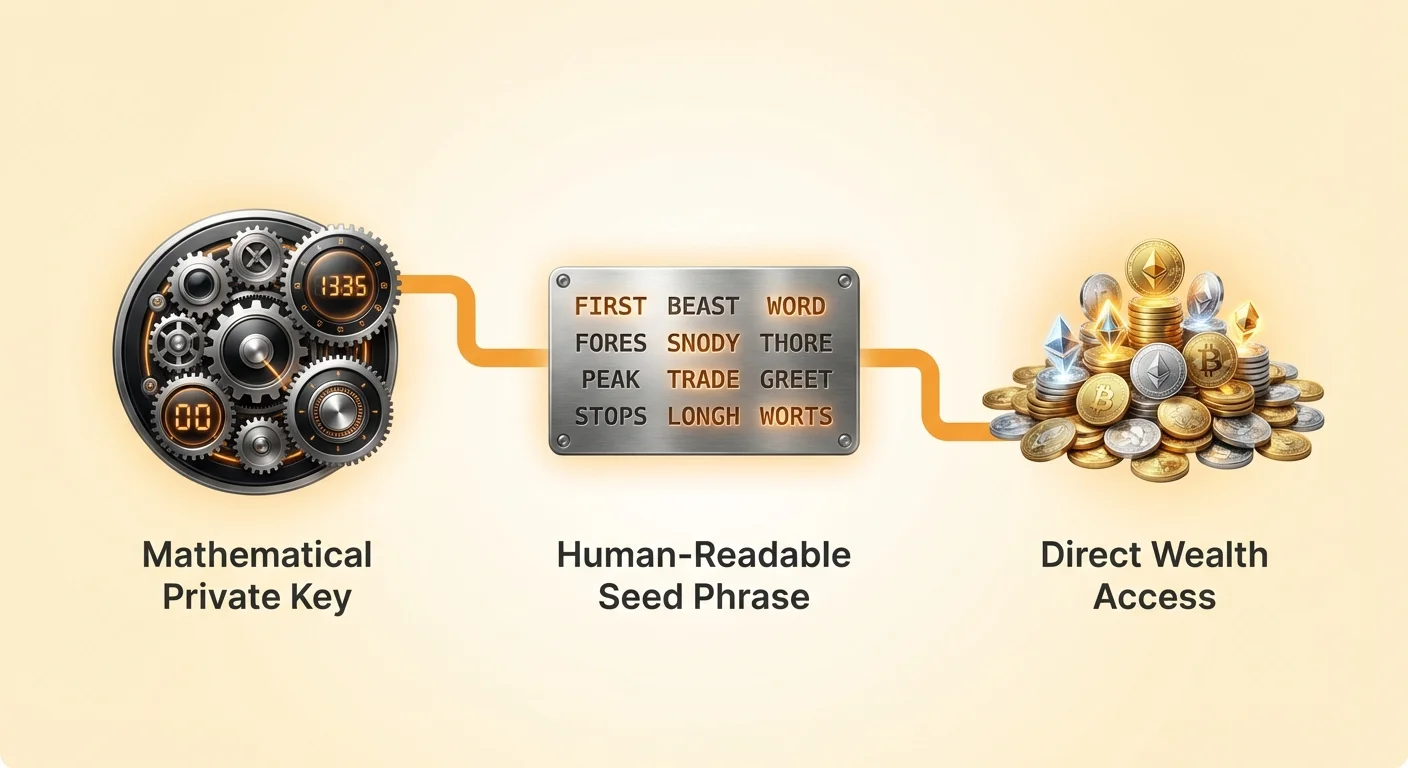
The fundamental secret guarding a wallet is the private key. Technically, this is a 256-bit number, an incredibly long string of characters that looks like a random jumble of letters and numbers. Using such a string directly is impractical for humans. It is prone to transcription errors, and memorizing it is nearly impossible for the average person.
To solve this usability challenge, the industry adopted standards that translate this complex binary data into a readable format. This is the seed phrase. It usually consists of 12 to 24 words chosen from a specific list of 2,048 common English words. These words, when processed by the wallet software, mathematically generate the underlying private keys.
Because the seed phrase is a direct representation of the private key, it commands the same level of authority. Anyone who possesses these words has the mathematical proof of ownership required to spend the funds. This is why the phrase must be treated with the highest classification of secrecy.
The Deterministic Nature of Modern Wallets
Most modern applications function as "hierarchical deterministic" wallets. This means that a single seed phrase can generate and control multiple accounts across different blockchains. A single list of 12 words can back up a Bitcoin wallet, an Ethereum wallet, and a Bitcoin Cash wallet simultaneously.
This consolidation offers convenience, but it also concentrates risk. Since one master key controls the entire portfolio, the security of that single phrase becomes paramount. If an attacker acquires the phrase, they gain access to every asset derived from it, regardless of the currency type.
Consequently, the backup strategy employed for this single phrase defines the security posture of the entire portfolio. Users must transition from viewing the seed phrase as a simple login credential to viewing it as the asset itself.
Physical Storage Strategies
For the vast majority of cryptocurrency holders, physical storage remains the gold standard for securing seed phrases. This approach involves recording the words on a tangible medium and keeping that object offline, completely disconnected from the internet. This method effectively neutralizes online threats such as malware, keyloggers, and hackers.
The Paper Standard and Its Limitations
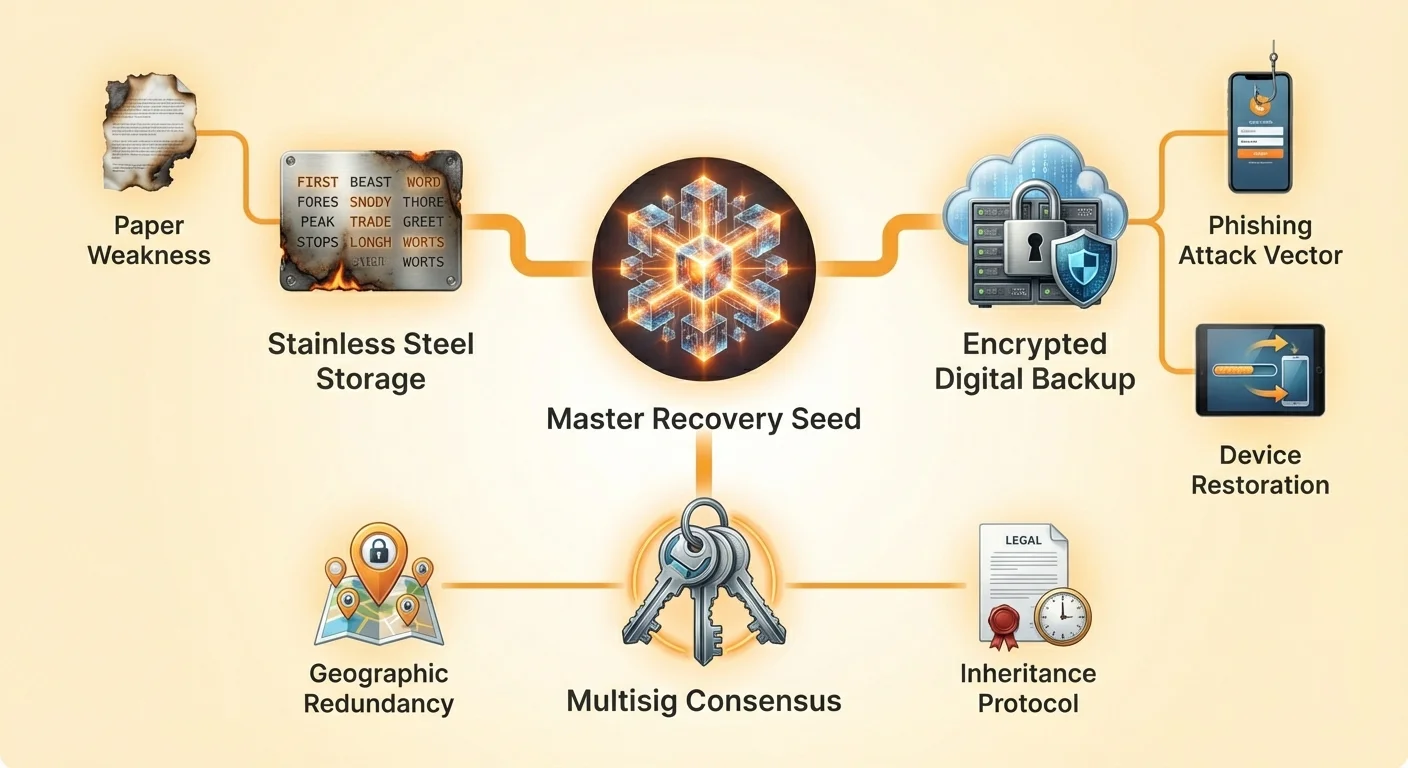
The most immediate method of backup is writing the phrase on paper. This is often the first step suggested during wallet setup. While effective against digital theft, paper has significant physical vulnerabilities. It degrades over time, is susceptible to water damage, and is instantly destroyed by fire.
Furthermore, paper can be easily misplaced or thrown away by accident. If a user chooses this route, they should use high-quality, acid-free paper and archival ink to prevent fading. However, relying solely on a single piece of paper is a fragile strategy for significant amounts of wealth.
Upgrading to Metal Storage
To mitigate the environmental risks associated with paper, many advanced users utilize metal backup solutions. These are plates made of stainless steel or titanium. The user records their seed phrase by stamping letters into the metal or sliding pre-etched tiles into a locked chassis.
Metal storage is impervious to water, resistant to extreme heat, and immune to standard wear and tear. In the event of a house fire or flood, a metal backup is likely to survive intact, ensuring the funds remain recoverable.
| Material | Fire Resistance | Water Resistance | Cost |
|---|---|---|---|
| Paper | Low | Low | Low |
| Stainless Steel | High | High | Medium |
| Titanium | Very High | High | High |
Geographic Redundancy
A single backup, no matter how durable, represents a single point of failure. If the physical location is compromised—perhaps by a natural disaster or burglary—the backup could be lost. To counter this, users should consider geographic redundancy.
This involves creating multiple copies of the seed phrase and storing them in separate, secure locations. One might be kept in a home safe, while another is stored in a bank safety deposit box or with a trusted family member. This strategy ensures that the destruction of one location does not result in the total loss of funds.
Digital and Cloud-Based Backup Protocols
While physical storage is robust, it is not always convenient. Managing physical items can be burdensome, and physical access can be lost. Recognizing this, some modern wallet providers have introduced automated cloud backup services. These systems aim to balance security with the convenience of modern technology.
Encryption is the key
It is critical to distinguish between a "cloud backup" and simply saving a screenshot to a cloud drive. Storing a plain text file or a photo of a seed phrase on a cloud service is a catastrophic security error. If the cloud account is hacked, the funds are immediately vulnerable.
Legitimate cloud backup services provided by self-custodial wallets operate differently. They encrypt the recovery phrase before it ever leaves the device. The user creates a custom, strong password that acts as a decryption key. The encrypted file is then stored in Google Drive or Apple iCloud.
The Role of the Decryption Password
In this setup, the cloud provider hosts the data, but they cannot read it. Access requires two distinct elements: access to the cloud account and knowledge of the custom decryption password. If a user loses their phone, they can reinstall the wallet app, log in to their cloud account, and input the password to restore their balances.
This method effectively creates a form of two-factor authentication for recovery. An attacker would need to compromise the cloud account and also crack the custom encryption password. This offers a viable alternative for users who are uncomfortable managing physical hiding spots or who travel frequently.
Advanced Custody: Multisignature Wallets
For individuals or organizations managing substantial sums, a standard single-key wallet may not offer sufficient security. In these scenarios, a multisignature (multisig) wallet configuration is the superior choice. This technology requires multiple approvals to authorize a transaction, distributing trust across several parties or devices.
How Multisig Works
A standard wallet is a "1-of-1" setup, requiring one signature from one key to move funds. A multisig wallet can be configured as "2-of-3," "3-of-5," or any other combination. In a 2-of-3 setup, three separate private keys are generated. To send a transaction, two of those three keys must sign it.
This structure eliminates the single point of failure. If one key is lost or stolen, the funds remain safe because the attacker cannot move them without a second key. Simultaneously, if the owner loses one key, they can still access their funds using the remaining two.
Use Cases for Shared Control
Multisig is ideal for organizational treasuries, where board members must reach a consensus before spending assets. It prevents a single rogue employee from draining the company accounts. It is also valuable for family security. A family might set up a wallet where parents and a trusted attorney hold keys, ensuring that access is available even if one person is incapacitated.
This method does introduce complexity. Users must manage multiple seed phrases and ensure that the software tools used to coordinate the signing process are compatible. However, the exponential increase in security makes it a standard for institutional-grade self-custody.
The Mechanics of Wallet Recovery
Possessing a backup is only half of the equation; knowing how to use it is equally important. Wallet recovery is the process of using the seed phrase to regenerate the private keys on a new device. This procedure is necessary if a phone is lost, a computer crashes, or a hardware wallet malfunctions.
Importing vs. Sweeping
When restoring access, users often encounter terms like "import" and "sweep." Importing a wallet involves entering the seed phrase into a new application. The software then locates the associated addresses on the blockchain and grants control. The keys remain the same.
Sweeping is slightly different and usually applies to paper wallets containing a single private key. Sweeping involves creating a brand new wallet and then transferring all funds from the old paper wallet to the new one. This is generally considered safer for single keys, as it retires the old, potentially exposed key.
The Restoration Process
To restore a wallet from a seed phrase, the user initiates the "Import Wallet" function in their chosen software. They are prompted to enter the 12 or 24 words in the exact order they were generated. Spelling and sequence are critical. If a single word is wrong, or if the order is shuffled, the wallet will generate a completely different set of keys, usually resulting in an empty balance.
Modern wallets make this easier by suggesting words from the standard dictionary list as the user types. This helps prevent spelling errors. Once the phrase is entered, the software scans the blockchain for transaction history associated with those keys and updates the balance.
Handling Sub-Wallets and Derivation Paths
Because modern wallets are multichain, restoring the seed phrase should theoretically recover all associated assets (Bitcoin, Ethereum, etc.). However, different wallet software may use different "derivation paths" to generate addresses.
If a user restores their seed phrase into a different wallet app than the one they originally used, they might not see all their coins immediately. The funds are safe, but the software is looking in the wrong "place" mathematically. Users should document which wallet software was used to create the seed phrase to ensure smooth recovery on compatible platforms.
Threat Mitigation and Operational Security
Securing a seed phrase is not just about static storage; it is about defending against active attacks. The irreversible nature of crypto transactions makes wallet holders high-value targets for criminals. Awareness of common attack vectors is a prerequisite for safety.
Phishing and Social Engineering
The most common method for stealing seed phrases is phishing. Scammers create fake websites that look identical to legitimate wallet support pages or decentralized applications. They trick users into entering their seed phrase under the guise of "verifying a wallet" or "claiming an airdrop."
A fundamental rule of crypto security is that no legitimate support agent, application, or administrator will ever ask for a seed phrase. The phrase is for the user's eyes only. Entering it into a website is almost always a guarantee of theft.
Digital Leakage
Digital leakage occurs when a seed phrase is exposed to the internet or a network-connected device unintentionally. This can happen if a user types their phrase into a note-taking app, sends it via email, or takes a photo of the paper backup.
Once the data is digital, it is accessible to malware. "Clipboard hijackers" are malicious programs that monitor a computer's clipboard for copied text that resembles a crypto address or seed phrase. Users should avoid copying and pasting seed words and should never store them in unencrypted digital files.
Physical coercion
While rare, physical threats exist. If an attacker knows a user holds significant crypto wealth, they may attempt to force the disclosure of the seed phrase. This is often referred to as the "$5 wrench attack."
Using a "passphrase extension" can mitigate this. This is an advanced feature where the user adds a 13th or 25th word of their own choosing to the standard seed phrase. This creates a completely hidden wallet. The user can keep a small amount of funds in the standard wallet (the decoy) to surrender under duress, while the bulk of the wealth remains hidden behind the extra word.
Inheritance and Estate Planning
One of the most overlooked aspects of self-custody is inheritance. Because no bank controls the assets, no bank can transfer them to next of kin upon death. If a crypto holder passes away without leaving instructions and access to their keys, the funds are effectively burned—lost to the network forever.
documenting the Access Protocol
Holders must create a clear plan for their heirs. This does not mean simply handing over the seed phrase while alive, which violates the security principle of limiting access. Instead, instructions can be placed in a sealed envelope within a will or safe deposit box.
The documentation should explain what the assets are, where the hardware or backups are located, and how to operate the devices. Since many heirs may not be technically proficient, detailed guides on how to restore the wallet or contact a specific trusted assistant are vital.
Dead Man's Switches
Some users employ digital "dead man's switches." These are automated systems that send emails or release information if the user fails to check in after a set period. While innovative, these systems introduce third-party risks and potential technical failures. For most, a physical plan involving legal counsel and secure physical storage remains the most reliable method for asset succession.
Conclusion
The transition to self-custodial finance offers unparalleled freedom and control over one's economic destiny. By removing intermediaries, individuals protect themselves from bank failures, frozen accounts, and censorship. However, this freedom is inextricably linked to the responsibility of key management. The seed phrase is the pivot point upon which this entire system rests.
Securing this phrase requires a layered approach that moves beyond scribbling words on a sticky note. It demands durable materials like steel to withstand physical disasters and rigorous operational security to ward off digital threats. Whether employing advanced multisignature setups or utilizing encrypted cloud backups, the goal remains the same: to ensure access is maintained for the owner while remaining impossible for attackers.
Ultimately, the strength of a digital vault is defined by the quality of the backup strategy protecting it. By treating the seed phrase with the gravity it deserves, investors can confidently navigate the digital asset ecosystem, knowing their wealth is truly their own.
If you do not control the keys, you do not control the money; secure your seed phrase offline immediately.