
The glow of the screen, the anticipation of the reels stopping, and the rush of a potential payout - slots are the heartbeat of the online casino industry. Whether you are spinning reels at a traditional online casino or wagering Bitcoin on a decentralized gambling DApp, the psychology remains the same. We all want to believe we can predict the unpredictable.
Human beings are hardwired to find patterns in chaos. When we see a slot machine payout three times in a row, we call it "hot." When we spin fifty times without a win, we claim it's "cold" or "rigged." In the world of crypto gambling, where transparency and technology reign supreme, these old superstitions still persist.
However, playing with a "hot wallet" (a connected crypto wallet) doesn't mean you should fall for "hot slot" myths. Understanding the mathematics and mechanics behind these games is the first step to becoming a smarter, safer player. In this guide, we will dismantle the most persistent myths in the industry, explain the difference between traditional RNGs and crypto "Provably Fair algorithms", and teach you how to approach slots with a strategy based on reality rather than superstition.
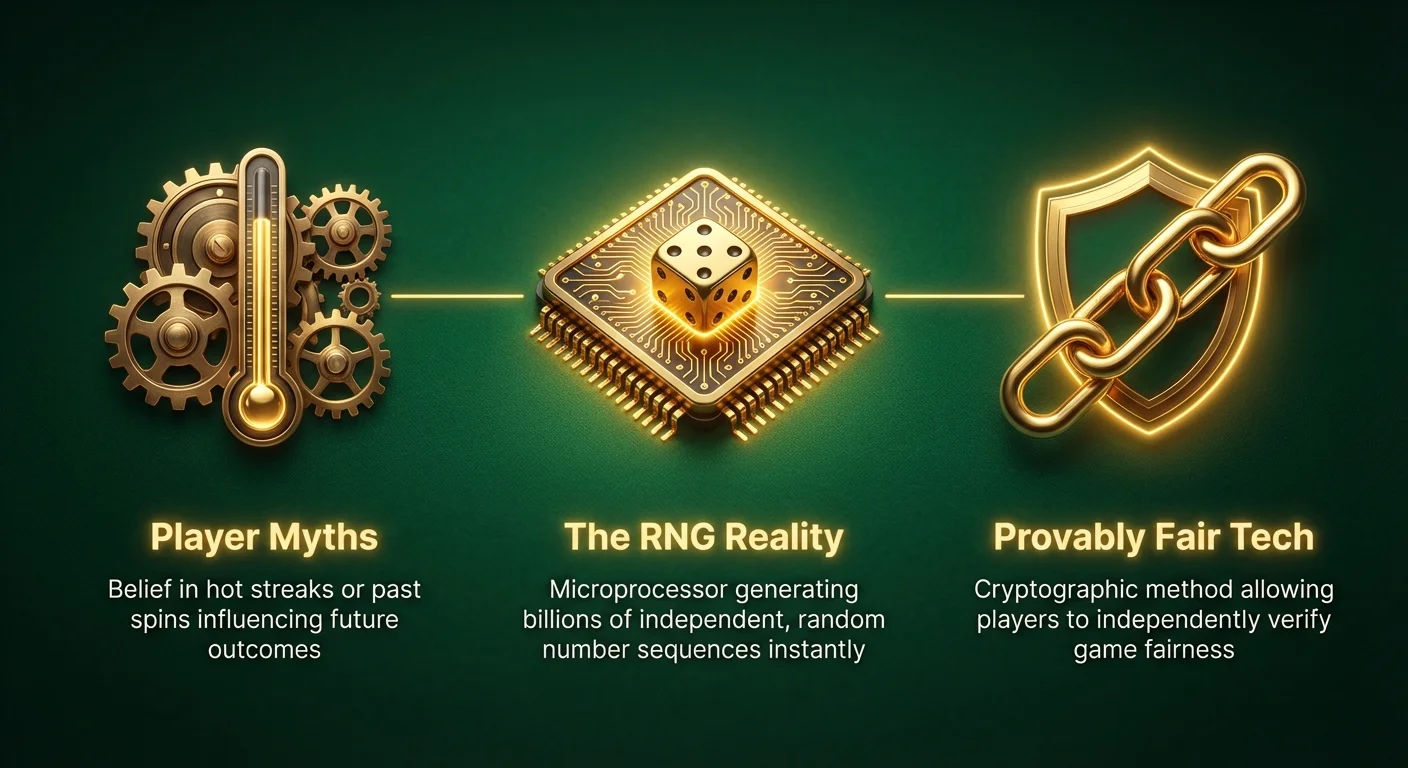
The Engine Room: How Slots Actually Work
Before we can bust the myths, we need to understand the engine driving the game. Many beginners believe that the reels spinning on the screen dictate the result. In reality, the reels are just a visual interface - an animation designed to make the math look exciting.
The Random Number Generator (RNG)
At the core of every legitimate slot machine is a Random Number Generator (RNG). As detailed in industry standards, the RNG is a microprocessor that generates billions of number sequences per second, even when the machine is not being played.
The moment you press the "Spin" button (or the moment your transaction hits the smart contract), the RNG freezes on a specific set of numbers. These numbers determine the outcome of the reels instantly.
- The Spin: The result is decided the millisecond you click.
- The Animation: The spinning reels are just a "movie" playing out the result that has already been determined.
- The Independence: The RNG has no memory. It does not know if you won big on the last spin or if you have lost your last ten bets.
Crypto Context: Provably Fair Gaming
In the crypto gambling world, we take the RNG concept a step further with Provably Fair algorithms. This is a massive advantage over traditional fiat casinos.
In a standard online casino, you have to trust the auditor that the RNG is fair. in a crypto casino, you can verify it yourself.
- Server Seed: The casino creates a random number and hashes it (encrypts it) before you bet.
- Client Seed: Your browser (or wallet) generates a random seed.
- The Result: The game outcome is generated by combining the Server Seed and Client Seed.
- Verification: After the spin, you can un-hash the data to prove the casino couldn't have changed the outcome after you placed your bet.
Even with this level of transparency, players still fall for the "Hot and Cold" myths. Let's dismantle them one by one.
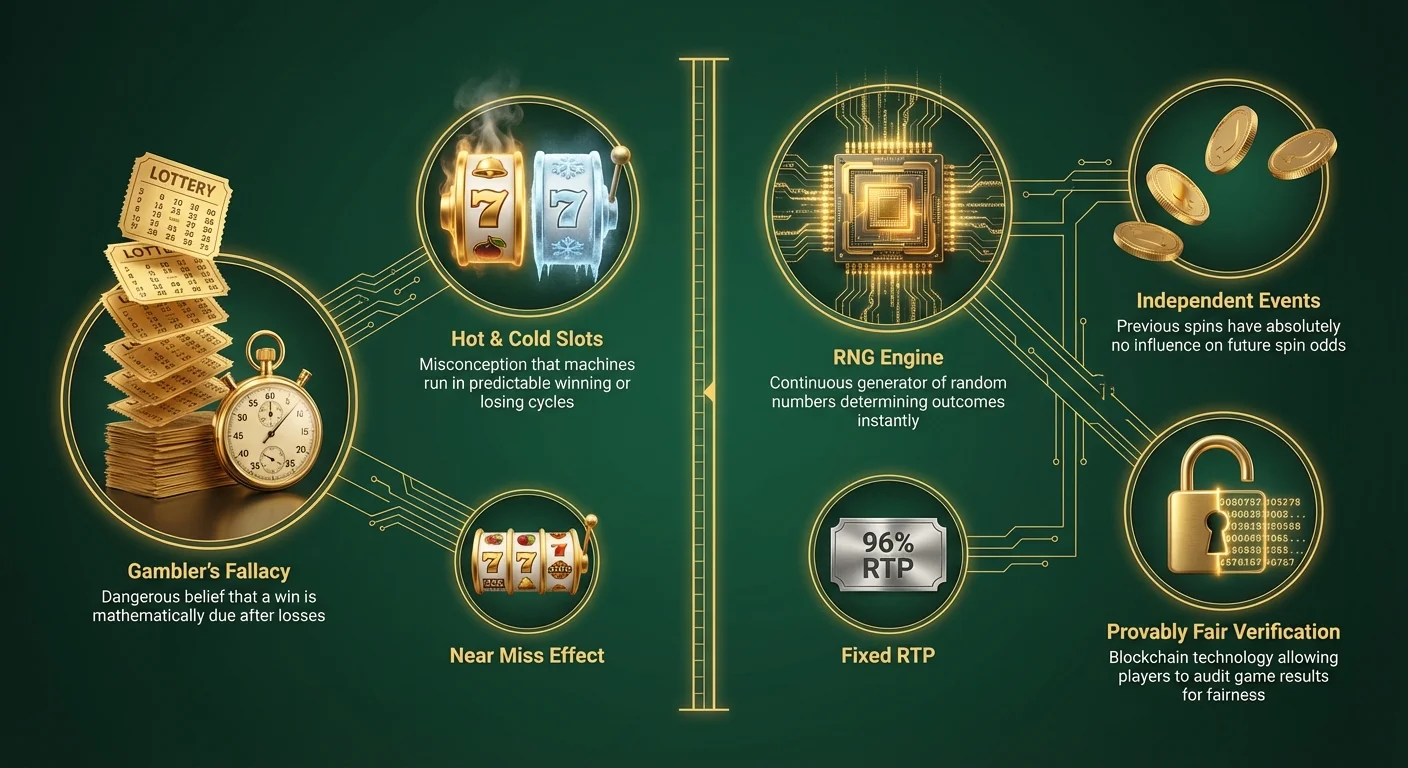
Myth #1: The "Hot" and "Cold" Slot Theory
The Myth: "This slot hasn't paid out in an hour; it's 'cold' and I should avoid it." or "That slot just paid a jackpot; it's 'hot' and I should ride the streak."
The Reality: Slots do not have temperatures, and they do not run in cycles.
This is perhaps the most pervasive myth in gambling history. It stems from the physical nature of old mechanical machines where gears might wear down. In digital and crypto slots, every spin is an independent event.
If you flip a coin and it lands on Heads, the chance of it landing on Heads again is still 50/50. If it lands on Heads 20 times in a row, the 21st flip is still 50/50. The coin has no memory. Neither does the slot machine.
Why "Streaks" Appear Real
You will inevitably experience streaks of wins or losses. This is simply variance (or volatility) playing out in real-time. In a random set of data (thousands of spins), clusters of wins and clusters of losses will naturally occur. Attributing this to the machine being "hot" is a psychological trick your brain plays on you to create a narrative out of randomness.
Myth #2: The Gambler's Fallacy
The Myth: "I have lost 50 spins in a row. The machine is 'due' to pay out soon. I just need to keep playing."
The Reality: A slot machine is never "due."
The Gambler's Fallacy is the dangerous belief that past events influence future probabilities in a random process. In the context of slots, it is the belief that the machine acts like a pressure cooker - building up "win pressure" the longer it goes without paying.
Because the RNG generates numbers continuously and independently, the odds of hitting a jackpot on your very first spin are exactly the same as the odds of hitting it on your 1,000th spin.
The Danger to Your Bankroll
Believing in the Gambler's Fallacy is the quickest way to drain your crypto wallet. It leads to "chasing losses," where players increase their bets to win back lost money, convinced that a turn of luck is mathematically guaranteed. It is not. The blockchain doesn't care how much you lost previously; the smart contract executes the same probability function every time.
Myth #3: Casinos "Tighten" Odds at Certain Times
The Myth: "Don't play on weekends; the casino lowers the RTP because they know more people are playing." or "Play at 3 AM when the slots are 'loose'."
The Reality: Changing the RTP (Return to Player) on the fly is generally illegal and technically difficult for reputable providers.
In the world of online and crypto slots, the casino usually does not host the game directly. The game is hosted by a software provider (like Pragmatic Play, NetEnt, or a blockchain-based provider).
- Fixed RTP: The math model is hard-coded.
- Regulatory Hurdles: To change the RTP, a provider would usually need to take the game offline, update the code, and have it re-certified by testing agencies.
- No "Switch": There is no master switch in the casino manager's office to "tighten" the games on a Friday night.
While some developers offer casinos different RTP versions of a game (e.g., a 94% version and a 96% version), the casino selects this when they license the game. They cannot toggle between them minute-by-minute based on player traffic.
Myth #4: The "Near Miss" Means You're Close
The Myth: "I got two Jackpot symbols and the third one was just one spot away! I almost won. I should spin again because I'm close."
The Reality: You were likely not close at all.
This is known as the "Near Miss Effect." As we learned from the mechanics of slot reels, the visual representation is just a show.
When the RNG determines you have lost, the software selects a visual display to show you how you lost. Game designers know that seeing two jackpot symbols and a blank is more exciting than seeing three random lemons. It keeps you engaged.
However, mathematically, a "near miss" is exactly the same as a total miss. The random number generated did not match the winning number. The fact that the reel stopped "just above" the winning line is a visual design choice, not an indicator that the RNG almost picked the winning number.
Myth #5: Max Bet Improves Odds of Winning
The Myth: "You have to bet max to get the random number generator to pick winning numbers."
The Reality: The RNG does not care about your bet size, but the game rules might.
This is a nuanced myth. The RNG itself generates the same random numbers regardless of whether you bet 0.0001 BTC or 1 BTC. However, the paytable rules sometimes punish low bettors.
The Jackpot Exception
In many progressive jackpot slots, you are contractually ineligible for the Grand Jackpot unless you bet the maximum amount. In this specific case, betting less does technically lower your "odds of winning the jackpot" to zero.
However, for standard gameplay on modern video slots, betting higher does not change the RTP.
| Feature | Low Bet | Max Bet |
|---|---|---|
| RNG Behavior | Same Randomness | Same Randomness |
| Multiplier Payouts | Proportional (e.g. 10x bet) | Proportional (e.g. 10x bet) |
| Bonus Trigger Chance | Same | Same |
| Jackpot Eligibility | Often Excluded | Often Included |
Advantage Play: The Only "Partial" Myth
Is it ever possible to predict a slot? Surprisingly, yes - but only on very specific types of machines. This is called Advantage Play.
As noted in expert insights on slot strategy, some older mechanical slots or specific video slots have "persistent state" features.
- Accumulators: Some games require you to collect 10 tokens to trigger a bonus. If a player leaves a machine with 9 tokens collected, the next player steps in with a statistical advantage.
- Progressive States: If a "Must Drop" jackpot is guaranteed to pay out before $10,000, and the pot is currently at $9,950, the statistical likelihood of a win on the next few spins skyrockets.
Crypto Caveat: In the online crypto world, persistent states are usually tied to the specific user account, not the "machine." If you leave a game halfway through collecting tokens, they are saved for you, not left for the next player. Therefore, "vulturing" abandoned slots is rarely a viable strategy online.
Practical Strategy: If Myths Are Fake, How Do I Win?
If we accept that slots are random, independent events and that we cannot predict streaks, does that mean strategy is useless? No. It means your strategy must shift from predicting the game to managing your risk.
1. Understanding Volatility (Variance)
Instead of looking for "hot" slots, look for the right volatility for your bankroll.
- High Volatility: Pays out rarely, but pays huge amounts (e.g., Jackpot slots). Long "cold" streaks are normal here. You need a large bankroll to survive the dry spells.
- Low Volatility: Pays out frequently but in smaller amounts. These games feel "hotter" because you win often, even if the total profit is lower. Good for smaller bankrolls.
2. Check the RTP (Return to Player)
Always check the "Info" tab of the slot. Look for an RTP of 96% or higher.
- A 96% RTP means that theoretically, for every $100 wagered, the machine returns $96 over millions of spins.
- Avoid slots with RTPs below 94% unless they offer massive progressive jackpots that justify the "tax."
3. Bankroll Management
Since you cannot control the spin, you must control the bet.
- The 1% Rule: Never bet more than 1% of your total bankroll on a single spin. If you have 0.1 BTC, your bet size should be 0.001 BTC or less.
- Loss Limits: Decide how much you are willing to lose before you open the game. When that crypto is gone, close the browser.
4. Utilize Crypto Bonuses
The one true edge you can get over a casino is a bonus. Welcome bonuses, free spins, and rakeback reduce the house edge.
- If a casino gives you a 100% deposit match, you are effectively doubling your ammunition against the variance.
- Note: Always read the wagering requirements.
Summary: Truths vs. Myths
| Myth | The Truth |
|---|---|
| "The machine is cold." | The machine has high volatility; every spin is independent. |
| "It's due for a win." | Probability has no memory. You are never "due." |
| "Casinos tighten slots on weekends." | RTP is generally fixed by the provider, not the operator. |
| "I can stop the reels to win." | The outcome was decided the moment you clicked spin. |
| "Crypto slots are riggable." | Provably Fair technology allows you to verify the math yourself. |
Conclusion
The allure of the "hot streak" is powerful. It's what keeps the lights flashing and the reels spinning. But as a crypto gambling enthusiast, your best weapon is not a rabbit's foot or a "gut feeling" - it is knowledge.
By accepting that every spin is a random, independent event secured by cryptographic hashes, you free yourself from the frustration of the Gambler's Fallacy. You stop chasing losses on "due" machines and start focusing on what you can control: your game selection, your volatility preference, and your bankroll management.
Enjoy the entertainment, verify your hashes if you're suspicious, and remember: in the world of crypto slots, the only thing truly "hot" should be your cold storage wallet after a lucky cashout.