
Sending cryptocurrency often feels like magic, but there is a brief moment of uncertainty that every user experiences. You enter the recipient’s address, double-check the amount, and press send. For a few seconds or minutes, the transaction sits in a state of limbo. It is broadcast to the network, but the funds have not formally arrived at their destination. This waiting period is not a flaw in the system. It is a feature designed to ensure the integrity of a decentralized ledger.
Unlike a credit card swipe which is authorized instantly by a central bank, crypto transactions rely on a distributed network of computers. These computers, or nodes, must agree that you have the funds to spend and that you haven't tried to spend them elsewhere. This agreement process results in what is known as finality. Understanding this concept is crucial for anyone interacting with digital assets. It explains why a coffee payment might be accepted instantly, but a real estate transfer requires an hour of waiting.
The gap between clicking "send" and the recipient fully owning the funds is bridged by block confirmations. This mechanism is the heartbeat of blockchain security. It turns a pending request into an immutable historical record. For newcomers and veterans alike, grasping the relationship between fees, block times, and security prevents anxiety. It also helps you make smarter decisions about when to pay for speed and when to prioritize economy.
The Mechanics of Blockchain Confirmation
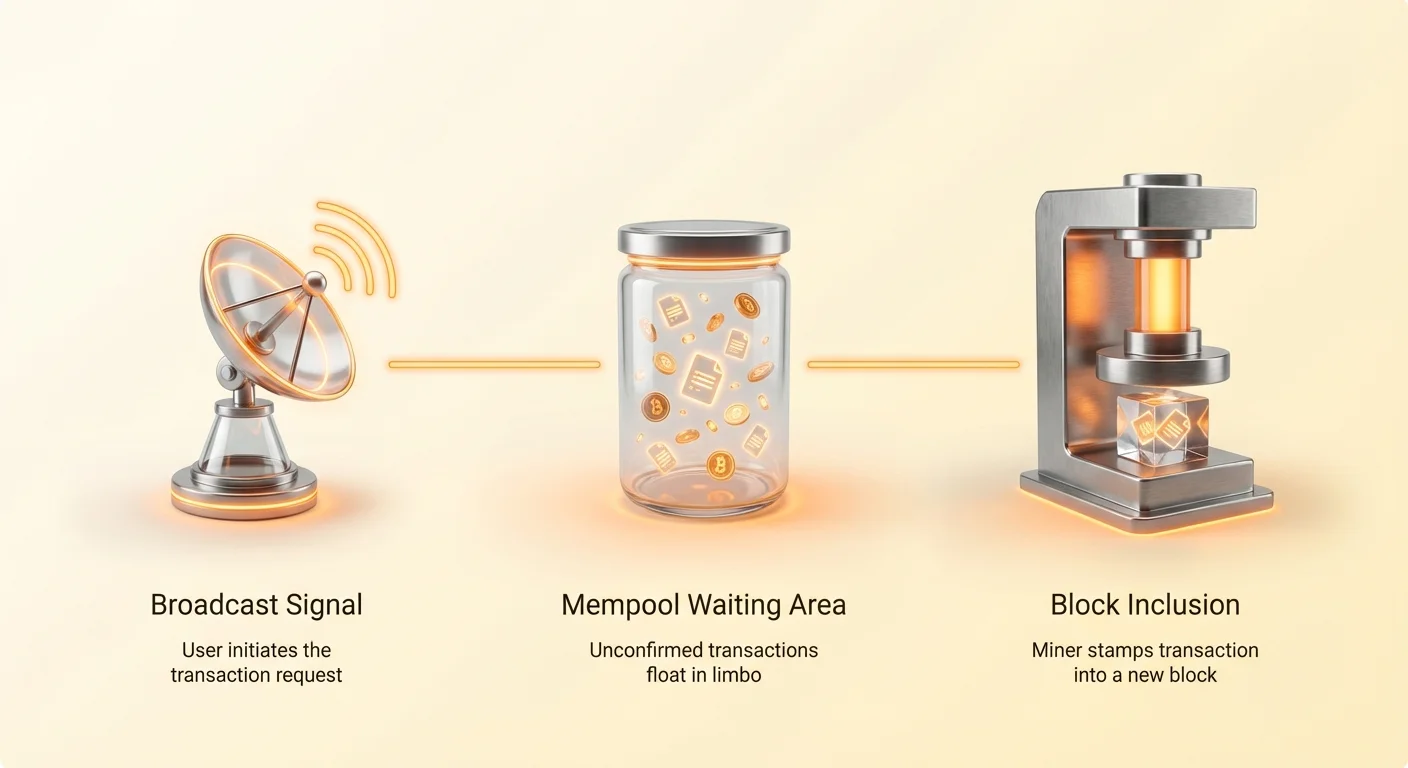
When you initiate a transaction, it does not immediately go into the blockchain. Instead, it enters a waiting area often referred to as the memory pool, or mempool. Here, unconfirmed transactions wait for a miner or validator to pick them up. This is the first step in the journey toward finality. The network participants scan this pool to find valid transactions to bundle into the next block of data.
From Broadcast to Block
Once a miner or validator selects your transaction, they include it in a candidate block. They then perform the necessary work—whether solving a cryptographic puzzle in Proof of Work or attesting to validity in Proof of Stake—to add that block to the chain. When this new block is successfully added to the end of the blockchain, your transaction receives its first confirmation. This is the pivotal moment where the network officially acknowledges the transfer of value.
At this stage, the transaction is technically on the ledger. However, in the world of blockchain, a single confirmation is often considered just the beginning. The network is dynamic, and occasionally, two blocks might be found at the same time, creating a temporary fork. To ensure your transaction is permanently recorded and not on a losing fork, you need more than just one block. You need the weight of the chain to build up behind it.
The Stacking Effect
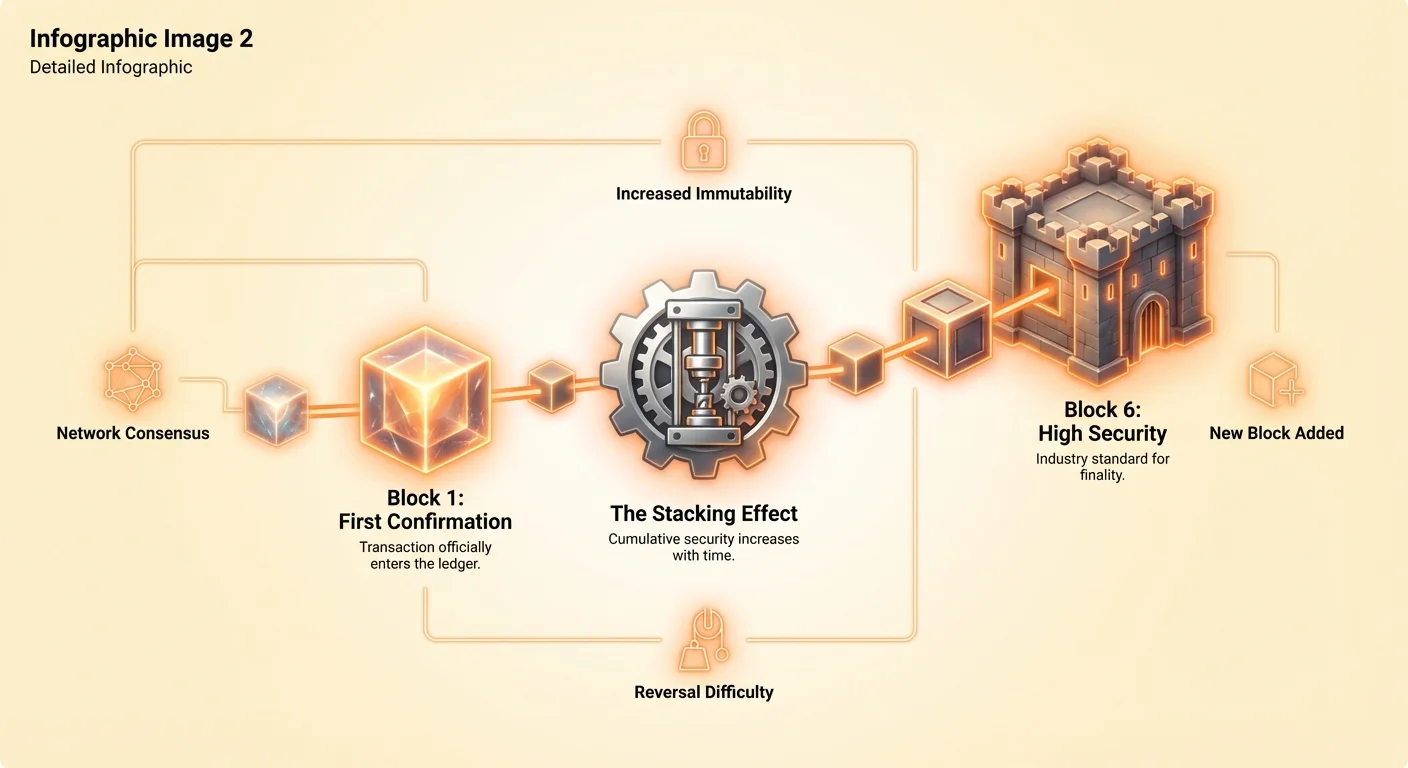
As time passes, new blocks are mined and added on top of the block containing your transaction. Each new block acts as an additional layer of security. When the block immediately following yours is added, your transaction now has two confirmations. When another is added, it has three, and so on. This stacking effect effectively buries your transaction deeper into the blockchain’s history.
The deeper a transaction is buried, the harder it becomes to alter or reverse. Changing a transaction that has ten confirmations would require an attacker to re-do the work for those ten blocks plus every new block being found. This computational effort becomes exponentially difficult and expensive. This accumulation of blocks transforms a reversible digital signal into digital stone, creating the property known as immutability.
Security Against Double-Spending
The primary reason confirmations are necessary is to prevent double-spending. In a physical cash system, you cannot give the same five-dollar bill to two different people at once. Once it leaves your hand, it is gone. In the digital realm, data can be copied. Without a central authority, a bad actor could theoretically broadcast two transactions spending the same coins to two different merchants.
Preventing Reversal Attacks
Confirmations solve this by establishing a chronological order of events that the entire network agrees upon. If a malicious user sends coins to a merchant and then tries to send those same coins to themselves in a different transaction, the network must decide which one is valid. Once a transaction is included in a block and confirmed, the network has chosen the winner. Any conflicting transaction attempting to spend those same inputs will be rejected by the protocol as invalid.
To reverse this "win," an attacker would need to reorganize the blockchain. They would need to create a new, longer chain of blocks that excludes the merchant's transaction and includes their own. This is why merchants wait. If a car dealership hands over the keys after zero confirmations, an attacker could potentially broadcast a conflicting transaction with a higher fee to override the payment. By waiting for multiple confirmations, the dealership ensures the payment is buried too deep to be replaced.
The 51% Attack Scenario
The specific number of confirmations required depends on the difficulty of rewriting the chain. This is often discussed in the context of a "51% attack," where an entity controls the majority of the network's computing power or stake. If an attacker controls 51% of the hash rate, they can rewrite recent history. However, maintaining this control is incredibly expensive for large networks like Bitcoin or Ethereum.
The more confirmations a transaction has, the longer the attacker must sustain this expensive dominance to rewrite history. For a small transaction, one confirmation might be enough risk mitigation. For a transaction worth millions of dollars, the recipient will likely wait for many confirmations. This makes the cost of the attack far higher than the potential gain from stealing the funds.
Time, Speed, and Network Variability
Not all blockchains process confirmations at the same speed. The block time, or the interval between new blocks, varies significantly across different protocols. This fundamental design choice impacts how quickly a transaction achieves finality. It is a trade-off between throughput and synchronization latency across the decentralized network.
Bitcoin’s Ten-Minute Heartbeat
Bitcoin operates with a target block time of approximately ten minutes. This means, on average, a new block is discovered every ten minutes. Consequently, getting a single confirmation takes about ten minutes. To reach the industry standard of six confirmations—often considered the threshold for absolute security on Bitcoin—a user must wait roughly one hour. This deliberate pace helps keep the network synchronized and secure globally.
While an hour might seem slow for a digital payment, it provides an extremely high level of assurance. For high-value settlements, this delay is negligible compared to the days required for traditional bank wires. However, for buying a cup of coffee, waiting an hour is impractical. This limitation has driven the development of faster chains and secondary layers designed for instant commerce.
Ethereum and Proof of Stake Finality
Ethereum and other modern chains operate differently, especially after transitioning to Proof of Stake mechanisms. Ethereum blocks are produced approximately every 12 seconds. This allows for much faster initial confirmations. However, because block production is faster, the probability of temporary forks can be slightly higher in the very short term. As a result, exchanges often require a higher number of confirmations, such as 30 or more, before crediting deposits.
Despite the higher number required, the total waiting time is often shorter than Bitcoin's due to the rapid block intervals. Other networks like Solana or Avalanche use different consensus mechanisms entirely to achieve "sub-second" or near-instant finality. In these systems, transactions are confirmed almost as soon as they are propagated, changing the user experience significantly but requiring different trust assumptions regarding validator centralization.
The Role of Network Fees
Fees play a direct role in how quickly your transaction gets its first confirmation. Since block space is limited, miners and validators cannot include every pending transaction in the very next block. They must prioritize. The primary metric for this prioritization is the fee attached to the transaction.
Bidding for Block Space
You can think of the mempool as an auction house. Users bid for space in the next block by offering a network fee. Miners are economically rational actors; they want to maximize their revenue. Therefore, they fill the block with the transactions paying the highest fees per byte of data. If you pay a high fee, you jump to the front of the line. Your transaction is likely to be included in the very next block.
If you set a low fee, your transaction may sit in the mempool for several blocks, or even hours, until network congestion clears. During periods of high activity, such as a bull market run or a popular NFT mint, demand for block space surges. "Average" fees effectively become too low, and users must increase their bids to get confirmed. This dynamic fee market ensures the network remains functional even under stress, but it forces users to balance cost against speed.
Estimating Gas and Data Costs
In ecosystems like Ethereum, this fee is known as "gas." Gas measures the computational effort required to execute an operation. A simple transfer requires less gas than a complex smart contract interaction. The total fee you pay is the gas limit (amount of work) multiplied by the gas price (cost per unit of work). Users willing to pay a higher gas price incentivize validators to process their complex transactions sooner.
Wallet applications often simplify this by offering presets like "Eco," "Fast," or "Fastest." These settings automatically adjust the fee based on current network conditions. Choosing "Eco" means you are willing to wait for a dip in traffic, potentially delaying that first confirmation. Choosing "Fastest" overpays slightly to ensure immediate inclusion. Understanding these settings prevents the frustration of a "stuck" transaction that stays unconfirmed due to an insufficient fee.
| Fee Tier | Est. Confirm Time | Best Use Case |
|---|---|---|
| Eco/Low | > 60 minutes | Consolidating wallets, non-urgent transfers |
| Standard | ~30 minutes | Regular payments, exchange deposits |
| Fast/High | < 10-20 minutes | Arbitrage, NFT mints, urgent settlements |
Scalability and Layer 2 Solutions
The constraints of Layer 1 blockchains—specifically the balance between decentralization, security, and speed—have led to the rise of Layer 2 solutions. These protocols operate on top of the main chain to provide faster confirmations and lower fees. They change the mechanics of finality for the end user while relying on the base layer for ultimate security.
Off-Chain Processing
Layer 2 solutions, such as the Lightning Network for Bitcoin or Rollups (Optimistic and ZK) for Ethereum, process transactions off the main blockchain. By handling the computation and state updates outside of the congested Layer 1, they can achieve vastly higher throughput. For a user on the Lightning Network, a payment feels instant. There is no ten-minute wait because the transaction is settled between peers in a payment channel.
Similarly, Ethereum Rollups bundle hundreds of transactions together into a single batch. They execute these transactions rapidly on the Layer 2 network. The user receives a confirmation from the Layer 2 sequencer almost immediately. This provides a snappy, web-like experience that is essential for modern decentralized applications and daily payments.
Settlement on the Main Chain
However, there is a nuance to Layer 2 finality. While the transaction is confirmed instantly on the second layer, it is not "finalized" on the main chain until the batch is posted and verified on Layer 1. For most users, the Layer 2 confirmation is sufficient. The security guarantees are high enough that the risk of reversal is negligible.
Yet, strictly speaking, the transaction inherits the full security of Bitcoin or Ethereum only after that settlement occurs. This architecture allows the ecosystem to scale. It reserves the expensive, slow, and ultra-secure block space of Layer 1 for settling large batches of data, while individual users enjoy speed and low costs on the layers above.
Using Blockchain Explorers
Since blockchains are public ledgers, anyone can verify the status of a transaction in real-time. This is done using a tool called a blockchain explorer. These search engines for the blockchain allow you to input a transaction ID (hash) or a wallet address to see exactly what is happening with your funds. This transparency is a key advantage over traditional banking, where a "pending" status often comes with zero visibility.
Tracking Your Transaction
When you search for your transaction ID in an explorer, the most important field to look for is "Status" or "Confirmations." If the transaction is in the mempool, the status will show as "Unconfirmed" or "Pending." This confirms that the network has received your request but has not yet processed it. If this state persists, you can check the "Fee Rate" compared to the network average to see if you paid enough.
Once a miner picks it up, the status changes to "Confirmed," and you will see a block number (height) associated with it. Most explorers will display a counter showing how many confirmations have accumulated since that block was mined. Seeing this number tick upward provides assurance that the funds are secure.
Interpreting Status Messages
Explorers also provide technical details that explain delays. You might see a message about "Network Congestion" or "High Gas Prices." For transactions involving smart contracts, an explorer can show if a transaction failed due to an "Out of Gas" error or a contract logic failure. In these cases, the transaction is technically confirmed (it was processed by a miner), but the outcome was a failure.
Using an explorer is a fundamental skill for crypto users. It removes the mystery of the waiting period. Instead of worrying if funds are lost, a user can verify that the money is simply waiting for a bus (block) that hasn't arrived yet. It empowers users to audit the system independently without relying on customer support.
Smart Contracts and Complex Finality
The concept of finality becomes even more critical when dealing with smart contracts and decentralized finance (DeFi). Unlike sending Bitcoin from Alice to Bob, DeFi transactions often involve complex steps. A single transaction might swap a token, add liquidity to a pool, and stake the resulting receipt token. These operations require significant computational resources from the Ethereum Virtual Machine (EVM).
Because these transactions are complex, they consume more block space and require higher gas limits. If the network is congested, complex transactions are often the first to be priced out if the user does not set an adequate gas cap. Furthermore, the order of transactions in a block matters immensely for DeFi. Front-running bots can manipulate the order to extract value, making the exact moment of confirmation vital for traders.
In this environment, "finality" also implies that the state of the smart contract has effectively updated. Until the transaction is confirmed, a loan is not repaid, or a trade is not executed. Users must interact with these contracts understanding that until the block is mined, market conditions could change. This latency is why high-performance chains are heavily favored for high-frequency trading applications.
Conclusion
Transaction finality is the bedrock of trust in a trustless system. It represents the transition from a mutable request to an immutable record. While the waiting period for block confirmations can feel like an inconvenience in a world accustomed to instant gratification, it is the price paid for decentralized security. By requiring multiple confirmations, the network protects users from fraud, double-spending, and history revision attacks.
Balancing speed, cost, and security is a constant negotiation in the crypto space. Users can pay higher fees for priority or utilize Layer 2 networks for instant throughput. However, understanding the underlying mechanics of blocks and miners helps users navigate these choices confidently. Whether waiting ten minutes for Bitcoin or ten seconds for a rollup, the mechanism ensures that once money moves, it stays moved.
Patience during confirmations is the digital equivalent of waiting for the ink to dry on a permanent contract.