
The conversation surrounding Bitcoin often hits a wall when the topic turns to energy. Headlines routinely declare Bitcoin mining a monstrous waste, consuming more energy than entire nations. For those building a foundational investment thesis around digital assets, this energy debate represents a major systemic risk—or a profound opportunity.
Moving beyond simple FUD (Fear, Uncertainty, Doubt) and superficial consumption comparisons, a deeper analysis reveals that Bitcoin is not merely a consumer of energy but an integrator, stabilizer, and monetizer of the global power grid. From an analyst’s perspective, understanding this utility—how mining interacts with renewable sources, mitigates waste, and enhances grid efficiency—is essential to evaluating the long-term sustainability and systemic resilience of the network.
This analysis shifts the focus from how much energy Bitcoin uses to how it uses it, exploring its efficiency metrics, its role in optimizing renewable energy deployment, and its potential to solve long-standing problems within the traditional energy sector.
I. Defining the Energy Metrics: Moving Beyond Simple TWh
To properly analyze Bitcoin’s energy footprint, we must first discard the misleading metric of absolute consumption (Terawatt-hours, or TWh) and adopt frameworks that measure utility, efficiency, and environmental impact relative to the generated output.
The Problem with Absolute Consumption Figures
When critics state that Bitcoin consumes as much power as a mid-sized country, they are making an accurate numerical comparison but an analytically flawed one.
- Ignoring Utility: Comparing Bitcoin’s TWh consumption to a country’s TWh consumption ignores the fundamental difference in output. A country's energy consumption powers everything from hospitals and manufacturing to lighting and transport. Bitcoin’s energy consumption powers one single global service: the creation of an immutable, decentralized, settlement layer and store of value. The appropriate comparison should be: What is the energy cost of running a global, permissionless, secure monetary network?
- Ignoring Mobility and Flexibility: Unlike traditional industries, data centers, or national grids, Bitcoin mining facilities are highly mobile and flexible. A typical factory must be situated near its input materials or labor, and a city grid must supply power continuously, regardless of cost. Miners, however, seek out the absolute cheapest power available, which is often excess, stranded, or renewable power that conventional consumers cannot access.
Introducing Energy Intensity vs. Energy Utility
A crucial step in analysis is distinguishing between energy intensity and energy utility.
Energy Intensity measures the amount of energy used per unit of output (e.g., Watts per transaction). While mining has a high energy intensity per secured block, this metric is often misapplied. Bitcoin’s energy is securing the entire network’s $1+ trillion market capitalization and all existing transactions, not just the single transaction currently being processed. Therefore, the energy cost is best viewed as the cost of security and immutability for the entire ledger.
Energy Utility measures the beneficial societal or economic output generated by the energy use. For Bitcoin, the utility is:
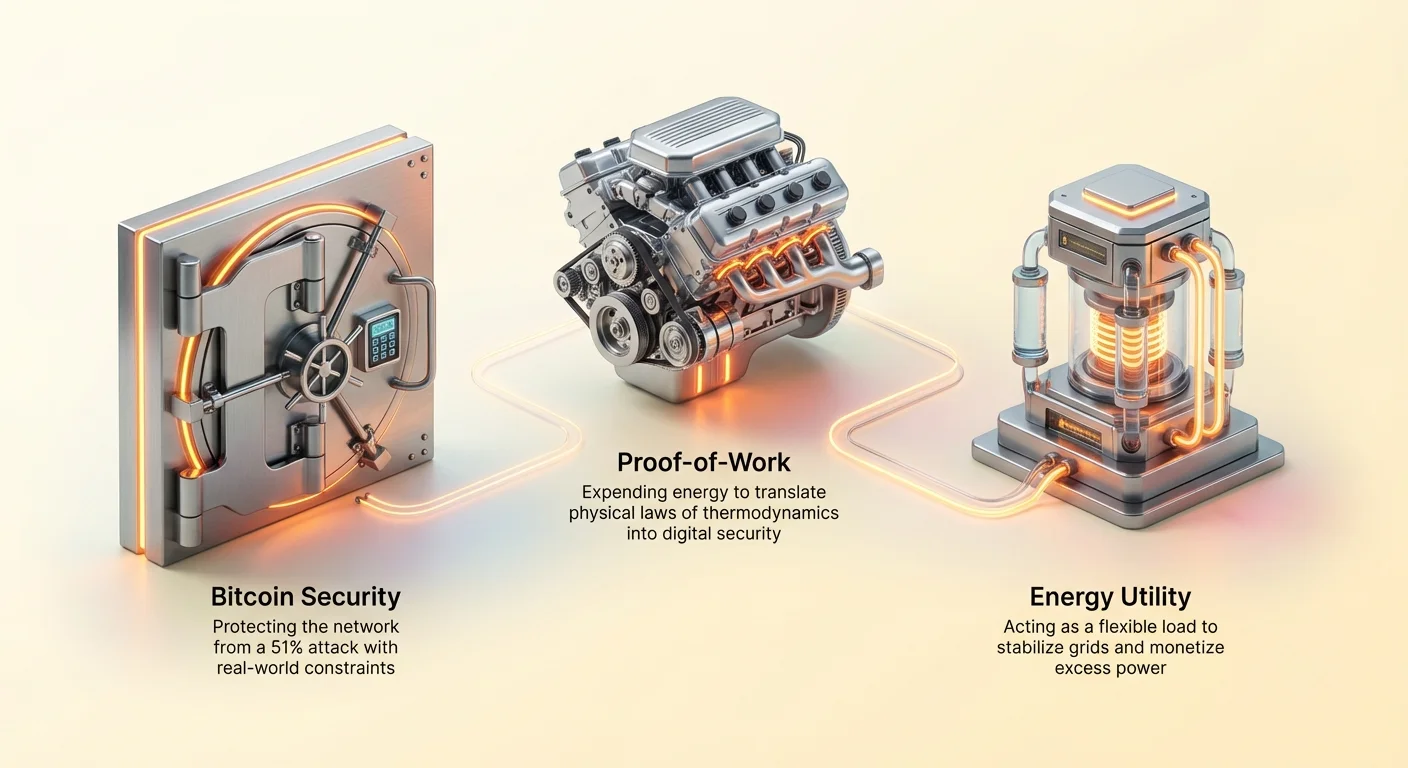
- Security: Protecting the network from a 51% attack.
- Decentralization: Providing geographically distributed infrastructure independent of political jurisdiction.
- Monetization: Converting otherwise wasted or stranded energy into globally liquid capital (BTC).
The Importance of the Marginal Cost of Energy
Bitcoin mining has a unique economic relationship with electricity markets: it is generally indifferent to the source of the energy, caring only about the price.
In modern electricity markets, the price of power varies dramatically by location and time. When demand is low (e.g., the middle of the night) or when renewable generation is abundant (a sunny, windy day), power prices can drop to zero, or even become negative (meaning the grid pays consumers to take the excess power to prevent overloads).
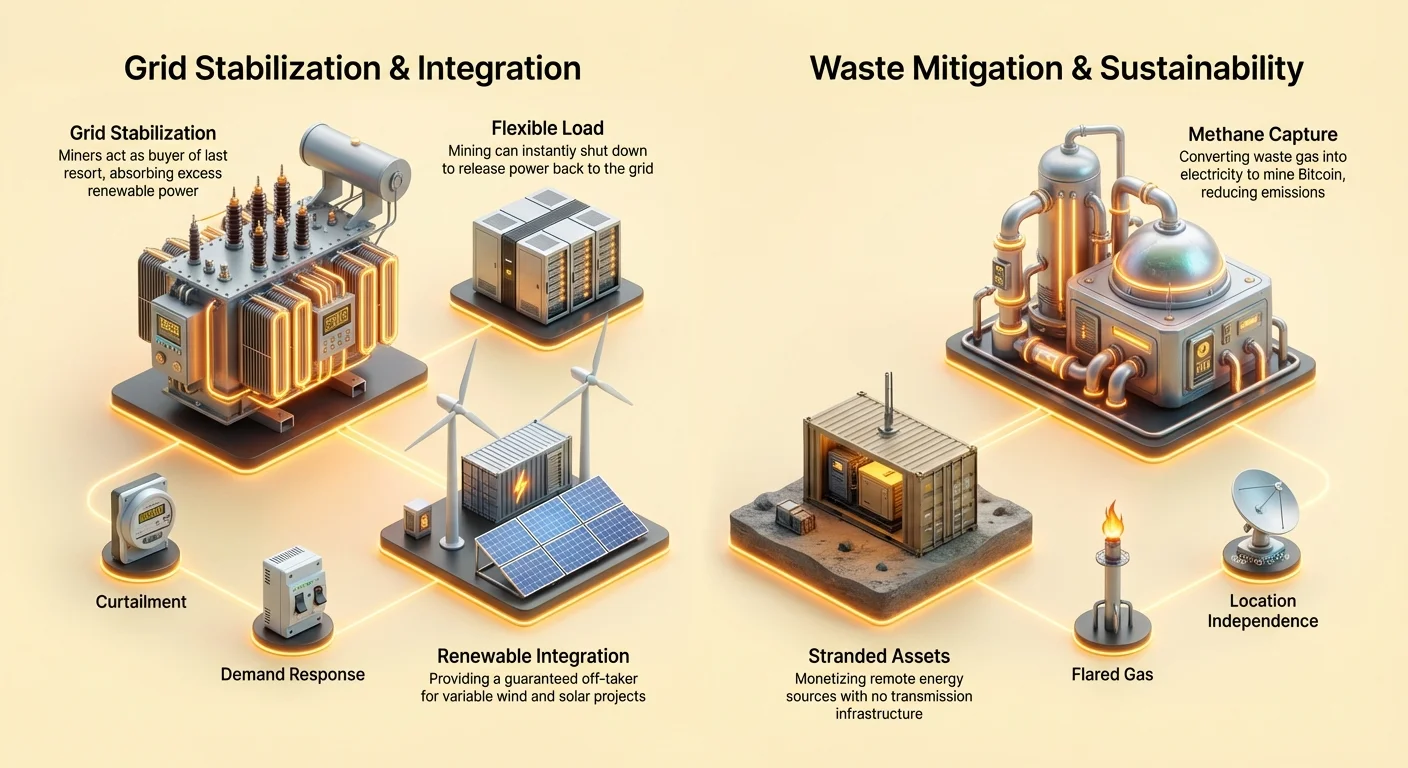
Bitcoin miners act as the buyer of last resort for this cheap, marginal, or surplus power. This means that, statistically, Bitcoin mining disproportionately utilizes electricity that conventional residential or industrial users cannot or will not consume, ensuring that it is often the greenest megawatt on the grid that is being utilized. This tendency naturally incentivizes miners to locate near and utilize renewable sources, which frequently produce periods of excess, low-cost power.
II. Deconstructing Proof-of-Work (PoW) Efficiency
The Proof-of-Work mechanism, invented by Satoshi Nakamoto, requires specialized computing hardware (ASICs) to expend energy guessing a cryptographic solution. This required expenditure of real-world resources (electricity and hardware) is the core mechanism that secures the network. Understanding the efficiency of this expenditure is paramount.
Analyzing Proof-of-Work’s Energy Return on Investment (ROI)
The ROI of PoW is not measured in transactions per second (TPS), but in network security per dollar of energy spent.
A highly successful 51% attack—where a bad actor controls more than half of the network’s hashing power—would destroy confidence and likely destroy Bitcoin’s value. The cost of preventing this attack is the energy required to compete with every other miner globally. The total energy expenditure acts as a security moat.
The Economic Feedback Loop:
- High BTC Price: The reward for mining (block subsidy + fees) increases.
- Increased Mining Revenue: More miners are incentivized to join the network.
- Increased Hashrate (Energy Usage): Competition intensifies, making the 51% attack exponentially more expensive.
- Increased Security: The network is more resilient, justifying the high BTC price.
The ROI is the value of the immutable, uncensorable settlement network relative to the physical cost of maintenance. From a macroeconomic perspective, if Bitcoin secures trillions of dollars in wealth and enables a global, trustless economy, the energy cost (even if measured in TWh) is negligible relative to the value created—a concept often overlooked by critics focusing only on the input cost.
Why Energy is Necessary for Security
Unlike Proof-of-Stake (PoS) systems, where security is derived from staking capital (digital ownership), PoW security is derived from real-world, physical constraint (energy expenditure).
Energy is the only resource that satisfies two essential criteria for securing a truly decentralized network:
- Scarcity and Fungibility: Energy is a universally measurable and fungible commodity. It cannot be counterfeited, and consuming it requires real-world industrial expenditure.
- Difficulty of Attack Scaling: To maintain a 51% attack, an attacker must acquire and continually pay for more energy than the rest of the honest network combined, indefinitely. This means buying real hardware, securing land, establishing power purchase agreements, and continuously paying electricity bills—a sustained, massive operational expenditure (OpEx) that dwarfs the cost of buying and staking digital tokens, making the attack economically suicidal.
In essence, PoW translates the physical laws of thermodynamics into digital security. The energy is not "wasted" but used to enforce scarcity and integrity.
The Global Energy Mix and Carbon Footprint Calculation
Calculating Bitcoin’s exact carbon footprint is challenging due to the difficulty in gathering real-time, granular data on where miners are actually plugged in. However, continuous research (notably by institutions like the Bitcoin Mining Council) provides general trends.
The common misconception is that miners are primarily using fossil fuels. While coal and gas remain a part of the global energy mix utilized by miners, the economic incentives steer miners heavily toward renewables:
- Low Operating Costs: Renewable energy sources (hydro, solar, wind) have high capital costs but near-zero operating fuel costs. This means that once built, the marginal cost of excess renewable power is incredibly low, making it ideal for the highly price-sensitive mining industry.
- Geographical Concentration: A significant portion of mining activity has historically gravitated towards areas with cheap, abundant hydroelectric power (e.g., Sichuan Province in China before the 2021 ban, and currently regions like Quebec, Washington State, and Paraguay).
Studies suggest that Bitcoin mining utilizes a renewable energy mix that is significantly higher than the global average power grid (which hovers around 40-45% non-fossil fuel sources, including nuclear). This rapid adoption of renewables is driven purely by profit-seeking behavior, making Bitcoin a market mechanism accelerating the shift towards greener energy.
III. Bitcoin as the "Buyer of Last Resort" for Power Grids
The most compelling utility argument for Bitcoin mining is its symbiotic relationship with electricity grids, particularly those reliant on variable renewable energy sources (VRES). Bitcoin mining capacity offers a dynamic, flexible load that traditional industry cannot match, effectively optimizing existing infrastructure.
Stabilizing Variable Renewable Sources (Wind and Solar Integration)
Wind and solar power are environmentally excellent but suffer from intermittency—they generate power when the sun shines or the wind blows, not necessarily when demand is high. This creates grid instability:
- Curtailment Risk (Wasting Power): If renewable generation exceeds local demand, the grid must either store the excess power (expensive battery storage) or pay to curtail it (turn off the wind turbines or solar panels). This wastes clean energy and makes the renewable project less financially viable.
- Grid Overload: Excessive, unabsorbed power can destabilize frequency and voltage, potentially leading to blackouts.
Bitcoin miners solve this problem by acting as a non-time-specific, interruptible load.
When a wind farm produces surplus energy at 3 AM that no city needs, the miner acts as a guaranteed customer, turning the excess clean power into revenue. If the grid suddenly needs that power at 7 AM when everyone wakes up, the mining facility can shut down instantaneously (a "demand response" event), releasing the power back to residential consumers.
This continuous, instant demand stabilizes the grid frequency, reduces renewable energy curtailment, and makes VRES projects more bankable because they have a guaranteed off-taker for their excess production.
Monetizing Stranded Energy Assets
"Stranded energy" refers to power generated in locations where transmission infrastructure to carry that power to end-users is uneconomical or non-existent.
Examples of Stranded Energy:
- Remote Hydro Dams: Large hydroelectric facilities built in remote areas (e.g., rural Latin America or central Asia) may have substantial excess capacity because local populations are small and transmission lines to major cities are too expensive to build.
- Geothermal/Gas Fields: Energy production in remote oil and gas fields or geothermal sites far from populated areas.
Before Bitcoin, this energy was often wasted or required massive, decade-long infrastructure projects to utilize. Now, miners can deploy specialized containers directly on-site. They consume the electricity generated from the stranded asset, and their output—Bitcoin—is transported wirelessly via satellite or internet connection.
This utility turns a liability (stranded asset) into a profitable revenue stream, often funding the initial construction or maintenance of the clean energy generator itself. This accelerates the construction of clean energy in remote locations.
Load Balancing and Demand Response Mechanics
Demand Response (DR) is the mechanism grids use to manage peak demand. If temperatures soar in a city and everyone turns on their air conditioning, the utility company needs extra power fast to prevent outages.
Traditional DR programs pay businesses to temporarily shut down during peak hours. Bitcoin miners are ideal participants in DR programs for several reasons:
- Scalability: A single large mining farm can draw hundreds of megawatts, offering massive capacity for immediate load shedding.
- Interruptibility: Unlike hospitals or manufacturing plants, mining can be instantly and safely interrupted without causing physical damage or operational complexity.
- Revenue Stream: DR payments, combined with revenue from consuming cheap off-peak power, provide the miner with a continuous, dual revenue stream, making their operations incredibly resilient across different energy price cycles.
By providing massive, instantaneous, and flexible load absorption, Bitcoin mining transforms electricity into a financial product that helps energy companies manage risk and optimize delivery.
IV. Advanced Sustainability Use Cases: Methane and Flared Gas
Perhaps the most tangible environmental benefit derived from Bitcoin mining comes from its application in mitigating the release of harmful greenhouse gases, specifically flared methane. This use case moves Bitcoin from carbon neutral to potentially carbon-negative in specific localized applications.
Turning Waste into Wealth: Flared Methane Capture
In the oil and gas industry, extracting petroleum often results in the concurrent extraction of natural gas, a large component of which is methane. If the volume of methane is insufficient to justify building a pipeline to transport it, or if regulatory environments are lax, producers historically resorted to "flaring"—burning the gas off at the wellhead.
Flaring is highly inefficient and releases carbon dioxide (CO2) into the atmosphere. Worse, sometimes the gas is simply vented (released directly into the atmosphere without burning). Methane is an extremely potent greenhouse gas, approximately 25 to 80 times more effective at trapping heat than CO2 over a 20-year period.
The Bitcoin Solution:
Miners set up specialized, sealed generators (often in shipping containers) directly at the wellhead. They pipe the methane (which would have been flared or vented) into the generator, converting the chemical energy into electricity. This electricity is immediately consumed by the ASICs to mine Bitcoin.
- Eliminating Waste: The methane, previously a financial liability (a waste product requiring disposal), becomes a financial asset (fuel for profit).
- Increased Efficiency: Burning methane in an industrial generator is a far cleaner and more complete combustion process than flaring it in an open flame. This dramatically reduces the release of uncombusted methane.
The economic incentive flips the script: instead of paying to pollute (or wasting a resource), the oil producer profits by converting their waste product into a globally marketable digital asset, accelerating the deployment of these methane mitigation systems.
Environmental Benefits of Methane Capture
The environmental ROI of Bitcoin-powered methane capture is profound. Studies have shown that a Bitcoin mining operation using captured methane significantly reduces the net carbon impact of the energy site compared to traditional flaring.
By capturing and combusting the gas more effectively, the project achieves two goals:
- Reduces Global Warming Potential: Replacing potent methane release with significantly less potent CO2 release (a necessary byproduct of electricity generation) results in a massive net reduction in equivalent CO2 emissions.
- Improves Local Air Quality: Complete combustion reduces smog and other localized pollutants associated with inefficient open flaring.
This utility demonstrates Bitcoin mining not as a burden on global sustainability, but as an elegant, market-driven mechanism for environmental remediation in the fossil fuel industry.
Geothermal and Hydro Optimization
Beyond methane capture, mining serves to optimize other specific renewable energy resources:
Geothermal Energy: Geothermal plants (which draw heat from the Earth's core) often operate continuously, regardless of grid demand, due to the difficulty of cycling their output. When grid demand is low, this power is often curtailed. Miners provide a continuous, high-volume baseline load for these plants, ensuring they operate at maximum efficiency and profitability, justifying further investment in geothermal expansion.
Micro-Hydro and Seasonal Power: Small, isolated hydroelectric power installations (micro-hydro) or seasonal hydro power (like snowmelt runoff) often have limited transmission capacity. Bitcoin mining provides a predictable, stable revenue stream for these producers, allowing them to monetize excess power during peak seasonal flows without needing massive, expensive transmission line upgrades.
V. Future Trajectories and Investment Implications
Understanding Bitcoin's role in the energy sector is critical for establishing a long-term investment thesis. The future value proposition of Bitcoin is increasingly tied not just to its monetary properties (digital gold) but to its industrial utility as a mechanism for energy independence and optimization.
Regulatory Risks and Geographical Decentralization
The energy debate is often politicized, leading to regulatory risk. Proposals to ban Proof-of-Work, or to apply punitive taxes on mining operations, represent a genuine threat to the network’s operational stability.
However, the trend toward geographical decentralization mitigates this risk. Following the Chinese ban on mining in 2021, hashrate rapidly dispersed globally to jurisdictions offering the cheapest, and often cleanest, energy (e.g., the US, Canada, Russia, and Central America).
Investment Implication: Decentralization enhances the network’s antifragility. When miners spread across varied political systems and diverse energy sources, a localized regulatory shock (like a regional ban) cannot cripple the network. This spreading reduces single points of failure, increasing confidence in Bitcoin’s long-term security guarantee.
The Shift to Renewable Energy Dominance
The economic incentives embedded within PoW ensure a continuous pressure on miners to seek the lowest-cost energy, which is increasingly renewable energy. As renewable technology costs continue to fall (due to falling solar panel and wind turbine costs), and as battery storage remains prohibitively expensive for grid-scale surplus management, Bitcoin mining will become the primary utility used to balance and monetize these massive variable energy flows.
The Economic Engine: Bitcoin mining acts as the venture capital arm of the renewable energy sector. By providing a guaranteed, flexible buyer for power in remote locations, miners unlock the economic viability of green projects that traditional finance would deem too risky or remote.
As institutional capital (ETFs, corporate treasuries) continues to flow into Bitcoin, the narrative shifts from simply being a volatile asset to being a foundational piece of the future, decentralized, energy infrastructure.
Zaključek
Razprava o porabi energije Bitcoina je v bistvu razprava o njegovi uporabnosti. Gledano skozi lečo finančnega analitika energija, porabljena s strani omrežja, ni zapravljivi izdatek, temveč ključni operativni strošek, potreben za ohranjanje varnosti, nespremenljivosti in globalnega dosega bilijonskega decentraliziranega monetarnega sistema.
Poleg tega edinstvene ekonomske lastnosti Bitcoina ustvarjajo močne spodbude, ki usklajujejo profitne motive z okoljsko trajnostjo. Z zagotavljanjem takojšnjega, prilagodljivega povpraševanja rudarji stabilizirajo obnovljiva omrežja, monetizirajo osamljena sredstva in ponujajo močno rešitev za zmanjševanje okoljskega vpliva zgorevanega metana.
Dolgoročna teza je jasna: Bitcoin se razvija dlje od svoje začetne opise kot "digitalno zlato". Postaja bistveni sestavni del globalne energetske infrastrukture, ki uporablja tržne sile za pospeševanje učinkovitosti, optimizacije omrežja in uvedbe čistejših, cenejših virov energije po svetu. Ta industrijska uporabnost krepi njegovo sistemske odpornosti in zagotavlja njegovo bistveno vlogo v digitalni ekonomiji v prihodnje.