
Dobrodošli v digitalno gospodarstvo. V tradicionalnem finančnem svetu lastništvo določa banka ali institucija, ki hrani vaša sredstva. Oni upravljajo knjige, nadzorujejo dostop in določajo pravila. Kriptovaluta deluje na fundamentalno drugačnem principu: samo-suverenost.
Da se boste orientirali v tej novi krajini, se morate najprej obvladati koncept kripto denarnice. Za razliko od fizičnih denarnic, ki jih nosimo v žepih, kripto denarnica ne hrani dejansko digitalnih sredstev. Namesto tega je prefinjeno orodje, ki upravlja kriptografske skrivnosti – ključe –, ki vam dajejo absolutni nadzor nad vašimi sredstvi, zapisanimi v javni knjigi.
Ta vodnik služi kot vaša temeljna lekcija o zavarovanju vaših sredstev. Razkrijemo ključno razmerje med zasebnimi ključi, javnimi ključi in naslovi, raziščemo mehaniko podpisovanja transakcij in definiramo varnostni spekter različnih vrst denarnic. Razumevanje teh konceptov ni opcionalno; je predpogoj za uveljavljanje prave finančne lastnine v decentraliziranem svetu.
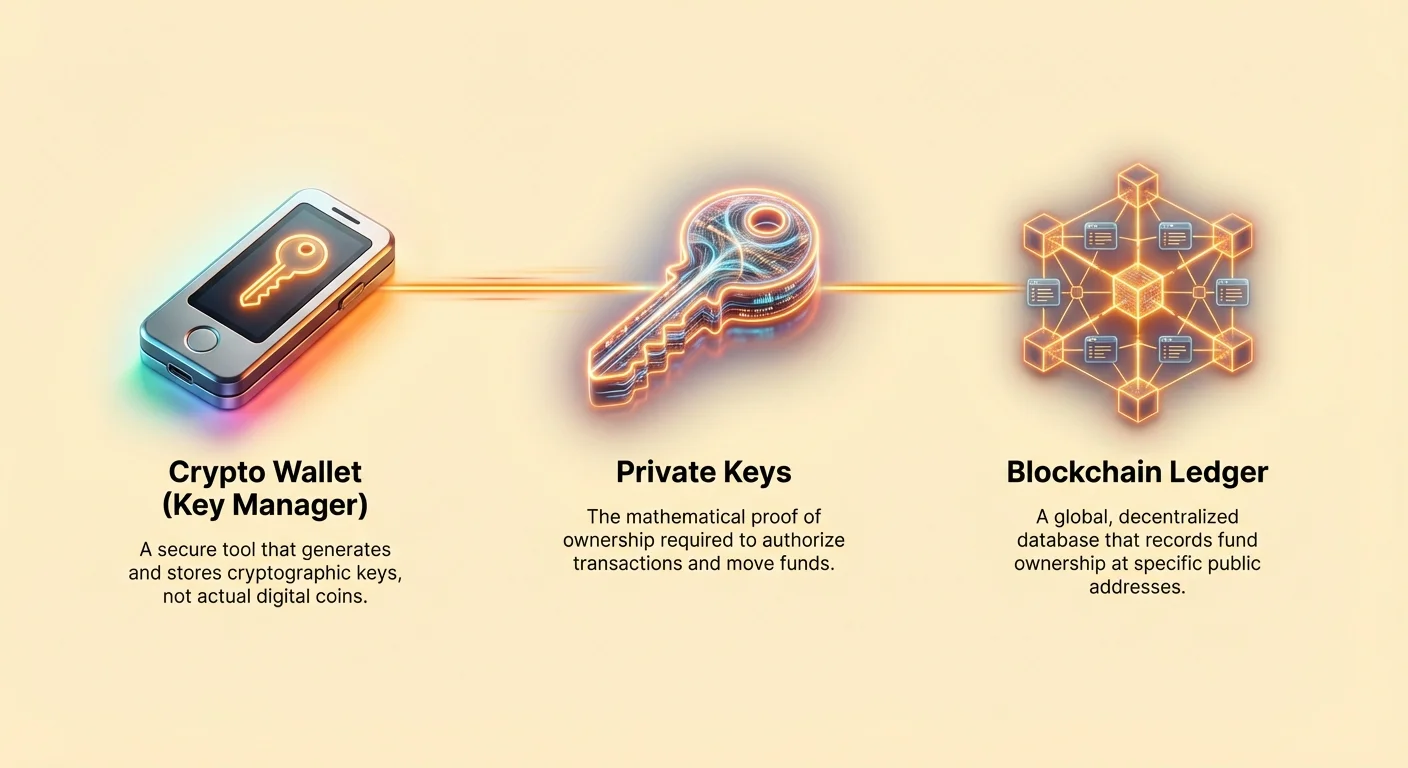
The Core Misconception: Wallets Do Not Store Crypto
The term "crypto wallet" is a deeply misleading metaphor derived from the traditional world. If you open a Bitcoin wallet and look inside, you won't find digital coins residing there. This realization is the single most important conceptual shift a newcomer must make.
If the coins aren't in the wallet, where are they?
The Blockchain Reality
All cryptocurrencies, such as Bitcoin (BTC) or Ethereum (ETH), exist solely as entries on a public, decentralized, and immutable database known as the blockchain. Think of the blockchain as a global, transparent bank ledger. This ledger records every transaction ever made.
When you "receive" Bitcoin, the network merely records an entry stating that a specific amount of BTC is now associated with a unique identifier, called your public address. These assets are not physically moved or stored in a file; they are simply registered at that address on the public ledger.
The Wallet’s True Purpose: Managing Access
Since the assets are permanently on the blockchain, the wallet’s job is much simpler, yet far more critical: it manages the complex cryptographic tools required to prove ownership and authorize spending from those addresses.
A crypto wallet is essentially a key manager.
It uses powerful cryptography to generate, store, and manage your private keys. These private keys are the mathematical proof of ownership required to move the associated assets on the blockchain ledger. If you lose your keys, you lose access to your funds, even though the assets remain perfectly recorded on the blockchain.
The Seed Phrase: The Master Key
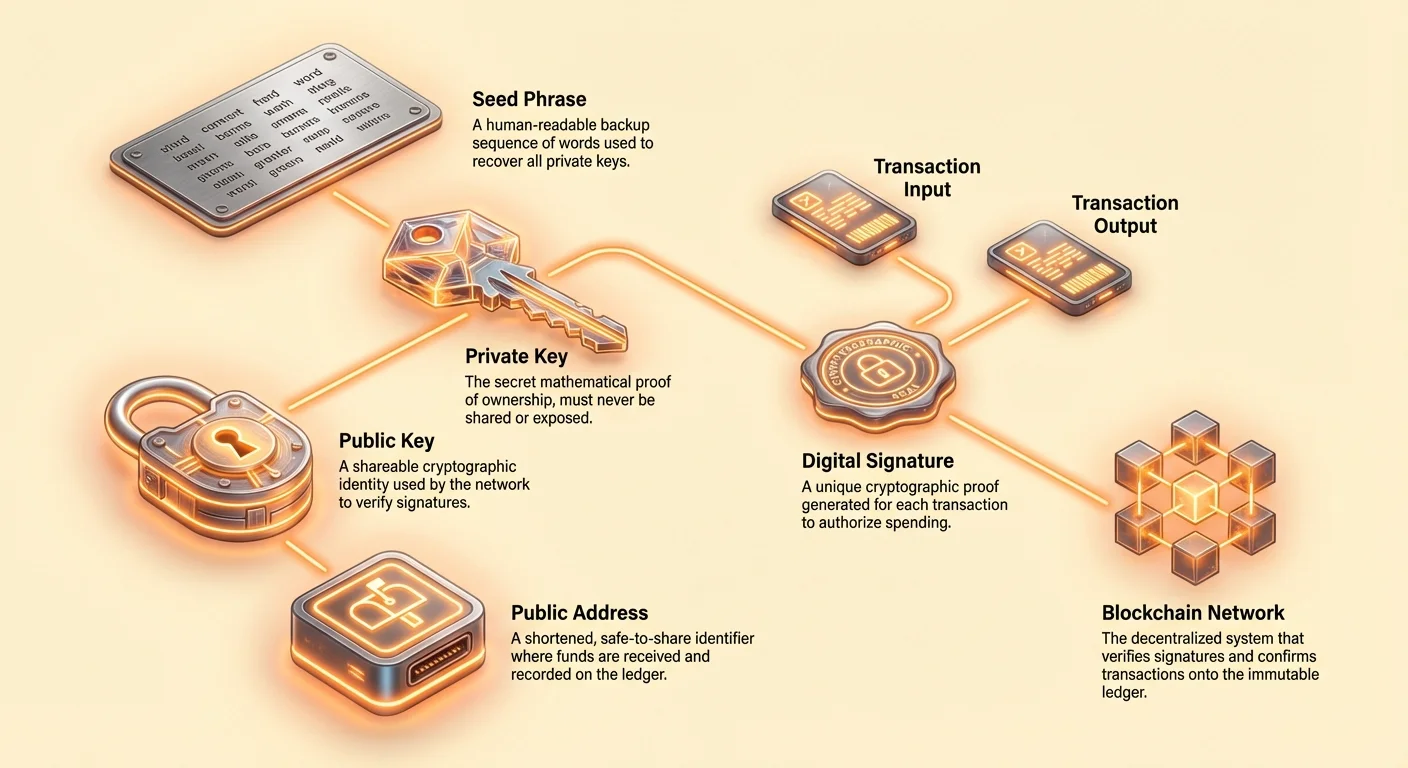
Most modern self-custody wallets do not require you to write down hundreds of individual private keys. Instead, they use a Seed Phrase (or Mnemonic Phrase)—typically a sequence of 12, 18, or 24 common words—to generate all your private keys.
This Seed Phrase is the absolute master secret. It is derived using standardized algorithms (like BIP39) and allows your wallet to mathematically re-create every private key and public address you own.
- Actionable Tip: If you lose your device, your wallet application, or your computer crashes, you can recover all your assets by entering this Seed Phrase into any compatible wallet application, instantly restoring your access.
The Pillars of Ownership: Cryptography and Keys
To understand how ownership is proven and transactions are authorized, we must break down the three fundamental components of every crypto account: the Private Key, the Public Key, and the Address.
The Private Key: The Ultimate Secret
The Private Key is a large, mathematically random number (often 256 bits long) that functions as your digital signature authority. It is the single most important piece of information in the cryptocurrency world.
Key Characteristics:
- Secret: It must never be shared, stored digitally in the cloud, or typed where it can be seen. Exposure of the private key means immediate and complete loss of funds.
- Proof of Ownership: Only the holder of the private key can mathematically generate the digital signature required to authorize a transaction (i.e., move coins) from the associated address.
- Self-Custody Core: When people talk about "self-custody," they mean you, and only you, possess and control this private key (or the Seed Phrase that generates it).
Think of your Private Key as the password to your global, immutable, and irreversible bank account.
The Public Key: The Verifiable Identity
The Public Key is mathematically derived from the Private Key using a special one-way cryptographic function (specifically, Elliptic Curve Digital Signature Algorithm, or ECDSA, in the case of Bitcoin).
Key Characteristics:
- Public: This key is designed to be shared. It verifies that a transaction was signed by the legitimate Private Key holder without revealing the Private Key itself.
- Verification: When a transaction is broadcast to the network, the Public Key is used to confirm that the Private Key generated the correct signature.
- One-Way Street: It is mathematically impossible (within the constraints of current technology) to reverse-engineer the Private Key just by knowing the Public Key.
Think of the Public Key as your digital fingerprint that the network uses to verify your signature.
The Address: The Mailbox
The Public Address is the identifier you share with others when you want to receive cryptocurrency. It is a shortened, user-friendly, and often highly encrypted version of the Public Key.
Key Characteristics:
- Destination: This is the identifier recorded on the blockchain ledger, showing where the assets are registered.
- Receiving Only: Addresses are designed purely for receiving funds. Sharing your address carries zero security risk.
- Streamlined: Addresses are designed to be shorter and safer to transmit than the full Public Key, reducing complexity and potential human error.
Think of the Address as your unique mailbox number. Anyone can send mail to it, but only the person holding the correct key can open the box and retrieve the contents.
The Key Relationship: Linking Private, Public, and Address
The security of cryptocurrency relies entirely on the powerful, one-way mathematical relationship between these three components. This relationship ensures that while your address is public, your ability to spend the assets tied to it remains completely private.
The Mathematical Hierarchy (The Funnel)
The generation process flows in a single, irreversible direction:
- Seed Phrase to Private Key: The Seed Phrase is fed through a cryptographic standard (often following BIP standards) to generate a massive list of individual private keys.
- Private Key to Public Key: The Private Key is run through the one-way ECDSA algorithm to generate the associated Public Key.
- Public Key to Address: The Public Key is run through a hashing function to create the shorter, human-readable Public Address.
Why this matters: Because the relationship is a one-way mathematical funnel, you can safely give out your Public Address without fear of someone tracing it backward to your Private Key. This is the cryptographic engine of decentralized financial security.
A Real-World Analogy: The Secure Locker
Imagine you are using a secure locker system:
| Crypto Component | Analogy | Function | Security Requirement |
|---|---|---|---|
| Private Key | The Physical Key | Opens the locker and authorizes access. | Keep secret (Self-Custody). |
| Public Key | The Lock Mechanism | Allows anyone to verify the correct key was used, but tells them nothing about the key itself. | Can be shared (Used for verification). |
| Address | The Locker Number | The location on the wall where assets are registered. | Can be shared (Used for receiving funds). |
| Blockchain | The Global Ledger | The record proving what is inside Locker #X. | Fully public and transparent. |
Securing Value: How Transactions Work
The actual process of spending cryptocurrency requires the private key to perform a cryptographic function called "signing." This process is crucial to understanding why the wallet needs access to your keys.
Initiating a Transaction
When you decide to send crypto, your wallet software performs three essential steps:
- Input Selection: The wallet identifies the assets on the blockchain ledger that are registered to your address. These assets (often called Unspent Transaction Outputs, or UTXOs in Bitcoin) are your inputs.
- Output Definition: The wallet structures the transaction data, defining the amount you want to send and the destination public address.
- Preparation for Signing: The wallet prepares a raw transaction message that needs authorization before it can be broadcast to the network.
The Signing Process: Proof by Cryptography
Authorization does not involve typing a password; it involves mathematical proof.
When you hit "Send," your wallet uses the Private Key to generate a unique, cryptographically secure digital signature based on the specific details of that raw transaction message (e.g., recipient address, amount, date).
- Immutability: If even a single digit in the transaction details (the amount, the recipient address, etc.) were changed, the generated signature would become invalid. This guarantees that the authorized transaction cannot be tampered with in transit.
- Irreversibility: Once the Private Key signs the transaction, the authorization is final and cannot be undone by any central authority.
Verification and Broadcasting
After the signature is generated, the complete transaction package (the raw message + the digital signature + the Public Key) is broadcast across the decentralized network (the miners/validators).
- Verification: Every node that receives the transaction uses the sender's Public Key to quickly and efficiently verify that the signature was legitimately generated by the corresponding Private Key. They do this without ever seeing the private key.
- Confirmation: If the signature is valid, and the sender has sufficient funds registered to their address, the transaction is bundled into a block and confirmed onto the blockchain.
- New Registration: The assets are now no longer registered to the sender’s address; they are registered to the recipient’s address. The coins haven't moved; only the ownership record on the ledger has changed.
The Wallet Spectrum: Hot Storage vs. Cold Storage
Not all key managers (wallets) are built equally. They are defined primarily by their connection to the internet, which determines their security risk profile. This distinction is the core of crypto security and defines the Custody Spectrum.
Hot Wallets: Speed and Convenience
A Hot Wallet is any wallet application or storage method that is connected to the internet, either constantly or frequently.
| Type | Description | Use Case | Risk Profile |
|---|---|---|---|
| Software Wallets | Applications (mobile or desktop) where the keys are stored on the user's internet-connected device. | Daily spending, small transfers, interacting with DeFi apps. | High risk of hacking, malware, and phishing if the device is compromised. |
| Exchange Wallets (Custodial) | The exchange manages your private keys on your behalf. | Trading, short-term liquidity, and services that require high-speed access. | High risk of counterparty failure (if the exchange is hacked or goes bankrupt). This sacrifices self-sovereignty. |
Hot wallets offer speed and accessibility, which are perfect for smaller amounts used for daily activities ("pocket change"). However, their constant connection exposes them to online threats.
Cold Wallets: Security and Insulation
A Cold Wallet is any wallet where the private keys are stored entirely offline, never touching an internet-connected device. This separation from the online world makes them significantly more resilient against hacking and remote attacks.
| Type | Description | Use Case | Security Profile |
|---|---|---|---|
| Hardware Wallets | Physical, specialized electronic devices (like a secure USB stick) designed solely to hold and isolate private keys. | Storing large amounts of value ("long-term savings" or "the vault"). | Keys never leave the device, even when signing transactions. Excellent security. |
| Paper Wallets | Keys physically written or printed out and stored in a secure location (e.g., a safe). | Legacy storage method; high risk of physical damage, but keys are fully air-gapped. | Physical security is paramount; requires extreme caution when sweeping funds. |
Cold wallets are considered the standard for long-term storage because the keys remain inaccessible to online threats. They function like an offline vault for your financial assets.
Choosing Your Tool
The choice between a hot and cold wallet depends entirely on your risk tolerance and the amount of value being stored:
- Hot Wallets are best for funds you need instant access to (like cash in your regular physical wallet).
- Cold Wallets are essential for protecting the majority of your savings (like assets stored in a safety deposit box).
Effective security involves using both—segregating your funds based on your immediate needs.
Essential Security Practices for the Digital Vault
The responsibility of key management shifts from a bank to you. This is the price and privilege of financial sovereignty. Implementing simple, non-negotiable security practices is critical to protecting your digital vault.
1. Guard Your Seed Phrase Above All Else
The Seed Phrase is the human-readable backup of your Private Key. It is the single point of failure for your entire crypto portfolio.
- Never Digitize It: Do not take a photo of your Seed Phrase, type it into a computer, store it in a cloud service (Dropbox, Google Drive), or send it via email. These actions turn cold storage into hot storage instantly and make it vulnerable to remote attack.
- Use Durable Storage: Write the phrase down using archival pens on paper, or, ideally, etch or stamp it onto fire- and flood-resistant material (like metal plates) and store it in multiple, secure, offline physical locations.
- Verify Your Backup: When setting up a new wallet, always confirm your backup before depositing significant funds. Many hardware wallets offer a backup verification feature.
2. Practice Threat Modeling 101
Threat modeling involves asking: "Who or what is likely to try to steal my funds, and how?"
| Threat Category | Example Method | Prevention Strategy |
|---|---|---|
| Remote Attack | Malware, Phishing, Keyloggers. | Use cold storage for savings; never enter seed phrases online; use a strong password manager for exchange accounts. |
| Physical Attack | Theft of device, fire, flood. | Store metal backups in geographically separate, secured locations (e.g., a home safe and a separate bank deposit box). |
| Human Error | Losing the seed phrase, sending funds to the wrong address. | Double-check addresses; use small test transactions; set up multisig if managing extremely high value. |
3. Understand the Dangers of Centralized Custody
While centralized exchanges (CEX) offer the convenience of holding your keys for you (custodial wallets), this sacrifices the core promise of cryptocurrency: self-sovereignty.
The Risk: If you leave your funds on an exchange, you are trusting that the exchange:
- Will not be hacked (losing your funds).
- Will not freeze your account (preventing access).
- Will not become insolvent (going bankrupt).
When you hold your own private keys (self-custody), the only person who can lose your assets is you. This removes the risk associated with relying on a third party.
4. Separate Your Keys and Your Funds
A best practice is to never keep a large sum of value on a device or platform that you use for everyday activities.
- Strategy: Use a secure, air-gapped Cold Wallet for 90% of your savings. Use a Hot Wallet (mobile or desktop) for the 10% you intend to trade or spend. This compartmentalizes your risk, ensuring that a security breach on your phone only compromises the "pocket change" amount.
Conclusion: The Path to Self-Sovereignty
The crypto wallet is the interface to your future financial freedom. By understanding that the wallet manages keys—not coins—you move past the common misconceptions and grasp the cryptographic engine that powers true ownership.
The Private Key is the centerpiece of your security. Mastering its management, diligently backing up the Seed Phrase, and separating your funds into hot and cold storage are the foundational steps toward building a secure digital legacy.
Your next steps in this journey involve diving deeper into the technical standards that make key derivation possible (BIP standards) and learning how to analytically match the right wallet technology to your personal risk profile—the critical components of implementing absolute self-sovereignty.