
The shift toward self-custody and active participation in the digital economy brings tremendous power, but it also demands a deeper understanding of underlying network mechanics. While most introductory guides focus on simply executing a transaction, the practical reality of using decentralized networks often involves congestion, unpredictability, and transactions that get "stuck."
When a cryptocurrency network experiences high demand, low-priority transactions—those paying minimal fees—can languish unconfirmed for hours or even days. This state of limbo is frustrating and can impact time-sensitive operations, such as arbitrage, urgent payments, or critical smart contract interactions.
This guide moves beyond basic execution to provide intermediate practitioners with the tactical tools necessary to manage, accelerate, and prioritize their network movements. We will explore trustless, native acceleration methods like Replace-by-Fee (RBF) and Child-Pays-For-Parent (CPFP) for Bitcoin-like chains, and delve into the intricacies of dynamic priority fee management within the Ethereum Virtual Machine (EVM) ecosystem. Mastering these techniques is essential for achieving strategic efficiency and true transactional self-sovereignty.
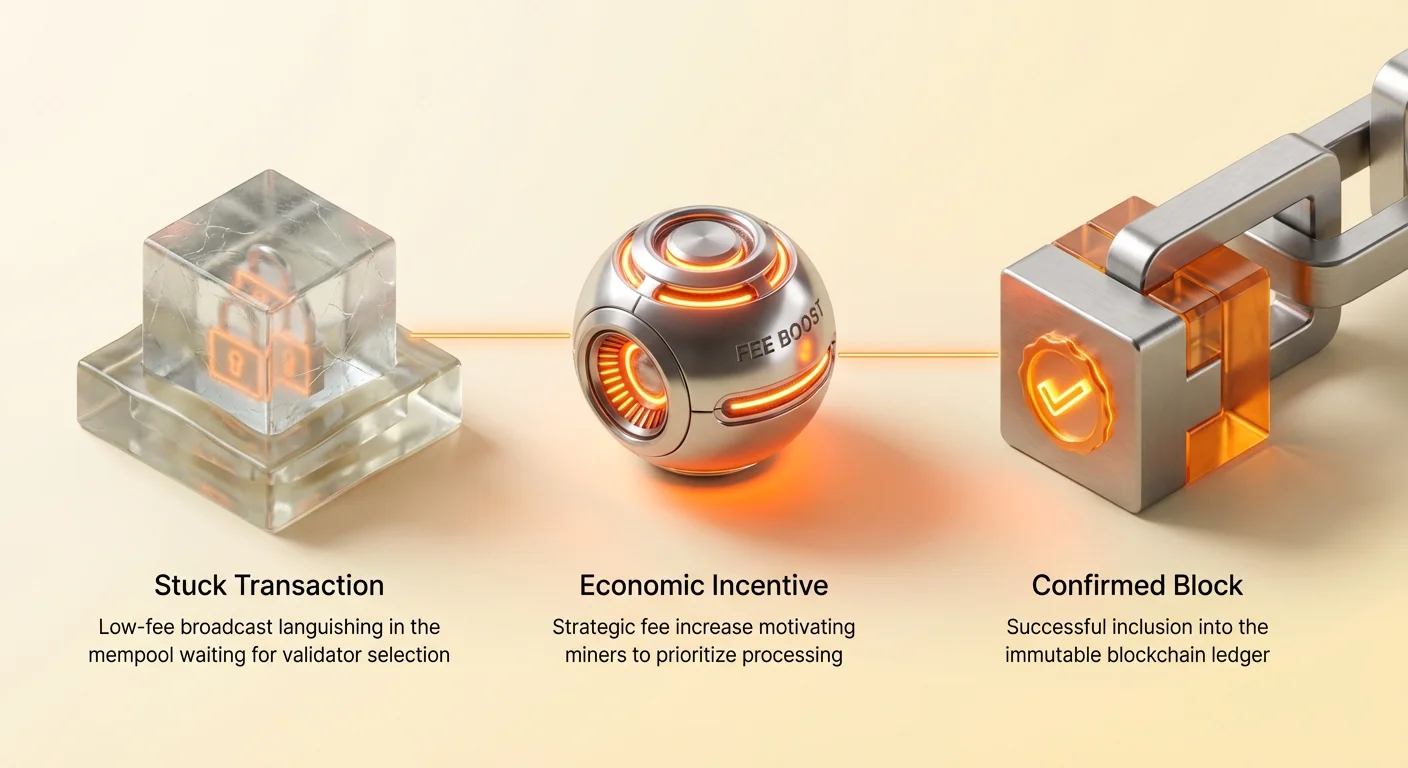
Anatomija čakajoče transakcije
Pred pospeševanjem transakcije moramo razumeti, zakaj se je sploh ustavila. Vsaka transakcija mora biti potrjena in vključena v blok s strani rudarja ali validatorja.
Mempool in čakalna vrsta
Mempool (zaloga pomnilnika) je čakalno območje za ne potrjené Bitcoin transakcije, medtem ko EVM verige temu pogosto pravijo zaloga čakajočih transakcij. Ko oddate transakcijo, ta počiva v tej zalogi in čaka, da jo izbere validator ali rudar.
V obdobjih visoke obremenitve se ta zaloga napihne. Ker je prostor v bloku omejen, rudarji dajejo prednost transakcijam na podlagi stopnje provizije – količine kriptovalute (Sats ali Gwei), plačane na enoto podatkov transakcije (vByte ali enota plina). Če je vaša stopnja provizije pod trenutno tržno uravnoteževalno stopnjo, je vaša transakcija dejansko postavljena na konec zelo dolge vrste.
Težava nespremenljivosti in obtičalih transakcij
Osrednja dilema pospeševanja transakcije izhaja iz nespremenljivosti verige blokov. Ko je transakcija podpisana in oddana, je ni mogoče preprosto urediti. Mreža jo vidi kot specifično navodilo. Če želite spremeniti provizijo, morate ustvariti novo, povezano transakcijo, ki spodbuja rudarje k potrditvi izvirne, ali pa ustvariti popolnoma novo, nadomestno transakcijo. Spodnje metode dosegajo te cilje z uporabo brez zaupanja vgrajene mrežne funkcionalnosti.
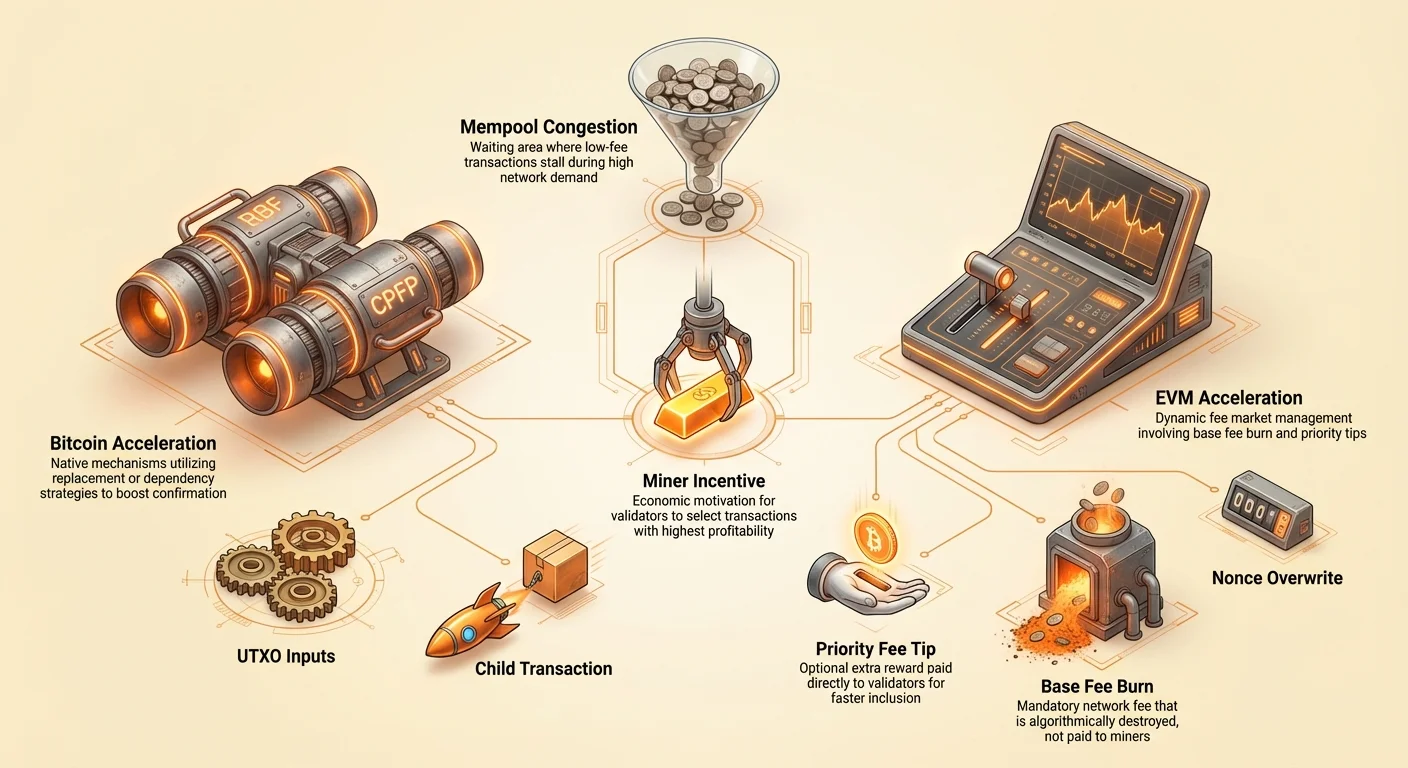
Bitcoin Acceleration Techniques: RBF and CPFP
The Bitcoin network utilizes two primary, native mechanisms for dealing with stuck transactions that require strategic intervention. Both methods rely on the miner's economic incentive to maximize immediate profit.
Replace-by-Fee (RBF): Mechanics and Implementation
Replace-by-Fee (RBF) is a protocol feature that allows a sender to create a new version of an unconfirmed transaction that uses the same inputs (UTXOs) as the original, but offers a significantly higher fee. The original transaction is then dropped from the network’s mempool and replaced by the new, higher-fee version.
How RBF Works
- Enabling RBF: Crucially, RBF must be enabled on the original transaction when it is first broadcast. This flagging (usually through a specific sequence number setting) signals to the network that the sender intends to potentially replace it later. If the original transaction was not flagged, most nodes will reject the replacement attempt, viewing it as a double-spend.
- Creating the Replacement: The user creates a new transaction that consumes the exact same Unspent Transaction Outputs (UTXOs) as the stuck transaction.
- Fee Rule: The replacement transaction must pay a total fee that is greater than the total fee of the original transaction plus a small premium to compensate miners for the bandwidth cost of handling the replacement. This premium usually ensures the new fee rate is competitive with current mempool rates.
- Broadcasting: The wallet broadcasts the new, higher-fee transaction. Nodes that support RBF will recognize the flag, see the higher fee, drop the original transaction, and relay the replacement.
Use Case: RBF is the cleanest method to accelerate a transaction where you are the sender and you control the inputs. It’s ideal for fixing a low-fee transaction quickly.
Practical Implementation: Wallet Support
To use RBF, you must use a wallet that explicitly supports the feature. Popular self-custody wallets like Electrum, Ledger Live (for certain chains), and Trezor Suite often provide a simple "Bump Fee" or "RBF" option next to pending transactions. The wallet handles the technical process of generating the replacement transaction.
Child-Pays-For-Parent (CPFP): The Bribe Strategy
Child-Pays-For-Parent (CPFP) is a technique that does not require the original transaction to be RBF-enabled. It is an economic strategy that bundles a low-fee, stuck transaction (the Parent) with a new, high-fee transaction (the Child), creating a strong economic incentive for miners to confirm both simultaneously.
The Dependency Chain
- The Parent (Stuck Tx): Your original low-fee transaction is stuck. It creates new UTXOs that don't exist yet because the transaction hasn't confirmed.
- The Child (Accelerator Tx): You create a new transaction that spends the output of the stuck Parent transaction. Since the Child transaction relies on the Parent's output, it is fundamentally dependent on the Parent being confirmed first.
- Massive Fee: The Child transaction is crafted with an extremely high fee, compensating not only for its own data size but also economically covering the low fee paid by the Parent.
- The Miner's Incentive: Miners evaluate the combined fee rate of the Parent-Child package. If the combined rate is high enough to be profitable, the miner will include both transactions in the same block to collect the large fee attached to the Child.
Use Case: CPFP is typically used when you are the recipient of a stuck transaction, but need that transaction confirmed to spend the funds immediately. It is also used when the original sender did not flag the transaction for RBF.
When to Use RBF vs. CPFP
| Strategy | Required Condition | Who Initiates | Primary Benefit |
|---|---|---|---|
| RBF | Sender must have enabled RBF on the original transaction. | Sender (needs to control the private key for the input). | Cleanest, replaces the original transaction entirely. |
| CPFP | The stuck transaction must have a usable output (UTXO). | Recipient or Sender (anyone who controls the Child input). | Works even if RBF was not enabled; useful for chain spending. |
Expert Tip: RBF is generally preferred when possible because it cleans up the mempool by removing the original transaction. CPFP is a necessary tool when RBF is unavailable or when a recipient is trying to force confirmation of incoming funds.
Priority Fee Management on EVM Chains (EIP-1559)
Ethereum and other EVM-compatible chains (like Polygon, Avalanche, BNB Chain, etc.) use a highly sophisticated, dynamic fee market defined by EIP-1559. This mechanism fundamentally changes how acceleration works compared to the simple "first-price auction" system historically used by Bitcoin.
EIP-1559 splits the transaction fee into two components: the Base Fee and the Priority Fee (Tip), giving users more predictable control over transaction inclusion.
Understanding EIP-1559: Base Fees and Priority Fees
1. The Base Fee (Burned)
The Base Fee is the mandatory, algorithmic fee required to include a transaction in the current block.
- Fixed: The Base Fee is set dynamically by the network based on block utilization (how full the previous blocks were).
- Predictability: This fee adjusts up or down automatically, stabilizing gas costs.
- Burning: Crucially, the Base Fee is burned (removed from circulation), making it impossible for validators to manipulate it.
2. The Priority Fee (Tip)
The Priority Fee (often called the "Tip" or "Inclusion Fee") is the acceleration mechanism under EIP-1559.
- Optional: This fee is an extra amount sent directly to the validator who includes your transaction in the block.
- Auction Component: The Priority Fee is the true competitive element. When the network is congested, validators select transactions offering the highest Priority Fees first to maximize their profit.
- Acceleration: To accelerate a stuck transaction, you must increase the Priority Fee offered to make the transaction more attractive than others in the pending queue.
Setting the Max Fee: Users must also set a Max Fee (or Fee Cap), which is the absolute maximum amount they are willing to pay (Base Fee + Priority Fee). If the Base Fee suddenly spikes above this cap, the transaction will not execute. When the transaction executes, the user only pays (Base Fee + Actual Priority Fee), up to the Max Fee limit.
Dynamic Gas Auctions: How Validators Choose
EVM validators essentially run a continuous internal auction among pending transactions. They are looking at:
- Gas Limit: The maximum computation (Gas) the transaction requires.
- Priority Fee: The extra reward offered to the validator.
When block space is constrained, a transaction with a higher Priority Fee will jump ahead of a transaction with a lower Priority Fee, regardless of when the transaction was broadcast.
Tactical EVM Acceleration: Re-broadcasting and Overwriting
Unlike Bitcoin's RBF, which requires specific flagging, EVM chains allow a sender to simply "overwrite" a pending transaction, provided certain conditions are met.
1. Overwriting via Nonce Management
The fundamental identification method for EVM transactions is the Nonce—a sequential counter associated with your wallet address.
- A pending transaction has a specific Nonce (e.g., Nonce 10).
- To accelerate or replace it, you must submit a new transaction from the same wallet address with the exact same Nonce (10).
If the network sees two transactions with the same Nonce, it will accept the one that offers the higher effective fee rate (Max Fee / Priority Fee). The original transaction is then effectively replaced in the pending pool.
2. Accelerating a Stuck Transaction
If your transaction is stuck because the Priority Fee was too low, you use your wallet interface (MetaMask, Rainbow, etc.) to rebroadcast the transaction with the same Nonce but with a significantly higher Max Fee and Priority Fee.
- Step 1: Identify the Nonce of the stuck transaction.
- Step 2: Create an identical transaction (same recipient, same amount) or a cancellation transaction (sending 0 ETH to yourself).
- Step 3: Manually set the Nonce for the new transaction to match the stuck one.
- Step 4: Increase the Priority Fee (Tip) substantially (often 15-25% higher than the current market rate) and ensure your Max Fee covers the highest possible Base Fee.
- Step 5: Broadcast the new transaction.
Cancellation Strategy: If you simply want to cancel a stuck EVM transaction, you send a 0 ETH transaction to your own address using the stuck transaction's Nonce, and attach a very high Priority Fee. This ensures the zero-value transaction confirms quickly, consuming that Nonce and effectively voiding the original instruction.
Specialized Acceleration Services
In scenarios of extreme network congestion, or when native methods like RBF/CPFP are not feasible, specialized third-party services can sometimes be utilized. These services are typically used only for Bitcoin transactions.
How Third-Party Accelerators Work
Bitcoin transaction accelerators are often run by mining pools. They offer a paid service (or sometimes a free service with restrictions) where they monitor the mempool for your transaction ID. If they find it, and you have paid their required fee (usually based on the size of your transaction), they guarantee that their mining pool will include your transaction in the next block they successfully mine.
In essence, you are paying the mining pool directly to bypass the standard fee auction process. This can be effective if time is critical and native RBF/CPFP options have failed or are unavailable.
Risks and Centralization Concerns
While effective, using third-party accelerators comes with inherent risks and strategic drawbacks:
- Trust Requirement: You must trust the third party to fulfill their promise once paid.
- Privacy Concerns: You publicly link your transaction ID (and thus, your activity) to a centralized entity.
- Cost: These services often charge a high premium, sometimes exceeding the cost of simply paying a competitive fee rate in the first place.
- Centralization: Relying on pools to manually push transactions undermines the principles of a decentralized, fee-based market. Continuous reliance on these services defeats the purpose of mastering native acceleration tools.
Recommendation: Specialized accelerators should be viewed as a last resort, primarily for emergency situations where time-sensitivity outweighs the cost and centralization risk.
Best Practices for Proactive Fee Management
The best defense against a stuck transaction is a good offense: setting optimal fees initially. Mastery of acceleration techniques is a powerful troubleshooting skill, but strategic fee management prevents the need for emergency intervention.
Monitoring Network Health
Always check the current state of the mempool or the pending gas prices before sending a non-urgent transaction.
- For Bitcoin: Use block explorers or mempool visualization sites (like mempool.space) to determine the fee rate (Sats/vByte) required for the next 1-3 blocks.
- For EVM Chains: Use gas tracking sites (like Etherscan’s gas tracker) to assess the current Base Fee and the competitive Priority Fee (Tip) required for rapid inclusion.
If the network is highly congested (e.g., during major NFT drops or extreme volatility), consider delaying non-essential transactions or setting very high fees proactively.
Avoiding Fee Underpayment (The Fee Buffer)
When setting fees manually, always add a small buffer. Instead of targeting the exact minimum fee for the next block, aim for the fee required for the second block confirmation. This slight overpayment acts as a cushion against sudden spikes in network demand, providing reasonable assurance that your transaction will confirm quickly without immediate need for RBF or Nonce replacement.
Security and Self-Custody Considerations
Acceleration methods require generating new transactions that spend the same inputs or use the same Nonce. This means you must have full access to your private keys and a capable self-custody wallet.
Never share your private keys or seed phrase with any third-party "accelerator service" that claims to fix your transaction manually. Trustless RBF and CPFP are executed within your secure wallet environment.
Zaključek
Nadzor transakcijskega toka je ključni steber samo-suverenosti v digitalni ekonomiji. Čeprav je zamašenost mreže neizogibna realnost uspešnih javnih blockchainov, obvladovanje tehnik pospeševanja spremeni uporabniško izkušnjo iz pasivne frustracije v strateški nadzor.
Z razumevanjem nianisiranih razlik med nadomestitvijo vhodov Bitcoina (RBF) in strategijami odvisnosti (CPFP) ter z učinkovitim upravljanjem osnovnih in prioritetnih provizij znotraj okvira EVM praktiki pridobijo taktično strokovnost, potrebno za zagotovitev, da se njihova sredstva premaknejo tja, kamor morajo, ko morajo. Prioritizacija proaktivnega nastavljanja provizij in zanašanje na domače, zaupanja vredne metode pospeševanja zagotavlja skladnost z mrežnimi pravili in strateško učinkovitost v obrazih nepredvidljivega tržnega povpraševanja.