
Vstop v svet digitalnih sredstev pomeni prevzemanje nadzora nad svojo finančno varnostjo. Za razliko od tradicionalnega bančništva, kjer institucija drži ključe, v kripto vi držite ključe. Ta osrednji koncept samo-suverenosti je močan, vendar uporabniku nalaga tudi znatno odgovornost.
Vaša kripto denarnica ni fizična škatla za shranjevanje; gre za orodje, ki ga uporabljate za dostop in upravljanje svojih sredstev na blockchainu. Izbira prave denarnice je nedvomno najpomembnejša odločitev, ki jo bo novinec sprejel. Najboljša denarnica za nekoga, ki dnevno izvaja desetine visoko hitrih trgovanj, je v osnovi drugačna od najboljše denarnice za nekoga, ki želi zavarovati svoje pokojninske prihranke za desetletje.
Ta vodnik presega preproste sezname sredstev in generične priporočila. Ponujamo funkcionalno primerjavo, ki vam pomaga izbrati denarnico ne glede na kovanec, ki ga držite, temveč glede na specifične dejavnosti – DeFi trgovanje, dolgoročno stakiranje ali zbiranje NFT – ki jih nameravate izvajati. Z razumevanjem funkcionalnih kompromisov med udobnostjo, varnostjo in integracijo lahko zgradite robustno strategijo, prilagojeno vašim osebnim ciljem v digitalni ekonomiji.
1. The Core Distinction: Custodial vs. Non-Custodial Security
Before diving into use cases, every user must grasp the fundamental difference between who controls the assets. This distinction dictates the level of risk you assume and the convenience you sacrifice.
Understanding Private Keys and Seed Phrases
In cryptocurrency, control is absolute. This control rests in the hands of whoever possesses the private key—a long, secret alphanumeric code that authorizes transactions.
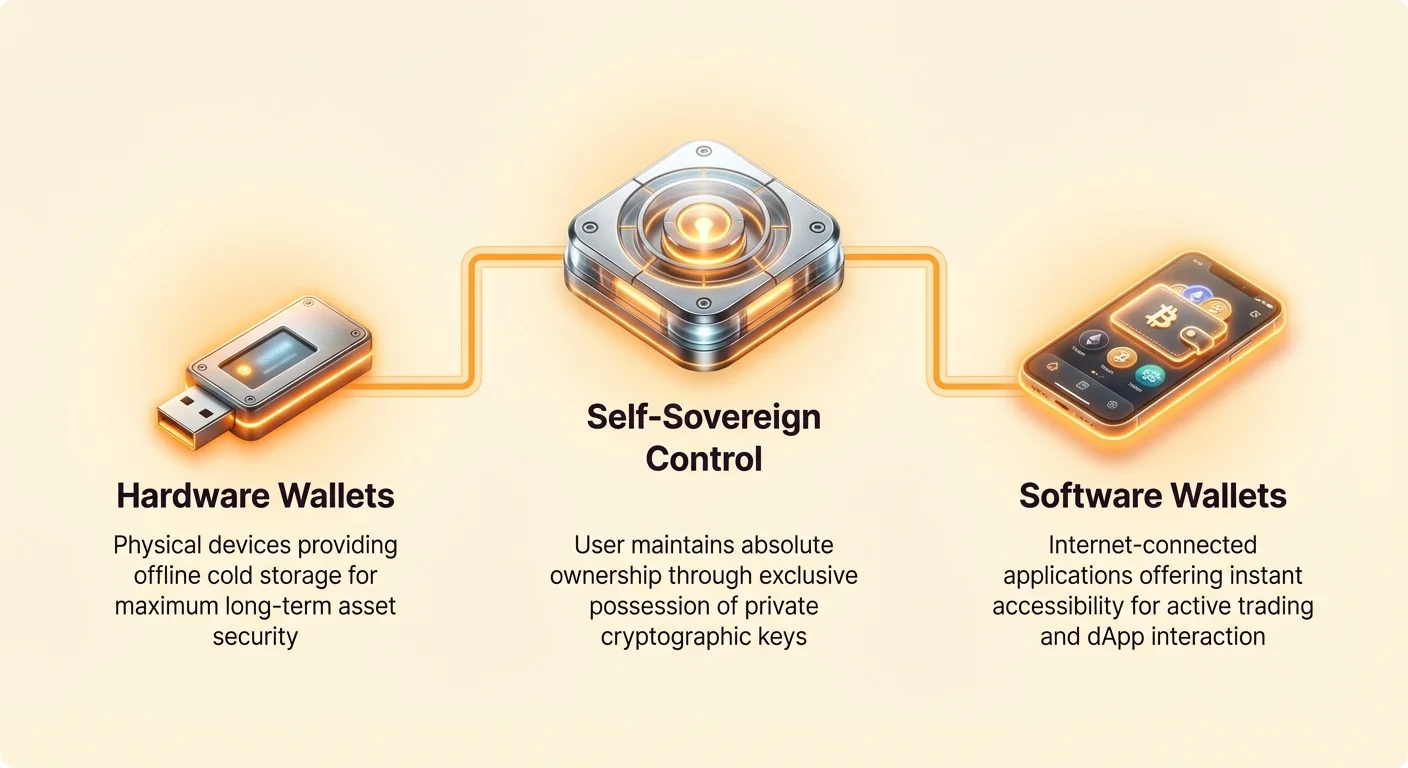
A non-custodial wallet provides you, and only you, with direct access to this private key, usually in the form of a 12-to-24-word seed phrase (or recovery phrase). If you lose this phrase, you lose access to your funds forever. If someone else gains access to it, they control your funds instantly. This is the definition of self-sovereignty: you are your own bank.
Conversely, a custodial wallet means a third party (often a centralized exchange like Coinbase or Binance) manages the private keys on your behalf. You have an account and a password, but the institution technically owns the keys to the funds until you withdraw them.
| Feature | Non-Custodial (Self-Custody) | Custodial (Exchange/Third-Party) |
|---|---|---|
| Control of Keys | User holds the private keys/seed phrase. | Third party holds the private keys. |
| Responsibility | Full security responsibility falls on the user. | Security managed by the institution. |
| Recovery | Impossible if seed phrase is lost. | Possible through customer service (password resets). |
| Primary Risk | User error, phishing, or loss of device. | Exchange hacking, bankruptcy, or regulatory seizure. |
Risk Assessment: When is Centralized (Custodial) Okay?
While self-custody is the ideal for true financial independence, custodial solutions offer unparalleled convenience for certain activities.
- High-Frequency Fiat On/Off Ramps: Exchanges (custodial wallets) are necessary for converting traditional currency (fiat) into crypto and vice versa. Using an exchange wallet for a short period—just long enough to buy crypto and immediately transfer it to your self-custody wallet—is a common, low-risk practice.
- Short-Term Trading: If you are actively day trading, keeping a portion of your funds on a centralized exchange allows for faster execution, lower trading fees, and access to advanced tools like futures or margin trading. Best Practice: Never keep your entire portfolio on an exchange. Only keep the capital you are actively trading.
- New Users: For absolute beginners, a custodial wallet can provide a safer learning environment, mitigating the immediate risk of losing a seed phrase while they learn basic transaction mechanics.
For any substantial long-term holdings, staking activities, or specialized Web3 interactions (like NFTs), non-custodial wallets are mandatory.
2. Wallet Architecture: Software, Hardware, and Smart Contracts
Non-custodial wallets come in several formats, each representing a different balance between accessibility (hot storage) and security (cold storage).
Software Wallets (Hot Wallets): Pros and Cons
Software wallets (often called hot wallets) are applications installed on your computer or phone, or browser extensions (like MetaMask). They are highly convenient because they are always connected to the internet (hence "hot").
Advantages:
- Accessibility: Instant access for trading, signing transactions, and interacting with dApps (Decentralized Applications).
- Interoperability: Most dApps, DEXs, and NFT marketplaces are optimized to connect seamlessly with leading hot wallets via protocols like WalletConnect.
- Low Barrier to Entry: Typically free and easy to set up.
Disadvantages:
- Security Risk: Because the private keys reside on an internet-connected device, they are vulnerable to malware, keyloggers, and phishing attacks.
- Phishing Vulnerability: The browser extension format, while convenient for DeFi, is highly susceptible to malicious websites asking for approval permissions.
Best Use Case: Managing small amounts of crypto, active DeFi participation, small daily transactions, and interacting with the NFT ecosystem. They are the essential tools for active Web3 users.
Hardware Wallets (Cold Storage): The Gold Standard for Self-Custody
Hardware wallets are specialized physical devices, often resembling a USB stick, designed solely to secure your private keys offline. They are considered cold storage because the keys never touch an internet-connected computer.
When you want to send a transaction, you compose it on your computer, but the transaction signature—the cryptographic proof that you own the assets—must be physically executed on the hardware wallet itself. This creates an "air gap" protection layer.
Advantages:
- Maximum Security: Immune to online threats like viruses, malware, and phishing. If your computer is compromised, the attacker still needs physical possession of your device and your PIN to steal funds.
- Asset Segmentation: Ideal for securing large, long-term holdings (Bitcoin, Ethereum, long-term staking collateral).
Disadvantages:
- Inconvenience: Every transaction requires retrieving the physical device, plugging it in, and entering a PIN. This is impractical for high-frequency trading.
- Cost: Quality hardware wallets require an upfront investment.
Best Use Case: Securing assets held for months or years, retirement funds, institutional holdings, and large NFT collections. They should be used to store the majority of your crypto wealth.
Introducing Smart Contract Wallets
A modern evolution of the crypto wallet is the Smart Contract Wallet (or Account Abstraction). Unlike standard wallets, which rely on Externally Owned Accounts (EOA) linked to a single seed phrase, these wallets are governed by code deployed on a blockchain (like Ethereum).
Key Differentiators:
- Programmable Security: Allows for features traditionally only found in banks, such as social recovery (allowing trusted parties to help restore access), setting daily spending limits, and requiring multiple signatures for large transfers (multisig).
- Improved User Experience: Can allow for things like paying transaction fees with any token, not just the native network gas token (e.g., paying ETH gas fees with USDC).
While still emerging, Smart Contract Wallets represent the future of wallet technology, providing both enhanced security and customization, blurring the lines between the rigidity of EOAs and the flexibility of decentralized finance.
3. Use Case 1: High-Frequency DeFi Trading and DEX Interaction
The user dedicated to active DeFi trading requires a wallet that prioritizes speed, network compatibility, and granular control over transaction costs. Security is important, but must be balanced against the necessity of rapid transaction signing.
Key Features for Active Trading (Speed and Multi-Chain Support)
DeFi trading primarily occurs on Decentralized Exchanges (DEXs) like Uniswap or PancakeSwap, requiring constant interaction with smart contracts.
- Customizable Gas Fees: The ability to adjust gas (transaction fees) is crucial. In highly congested periods, being able to raise your gas price slightly ensures your transaction is processed quickly, avoiding failed swaps or missed arbitrage opportunities. A dedicated DeFi wallet must offer simple, yet advanced, gas controls.
- Broad Network Compatibility: The best trading opportunities often span multiple Layer 1 and Layer 2 ecosystems (e.g., Ethereum, Solana, Polygon, Arbitrum). The ideal DeFi wallet supports multiple chains natively and allows for easy toggling between networks without requiring a complicated setup process for each new environment.
- Integrated Swap Functionality: Many sophisticated hot wallets now include native integration for swapping tokens directly within the wallet interface, often sourcing the best price across multiple DEXs. This saves precious seconds and mitigates the risk of connecting to a potentially malicious third-party site.
Security Protocols for Frequent Interaction (WalletConnect and Approvals)
High-frequency DeFi users are exposed to greater security risks because they connect their wallet to dozens of different dApps weekly.
Actionable Tip: Revoke Approvals Regularly When you interact with a DEX or liquidity pool, you often grant that smart contract token approval to spend a specific amount (or unlimited amount) of your crypto. If that DEX later suffers a security breach, the hacker could use that granted approval to drain your funds. Active traders must use tools (like Etherscan’s Token Approval tool) to revoke unnecessary approvals weekly. The ideal DeFi wallet will include a native feature to manage and revoke these permissions easily.
WalletConnect: This protocol is the standard for connecting mobile wallets to desktop dApps. While convenient, users must be extremely cautious, ensuring they verify the URL of the dApp they are connecting to. Never sign a transaction unless you are absolutely certain what contract you are interacting with.
Comparison Matrix: Top Wallets for DEX Interaction
| Wallet Type | Suitability | Key Advantages for DeFi | Security Caveat |
|---|---|---|---|
| MetaMask | Excellent (Ethereum & EVM Chains) | Industry standard, massive dApp support, granular gas control, integrates with most Layer 2s. | Highly targeted by phishing attacks; users must be vigilant about browser security. |
| Trust Wallet | Very Good (Multi-Chain/Mobile Focus) | Strong mobile experience, built-in dApp browser, supports a wide range of non-EVM chains. | Less advanced gas customization compared to desktop extensions. |
| Core (by Avalanche) | Specific EVM Chains | Optimized specifically for the Avalanche ecosystem, superior speed and staking integration for AVAX. | Limited utility outside of the Avalanche network. |
| Trezor/Ledger (Used with MetaMask) | Moderate | Maximum security, keys are cold, but speed is reduced due to mandatory physical signing. | Impractical for rapid, high-frequency trading. Used only for transferring large trading capital onto the hot wallet. |
4. Use Case 2: Long-Term Staking and Passive Yield Generation
Users focused on staking are prioritizing security and efficiency over speed. Staking involves locking up assets in a Proof-of-Stake (PoS) network to secure the chain and earn passive yield. Because assets are typically locked for extended periods, cold storage and native integration are paramount.
Direct vs. Exchange Staking: Which Wallet Supports Which?
The primary choice for stakers is whether to stake directly (non-custodial) or use a centralized exchange (custodial).
Exchange Staking (Custodial):
- Process: Simple—click a button on the exchange interface.
- Security: Exchange custody risk applies. If the exchange is hacked or fails, your principal is at risk.
- Control: The exchange manages the validator nodes and controls the keys. You merely receive a passive percentage of the yield.
Direct Staking (Non-Custodial):
- Process: Requires delegating assets to a public validator node (or running your own node). This is done through a self-custody wallet.
- Security: Your private keys remain safely in your hardware or software wallet.
- Control: You maintain ownership of the asset principal.
For long-term holders seeking true self-sovereignty and risk reduction, direct, non-custodial staking is the superior choice, and it requires a wallet capable of integrating directly with the specific blockchain’s staking mechanism.
Selecting Wallets with Native Staking Integration
The best staking wallets are those that integrate staking functionality directly into their user interface, simplifying the delegation process while maintaining cold storage security.
Hardware Wallets for Staking: Many modern hardware wallets (like Ledger and Trezor) offer specialized companion applications (e.g., Ledger Live) that support staking for specific PoS assets (e.g., Cardano, Polkadot, Tezos, Solana).
- How it Works: The wallet facilitates the delegation process, allowing the user to select a validator and commit funds, but the actual transaction signing happens on the offline hardware device. This combination offers the highest security standard for staking.
- Key Advantage: Your assets remain cold, even while they are actively earning yield on the network.
Dedicated Software Wallets for Specific Chains: Some chains have powerful, chain-native software wallets that offer better staking interfaces than generalized wallets. For instance, the ecosystem wallet for the Cosmos network often provides better tools for managing different delegation strategies and claims than a standard multi-chain hot wallet.
Practical Example: Liquid Staking For assets like Ethereum (ETH), where staking directly requires locking up 32 ETH, many users opt for liquid staking protocols (like Lido or Rocket Pool). These protocols issue a receipt token (e.g., stETH) in exchange for the locked ETH. Wallets that are ideal for liquid staking are standard DeFi hot wallets (like MetaMask) that can hold and utilize these liquid receipt tokens within the broader DeFi ecosystem, offering flexibility while earning yield.
Risk Management for Staked Assets (Slashing and Lock-up Periods)
When selecting a wallet for staking, consider two primary risks that the interface should help manage:
- Slashing Risk: In PoS networks, if a validator node behaves maliciously or fails its duties (e.g., goes offline for too long), the network can punish the validator by "slashing" (confiscating) a small portion of the staked tokens. The best staking wallets provide tools and information to help users select high-quality, reliable validators to minimize this risk.
- Lock-up Periods: Many chains enforce specific lock-up (or unbonding) periods during which staked assets cannot be accessed, sometimes lasting weeks. The wallet should clearly display these rules before you commit assets. This is why liquid assets are unsuitable for trading capital; they must be managed with a secure, long-term strategy.
5. Use Case 3: NFT Management and Web3 Utility
NFTs (Non-Fungible Tokens) are typically held on networks like Ethereum and Solana. Managing an NFT collection requires a wallet that emphasizes visualization, interaction with marketplace smart contracts, and often, cross-chain utility.
Visualization and Display Features
A standard crypto wallet only needs to display a token balance (e.g., 5.0 ETH). An NFT wallet must be capable of rendering complex media and metadata.
- Gallery View: The ideal NFT wallet functions as a gallery, seamlessly displaying the artwork, properties, and rarity rankings of the NFTs within the wallet interface. This convenience often comes built into leading software wallets (e.g., wallets popular in the Ethereum ecosystem).
- Metadata Integration: NFTs rely on metadata stored off-chain (often via IPFS). A quality NFT wallet needs strong integration to consistently and correctly fetch and display this metadata, ensuring the user sees the true, current state of the asset.
Integrated Marketplace Browsing and Security
NFT transactions are often highly sensitive—a single click can approve the transfer of a highly valuable asset.
Direct Marketplace Connection: The vast majority of NFT buying and selling occurs through marketplace platforms (like OpenSea or Magic Eden). Therefore, the chosen wallet must have seamless, reliable connectivity to these platforms, usually through a browser extension or WalletConnect.
Security Alert: Blind Signing A critical security challenge for NFT users is blind signing—signing a transaction on your wallet (especially on a hardware device) without being able to see the full, human-readable details of the smart contract interaction. For high-value NFTs, cold storage wallets are recommended, but users must be extremely careful to connect only to verified marketplaces, as a malicious blind signature could authorize the transfer of the entire NFT collection.
Tip: For high-value NFTs, always use a dedicated, segregated hot wallet (a "burner wallet") for marketplace browsing, which is then funded only when a purchase is imminent. The bulk of the collection should remain secured in a hardware wallet (cold storage) that is only connected for major transfers.
Bridging Assets Across Ecosystems
NFT utility often spans multiple blockchains. An NFT wallet must support the ability to move assets—both fungible crypto (for payment) and non-fungible assets (the NFTs themselves)—across different chains.
- Wrapped Assets: For example, an NFT collector might hold their collection on Ethereum but need to use Polygon for faster, cheaper transactions. The wallet must easily handle wrapped tokens and bridged assets, allowing the user to pay gas fees in the correct native token for the chain they are currently operating on.
- Multi-Wallet Approach: Often, a collector will use a specialized wallet for one ecosystem (e.g., Phantom for Solana) and a different wallet for another (e.g., MetaMask for Ethereum), necessitating a robust portfolio tracking system to manage assets across these silos.
6. Advanced Security Implementation and Portfolio Management
As your crypto journey progresses and your holdings increase in value, combining wallet types into a strategic portfolio management system becomes essential. The goal is to maximize security for your principal while retaining necessary functionality for yield generation and trading.
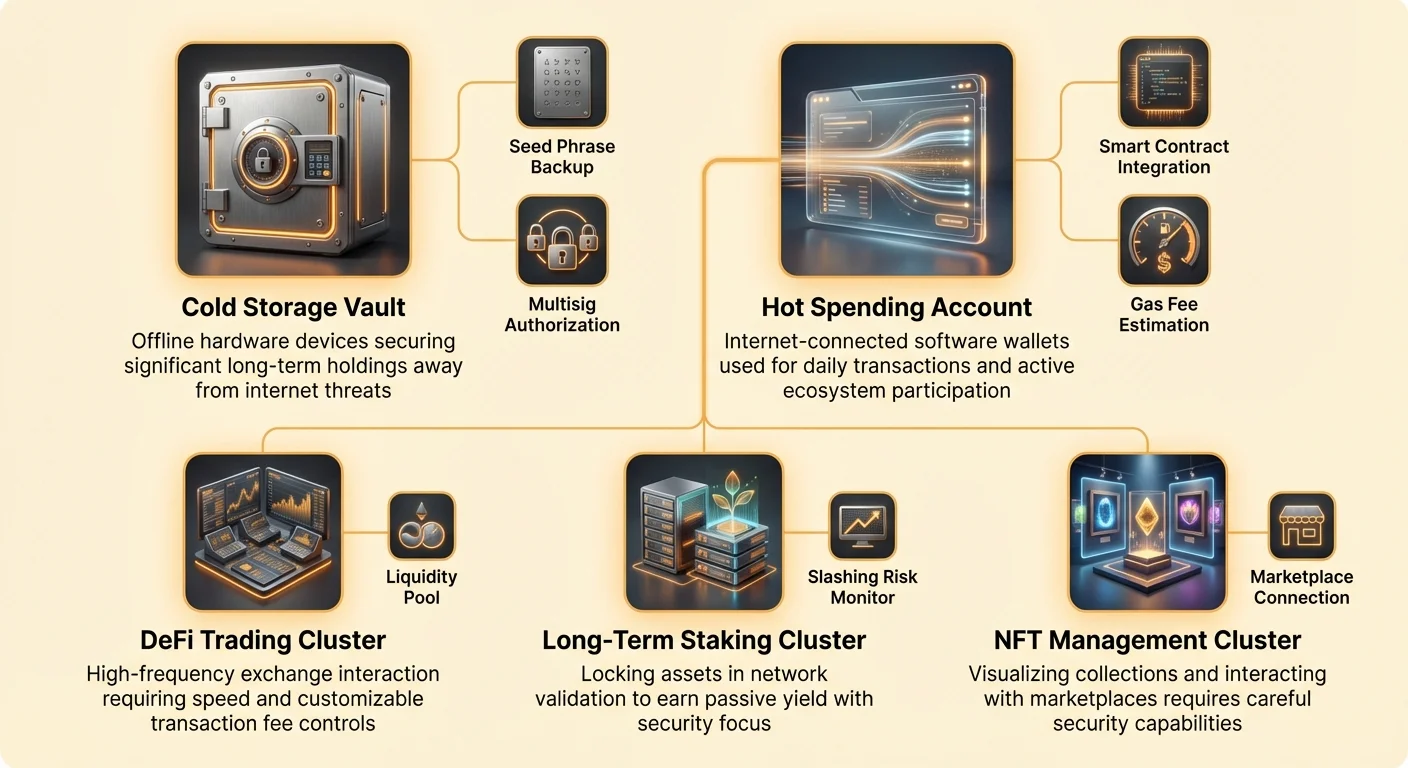
The Hardware/Software Strategy (The "Hot/Cold" Rule)
This strategy is foundational for secure crypto management and applies to all use cases (DeFi, Staking, NFTs).
1. Cold Storage (The Vault):
- Purpose: Long-term savings, staked assets, high-value NFTs, and emergency funds.
- Tool: A dedicated hardware wallet (Ledger, Trezor).
- Rule: This wallet should only interact with smart contracts for long-term actions (e.g., delegating staking, transferring large sums to a hot wallet). Minimize connection to Web3 dApps.
2. Hot Storage (The Spending Account):
- Purpose: Active trading capital, gas fees, quick swaps, new dApp testing, small NFT purchases.
- Tool: A software wallet (MetaMask, Trust Wallet) loaded on a secure device.
- Rule: Keep only enough funds here to cover current operations. Refill only when necessary from the Cold Storage vault. This wallet bears the primary risk of interaction, ensuring that if it is compromised, the loss is limited to disposable capital.
By segmenting your assets, you prevent a compromise on your active trading wallet from affecting your long-term wealth.
Multisig Wallets and Portfolio Segmentation
For finance professionals or high-net-worth individuals, security extends beyond a single hardware device. Multisignature (Multisig) wallets are a form of smart contract wallet that requires multiple private keys (or signatures) to authorize a transaction.
- How Multisig Works: A common setup is a 2-of-3 scheme, where three separate keys are created, and any two of them must sign a transaction for it to be broadcast.
- Use Case: This is ideal for managing organizational treasuries, family trusts, or highly valuable personal portfolios. If one hardware wallet is lost, stolen, or damaged, the other two keys can still be used to recover the funds. This provides redundancy against both loss and internal security failure.
Integrating with Hardware: The best practice for multisig security is to utilize three separate hardware wallets as the three signing keys (key 1, key 2, key 3). This removes the single point of failure inherent in any standard single-key wallet.
Strategic Wallet Pairing and Interoperability
The modern crypto environment demands interoperability. You may need a wallet that can handle both the secure custody of Ethereum (for staking) and the fast transactions of Solana (for trading NFTs).
- The Bridge Wallet: Some multi-chain wallets (like Exodus or certain mobile-first applications) excel at providing a user-friendly interface across dozens of distinct blockchain ecosystems. While not always the best for granular DeFi activity, they serve as excellent portfolio trackers and management hubs, allowing users to move assets between specialized chain-native wallets (e.g., from an optimized Solana wallet to an optimized Cosmos wallet) without relying solely on centralized exchanges.
- Connecting Hardware to Software: Almost every major software wallet (MetaMask, Phantom) can be linked to a hardware wallet. When linked, the hot wallet interface handles the viewing and broadcasting, but the hardware wallet retains custody, requiring a physical sign-off for every send or interaction. This allows cold storage assets to participate in DeFi or NFT interaction without ever exposing their private keys to the internet—the perfect blend of security and functionality for the advanced user.
Conclusion
Selecting the right wallet is a strategic process dictated by your goals. There is no single "best" wallet; there is only the best wallet for a specific task.
- For High-Frequency DeFi: Prioritize speed, multi-chain support, customizable gas fees, and a robust system for revoking token approvals. Hot wallets are essential here, but must be treated as segregated spending accounts.
- For Long-Term Staking: Prioritize cold storage security and native chain integration to minimize slashing risk and maximize yield security. Hardware wallets paired with staking interfaces are the standard.
- For NFT Management: Prioritize visualization, seamless marketplace connectivity, and asset segmentation (hot wallet for browsing, cold wallet for storage) to mitigate blind signing risk.
By adopting a tiered, multi-wallet strategy—utilizing hardware for security, software for interaction, and multisig for institutional-grade protection—you transition from a crypto newcomer to a self-sovereign participant capable of navigating the complex terrain of the digital economy securely and effectively. Remember: your wallet is your gateway; securing it is securing your future.