
For years, Bitcoin (BTC) stood alone as the undisputed leader in cryptocurrency value and security. Its foundational strength lies in its simplicity: a secure, decentralized store of value and medium of exchange. However, as the world of decentralized finance (DeFi) exploded—primarily built on Ethereum and other high-throughput chains capable of complex smart contracts—a significant problem emerged: how do you utilize Bitcoin’s immense liquidity and store of value within these complex financial ecosystems?
The solution that rose to market dominance is Wrapped Bitcoin, or wBTC. Launched in 2019, wBTC is an ERC-20 token (meaning it lives on the Ethereum blockchain) pegged 1:1 to Bitcoin. This ingenious mechanism allows Bitcoin holders to participate in Ethereum DeFi—lending, borrowing, and yield farming—without ever having to sell their underlying BTC.
While wBTC has been wildly successful, becoming the most widely used tokenized form of Bitcoin by far, its architecture introduces a critical trade-off. To achieve the necessary speed and regulatory compliance, wBTC relies on a centralized, custodial structure. This deep dive will explore the specific mechanics of wBTC, detailing the roles of the merchants and custodians, and critically analyzing the centralized risks that users assume when they swap true self-sovereignty for DeFi utility.

The Imperative for Wrapped Bitcoin
To understand why wBTC is necessary, we must first recognize the fundamental architectural differences between the Bitcoin and Ethereum blockchains. They were designed for different purposes, leading to complementary strengths and inherent limitations.
Bitcoin's Strengths and Limitations
Bitcoin was engineered for maximum security and decentralization, prioritizing these attributes over smart contract complexity or transaction speed. The Bitcoin blockchain uses a scripting language that is intentionally limited, making it extremely robust against complex exploits but fundamentally incapable of running the sophisticated decentralized applications (dApps) required for modern DeFi.
Bitcoin's primary function remains a store of value. While developers have implemented layer-2 solutions like the Lightning Network to increase transaction speed, and innovation continues to expand Bitcoin's potential for smart contracts, the base layer (Layer 1) remains slow and expensive for frequent, complex operations.
Bridging the Digital Divide
Ethereum, conversely, was designed as a "world computer," prioritizing smart contract capability and programmability. The Ethereum DeFi ecosystem needs liquidity to function effectively. Without a mechanism to use the world's largest cryptocurrency (BTC) within Ethereum’s dApps, the DeFi ecosystem would be starved of capital.
wBTC serves as the centralized bridge—a technological translation service that allows BTC to flow into Ethereum. By "wrapping" the BTC, users gain a token that adheres to Ethereum standards (ERC-20), making it instantly compatible with every wallet, decentralized exchange (DEX), and lending protocol on the network.
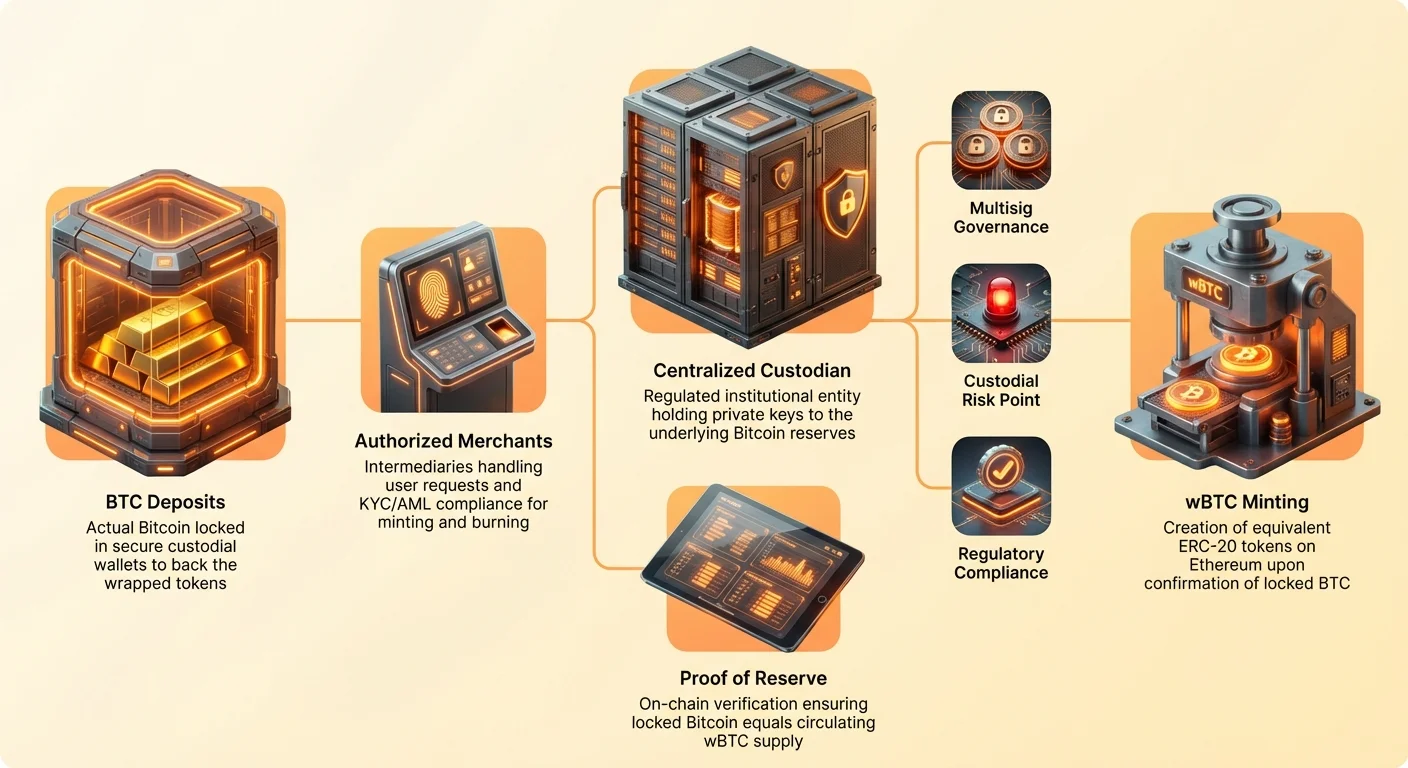
Understanding wBTC's Centralized Architecture
wBTC is often described as a “tokenized IOU” (I Owe You). When you hold wBTC, you don't hold the actual Bitcoin; you hold a redeemable claim, much like a warehouse receipt for a physical asset. This claim is guaranteed by a complex legal and technical structure involving multiple institutions.
The Core Mechanism: Minting and Burning
The process of creating (minting) and destroying (burning) wBTC is essential to maintaining the 1:1 peg:
- Minting: A user (or more typically, a Merchant acting on behalf of a user) sends 1 BTC to the designated Custodian’s Bitcoin address. Once the BTC is confirmed, the Custodian notifies the smart contract on Ethereum, and 1 wBTC is created (minted) and sent to the Merchant’s Ethereum address.
- Burning (Redemption): To convert wBTC back to BTC, the wBTC is sent to the smart contract, where it is permanently destroyed (burned). The Custodian receives notification and releases the corresponding 1 BTC from the reserve vault back to the Merchant (who then passes it back to the end user).
This structure ensures that the total supply of wBTC circulating on Ethereum always matches the exact amount of BTC locked in the Custodian's controlled wallets.
The Role of the Custodian
The Custodian is the single most critical and centralized component of the wBTC structure. The Custodian is the entity—typically a highly regulated, institutional third party like BitGo—that holds the actual private keys to the underlying Bitcoin reserves.
The Custodian is responsible for the secure storage of the Bitcoin. They operate the multisig addresses and the technological infrastructure necessary to confirm incoming BTC deposits and authorize outgoing BTC redemptions. Because the Custodian holds the keys, users of wBTC must place absolute trust in this entity’s security, solvency, and legal compliance.
The Merchant-Custodian Dynamic
The wBTC structure deliberately separates the custody of the assets (the Custodian) from the distribution and access points (the Merchants). This separation is designed primarily for regulatory compliance and operational efficiency.
The Merchant: The User-Facing Gateway
Merchants are authorized institutions, such as large exchanges, centralized finance platforms, or institutional desks, that interact directly with the end users and the Custodian.
The primary responsibilities of the Merchant include:
- KYC/AML Compliance: Because the Custodian often operates under strict regulatory scrutiny, Merchants are usually responsible for conducting Know Your Customer (KYC) and Anti-Money Laundering (AML) checks on the users requesting large mints or burns. A retail user cannot typically send Bitcoin directly to the Custodian; they must go through an authorized Merchant.
- Liquidity Provision: Merchants manage the supply and demand for wBTC. They accumulate BTC from users and request the minting of large batches of wBTC. They distribute this wBTC to smaller users or sell it on DEXes, creating the liquidity pool accessible to the retail market.
- Initiating Transfers: Merchants act as the trusted intermediary, initiating the communications necessary to tell the Custodian to lock BTC (mint) or unlock BTC (burn).
The wBTC Merchant Custodian Role is therefore defined by a necessary division of labor: the Custodian guards the vault, and the Merchant manages the flow of traffic into and out of the vault.
Why the Separation?
The separation of roles serves multiple purposes:
- Risk Mitigation: By splitting responsibility, the system aims to prevent a single entity from having both custody of the funds and the power to approve user transactions unilaterally.
- Compliance: Merchants handle the highly regulated, user-facing compliance duties (KYC), allowing the Custodian to focus strictly on institutional-grade security for the Bitcoin reserves.
- Scalability: Merchants provide a flexible distribution layer, allowing many different entities to onboard users and provide wBTC liquidity without having to integrate directly into the highly secure, and potentially rigid, Custodian system.
Analyzing wBTC's Centralized Points of Failure
While wBTC offers unparalleled interoperability, its success comes at the cost of decentralization. For those committed to the self-sovereignty principles of Bitcoin, wBTC represents a significant security and trust trade-off. Understanding these centralized risks is paramount for any user holding significant amounts of wBTC.
Custodial Risk: The Single Largest Threat
The fundamental risk of wBTC is Custodial Risk. Since the Custodian holds the private keys to the locked BTC, the wBTC asset is only as secure as the single, centralized entity acting as the fiduciary.
If the Custodian were to fail, the consequences could be catastrophic:
- Key Theft (Hacking): If the Custodian’s systems were breached and the reserves stolen, the wBTC circulating on Ethereum would instantly become worthless, as the 1:1 backing would vanish.
- Insolvency or Fraud: If the Custodian becomes insolvent (bankrupt) or acts fraudulently by minting wBTC without locking corresponding BTC, the system collapses. Users would find their ERC-20 tokens unredeemable.
- Regulatory Seizure: Because the Custodian is a regulated institution operating in specific jurisdictions, a government or regulatory body could theoretically compel the Custodian to seize or freeze the underlying Bitcoin reserves, effectively censoring user access to redemption. This is a primary wBTC centralized risk.
Governance and Multisig Reliance
While the Custodian manages the daily operations, the overall security and governance of the wBTC contract relies on a consortium known as the DAO (Decentralized Autonomous Organization). However, this DAO is not decentralized in the common crypto sense; it is a federation of approved institutional members (including various exchanges and DeFi organizations).
Redemption of BTC is controlled via a multisignature (multisig) scheme. This means that multiple approved signatories must sign a transaction for the Bitcoin to be moved. While multisig technology adds operational security by preventing a single rogue employee from running off with the keys, it does not mitigate the central risk that the group of signatories is centralized, identifiable, and legally accountable.
If a consensus among the governance members is reached (or mandated by external pressures), the multisig could be used to freeze assets, blacklist addresses, or alter the tokenization mechanism.
Legal and Regulatory Vulnerabilities
wBTC relies heavily on legal contracts and binding agreements, rather than purely cryptographic assurance (which is the ideal of a truly decentralized bridge).
When you interact with a wBTC Merchant, you are entering into a legal arrangement that dictates your rights to redemption. If a dispute arises, the resolution often relies on traditional legal frameworks, not on automated smart contract code. This places wBTC squarely within the regulated financial sector, making it susceptible to geographic and jurisdictional rules that Bitcoin itself was designed to bypass.
Verification and Auditing: Trusting the Centralized System
Since wBTC requires trust in a third party, the system must provide mechanisms for verifying that the underlying assets exist. These mechanisms are called "Proof of Reserve."
Proof of Reserve
The Custodian is responsible for providing on-chain proof that the Bitcoin reserves match the wBTC supply. This is achieved through two main components:
- Public Bitcoin Address: The BTC is held in a publicly known Bitcoin address (or set of addresses). Anyone can view this address on a Bitcoin block explorer and see the exact balance of BTC locked up.
- Public Ethereum Contract: The total supply of wBTC can be viewed instantly on an Ethereum block explorer.
The verification process is straightforward: compare the balance of BTC in the locked address with the total supply of wBTC on Ethereum. If the numbers match 1:1, the system is solvent. Major institutions often conduct third-party audits (attestations) to verify these balances periodically.
Limitations of Auditing
While Proof of Reserve offers transparency regarding solvency, it is critical to recognize its limitations:
- Auditing Does Not Equal Security: An audit confirms that the funds exist at the moment of the audit. It does not confirm the security procedures the Custodian uses to protect the private keys, nor does it guarantee that the Custodian will remain solvent or honest in the future.
- Censorship Risk Remains: Even if the BTC reserves are perfectly balanced, the Custodian still retains the power to block specific redemption requests or freeze assets if compelled by a legal authority. Auditing verifies the asset quantity, not the security or censorship resistance of the custodian.
Comparing Centralized vs. Decentralized Bridging
wBTC's architecture highlights the fundamental trade-off in the crypto bridging landscape: convenience and speed versus trustlessness and decentralization.
The Speed vs. Trust Trade-Off
wBTC’s centralized model allows it to dominate the market because it is highly efficient, highly liquid, and generally low-cost for institutional players. Because the Custodian is a known, regulated entity, traditional finance institutions are often more comfortable interacting with wBTC than with newer, complex decentralized bridges.
- Centralized Bridges (wBTC): High liquidity, fast minting/burning (due to off-chain legal processing), high regulatory compliance, but high Custodial Risk.
- Decentralized Bridges (e.g., tBTC): Low Custodial Risk (relies on cryptography/smart contracts), high censorship resistance, but often more complex, slower, and potentially more expensive due to the overhead of complex trustless mechanisms.
Alternatives: Threshold Cryptography and Decentralized Bridges
The perceived weaknesses of wBTC's centralized custody model have spurred significant innovation in the decentralized bridging space. Projects like tBTC (Threshold Bitcoin), which utilize advanced cryptographic techniques such as threshold signatures, aim to eliminate the need for a single, known custodian.
In a decentralized model, instead of trusting a legal entity to hold the keys, the BTC keys are split across a large, randomized network of anonymous participants (a threshold network). This ensures that no single entity can access or steal the locked BTC, making the bridge trustless. While complex, these alternatives uphold the true spirit of self-custody and are designed to solve the very wBTC centralized risks that define the dominant implementation.
Conclusion
Wrapped Bitcoin (wBTC) serves a vital function in the crypto ecosystem, acting as the essential liquidity pipeline connecting the vast store of value on the Bitcoin blockchain to the dynamic world of Ethereum DeFi. By adopting the ERC-20 standard and utilizing a professional, regulated Custodian, wBTC achieved widespread adoption and institutional acceptance faster than any decentralized alternative.
However, users must maintain a clear understanding of the architectural trade-off. When holding wBTC, you are temporarily exchanging the self-sovereignty inherent in native Bitcoin for the utility of Ethereum's dApps. Your asset is protected not by the immutable laws of cryptography and decentralization, but by the legal obligations and physical security systems of a centralized financial institution.
For institutional traders seeking high liquidity and regulatory comfort, wBTC is an ideal tool. For retail users prioritizing maximum security and censorship resistance, a deep awareness of the how does wbtc work custody model—and its reliance on the Merchant and Custodian—is critical before committing capital. As the crypto ecosystem evolves, users must choose whether they prioritize the convenience of centralization or the enduring assurance of trustless systems.