Za mnoge ljudi, ki so radovedni glede Bitcoina, je največja ovira zaznana cena. Opazovanje trgovanja Bitcoina za desetine tisoč dolarjev pogosto vodi do napačne ugotovitve, da si ga lahko privoščijo le bogate institucije ali izkušeni trgovci. Ta zmota povzroči, da nešteto novincev odloži vstop, ker predpostavljajo, da morajo shraniti dovolj denarja za nakup »celotnega kovanca.«
Realnost je precej drugačna. Ni vam treba kupiti celotnega Bitcoina (BTC), pravzaprav ga večina maloprodajnih vlagateljev kupuje v majhnih delcih. To je mogoče, ker je Bitcoin deljiv do osmih decimalnih mest. Najmanjša enota Bitcoina se imenuje Satoshi ali krajše »sat« – poimenovana po psevdonimnem ustvarjalcu Bitcoina, Satoshi Nakamotu. En sam Bitcoin je sestavljen iz 100.000.000 Satoshijev.«
Ta vodnik je zasnovan za razkritje prvega nakupa. Osredotočili se bomo na praktičen, korak za korakom postopek pridobivanja Bitcoina, s poudarkom na Strategiji Sats in jo kombiniramo z najbolj zanesljivo nizko-tvegan tehnika naložb: Dollar-Cost Averaging (DCA). Do konca tega načrta boste imeli znanje, potrebno za izvedbo prve varne, obvladljive naložbe in začetek poti do samo-suverenosti.«
Step 1: Understanding Bitcoin Fractions (The Sat Strategy)
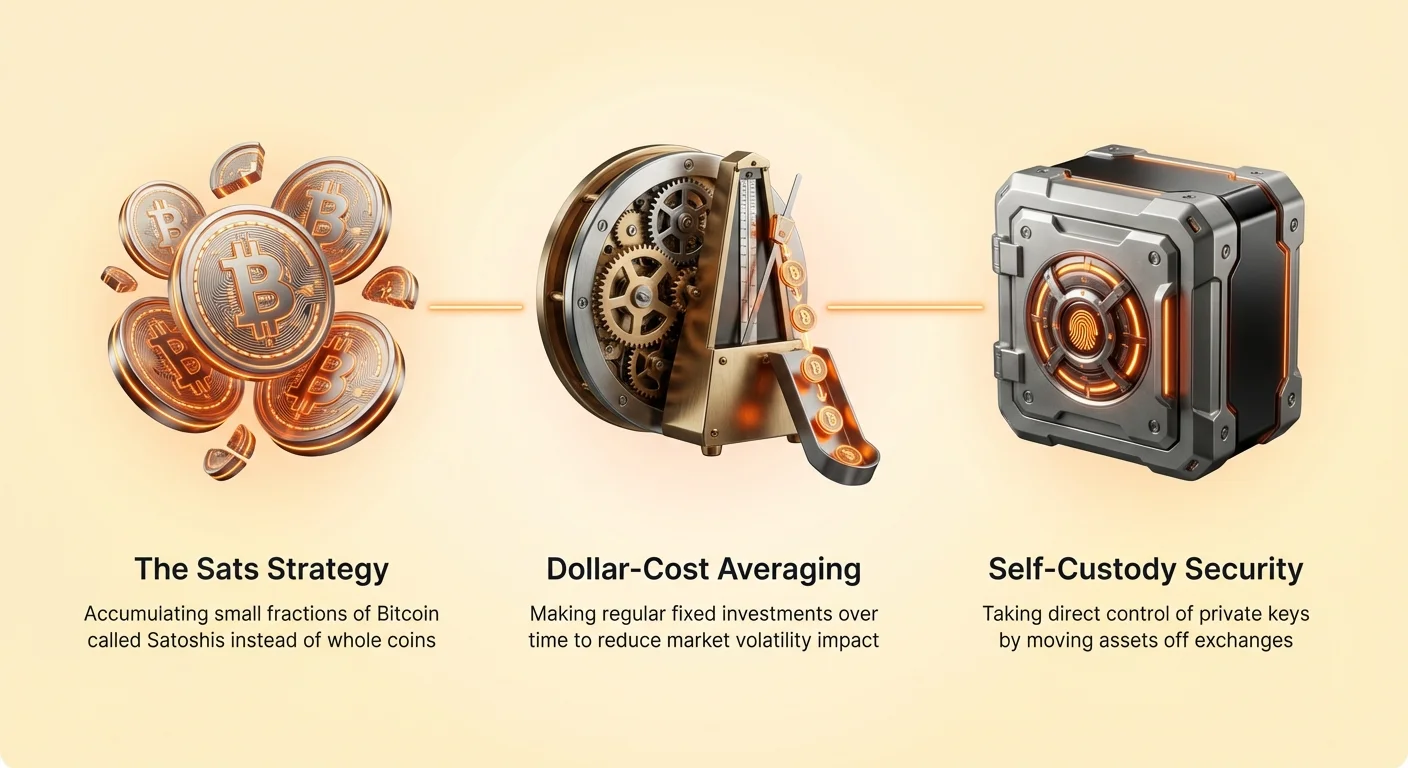
The first psychological barrier to buying Bitcoin is its intimidating price. By reframing your investment from purchasing "Bitcoin" to accumulating "Sats," the process instantly becomes more accessible and scalable.
Why We Buy Satoshis, Not Whole Coins
Thinking in Satoshis allows you to normalize recurring, small investments. When you buy $25 worth of BTC, you are not buying 0.0004 BTC; you are buying 40,000 Satoshis. This is a complete unit of value that can be sent, stored, and used just like a whole coin.
This concept addresses the key question asked by beginners: Can you buy less than one Bitcoin? Absolutely. The Sat Strategy allows you to invest any amount—from $1 to $1,000—without worrying about the current market price of a full Bitcoin. Your goal is simply to stack more sats over time.
Calculating Your First Purchase
Since a satoshi is only one hundred-millionth of a Bitcoin, any fiat currency amount (USD, EUR, etc.) translates into a large number of sats, making the purchase feel substantial, even for small budgets.
Example Calculation: If the price of Bitcoin is $60,000, and you decide to invest $50:
- $50 / $60,000 = 0.00083333 BTC
- 0.00083333 BTC * 100,000,000 = 83,333 Satoshis
By focusing on the 83,333 sats you acquired, rather than the small fraction of a whole coin, the transaction feels empowering. This mindset shift is foundational to long-term accumulation.
Step 2: Choosing Your Crypto Entry Point (Exchanges)
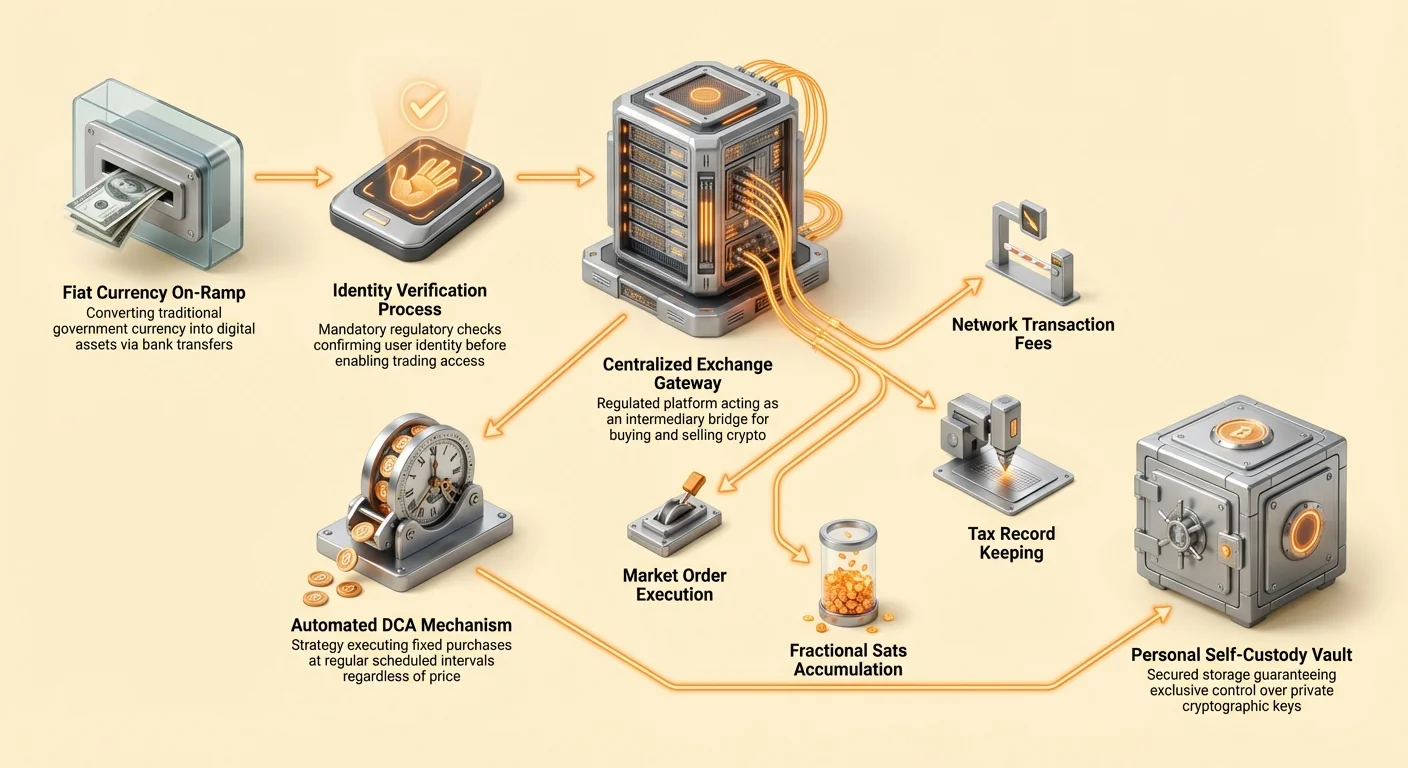
To convert your traditional government-issued currency (fiat) into Bitcoin, you need to use a regulated trading platform, known as a cryptocurrency exchange. For beginners, the safest and easiest route is typically through a Centralized Exchange (CEX).
Centralized Exchanges (CEXs): The Easiest On-Ramp
Centralized Exchanges act as highly regulated intermediaries. They operate similarly to traditional stock brokerages, offering high liquidity (meaning trades execute quickly) and a user-friendly interface. They are the essential bridge between the legacy financial system and the crypto economy.
Advantages of using a CEX for beginners:
- Familiarity: Interfaces resemble banking apps or stock trading platforms.
- Liquidity: Easily buy or sell large amounts of crypto instantly.
- Support: They offer customer service if you forget a password or encounter an issue.
- Fiat Gateways: Simple integration with bank accounts, debit cards, and wire transfers.
Necessary Verification Steps (KYC/AML)
Because CEXs deal with fiat currency and operate under government regulations, they are required to implement Know Your Customer (KYC) and Anti-Money Laundering (AML) policies. Before you can deposit funds or purchase Bitcoin, you will need to complete an identity verification process.
This usually involves:
- Providing a government-issued photo ID (driver’s license or passport).
- Proof of address (utility bill or bank statement).
- Sometimes, a live webcam selfie to confirm identity (liveness check).
While this centralized step might seem counterintuitive to the decentralized philosophy of Bitcoin, it is a necessary regulatory requirement for converting fiat to crypto through standard, legal banking rails.
Comparing Fees and Security
When selecting a CEX, compare two primary factors:
- Trading Fees: These are fees charged for executing the buy or sell order. They typically range from 0.1% to 0.6% per transaction. Look for tiered systems, where higher volume traders pay lower fees, although beginners should prioritize simplicity over marginal savings initially.
- Withdrawal Fees: This is the cost incurred when you move your Bitcoin off the exchange and into your private, self-custody wallet (a crucial step we cover in Step 5). Withdrawal fees cover the cost of the Bitcoin network transaction fee (the "miner fee") plus a small margin the exchange may charge.
Choose an exchange known for its high security standards, strong insurance policies (though these rarely cover user error), and transparent fee structure.
Step 3: Mastering the Dollar-Cost Averaging (DCA) Strategy
The largest enemy of a beginner investor is volatility and emotion. Bitcoin’s price can swing wildly, tempting investors to try and "time the market"—buying low and selling high. This rarely works, even for professionals. The simplest and most proven strategy to mitigate volatility and build wealth responsibly is Dollar-Cost Averaging (DCA).
This foundational technique is vital for successfully executing the DCA bitcoin strategy.
What is DCA and Why Does it Work?
Dollar-Cost Averaging (DCA) is an investment strategy in which an investor divides the total amount they wish to invest across periodic purchases of a target asset. These purchases occur at regular intervals (e.g., weekly or monthly), regardless of the asset's price.
How DCA smooths volatility: Imagine you have $1,200 to invest over a year.
- Lump Sum (Buying all at once): If you buy $1,200 worth of BTC when the price is $60,000, and the price immediately drops to $40,000, you have suffered a significant immediate loss.
- DCA (Buying $100 every month): You buy some Bitcoin when the price is $60,000, some when it drops to $40,000, and some when it rises to $70,000. By buying at multiple price points, your average purchase price becomes lower than if you had bought only at the peak.
DCA removes the emotion from investing. You commit to a schedule, not a price prediction. Over the long term, this structured approach generally outperforms impulsive, speculative attempts to time the market.
Setting Up Automated Purchases
Most major Centralized Exchanges facilitate automated DCA purchases, making the process effortless and adhering to the "set it and forget it" principle.
- Determine Your Budget: Decide on a sustainable weekly or monthly amount you are comfortable committing (e.g., $20 every Friday).
- Configure the Exchange: Go to the "Recurring Buys" or "Auto-DCA" section of your chosen exchange.
- Link and Schedule: Link your bank account and select the amount, frequency, and the asset (Bitcoin/BTC).
- Confirmation: The exchange will automatically draw the funds from your account and execute the purchase at the scheduled time.
Automated DCA is the most effective way for how to buy bitcoin for beginners reliably, steadily increasing your stack of sats without requiring constant monitoring of the market.
DCA vs. Lump Sum Investing
While financial theory sometimes suggests a lump sum investment might yield better returns if the asset is expected to rise consistently, this assumes the investor has the discipline and luck to buy at an optimal time.
For beginners, the psychological benefit of DCA outweighs the potential edge of lump sum investing. DCA offers peace of mind because you know you are neutralizing the risk of a major market downturn immediately after your purchase. DCA teaches discipline and patience—two essential traits for successful long-term Bitcoin investors.
Step 4: The Buying Process: From Fiat to Bitcoin
Once your exchange account is verified and you understand the power of DCA, executing the actual purchase is straightforward.
Linking Your Bank Account and Funding the Exchange
The first step is moving your fiat money onto the platform.
- ACH/Bank Transfer: This is usually the cheapest method but can take 3-5 business days for funds to clear and become available for trading.
- Debit Card Purchase: Instant funding, but often comes with a much higher transaction fee (sometimes 2-4%), making it generally unsuitable for large, recurring DCA investments.
For automated DCA, setting up a direct ACH withdrawal from your checking account is the standard, low-cost approach.
Executing the Trade (Market vs. Limit Orders)
When you are ready to make a manual purchase, you will encounter two main order types:
- Market Order: This is the easiest choice for beginners. You simply tell the exchange, "Buy $100 worth of Bitcoin right now." The order executes immediately at the best available current market price. This guarantees speed but not necessarily the best possible price.
- Limit Order: You set a specific price you are willing to pay. For example, "Buy $100 worth of Bitcoin only if the price drops to $59,000." If the market never hits your limit price, the order does not execute. Limit orders are useful for experienced traders attempting to capitalize on short-term dips but are unnecessary for long-term DCA buyers.
Beginner Tip: For scheduled DCA, a simple Market Order is used by the exchange to ensure the purchase is completed on time.
Confirmation and Exchange Account Balance
Once the trade is executed, the exchange confirms the transaction, showing you exactly how many Satoshis you received and the average price you paid. This Bitcoin will initially reside in your exchange account balance.
Crucially, while the exchange holds your funds, they are technically holding the private keys to your Bitcoin. This means the exchange is the custodian. For true self-sovereignty, the next step is mandatory.
Step 5: Securing Your Investment (Moving to Self-Custody)
The most important step in the entire investment process is taking control of your private keys. If you leave large amounts of Bitcoin on an exchange indefinitely, you subject yourself to risks such as exchange hacks, regulatory seizures, or bankruptcy.
Why "Not Your Keys, Not Your Coin" Matters
This famous crypto adage is the cornerstone of Bitcoin philosophy. Your Bitcoin wallet is not a physical place; it’s a digital key. Whoever holds the private key controls the funds. When funds are on a CEX, the exchange holds the key.
Self-custody means: You move your newly acquired sats from the exchange and send them to a non-custodial wallet (either software or hardware). In this wallet, you alone possess the private keys, usually in the form of a 12- or 24-word "seed phrase." This makes you your own bank, responsible for your own security.
(For detailed guidance on setting up your wallet, refer to the related guide: Choosing Your First Wallet: A Non-Custodial vs. Custodial Decision Guide.)
The Withdrawal Process (Sending to your wallet address)
To move your sats, follow these steps on your exchange:
- Obtain Your Wallet Address: Open your non-custodial wallet application and select the "Receive" function. This generates a long string of letters and numbers called a Bitcoin wallet address (starting with 1, 3, or bc1).
- Initiate Withdrawal: On the CEX platform, select "Withdraw BTC" or "Send Crypto."
- Enter Destination Address: Paste the receiving address from your personal wallet into the exchange’s withdrawal field. Double-check this address. Errors here can lead to permanent loss of funds.
- Confirm Amount and Fee: Specify the amount of BTC you wish to withdraw. The exchange will show the network fee (the cost to process the transaction on the blockchain).
- 2FA Confirmation: Use Two-Factor Authentication (2FA) codes, usually sent via email and/or an authenticator app, to confirm the withdrawal.
Best Practices for Transaction Safety
When moving crypto, especially for the first time, take these precautions:
- Test Transaction: For your very first withdrawal (regardless of the amount), send a tiny amount (e.g., $5 worth of sats) first. Wait until the small amount arrives in your non-custodial wallet before sending the main bulk of your funds.
- Use 2FA: Never rely solely on passwords. Use Google Authenticator or similar apps for both your exchange login and your withdrawal confirmation.
- Address Verification: Always visually verify the first and last few characters of the pasted wallet address to ensure it hasn't been altered by malicious software (clipboard hijackers).
Step 6: Navigating the Tax Landscape (A Quick Primer)
While we are not providing specific tax advice (always consult a licensed professional in your jurisdiction), understanding the basics of how Bitcoin investments are typically taxed is essential for responsible accumulation.
When Does Crypto Become Taxable?
In most jurisdictions, tax is triggered when a taxable event occurs. Simply buying and holding Bitcoin is usually not a taxable event.
Taxable events often include:
- Selling Crypto for Fiat: Cashing out BTC for USD.
- Trading Crypto for Other Crypto: Swapping BTC for Ethereum (ETH) or any other altcoin.
- Using Crypto to Purchase Goods or Services: Spending Bitcoin at a retailer.
In these events, you realize a capital gain or loss. A gain occurs if the price of the Bitcoin you sold was higher than the price you originally purchased it for (your cost basis).
The Importance of Record Keeping
Since DCA involves many small purchases over time, determining your cost basis for every transaction can become complicated. You will need to track every single buy, sell, and trade.
Key Records to Keep:
- Date of Purchase/Sale: The exact date the transaction occurred.
- Cost Basis (Price Per Sat/BTC): The price you paid in fiat at the time of purchase.
- Transaction Fee: The cost to execute the trade or send the funds.
Fortunately, most major exchanges provide detailed transaction history reports that can be exported for tax purposes. Additionally, specialized crypto tax software exists to help aggregate this data and calculate capital gains and losses automatically. Do not underestimate this step; robust record-keeping prevents potential complications down the line.
Zaključek
Začetek vaše naložbene poti v Bitcoin je manj o doseganju loterije in bolj o vzpostavljanju disciplinskih navad. S sprejetjem Strategije Sats premagate psihološko oviro visoke cene Bitcoina. Z uporabo Dollar-Cost Averaging nevtralizirate tržno volatilnost in odpravite stres pravočasnega naložbovanja.«
Sedaj imate temeljni načrt za varno pridobivanje Bitcoina: izberite varno borzo, avtomatizirajte svoj DCA, izvedite nakup in takoj premaknite te dragocene sate v svojo osebno denarnico samooskrbe. Ta proces je prvi, najbolj ključni korak proti finančni neodvisnosti in gradnji prave samo-suverenosti v digitalnem gospodarstvu.«