
For the first decade of its existence, Bitcoin was primarily a retail asset—the domain of passionate early adopters, technologists, and individual investors seeking an alternative to the traditional banking system. Its price movements were often dictated by viral news, forum activity, and the volatility inherent in new, emerging markets.
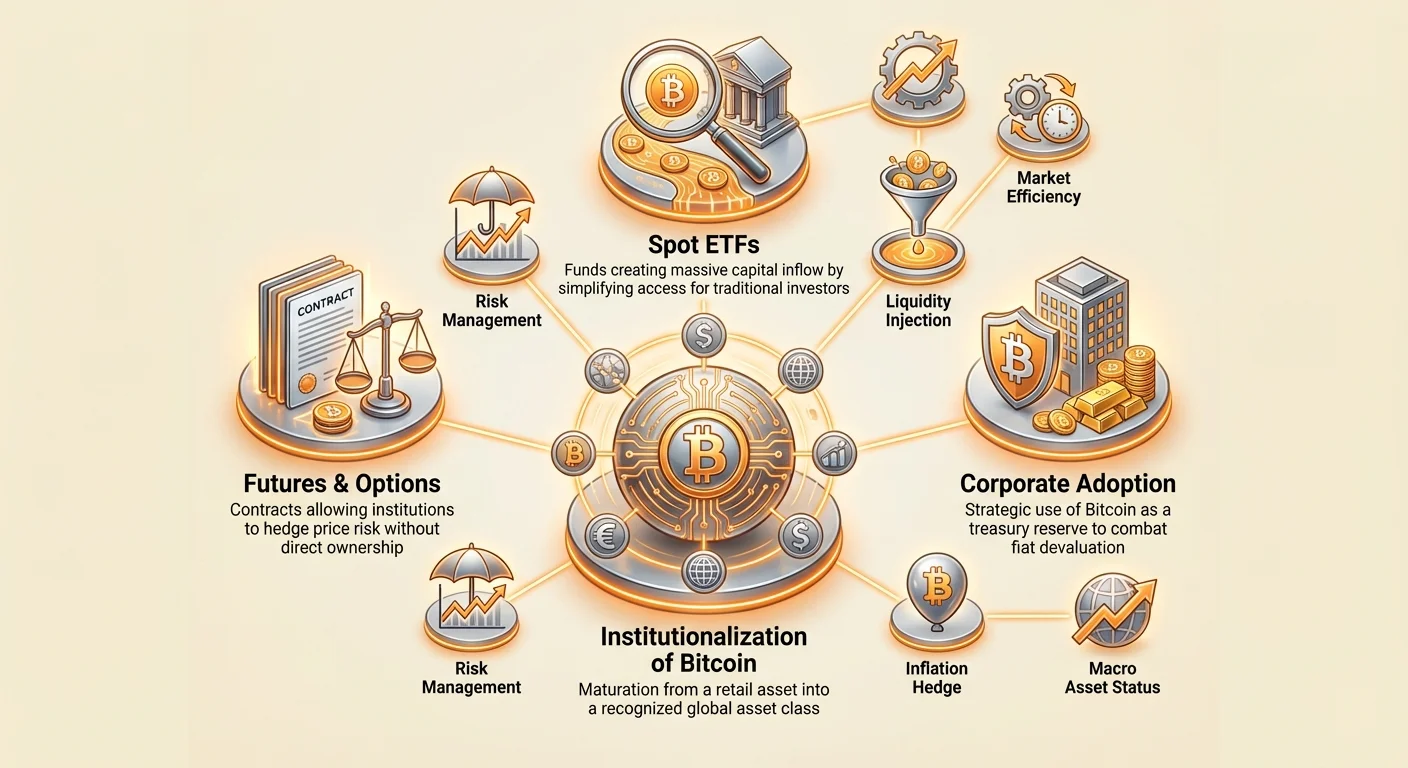
However, over the last few years, a profound shift has occurred. Large financial institutions, public corporations, and regulated exchanges have begun integrating Bitcoin into the traditional financial (TradFi) structure. This process, known as institutionalization, signals the maturation of Bitcoin from a niche technology into a recognized, regulated, and significant global asset class.
This deep dive examines the three primary pillars of Bitcoin’s institutional integration: the introduction of regulated financial products (Futures and Options), the arrival of spot Exchange-Traded Funds (ETFs), and the strategic adoption of Bitcoin as a corporate treasury reserve asset. Understanding these pillars is essential for any investor or analyst seeking to project Bitcoin’s long-term market dynamics and its role within the broader macroeconomic environment.
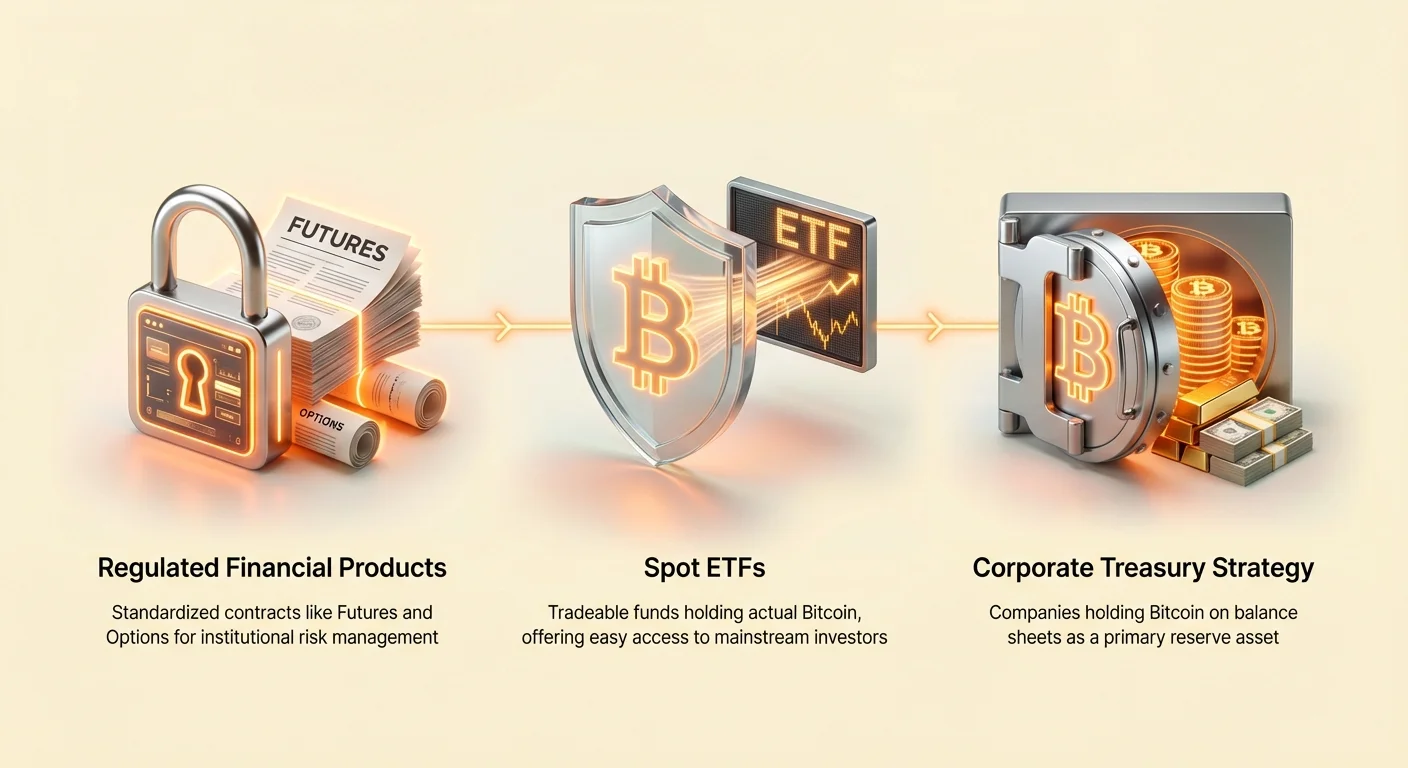
Phase One: The Gateway Drug—Regulated Financial Products
The initial steps toward institutional acceptance were cautious, focusing on derivatives markets. Institutions required regulated, standardized products that allowed them to participate in Bitcoin’s price movements without directly handling the complexities of cryptocurrency exchanges, private keys, or wallet security. This necessity gave rise to Bitcoin Futures and Options trading, predominantly through established exchanges like the CME (Chicago Mercantile Exchange).
Understanding Bitcoin Futures Contracts
A Bitcoin futures contract is a derivative agreement where two parties agree to buy or sell a specific quantity of Bitcoin at a predetermined price on a set future date.
Crucially, cash-settled futures (like those offered by the CME) do not require the physical delivery of Bitcoin. Instead, when the contract expires, the difference between the agreed-upon price and the current market price is settled in fiat currency (USD).
Why this matters for institutions:
- Risk Management: Futures allow institutions to hedge against potential price declines if they already hold Bitcoin, or to lock in future purchase prices.
- Regulatory Clarity: Trading futures on regulated exchanges places the activity squarely within existing financial oversight, satisfying compliance departments and risk officers.
- Leverage: Institutions can gain significant exposure to Bitcoin’s price movements by posting only a fraction of the contract value as margin.
Analyzing the Futures Market Premium: Contango and Backwardation
One of the most valuable indicators derived from the institutional futures market is the relationship between the Spot Price (the current market price) and the Futures Price (the price of a contract set to expire months from now). This relationship reveals institutional expectations and the cost of capital in the crypto space.
Contango (The Standard State)
When the Futures Price is higher than the Spot Price, the market is said to be in Contango. This is the standard state for most commodities and assets, reflecting the cost of carrying the asset (storage costs, insurance, and interest rates).
- Interpretation: In Bitcoin, contango usually implies that institutions are willing to pay a premium to acquire exposure later. It often reflects general bullish sentiment or the cost incurred by arbitrage traders (those who buy spot and sell futures to lock in a profit).
Backwardation (The Stress State)
When the Futures Price is lower than the Spot Price, the market is in Backwardation. This is a rare and often significant market signal.
- Interpretation: Backwardation suggests extreme demand for Bitcoin in the near term, or intense selling pressure on long-dated contracts. Historically, this state can indicate that short-term players are aggressively buying spot Bitcoin (creating high demand) while professional traders anticipate a future price drop, or that institutions are heavily hedging their long-term positions. It can be a sign of market stress or heavy shorting.
By observing the futures curve (the prices of futures contracts across different expiry dates), analysts gain insight into institutional sentiment and market health, providing a level of transparency that was previously absent in purely retail-driven crypto markets.
The Role of Options Markets in Hedging
Complementing futures are Bitcoin options contracts. An option gives the holder the right, but not the obligation, to buy (a call option) or sell (a put option) Bitcoin at a specified price before a specific expiration date.
Institutional investors use options extensively for complex risk management strategies:
- Insurance: Purchasing put options acts as insurance against a massive price drop.
- Income Generation: Selling covered call options can generate income on existing Bitcoin holdings.
The growth of regulated options trading adds crucial layers of maturity to the Bitcoin market, allowing professionals to execute detailed volatility and directional bets, leading to deeper overall market liquidity and better price discovery.
The Game Changer: Spot Exchange-Traded Funds (ETFs)
While futures provided institutions with a hedging tool, they did not offer the simplest, most direct mechanism for mainstream investors and pension funds to gain exposure. The Spot Bitcoin ETF—a fund that holds actual Bitcoin and issues shares traded on traditional stock exchanges—changed the investment landscape entirely.
Accessibility and the Demand Shock
Prior to the spot ETF, a typical financial advisor recommending Bitcoin exposure to a client faced significant hurdles: opening accounts on unfamiliar crypto exchanges, dealing with self-custody or high-fee trust products, and navigating complex tax reporting.
A spot ETF eliminates these barriers by providing a simple stock ticker:
- Seamless Integration: Investors can buy ETF shares directly through their existing brokerage accounts (Fidelity, Schwab, etc.), retirement accounts (401k, IRA), and institutional platforms.
- Due Diligence: Because the ETF must be approved by financial regulators (like the SEC in the US), it carries an implicit layer of governmental oversight and legitimacy that satisfies compliance and risk departments across large institutions.
- Massive Capital Flow: This accessibility unlocks vast pools of capital—including pension funds, endowments, and managed wealth funds—that are legally restricted from investing in unregulated assets but can easily purchase shares of a regulated ETF. The result is a substantial structural demand shock for Bitcoin.
Impact on Liquidity and Price Discovery
The flow of billions of dollars into spot ETFs has fundamentally altered Bitcoin's market structure, primarily by centralizing significant custodial responsibility and enhancing market efficiency.
Liquidity Injection
Liquidity refers to how easily an asset can be bought or sold without significantly impacting its price. ETFs require major financial players (known as Authorized Participants or APs) to create and redeem shares.
- Creation: When demand for the ETF share exceeds supply, APs must buy physical Bitcoin from the open market and deliver it to the ETF issuer in exchange for new shares. This process directly injects demand into the underlying asset market.
- Redemption: When ETF shares are sold off, APs redeem the shares with the issuer for physical Bitcoin, which they then sell on the open market.
This continuous process, managed by expert market makers, dramatically increases the depth and robustness of the spot market, reducing the impact of single large trades and potentially dampening extreme volatility over the long term.
Improved Price Discovery
Before institutional adoption, Bitcoin’s price was largely driven by trading on offshore exchanges with varying degrees of oversight. Now, with major players like BlackRock and Fidelity operating massive spot ETFs, the price discovery process is increasingly informed by the most sophisticated market makers in the world.
These market makers use complex algorithms and real-time data to ensure the ETF price accurately reflects the underlying BTC price. This pressure ensures that Bitcoin's global price is determined more efficiently and transparently, linked directly to global financial indices and platforms.
Custody and Security: Delegating the Risk
For traditional finance, managing digital assets presents enormous operational risks. A centralized financial institution cannot afford the risk of losing private keys. The spot ETF solves this operational headache.
When an investor buys an ETF share, they are not taking on the burden of self-custody. Instead, the ETF issuer hires specialized, highly regulated custodians (often institutional entities like Coinbase Custody or Gemini Trust Company) to securely store the vast reserves of Bitcoin in dedicated cold storage vaults.
This delegation of security and operational risk is essential for institutional confidence. It allows pension funds and endowments to participate in Bitcoin’s potential growth without building expensive, specialized cybersecurity infrastructure internally.
Phase Two: The Corporate Treasury Strategy
While Futures and ETFs addressed how external investors interact with Bitcoin, the second major wave of institutionalization involved corporations—specifically, the strategic decision to hold Bitcoin on their own balance sheets as a primary treasury reserve asset.
This movement represents a fundamental shift in how corporations view their cash reserves, moving away from traditional, low-yielding fiat assets toward a potentially higher-growth, inflation-resistant store of value.
Why Corporations Hold Bitcoin: The Inflation Hedge Thesis
Traditional corporate treasury management dictates that cash reserves—money the company doesn't need for immediate operations—should be held in extremely low-risk assets like short-term Treasury bills or bank deposits. The primary goal is preservation of capital.
However, in periods of high monetary expansion and sustained inflation, these fiat assets rapidly lose purchasing power. If inflation runs at 5% annually, a dollar held in cash is worth 5% less a year later.
Bitcoin, due to its verifiable scarcity—a fixed supply cap of 21 million coins—is viewed by some corporate treasurers as a superior hedge against fiat devaluation.
Key features supporting the treasury thesis:
- Absolute Scarcity: Unlike fiat currencies, which can be printed indefinitely, Bitcoin’s supply schedule is fixed and auditable.
- Immutability: Its rules cannot be changed by any single government or central bank, offering protection against geopolitical risk.
- Portability: Large values can be secured and transported globally with ease, making it a highly effective international reserve asset.
By converting portions of their treasury reserves into BTC, corporations aim to preserve, and potentially grow, the value of their shareholders' capital over the long run, positioning themselves to maintain purchasing power in a volatile macroeconomic climate.
Case Study: MicroStrategy (MSTR) and the Corporate Pioneer Model
The prime example of the corporate treasury strategy is MicroStrategy (MSTR), led by Chairman Michael Saylor. Starting in 2020, MSTR adopted a strategy to make Bitcoin its primary treasury reserve asset.
MicroStrategy's strategy is unique and highly aggressive:
- The Bitcoin Standard: They recognized the erosion of value in traditional cash holdings and publicly declared a shift to the Bitcoin standard.
- Debt and Equity Financing: MSTR aggressively raised capital—issuing senior convertible notes (debt) and selling stock (equity)—specifically to purchase more Bitcoin. This effectively leveraged their balance sheet to acquire the asset.
- A Proxy Investment: MSTR has functionally become a Bitcoin holding company that also runs a software business. Because their holdings are so large relative to their traditional business, MSTR shares now trade as a highly volatile proxy for Bitcoin itself.
The MSTR model demonstrates institutional confidence in Bitcoin's long-term trajectory. It argues that a corporation's primary duty is to maximize shareholder value, and in a climate of persistent fiat degradation, holding scarce digital assets is the most responsible treasury strategy.
Accounting Challenges and Shareholder Risk
While the rewards of corporate adoption can be significant, the strategy introduces notable complexity and risk:
Accounting Treatment
Under traditional accounting standards (like GAAP in the US), Bitcoin is treated as an "intangible asset with an indefinite life," not a financial asset like currency. This mandates that companies must record an impairment loss if Bitcoin's price drops below the initial purchase cost, but they cannot record gains until the asset is sold.
- The Problem: If a company buys BTC at $50,000 and the price drops to $30,000, they must record a $20,000 loss on their income statement (impairment), even if they haven't sold the asset. If the price then recovers to $60,000, they cannot record the $30,000 recovery or the $10,000 profit until the sale occurs. This creates misleading volatility on corporate earnings reports, often frustrating investors who do not understand the underlying accounting quirk.
Shareholder Volatility
For companies following the MSTR model, their share price becomes tightly correlated with Bitcoin’s price history. This drastically changes the risk profile of the stock. Investors purchasing MSTR are primarily betting on the future price of BTC, not necessarily the performance of the company's core software business. This adds considerable volatility and systemic risk to the traditional equity market.
Despite these challenges, the precedent set by corporate adoption signifies that Bitcoin has moved beyond mere speculation and has entered the realm of strategic, macroeconomic asset allocation.
Synthesizing the Institutional Impact on Market Structure
The unified force of institutional products (ETFs, Futures) and corporate balance sheets (Treasury Adoption) has profound implications for Bitcoin’s long-term market behavior and its relationship with the global economy.
From Retail Asset to Macro Asset
Institutionalization means Bitcoin is no longer solely driven by the retail cycle. Its price movements are increasingly influenced by the same macro factors that govern traditional assets:
- Interest Rate Policy: Like gold and other non-yield-bearing assets, Bitcoin tends to respond negatively to rising real interest rates and positively to quantitative easing or rate cuts.
- Dollar Strength (DXY): As a global risk-off/risk-on asset, Bitcoin often shows an inverse correlation with the US Dollar Index (DXY).
- Geopolitical Stability: In times of high geopolitical stress or banking crises, institutions view Bitcoin as an unregulated, seizure-resistant safe haven, driving demand.
The asset’s status has shifted from a fringe technology investment to a legitimate player in the global macro playbook, requiring analysts to apply traditional financial models (such as discounted cash flow models or scarcity analysis) rather than purely technological ones.
New Correlation Dynamics and Portfolio Theory
Initially, one of Bitcoin's most attractive qualities for traditional investors was its uncorrelation with traditional stocks and bonds. This meant adding a small allocation of Bitcoin to a portfolio could improve overall returns while lowering volatility (a cornerstone of the Modern Portfolio Thesis).
However, as institutional adoption accelerates, Bitcoin's correlation with certain high-beta (high-risk, high-growth) technology stocks and assets tends to increase, especially during "risk-on" environments.
When institutions buy Bitcoin through ETFs, they are often using the same capital allocation models and decision-making processes that they use for tech stocks. During market crashes (risk-off events), institutions tend to sell all their risk assets simultaneously, leading to higher correlation across the board.
Understanding this evolving correlation profile is critical for portfolio managers. While Bitcoin may maintain its utility as a long-term inflation hedge, its effectiveness as a short-term, uncorrelated diversification tool may diminish as institutional ownership deepens.
The Rise of Market Efficiencies
Ultimately, institutional integration drives efficiency. The involvement of professional market makers, high-frequency trading firms, and regulated platforms results in:
- Tighter Spreads: The difference between the highest buy price and the lowest sell price (the spread) narrows, making transactions cheaper.
- Lower Arbitrage Opportunities: Price discrepancies between different global exchanges are quickly closed, resulting in a single, more reliable global price for BTC.
- Reduced Manipulation Potential: While manipulation risks always exist, the sheer volume and deep pockets of institutional participants make it exponentially harder for small groups to significantly sway the market.
This enhanced efficiency solidifies Bitcoin’s position as a mature, globally traded asset suitable for large-scale capital deployment.
Conclusion
The institutionalization of Bitcoin is not just a passing trend; it is the inevitable structural evolution required for any asset to transition from a revolutionary concept to a global reserve candidate.
The pathway was paved first by sophisticated derivatives (Futures and Options) that allowed institutions to manage risk and express price opinions, followed by the breakthrough of the Spot ETF, which provided seamless, regulated access to trillions of dollars in traditional capital. Finally, the corporate treasury movement legitimized Bitcoin’s role as an inflation hedge and long-term store of value on the balance sheets of public companies.
This unified institutional front has transformed Bitcoin from a purely retail, cyclical phenomenon into a macro asset sensitive to global economic policy. While it introduces new levels of complexity, regulation, and correlation with traditional risk assets, it also ensures permanence, deep liquidity, and a reliable structure for future capital flows. For the serious investor, monitoring the activities in the futures market, the flows in the ETF vehicles, and the ongoing corporate adoption trends provides the clearest roadmap for navigating the future of this digital asset class.