
The rise of decentralized finance (DeFi) fundamentally changed how users interact with cryptocurrency, moving beyond simple transactions to complex lending, borrowing, and trading protocols. However, the world’s most secure and recognized cryptocurrency, Bitcoin (BTC), was architecturally incompatible with these highly programmable environments, particularly those built on chains like Ethereum.
To bridge this massive liquidity gap, the concept of "wrapped Bitcoin" was introduced. Wrapped Bitcoin (most famously wBTC) is essentially a tokenized representation of actual BTC, allowing Bitcoin’s value to be utilized on other blockchains. This innovation unlocked billions of dollars in liquidity for the DeFi ecosystem.
While wrapped assets offer unparalleled interoperability, they introduce profound security, custody, and centralization risks that fundamentally undermine the self-sovereignty Bitcoin champions. This article provides a critical analysis of the necessary compromises required to wrap Bitcoin, focusing on the custody models, bridging architecture, and the complex trade-offs users must navigate to participate in cross-chain finance. For the user, understanding these risks is the difference between utilizing a secure, tokenized asset and exposing capital to a devastating single point of failure.
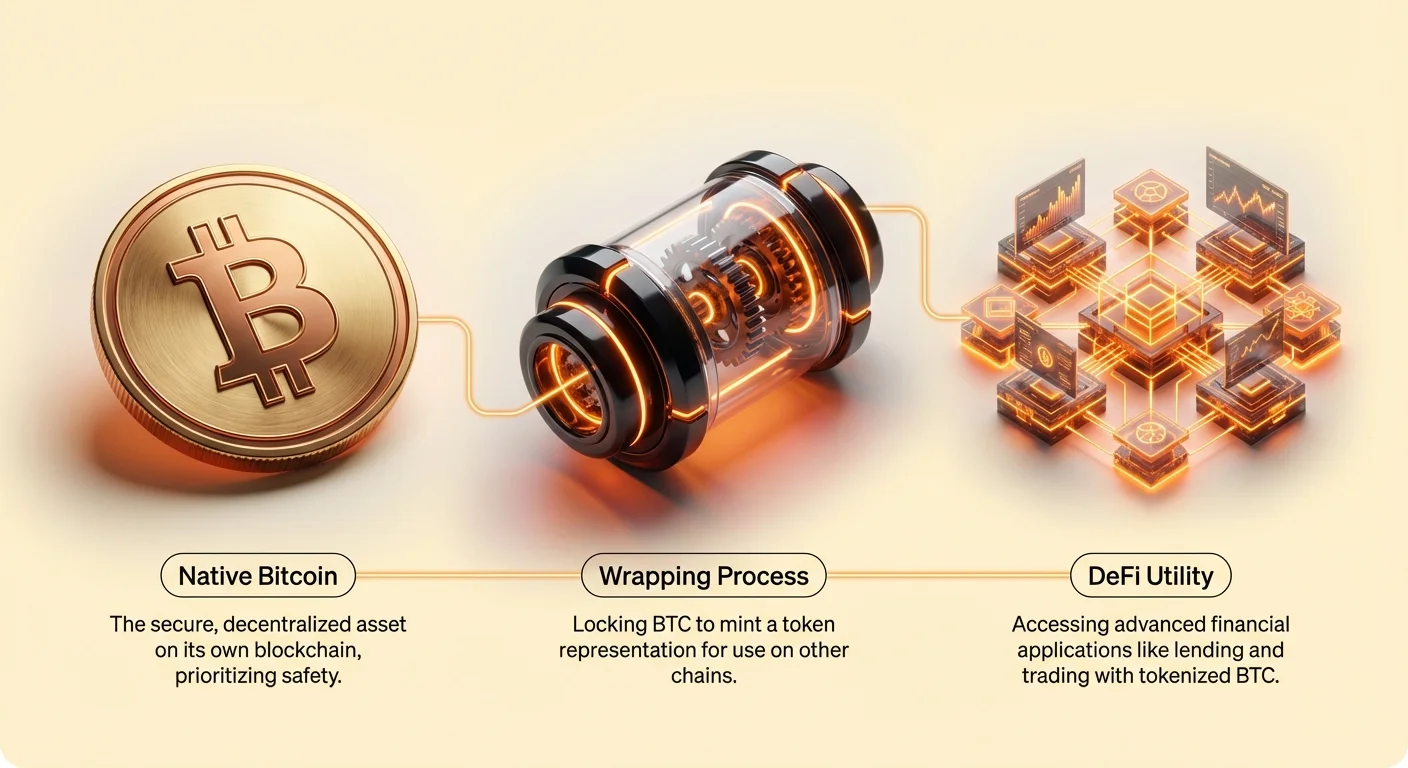
The Necessity of Wrapping: Bitcoin’s Trade-Off
Bitcoin's foundational design prioritizes security, decentralization, and predictability above all else. Its scripting language, intentionally simple, makes it incredibly robust for peer-to-peer monetary transfers but highly unsuitable for the complex, state-changing logic required by DeFi applications—such as automated market makers or collateralized debt positions.
When users want to leverage their BTC in the Ethereum ecosystem (or any other smart contract platform), they face the "walled garden" problem: the two networks cannot natively communicate or transfer assets directly. Wrapping Bitcoin is the technical solution to this interoperability challenge.
What is a Wrapped Asset?
A wrapped asset is a crypto token that maintains its value by being "pegged" 1:1 to an underlying asset held in reserve. Think of it like a digital IOU (I Owe You).
- A user deposits 1 BTC into a digital vault (or smart contract).
- The vault locks the BTC.
- A corresponding 1 wrapped BTC (e.g., 1 wBTC) is minted on the target blockchain (e.g., Ethereum).
- The user can then use this wBTC within Ethereum's DeFi ecosystem.
This process maintains the economic value of Bitcoin while gaining access to the technical functionality of a different blockchain. However, the integrity of this entire system relies solely on the security and trustworthiness of the mechanism holding the original 1 BTC in the vault.
The Interoperability Security Spectrum
To facilitate this cross-chain movement, a "bridge" must be established. All bridges fall somewhere on the spectrum between fully custodial (requiring trust in a central party) and fully trustless (relying solely on cryptographic proofs and decentralized validators). The choice of mechanism directly determines the security risks borne by the user.
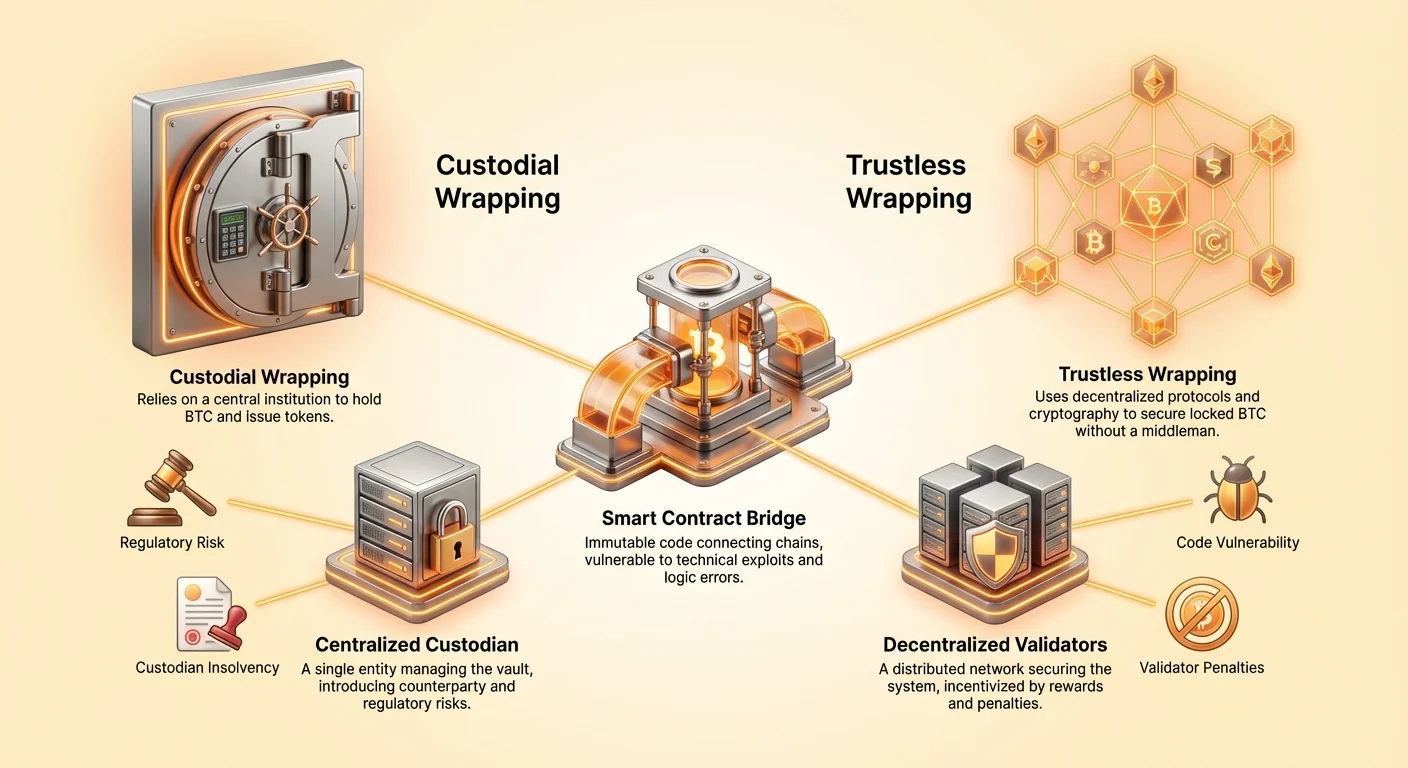
Custodial vs. Trustless Pegging Mechanisms
The way Bitcoin is locked and the corresponding wrapped token is issued defines the set of security risks. Most of the liquidity currently utilized by DeFi comes from the custodial model, which carries the highest degree of centralization risk.
1. Custodial Wrapping (The wBTC Model)
The dominant model for wrapped Bitcoin is custodial, where a consortium of institutions (custodians and merchants) manages the locking and minting process. Wrapped Bitcoin (wBTC) is the prime example of this architecture.
Reliance on Third-Party Trust
In the custodial model, users must deposit their BTC with an authorized custodian—a centralized entity that holds the real Bitcoin in reserve. This structure instantly reintroduces counterparty risk, which is exactly what Bitcoin was designed to eliminate.
The security of the wrapped token is no longer derived purely from cryptography or network decentralization but from the trustworthiness, legal standing, and security practices of the custodian. If the custodian is hacked, mismanages the funds, or is subject to regulatory seizure, the underlying BTC backing the wrapped token may be lost or rendered inaccessible.
Centralized Control and Compliance Risk
Because custodians are often regulated financial entities, they must comply with Anti-Money Laundering (AML) and Know Your Customer (KYC) laws. This means the process of minting and redeeming wBTC is often permissioned. While the wBTC token itself is decentralized on Ethereum, the creation and destruction of the token are centralized.
This centralized control introduces compliance risk: the custodian could, under legal or regulatory duress, be forced to freeze, seize, or refuse redemption of the underlying BTC linked to specific wrapped tokens. For users pursuing self-sovereignty and censorship resistance, custodial wrappers fundamentally compromise these goals.
2. Trustless Wrapping (Decentralized Bridges)
Decentralized, or trustless, wrapping protocols (such as tBTC, Threshold Network) aim to remove the centralized custodian, relying instead on decentralized security measures like cryptographic proof, multi-party computation (MPC), or threshold signatures.
Security through Cryptography and Staking
In a trustless system, the real BTC is secured not by one vault manager, but by a decentralized network of signers or validators. These signers must collaborate using advanced cryptography (like threshold signatures) to release the BTC. They are usually incentivized through rewards and penalized (slashed) if they attempt to steal the funds or fail to perform their duties.
The primary risk shifts away from counterparty failure to technical failure. The security of trustless wrapping relies entirely on the correct execution of highly complex smart contracts and the honesty of the validator set.
Smart Contract Vulnerabilities
While decentralized, these systems are vulnerable to sophisticated smart contract exploits. If a bug exists in the code governing the MPC protocol or the slashing mechanism, hackers could exploit it to steal the locked BTC without triggering the penalty system. Due to the complexity of these cryptographic protocols, identifying and securing every potential vulnerability is an immense challenge.
The Threat Surface of Cross-Chain Bridges
Regardless of whether the pegging mechanism is custodial or trustless, the entire system relies on the "bridge" that connects the two blockchains. Bridges are the most exploited piece of infrastructure in the crypto ecosystem. They are massive “honeypots” containing billions of dollars, making them prime targets for malicious actors.
Bridge Vulnerability: The Code is Law (Until It Fails)
Bridges operate using logic written into smart contracts. These contracts are immutable and self-executing, managing the complex process of locking assets on the source chain and minting them on the destination chain.
Technical Exploits and Logic Errors
The vast majority of bridge hacks stem from technical flaws, not brute-force attacks. Hackers often exploit subtle errors in the contract logic, signature verification systems, or the way the bridge communicates information across chains (oracles).
Example: If a bridge fails to correctly verify the proof that assets were locked on Chain A, a hacker might be able to trick the bridge on Chain B into minting tokens that are not actually backed by anything—leading to catastrophic loss for the protocol and leaving users with worthless, unbacked tokens.
Centralization of Validators
Many bridges, even those marketed as decentralized, rely on a relatively small set of validators (often fewer than 20) to confirm the transactions. If a malicious actor gains control of a simple majority of these validator keys, they can authorize fraudulent transactions, emptying the entire reserve of locked BTC. This is essentially a centralized point of failure disguised as a distributed system.
Governance and Upgrade Risks
Bridges are not static; they require updates, bug fixes, and improvements. The process by which the smart contract governance is managed introduces another major risk vector.
Malicious or Compromised Governance
If the bridge governance system (often controlled by a small council or multisig wallet) is compromised, the attackers can vote to change the bridge contract parameters, redirecting the locked funds to their own wallets. This is often the risk associated with a "rug pull" or developer exit scam, where the bridge architects intentionally exploit the system’s upgrade mechanism. Users who commit assets to a bridge must perform intense due diligence on the governance structure: Who holds the keys, and what powers do they have?
Economic and Systemic Security Risks
Beyond the technical risks of custody and bridging, using wrapped Bitcoin exposes users and the wider ecosystem to specific economic and systemic threats related to maintaining the 1:1 peg.
The Threat of De-Pegging
The core promise of wrapped Bitcoin is that 1 wBTC can always be redeemed for exactly 1 BTC. A "de-peg" occurs when this parity is lost, and the wrapped asset begins trading at a significant discount to the underlying asset.
Causes of De-Pegging
De-pegging is typically triggered by a catastrophic event that breaks the faith in the redemption mechanism:
- Bridging Exploit: A major hack drains the underlying BTC reserves, making it impossible for the custodian/bridge to honor redemption requests. Since the market knows the asset is no longer fully backed, the wBTC price collapses.
- Custodian Insolvency: In a custodial model, the custodian could face bankruptcy or regulatory seizure, freezing the reserve assets and preventing withdrawal.
- Market Panic: Fear, uncertainty, and doubt (FUD) alone can trigger a temporary de-peg if a mass exodus forces users to sell wBTC rather than wait for the redemption process, driving down its trading price.
The risks here are asymmetric: While a bridge hack might only affect the bridge, a widespread wBTC de-peg could threaten the stability of the entire DeFi ecosystem, given how frequently wBTC is used as collateral for loans.
Regulatory and Tax Uncertainty
Wrapped assets introduce significant complexity in the eyes of regulators and tax authorities.
For regulators, the question remains: Is a wrapped asset considered a derivative, a security, or merely a cryptographic IOU? The answer could determine which regulatory body (if any) has jurisdiction over the custodian or the bridge operators. This uncertainty makes the entire ecosystem vulnerable to sudden, disruptive regulatory enforcement actions.
For users, determining tax liability for wrapping, unwrapping, and transacting with the tokenized asset across different chains can be highly complex, potentially leading to unforeseen compliance burdens.
Systemic Concentration Risk
Because wBTC dominates the wrapped Bitcoin market, it introduces systemic concentration risk. If wBTC were to suffer a critical failure—such as a large-scale compromise of its custodial reserves—the repercussions would ripple throughout every major lending, borrowing, and trading protocol that relies on it as collateral.
In essence, by funneling the vast majority of Bitcoin’s DeFi liquidity through a single centralized mechanism, the system has created a crucial dependency. This dependency negates the distributed, resilient nature of Bitcoin itself, replacing it with a fragile, interconnected financial structure built upon trust in a few key actors.
User Due Diligence: Mitigating Wrapped Bitcoin Risks
For users who decide that the utility of accessing DeFi outweighs the associated security compromises, careful due diligence is paramount. The responsibility for evaluating the safety of wrapped assets falls entirely on the user.
1. Analyze the Pegging Mechanism
The first step is identifying who holds the keys to the kingdom.
| Model | Key Question | Security Risk Type |
|---|---|---|
| Custodial (e.g., wBTC) | Who is the custodian? Are they regulated? Do they undergo regular, verifiable audits of their reserves? | Counterparty risk, regulatory risk, centralized control. |
| Trustless (e.g., tBTC) | How many validators are securing the BTC? What is the penalty (slashing) mechanism if they misbehave? Is the code open source? | Smart contract risk, economic incentives failure, governance risk. |
Actionable Tip: Always seek out real-time proof-of-reserve audits for custodial models. For trustless models, examine the size and reputation of the validator set and review security audits of the smart contracts.
2. Evaluate Bridge Architecture and Governance
The bridge is the most likely attack vector. Research the specific bridge being used (e.g., if wBTC is moved across chains via a secondary bridge).
- Validator Set Size: A small validator set (e.g., 5-10 signers) indicates a high risk of collusion or compromise. A larger, more distributed set improves security.
- Time Tested: Newer bridges, while innovative, have not had sufficient time to prove their resilience in the face of sophisticated attacks. Older, battle-tested bridges, while not immune, carry a slightly lower risk profile.
- Insurance and Risk Mitigation: Does the protocol offer decentralized insurance or a recovery fund for users in the event of a catastrophic failure? This does not eliminate risk but provides a financial safety net.
3. Maintain Diversification and Limit Exposure
Never allocate a disproportionate amount of capital to a single wrapped asset or a single bridging solution.
Wrapped assets should be treated as high-risk, high-utility tools, not as primary stores of value. If you utilize wBTC as collateral, be hyper-aware of your liquidation levels, especially during periods of market stress when a de-peg event could trigger massive, cascading liquidations.
The decentralized nature of crypto means that no central authority will bail out users when a bridge fails or a custodian is compromised. Self-custody of the original Bitcoin (on the native Bitcoin blockchain) remains the most secure long-term storage solution.
Conclusion: The Interoperability Trade-Off
Wrapped Bitcoin represents an undeniable triumph of technical ingenuity, successfully marrying the deep liquidity of Bitcoin with the complex programmability of chains like Ethereum. It has driven massive innovation and capital efficiency in the DeFi space.
However, this utility is achieved only through a fundamental, inescapable compromise: trading the absolute security and censorship resistance of the native Bitcoin network for the functional utility of a tokenized representation.
Whether utilizing custodial or trustless wrapping methods, users must accept that they are relying on complex infrastructure—be it a centralized financial entity or a brittle smart contract bridge—that introduces a single point of failure. The trade-off is clear: more functionality comes with exponentially greater risk.
For the self-sovereign user, understanding the risks inherent in wrapped assets—from counterparty custody and smart contract exploits to the potential for systemic de-pegging—is the final and most critical layer of security in the new digital economy. True self-sovereignty demands skepticism toward any mechanism that requires locking away your underlying asset in a third-party vault.