
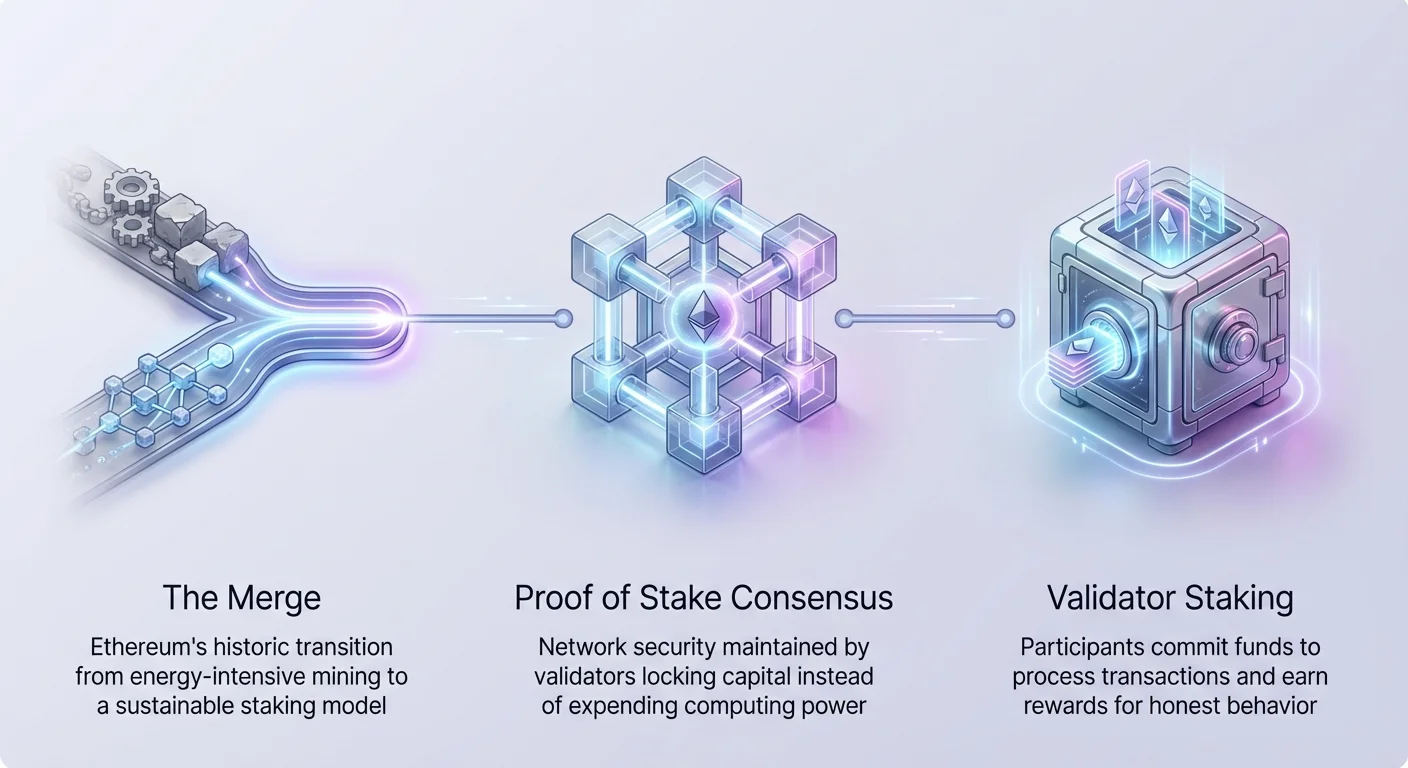
The transition of Ethereum from a mining-based system to a staking-based model represents one of the most significant upgrades in the history of blockchain technology. This shift, often referred to as The Merge or Ethereum 2.0, fundamentally altered how the network achieves consensus and maintains security. Unlike the previous system that relied on energy-intensive hardware to solve complex mathematical puzzles, the new model secures the network through financial commitment.
This evolution addresses several critical challenges facing decentralized networks. The primary goals are to increase speed, improve efficiency, and enhance scalability without compromising the core tenets of security or decentralization. By replacing physical mining infrastructure with virtual validators, the network has drastically reduced its environmental footprint while laying the groundwork for future scaling solutions.
Staking serves as the economic engine that powers this new consensus mechanism. It functions as a system of incentives and penalties designed to align individual behaviors with the health of the entire network. Participants lock up their cryptocurrency as a form of collateral, granting them the right to process transactions and propose new blocks. This financial bond ensures that those securing the network have a tangible interest in its continued success and integrity.
The Mechanics of Proof of Stake
The Proof of Stake (PoS) mechanism replaces the competitive nature of mining with a deterministic selection process. In this system, validators are chosen to create new blocks based on the amount of cryptocurrency they have committed to the protocol. This selection process eliminates the need for massive computational power, shifting the resource requirement from electricity to capital.
The Role of Validators
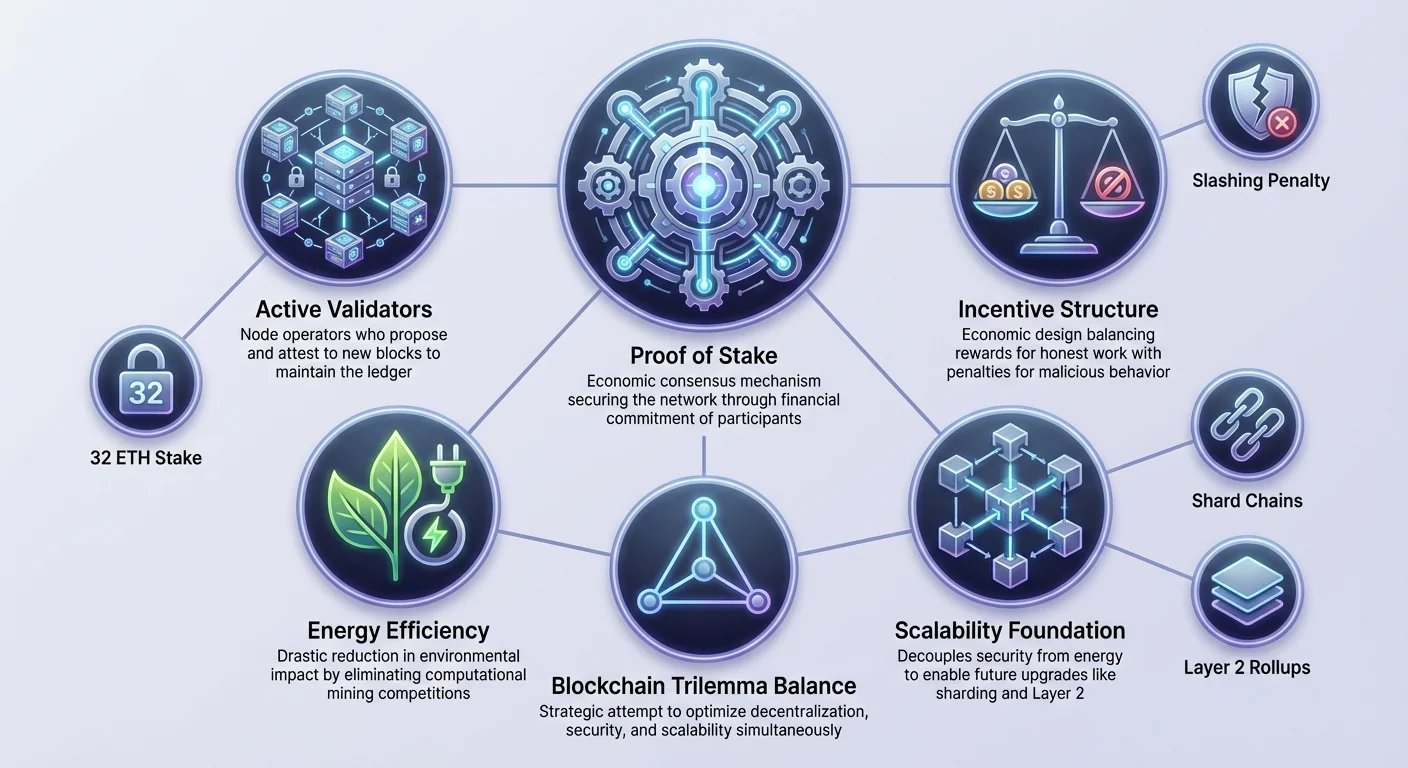
Validators are the backbone of the Proof of Stake model. To participate, a user must stake a specific amount of cryptocurrency—typically 32 ETH in the case of Ethereum—into a smart contract. This act of staking transforms a user into a validator, effectively replacing the miners of the previous Proof of Work era. Once active, validators are responsible for checking transactions, verifying activity, and voting on the validity of blocks proposed by others.
When a validator is selected to propose a new block, they organize pending transactions and broadcast them to the network. Other validators then attest to this block, confirming that it follows all protocol rules. This collaborative process ensures that the distributed ledger remains consistent across all nodes globally. The system relies on a large, distributed set of these participants to prevent any single entity from gaining control.
Rewards and Penalties
The security of a Proof of Stake network relies on a "carrot and stick" approach. Validators earn rewards for performing their duties correctly. These rewards come from newly minted cryptocurrency and transaction fees paid by users. This income stream incentivizes honest participation and encourages users to lock up their assets, reducing the circulating supply and potentially influencing market dynamics.
Conversely, the protocol enforces strict penalties for malicious behavior or negligence. If a validator attempts to validate fraudulent transactions or attack the network, they face a punishment known as "slashing." Slashing involves the forfeiture of a portion, or potentially all, of the staked assets. Even failing to stay online can result in minor penalties. This financial risk ensures that attacking the network is economically irrational, as the attacker would destroy their own capital in the process.
Solving the Blockchain Trilemma
A core challenge in cryptocurrency development is the "blockchain trilemma." This concept posits that a decentralized network can typically only optimize for two of three primary features: decentralization, security, and scalability. For example, a network might be highly secure and decentralized but slow, or fast and secure but centralized. The move to Proof of Stake is a strategic attempt to overcome these inherent trade-offs.
Decentralization and Security Balance
In the previous Proof of Work system, security was derived from the immense cost of electricity and hardware required to overwhelm the network. However, this led to the rise of massive mining farms, arguably centralizing power among those with access to cheap energy and specialized equipment. Proof of Stake changes this equation by lowering the hardware barrier to entry. Validators do not need industrial-grade servers; they can operate on consumer-grade computers.
This accessibility theoretically allows for a wider distribution of network participants. With thousands of active validators, the network becomes more resistant to censorship and manipulation. To compromise the chain, an attacker would need to acquire a majority of the staked supply, a feat that becomes increasingly expensive as the network grows. The diversity of validators helps maintain "credible neutrality," ensuring the protocol does not discriminate against specific users or transactions.
The Scalability Hurdle
Scalability remains the third pillar of the trilemma. While the transition to Proof of Stake immediately improved energy efficiency, it did not instantly solve transaction throughput issues. The Ethereum mainnet still faces congestion during periods of high demand, leading to elevated gas fees. This occurs because every node in the network must process every transaction, creating a bottleneck.
To address this, the network is implementing a multi-phase upgrade path. Proof of Stake is merely the foundation required to support more advanced scaling techniques. By decoupling the security mechanism from energy consumption, the network can safely implement complex data structures that split the workload. This paves the way for solutions that allow parallel processing, significantly increasing the number of transactions the system can handle per second.
Sharding and Future Scaling
The implementation of Proof of Stake is a prerequisite for a scaling technique known as sharding. Sharding involves partitioning the network's database into smaller, manageable pieces called "shards." Each shard operates like a semi-independent blockchain with its own state and transaction history. This division of labor allows the network to process many transactions simultaneously rather than sequentially.
In a Proof of Work system, sharding is dangerous because it dilutes the security power. If the hashrate is split among many shards, it becomes easier for an attacker to overpower a single shard. However, in Proof of Stake, validators are randomly assigned to different shards. This randomization makes it statistically impossible for an attacker to concentrate their stake on a specific shard to corrupt it, provided the overall network is secure.
The timeline for these upgrades is gradual. The initial phases focus on data availability, allowing the network to store more information. Later stages aim to enable shards to execute smart contracts and manage accounts independently. This architecture aims to transform Ethereum into a high-speed platform capable of supporting global financial applications without the congestion issues that have historically plagued the mainnet.
Economic Implications and Risks
Moving to a staking model introduces new economic dynamics and potential risks that differ from mining-based systems. The security of the network is now directly tied to the value of the underlying asset. This circular relationship means that the token serves as both the currency of the network and the tool used to secure it.
| Feature | Proof of Work | Proof of Stake |
|---|---|---|
| Resource | Electricity & Hardware | Staked Cryptocurrency |
| Barrier to Entry | High (Hardware cost) | Variable (Asset cost) |
| Security Cost | Energy expenditure | Capital opportunity cost |
Wealth Concentration Concerns
A common criticism of Proof of Stake is the potential for wealth concentration, often described as "the rich get richer." Since rewards are paid roughly in proportion to the amount staked, those with large capital reserves earn more rewards. Over time, this could theoretically lead to a situation where a small group of large holders accumulates a dominant position in the network.
Unlike mining, where hardware depreciates and operational costs (electricity) force miners to sell coins, staking has near-zero marginal costs. Validators can compound their rewards without significant external expenditure. Proponents argue that mining was also exclusive to wealthy operations, but the dynamics of capital accumulation in Proof of Stake require careful monitoring to prevent centralization of governance and control.
The "Nothing at Stake" Problem
Early theoretical criticisms of Proof of Stake focused on the "nothing at stake" problem. In the event of a fork (a split in the blockchain), validators might be incentivized to validate both chains because it costs them nothing to do so. In a mining system, splitting hashrate is costly, but in staking, it is just digital signing. If validators support all forks to maximize rewards, the network could fail to achieve consensus.
Ethereum addresses this through its slashing mechanism. The protocol includes specific rules that punish validators for voting on conflicting blocks or supporting multiple versions of the chain history simultaneously. This economic threat ensures that validators must choose the correct canonical chain to protect their capital. The financial consequences of equivocation serve as the primary defense against consensus failure.
Layer 2 and The Staking Foundation
While staking secures the base layer (Layer 1), much of the actual transaction volume is moving to Layer 2 solutions. These solutions, such as rollups, sit on top of the main Ethereum network. They execute transactions off-chain at high speeds and low costs, then bundle the data and settle it on the main blockchain.
Layer 2 solutions rely entirely on the security provided by Layer 1 validators. Whether using Optimistic rollups, which assume validity unless challenged, or Zero-Knowledge (ZK) rollups, which use cryptographic proofs, the final "truth" of the ledger is guarded by the Proof of Stake consensus. This modular approach allows the mainnet to focus on security and data availability while leaving execution to efficient secondary layers.
The synergy between staking and Layer 2 is critical. As the network scales, the base layer becomes a settlement layer for high-value data. The validators' role shifts toward securing these large batches of data rather than processing every individual coffee purchase. This hierarchy ensures that user transactions remain cheap while benefiting from the multi-billion dollar economic security provided by stakers.
Governance and Network Evolution
Ethereum is not a static protocol; it requires constant evolution to fix bugs and adapt to new demands. Governance in a decentralized system is a complex political process involving various stakeholders, including validators, developers, and users. The transition to Proof of Stake has elevated the importance of validators in this ecosystem, as they are the ones who must voluntarily adopt software upgrades.
The EIP Process
Changes to the network are managed through Ethereum Improvement Proposals (EIPs). Anyone can draft a proposal, but it must pass through rigorous debate and testing. Core developers write the code, but they cannot force it onto the network. The community of node operators and validators must choose to update their software to include the new rules. If the community disagrees, it can lead to a network split, as seen in the historical divergence between Ethereum and Ethereum Classic.
This process relies on "rough consensus." There is no central CEO to make decisions. Instead, stakeholders deliberate until a majority agrees on the path forward. This decentralized governance model ensures that changes reflect the values of the community, such as censorship resistance and open access. However, it also means that controversial upgrades can take years to implement as developers seek to build broad support.
Node Diversity and Centralization Risks
For governance to remain healthy, the network requires a diverse set of node operators. If a few large entities manage the majority of validators, the network becomes vulnerable to regulatory pressure or technical failure. For instance, if a single service provider that many users rely on goes offline, it can disrupt access for a significant portion of the ecosystem.
The barrier to entry for running a node is a key factor in maintaining diversity. The Ethereum community actively debates the requirements for hardware and data storage. If the blockchain becomes too large or complex to process, only industrial data centers will be able to participate. Keeping requirements low enough for enthusiasts to run nodes at home is essential for preserving the network's "credible neutrality" and ensuring no single group can dictate the protocol's future.
Conclusion
The shift to Proof of Stake marks a maturing of the blockchain landscape, moving away from raw energy consumption toward a more sustainable economic security model. By leveraging financial incentives, the network has created a system where security scales with value. This structure not only reduces the environmental impact by over 99% but also enables new technical architectures that were previously impossible to implement safely.
As the network continues to evolve through its roadmap, staking remains the central pillar supporting all future upgrades. From sharding to Layer 2 data settlement, the economic bond provided by validators ensures the integrity of the ledger. While challenges regarding wealth concentration and governance remain, the successful implementation of this consensus mechanism demonstrates the viability of securing decentralized networks through economic alignment rather than physical resource extraction.
Staking transforms digital assets from passive holdings into active security tools for the decentralized internet.