
You have likely already internalized the theoretical arguments for Bitcoin’s inclusion in a modern portfolio—its potential as a store of value, its low correlation with traditional assets, and its role in a digitally-driven macroeconomic environment.
However, theory is useless without execution. Understanding why Bitcoin is a valuable asset differs profoundly from knowing how to integrate it safely and effectively into your overall financial architecture. Due to Bitcoin's unparalleled volatility and unique market cycles, traditional asset allocation strategies must be adapted. A passive approach risks emotional decision-making, while an overly aggressive approach invites catastrophic loss.
This guide moves beyond definitions and into the practical mechanics of ownership. We will structure your portfolio using three fundamental pillars of discipline: determining the optimal allocation size, implementing a disciplined purchasing method through Dollar-Cost Averaging (DCA), and actively managing risk through systematic rebalancing. Mastering these execution strategies is the definitive step toward building a resilient, long-term Bitcoin position.
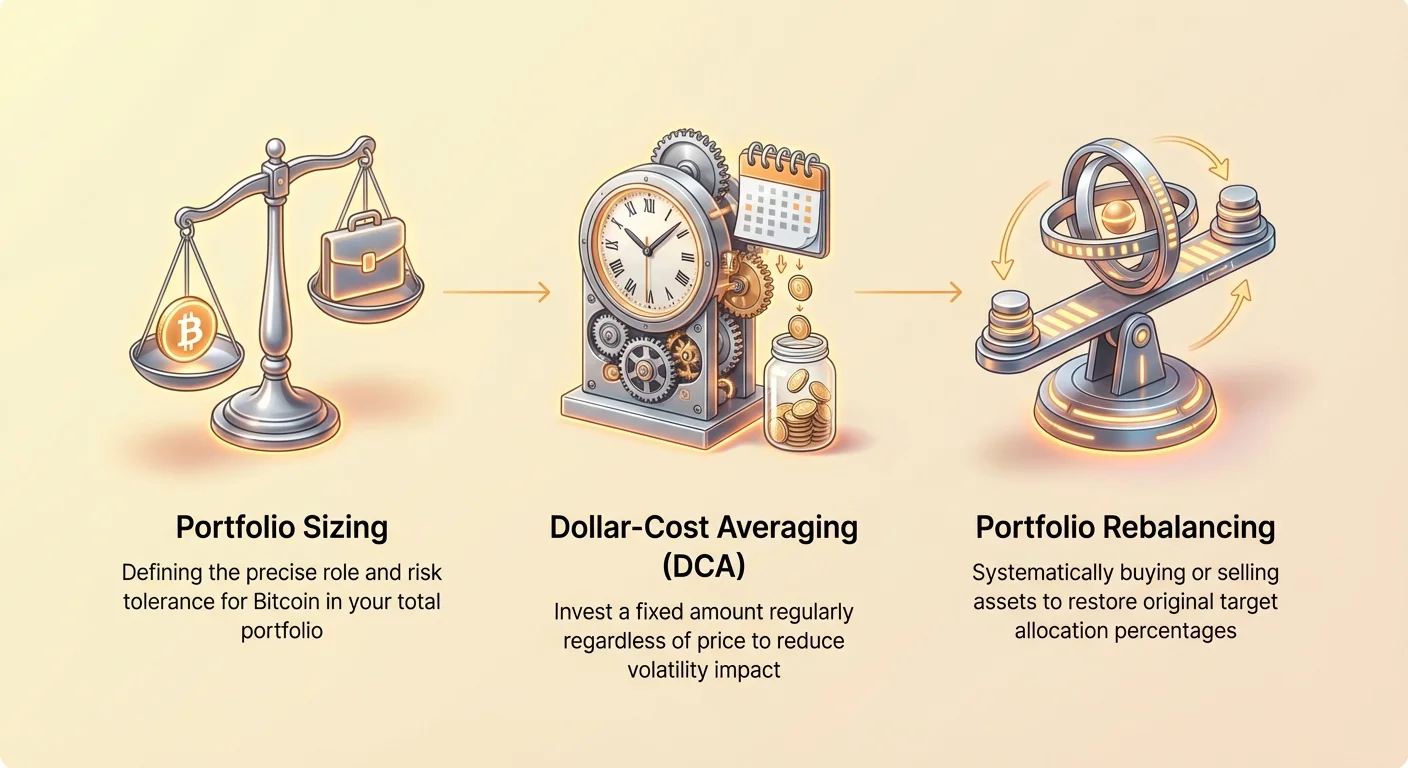
Vzpostavljanje vaše investicijske osnove: Zakaj je pomembno določanje velikosti portfelja
Pred klikom na „kupite“ mora vlagatelj določiti natančno vlogo, ki jo Bitcoin igra v celotni strukturi svojega portfelja. Ker lahko Bitcoin zlahka doživi 80 % padce (kot je bilo videti zgodovinsko) in 10-kratne dobičke v kratkih obdobjih, je pravilno določanje velikosti edino najpomembnejše orodje za omilitev tveganj, ki je na voljo.
Bitcoinov edinstveni profil tveganja/nagrade
V tradicionalnih financah (TradFi) upravitelji portfeljev uporabljajo koncept, imenovan korelacija. Če sredstvo A raste, ko sredstvo B pada, sta negativno korelirana, kar ponuja močno diverzifikacijo. Zgodovinsko je Bitcoin pogosto kazal nizko ali celo negativno korelacijo z glavnimi razredimi sredstev, kot so delnice (S&P 500) in dolgoročne obveznice.
Ta nekorelacija je glavna strukturna prednost Bitcoina v portfelju. Majhen delež BTC lahko potencialno poveča skupni donos portfelja, medtem ko rahlo zmanjša skupno nihanje če tradicionalni trgi doživljajo hudo stres.
Vendar nagrada prinaša ekstremno tveganje. Čista magnituda nihanja cene Bitcoina pomeni, da če dodelite preveč kapitala, bodo dobički – čeprav vznemirljivi – izravnani s paralizirajočim strahom, ki ga sprožijo med neizogibnimi padci medvedjega trga. Pravilno določanje velikosti zagotavlja, da lahko prestanete najhujše nihanje brez čustvene potrebe po prodaji na dnu.
Določanje tolerance do tveganja in investicijskega obzorja
Vaš idealen delež Bitcoina v celoti v celoti temelji na dveh osebnih dejavnikih:
- Tolerance do tveganja: Koliko od vašega celotnega portfelja ste duševno in finančno pripravljeni izgubiti? Če bi 50-odstotni padec vaše pozicije v Bitcoinu povzročil, da ne spite, je vaš delež prevelik.
- Investicijsko obzorje: Ali nameravate do tega denarja dostopati čez eno leto ali deset let? Bitcoin je nestanovitno, dolgoročno sredstvo. Vlagatelji s krajšimi časovnimi obzorji (npr. potrebujejo denar za polog za hišo čez tri leta) naj ohranijo bistveno manjši delež, če sploh. Priporočena strategija predpostavlja dolgoročno (5+ let) perspektivo.
Determining the Optimal Bitcoin Allocation Percentage
For the average investor, there is a consensus range regarding Bitcoin allocation. The goal is to maximize the benefit of non-correlation while minimizing the risk of portfolio catastrophe.
The Standard 1% to 5% Rule
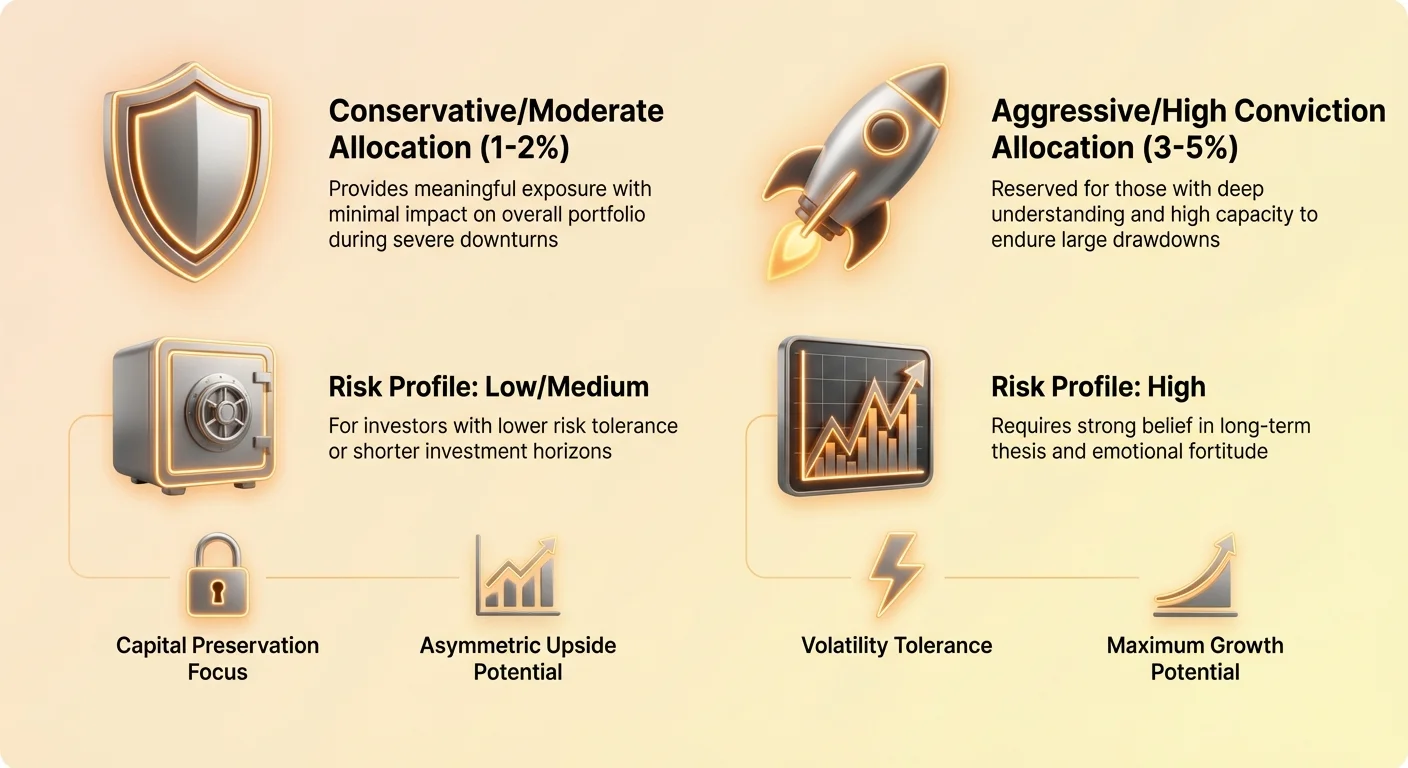
Most institutional analysts and experienced portfolio managers recommend an allocation between 1% and 5% of a total investable portfolio.
| Allocation Range | Risk Profile | Rationale |
|---|---|---|
| 1% - 2% | Conservative/Moderate | This allocation provides meaningful exposure to the asset's asymmetric upside (the potential for huge gains) without materially impacting overall portfolio performance during severe downturns. This is the optimal entry point for most newcomers. |
| 3% - 5% | Aggressive/High Conviction | Reserved for investors with a deep understanding of the technology, a robust belief in the long-term thesis, and a high financial and mental capacity to endure large drawdowns (e.g., 60-80%). |
Crucially, investable assets means excluding emergency funds, real estate equity, and other illiquid assets. You calculate the percentage based on the total value of your stocks, bonds, mutual funds, ETFs, and cash held for investment.
Example: If your total investment portfolio is $100,000, a 3% allocation means purchasing $3,000 worth of Bitcoin. If Bitcoin then loses 50% of its value, your $3,000 position becomes $1,500. This $1,500 loss represents only 1.5% of your total $100,000 portfolio—a very manageable loss that will not derail your financial plan.
Adjusting Allocation for Net Worth and Liquidity
While the 1-5% rule is a great starting point, wealthy individuals often err on the lower side, and younger individuals with high future earning potential may lean higher.
- High Net Worth: If 1% of your portfolio represents a massive sum of money (e.g., $500,000), you may decide that 0.5% or 1% is sufficient to capture the upside, as the absolute dollar value is already substantial.
- Early Career Investors: If you are younger, have a strong cash flow, and decades until retirement, you can afford to take on more risk, potentially pushing closer to the 5% mark, knowing you have time to recover from multiple market cycles.
The Golden Rule: Never size your position so large that a total loss of the capital would fundamentally change your lifestyle or retirement plans.
The Execution Strategy: Mastering Dollar-Cost Averaging (DCA)
Once you have defined how much capital you want to allocate to Bitcoin (the size), the next step is determining how to deploy that capital. For a volatile asset like BTC, attempting to "time the market" is a fool's errand. The most proven and emotionally sound strategy is Dollar-Cost Averaging (DCA).
Why DCA Works Against Volatility
DCA is a strategy where you invest a fixed amount of money at regular intervals, regardless of the asset’s price.
Mechanics of DCA:
- Set a budget (e.g., $100 per week).
- Set a frequency (e.g., every Tuesday).
- Execute the purchase automatically.
This strategy removes the paralyzing human tendency to buy when prices are soaring (FOMO) and sell when prices are crashing (panic). DCA forces discipline and utilizes volatility to your advantage.
When the price is high, your fixed dollar investment buys fewer units of Bitcoin. When the price is low (during a bear market correction), your fixed dollar investment buys significantly more units. Over time, your average purchase price will be lower than if you had made random, emotionally driven purchases, leading to a much stronger position.
Practical DCA Implementation and Frequency
The optimal DCA frequency is usually determined by your income schedule and transaction fees.
- Frequency: Most investors choose weekly or bi-weekly (every two weeks), as this aligns well with typical paychecks. Monthly DCA is also effective but may miss more short-term buying opportunities. Daily DCA, while mathematically optimal, can be cumbersome and lead to higher cumulative transaction fees.
- Consistency is Key: The most crucial element is the consistency of execution. Using automated features on exchanges or wallets ensures that you never miss a scheduled purchase, eliminating the temptation to wait for a "better" price.
Lump Sum vs. DCA: A Brief Comparison
Finance theory often suggests that a lump sum investment (investing the entire allocation at once) often statistically outperforms DCA in assets that trend upward over the long term, such as broad stock market indices. This is because "time in the market beats timing the market."
However, this statistical advantage largely disappears when dealing with hyper-volatile assets like Bitcoin, especially considering the psychological risk.
- The Risk of Lump Sum: If you commit a lump sum right before a major 50% market drop, the immediate paper loss can be so severe that it forces you to panic-sell, undermining the entire long-term thesis.
- The Advantage of DCA: DCA smooths out market entry, protecting your capital and, more importantly, protecting your mind from large, sudden losses, ensuring adherence to the long-term investment plan. For Bitcoin, DCA is the superior behavioral strategy.
Active Management: Implementing Bitcoin Portfolio Rebalancing
Once your DCA strategy is underway, market dynamics will inevitably cause your allocation to drift. If Bitcoin performs exceptionally well (a "bull market"), your 3% target might balloon to 8% or 10%. Conversely, a deep bear market might shrink it to 1%.
Rebalancing is the systematic process of buying or selling assets to bring your portfolio back to its original target allocation. It is a critical risk-management tool that forces you to buy low and sell high, maintaining discipline and preventing overexposure.
Time-Based Rebalancing (Calendar Approach)
The simplest method is setting a regular calendar schedule, regardless of market conditions.
- Execution: Rebalance quarterly (every three months) or bi-annually (every six months).
- Benefit: Simplicity and consistency. It ensures you perform risk checks at set intervals.
- Drawback: It may force you to trade during a highly volatile or irrational period. For instance, if Bitcoin is on a massive tear, rebalancing may feel like selling profits prematurely.
Threshold-Based Rebalancing (Volatility Indexing)
A more refined and effective strategy for Bitcoin is threshold-based rebalancing, which relies on volatility indexing. Instead of trading on a date, you trade only when your portfolio allocation drifts beyond a set boundary.
- Define Target: Let's assume your target allocation is 4%.
- Set Thresholds: Define the maximum allowed deviation, typically +/- 20% of the target allocation.
- Upper Threshold (Sell Trigger): 4% + (4% * 20%) = 4.8%. If BTC hits 4.8% of your portfolio, you sell the excess back down to 4%.
- Lower Threshold (Buy Trigger): 4% - (4% * 20%) = 3.2%. If BTC dips to 3.2% of your portfolio, you buy enough to bring the allocation back up to 4%.
This strategy allows you to profit from Bitcoin's natural volatility. You only rebalance when the asset has significantly moved, avoiding unnecessary transactions during sideways movement. This process ensures you systematically take profits when the market is euphoric and increase exposure when the market is fearful.
Rebalancing Mechanics: Selling High, Buying Low
The mechanical action of rebalancing requires funding the target purchase or selling the excess.
- When Selling (Bull Market): If your allocation exceeds the upper threshold (e.g., 5.5% target exceeded), you sell the difference (the 1.5% excess) back into stable assets—cash, bonds, or traditional index funds—to restore your target percentage.
- When Buying (Bear Market): If your allocation drops below the lower threshold (e.g., 2.5% target reached), you must draw funds from your established traditional asset allocation (cash or bonds) to buy more Bitcoin, bringing the percentage back up to the target.
This is often the most challenging part, as it requires the investor to sell an asset that is soaring or buy an asset that appears to be collapsing. Discipline, not emotion, dictates the trade.
Advanced Considerations for Portfolio Maintenance
Executing a rebalancing plan involves more than just market timing; it requires careful consideration of costs, taxes, and psychological endurance.
The Tax Implications of Rebalancing (Capital Gains)
One of the greatest points of friction in active portfolio management, especially with highly appreciating assets like Bitcoin, is taxation.
In many jurisdictions (including the US), selling Bitcoin is a taxable event. Any profits realized from the sale (the difference between the sale price and your original purchase price—the cost basis) are subject to capital gains tax.
- Short-Term vs. Long-Term: If you sell Bitcoin that you have held for less than one year, the profits are usually taxed at your standard income rate (short-term capital gains, which is often high). If held for over one year, the profits are taxed at a lower, long-term capital gains rate.
- The Rebalancing Dilemma: Because rebalancing forces you to sell Bitcoin during bull runs, you may realize substantial short-term gains, resulting in a large tax bill.
Practical Tip: When deciding to rebalance, prioritize selling coins that qualify for long-term capital gains (coins held for over one year). Use careful tax-lot accounting (FIFO—First-In, First-Out, or LIFO—Last-In, First-Out) to maximize tax efficiency. In some cases, the tax cost of rebalancing may slightly outweigh the risk reduction, necessitating a slight delay in action until more holdings qualify for the long-term rate.
Optimal Entry and Exit Points Based on Risk Profile
While DCA removes the need for precision timing, your chosen strategy should align with known market cycles.
- The Role of Market Cycles: As discussed in deeper analysis (referencing the related page on Market Cycles), Bitcoin tends to move in four-year cycles tied roughly to the halving event.
- Peak Bull Markets: These periods of euphoria are the natural, most efficient points for selling (rebalancing), as fear of missing out (FOMO) has driven the asset to high valuations.
- Deep Bear Markets/Accumulation: These periods of peak hopelessness and low valuation are the natural, most efficient points for buying (accelerated DCA/rebalancing), as panic has driven the price down.
Strategy Integration: A savvy investor uses the threshold-based rebalancing rule as the trigger for the trade, but executes the trade within the context of the overall market cycle. Do not pause DCA entirely during a bear market; instead, view the bear market as a prolonged discount period and continue your fixed contributions.
Security and Self-Custody
No allocation strategy matters if the underlying assets are not secure. Especially for the 1-5% allocation which represents a significant long-term position, moving from exchange storage to self-custody is mandatory.
- Wallets: Use a hardware wallet (like Ledger or Trezor) to store your private keys offline. This isolates your funds from exchange hacks and counterparty risk.
- Seed Phrase Management: Securely store your recovery seed phrase in multiple physical locations, ideally using steel stamping or fireproof solutions, ensuring you are the sole controller of your allocation. This is the cornerstone of building digital self-sovereignty.
Conclusion
Constructing a Bitcoin portfolio is not a passive activity; it requires intellectual honesty and execution discipline. By defining a conservative allocation (1% to 5%), adhering rigorously to a Dollar-Cost Averaging schedule, and actively utilizing threshold-based rebalancing, you neutralize the greatest threat to your long-term success: emotion.
Bitcoin's inclusion in your portfolio provides a powerful hedge and exposure to generational growth, but only if its unique volatility is managed proactively. Focus on the long-term plan, trust the systemic discipline of your strategy, and let time and market mechanics work in your favor.