
Welcome to the cutting edge of digital asset management. As you move beyond simply buying and holding cryptocurrencies, understanding the nuances of security and risk mitigation becomes essential. Cryptocurrency volatility often grabs the headlines, but the true risks to your digital wealth lie not just in market downturns, but in technical failure, operational incompetence, and smart contract exploits.
For the intermediate practitioner, risk mitigation is not just about avoiding email scams; it involves a professional framework for analyzing systemic failure. Whether you choose to hold assets in a Centralized Exchange (CEX) or dive into the world of Decentralized Finance (DeFi), you inherit a specific set of security challenges. This guide provides a structured approach to assessing, minimizing, and planning for catastrophic failure across the entire crypto landscape.
Our goal is to equip you with the knowledge necessary to perform effective custodial risk analysis and deeply understand DeFi smart contract risk, ensuring your journey toward self-sovereignty is built on secure and reliable foundations.
The Dual Landscape of Crypto Risk: Custody vs. Control
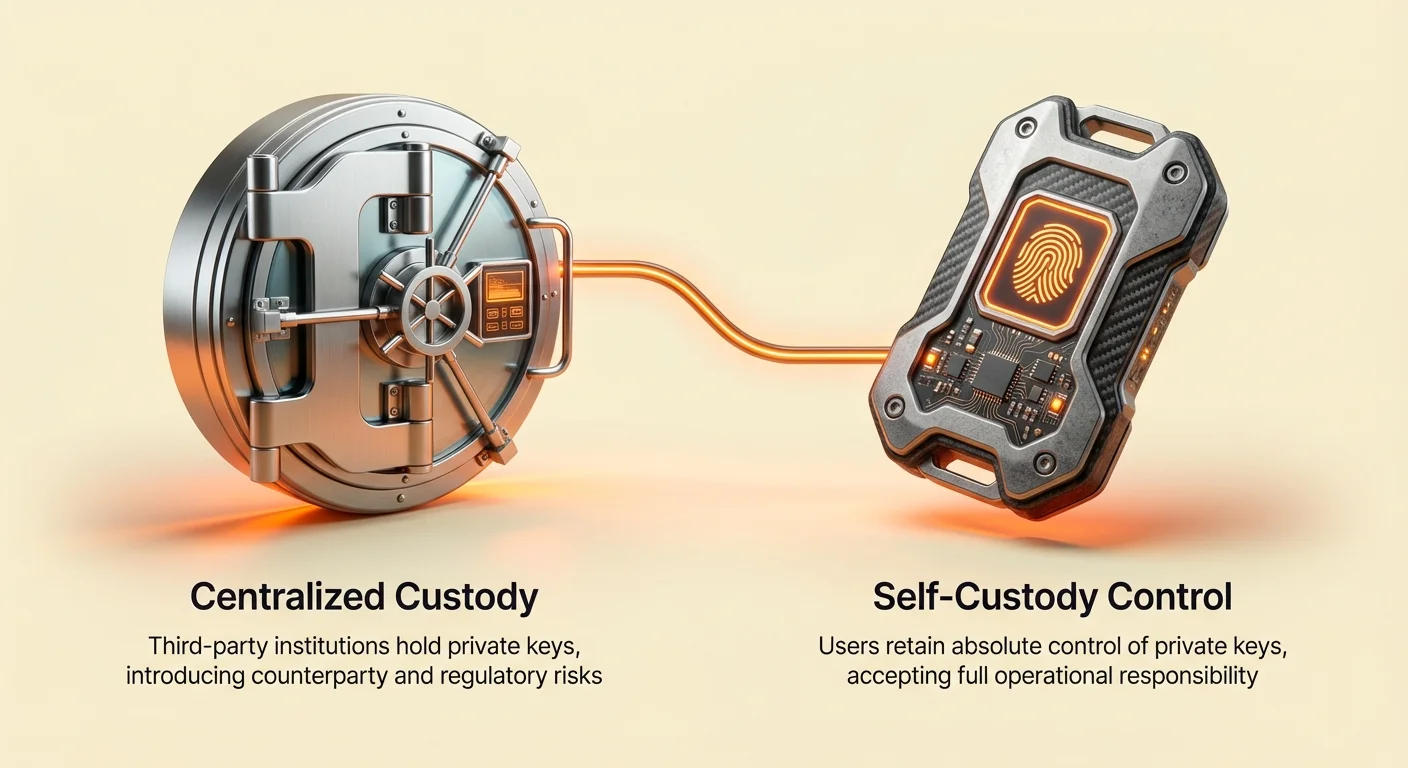
Before analyzing specific technical risks, we must first categorize where those assets reside. In the crypto world, risk is fundamentally tied to custody—who holds the keys that control the funds.
1. Centralized Custody: Convenience and Counterparty Risk
Centralized Exchanges (CEXs) like Coinbase or Kraken act as banks, holding your private keys on your behalf. This is highly convenient for trading and onboarding but introduces counterparty risk: the danger that the institution holding your assets will fail, be hacked, or misuse your funds. While a regulated CEX offers a sense of stability, the risk is consolidated in one entity.
2. Decentralized Custody (Self-Custody and DeFi): Total Control and Technical Risk
Self-custody means you hold your own private keys (usually via a hardware or software wallet). When you interact with DeFi protocols (lending, swapping, staking), you retain control of your keys, but you expose your assets directly to the underlying smart contract code. Here, the primary risks are technical—flaws in the code itself, known as DeFi smart contract risk. The risk is distributed, but the user is the final security gate.
3. The Custodial Risk Analysis Framework
To evaluate any platform (CEX, broker, or DeFi protocol), you must analyze three layers of risk:
- Technical Risk: Is the underlying technology secure? (Smart contract audits, server stability).
- Operational Risk: Is the team competent, transparent, and non-malicious? (Insider threats, poor management).
- Regulatory Risk: How might government intervention, sanctions, or legal changes affect access to your assets?
Managing Custodial Risk in Centralized Exchanges (CEXs)
For many investors, CEXs are the primary on-ramp to crypto. They offer familiar interfaces and liquidity. However, recent historical failures have demonstrated that CEXs, even large ones, represent significant concentrations of risk. Effective crypto risk mitigation strategies begin with scrutinizing the custodian itself.
1. Understanding Counterparty Failure
When you deposit funds into a CEX, you are trusting that institution not only to keep your funds secure but also to remain solvent. If the exchange uses client funds improperly, engages in risky leveraged trading with deposits, or suffers operational losses, users bear the consequences.
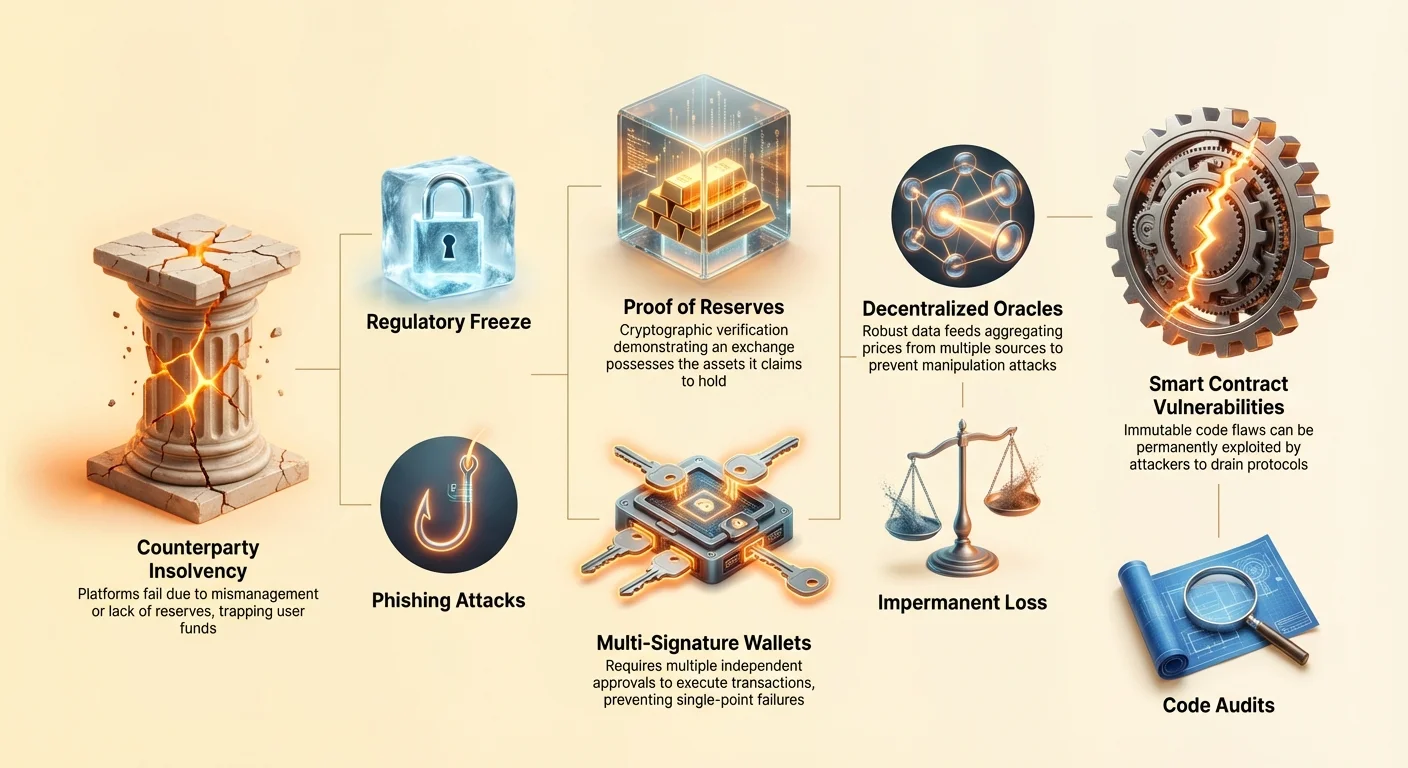
- The Insolvency Trap: Major exchange failures have occurred when platforms commingle user funds or lack sufficient reserves. Since the CEX holds the private keys, if the exchange goes bankrupt, users typically become unsecured creditors, often waiting years for minimal recovery (if any).
- Best Practice: Always treat a CEX as a temporary holding facility for trading, not a long-term savings vault. Withdraw funds immediately to a self-custody wallet once trading is complete.
2. Mitigating Platform Security and Operational Threats
While CEXs spend enormous resources on security, they remain massive targets. A successful hack can liquidate millions of user accounts instantly.
- Cold Storage Verification: Reputable exchanges disclose how much of their assets are held in "cold storage" (wallets not connected to the internet). Demand transparency. An exchange keeping a large majority of assets in cold storage limits the exposure should its hot (online) wallets be compromised.
- Proof of Reserves (PoR): Following high-profile failures, many exchanges now offer audited Proof of Reserves. This cryptographic verification demonstrates that the assets they claim to hold on behalf of users genuinely exist. While PoR doesn't verify liabilities (what the exchange owes), it is a key step in financial transparency and custodial risk analysis.
- Insider Risk: Never discount the threat from malicious employees. Operational controls, multi-signature requirements for large withdrawals, and regular background checks are internal measures that good CEXs must implement to mitigate insider threats.
3. Dealing with Regulatory Intervention and Seizure
CEXs operate within regulated jurisdictions and must comply with laws, including Know Your Customer (KYC) and Anti-Money Laundering (AML) requirements. This compliance introduces a different layer of risk.
- Freezing Assets: Governments or court orders can compel a CEX to freeze specific accounts or jurisdictions. Since the CEX controls the keys, they must comply immediately, potentially locking users out of their own funds during geopolitical or legal disputes.
- Data Breach Risk: KYC requirements mean CEXs hold vast amounts of personal identification data. If an exchange’s centralized database is breached, your financial details and personal identity may be compromised. This makes the selection of CEXs with exceptional data encryption standards a crucial part of crypto risk mitigation strategies.
Operational Security in Self-Custody
Shifting from centralized platforms to self-custody eliminates counterparty risk but maximizes operational risk—the risk that you make a mistake. When you hold your own keys, you become the security manager, the vault custodian, and the failure point.
1. The Single Point of Failure: Seed Phrase Management
The seed phrase (or recovery phrase, typically 12 or 24 words) is the master key to your funds. If it is lost, your funds are gone forever. If it is discovered, your funds can be drained instantly.
- Physical, Non-Digital Storage: Never store your seed phrase on a networked device, in a cloud document, or in a photo. The standard best practice is to physically etch or stamp the phrase onto metal plates, which are resistant to fire and water, and store them securely in geographically separate locations (e.g., a bank safety deposit box and a home safe).
- Digital Hygiene and Sanitization: If you use a software wallet, ensure the device is free from malware. If you use a hardware wallet, verify its legitimacy directly from the manufacturer and ensure you never input the seed phrase into a computer or phone unless absolutely necessary for authorized recovery onto a new device.
2. Transaction Verification and Phishing Mitigation
The most common user error leading to loss is blindly signing a malicious transaction or confirming a withdrawal to the wrong address.
- Address Double-Checking: Always verify withdrawal addresses across multiple channels (e.g., check the first four and last four characters of the address on both the sending and receiving devices). Address poisoning scams, where hackers subtly substitute an address you recently used, are becoming more prevalent.
- Understanding Wallet Permissions: In DeFi, you are often asked to "approve" a smart contract to spend a certain amount of a token. Always use the "Max Spend" or "Set Limit" function sparingly. Give contracts only the necessary permissions, and regularly review and revoke old, unused token approvals via block explorer tools.
3. Advanced Operational Strategies: Multi-Signature Wallets
For managing significant wealth, reliance on a single hardware device or a single seed phrase introduces too much risk. Multi-Signature (Multi-Sig) wallets require multiple keys (e.g., 2 out of 3, or 3 out of 5) to approve any transaction.
- How Multi-Sig Mitigates Risk:
- Loss Mitigation: If one key is lost or destroyed, the other keys can still recover the funds.
- Theft Mitigation: A thief must gain access to multiple separate locations and devices to drain the wallet, making the effort exponentially harder.
- Inheritance Planning: Multi-Sig wallets are essential for creating an effective crypto inheritance plan, allowing trusted family members or estate attorneys to access the necessary keys upon incapacitation or death, ensuring the funds can be moved without relying on a single individual.
Deciphering Decentralized Finance (DeFi) Technical Risks
DeFi protocols allow users to access financial services (lending, trading, insurance) via self-executing contracts on a blockchain. This eliminates the financial intermediary, but replaces human risk with technical DeFi smart contract risk. When assessing a protocol, the code itself is the greatest threat.
1. Smart Contract Vulnerabilities and Code is Law
Smart contracts are immutable—once deployed, they cannot easily be changed. This immutability is a feature, but it means any bug or flaw is permanently exploitable until the contract is deprecated or updated (if it supports upgrades).
- Reentrancy Attacks: A famous early vulnerability where a function could be recursively called multiple times before the initial state was updated. While largely mitigated by modern development standards, new, subtle reentrancy variants still pose a threat.
- Logic Errors: Simple mistakes in how the contract calculates interest, handles withdrawal conditions, or verifies user inputs. These errors can lead to situations where a malicious user can drain funds or inflate their collateral value without actually exploiting a technical bug.
- Proxy Contracts and Upgradability: Many modern DeFi protocols use proxy contracts, which allow the underlying logic to be upgraded. While useful for patching bugs, this introduces governance risk. Users must trust that the governance mechanism or the core team will not introduce malicious or vulnerable updates. Always analyze the governance structure before committing capital.
2. Oracle Attacks and Data Manipulation
DeFi protocols often need real-world data—most importantly, the price of crypto assets—to function. They obtain this data via "Oracles," which are services that feed off-chain data onto the blockchain. Oracles are a necessary but complex link in the security chain.
- The Oracle Problem: If a protocol relies on a single, easily manipulated data source (a "single point of failure" oracle), an attacker can temporarily manipulate that price off-chain and then use the resulting faulty on-chain price to execute malicious trades (e.g., borrow cheap assets or liquidate others unfairly).
- Flash Loan Exploits: A sophisticated attack vector that leverages the unique characteristics of DeFi. An attacker borrows a massive amount of capital (a flash loan, which must be repaid in the same transaction block) to manipulate a small, illiquid price pair on a decentralized exchange (DEX). They then use that manipulated price feed to profit on a lending protocol before repaying the loan, all in one atomic transaction.
- Mitigation Strategy: Look for protocols that use robust, decentralized oracle networks (like Chainlink), which aggregate prices from multiple independent sources, making a single manipulation exponentially more difficult and expensive.
3. Liquidity Risk and Impermanent Loss (IL)
If you decide to participate as a liquidity provider (LP) in a DEX or yield farm, you face risks related to market movement and the concentration of capital.
Impermanent Loss (IL) Explained
When you provide liquidity, you deposit a pair of assets (e.g., 50% ETH, 50% USDC). If the price ratio between those two assets drastically changes (e.g., ETH price doubles), arbitrage traders will remove the now-cheaper asset (ETH) and replace it with the now-more-expensive asset (USDC) to rebalance the pool.
- Definition: Impermanent Loss is the difference between the dollar value of the assets you held in the liquidity pool versus the dollar value of simply holding (HODLing) those two assets in your wallet for the same period.
- Risk: The loss is "impermanent" only if the asset ratio eventually returns to the point where you initially deposited them. If you withdraw your assets before this happens, the loss is realized. IL is a critical risk factor for LPs and must be calculated against the farming fees (yield) earned.
Concentration Risk
Liquidity pools in DeFi can experience "bank runs" if a large portion of users panic-withdraw their capital. If you are participating in a pool with low total value locked (TVL), a single large withdrawal can severely affect the pool’s health and the rewards earned by other LPs.
Advanced Mitigation Strategies and Decentralized Insurance
While auditing and robust design are primary defense mechanisms, they do not guarantee safety. To truly practice professional-grade crypto risk mitigation strategies, users should explore covering systemic risks via insurance.
1. Decentralized Coverage Models
Traditional insurance firms are typically slow to cover smart contract risk. Decentralized insurance protocols fill this gap by allowing users to collectively pool funds to pay out claims when a covered event (usually a smart contract exploit) occurs.
- How it Works (e.g., Nexus Mutual): Users buy coverage for specific protocols (e.g., "I want $10,000 of coverage if Protocol X is hacked"). Other users ("capital providers") stake collateral to back this coverage. If an exploit occurs, members vote on whether the claim is valid, and if approved, the claimant is paid out from the collective pool.
- Focus: This coverage model specifically addresses the technical DeFi smart contract risk, offering a financial safety net against coding flaws, which is often uninsurable by traditional means.
- Limitation: Decentralized insurance does not typically cover custodial risk (CEX failure) or market risk (impermanent loss).
2. The Role of Smart Contract Audits
Before depositing significant capital into a new DeFi protocol, it is mandatory to review its security track record. The gold standard is a comprehensive third-party audit.
- What Audits Provide: Reputable auditing firms (like Certik or PeckShield) meticulously examine the contract code for vulnerabilities, logic errors, and attack vectors. The resulting public report details the findings, severity levels, and whether the issues were remediated.
- The Caveat: An audit is a point-in-time review and is never a guarantee. New complexity, new attack vectors, or post-audit changes can still introduce flaws. Moreover, audits rarely cover operational risks or economic design risks (like impermanent loss risk).
- Actionable Step: Always confirm the auditor is reputable, review the date of the audit (is it current?), and ensure that the code deployed matches the code that was reviewed.
3. Systematic Portfolio Diversification
Risk mitigation is fundamentally achieved through diversification—not just across assets, but across technical infrastructure.
- Geographic and Regulatory Diversification: Use CEXs registered in different, stable jurisdictions. This reduces the risk that political or regulatory action in one country could instantly freeze all your assets.
- Protocol and Chain Diversification: Avoid staking or depositing all capital into a single DeFi protocol, even if it is highly reputable. A major exploit could lead to catastrophic loss. Similarly, diversify across different Layer 1 blockchains (Ethereum, Solana, Avalanche) to avoid systemic risk tied to one blockchain's technical failure or consensus mechanism vulnerability.
- Risk Layering: Reserve highly experimental, unaudited protocols for only tiny amounts of risk capital. Allocate the largest portions of capital to time-tested, multi-audited, insured protocols with massive TVL (which often implies deeper security scrutiny).
Incident Response and Recovery Planning
Even the most meticulous planning can fail. A mature crypto risk mitigation strategy includes a detailed plan for what to do after a security event occurs, whether it’s a CEX insolvency or a smart contract hack.
1. Responding to a Centralized Exchange Failure
If a major CEX announces insolvency or freezes withdrawals, immediate action is crucial for legal and tax purposes.
- Immediate Documentation: Take screenshots of all your holdings, trade history, and confirmation that your withdrawal attempts failed. This documentation is vital for legal and potential insurance claims.
- Legal Representation: Contact legal counsel specializing in bankruptcy or digital asset recovery in the jurisdiction where the exchange is registered. Being part of a collective legal action often increases the chances of partial recovery.
- Tax Implications: In many jurisdictions, losses incurred due to exchange failure may be considered a taxable event (a capital loss). Consult a crypto tax professional immediately to understand how to claim the loss accurately, simplifying future tax reporting.
2. Responding to a DeFi Smart Contract Exploit
When a protocol you use is hacked, the response timeline is measured in minutes or seconds.
- Determine Exposure: Immediately check if your specific deposited assets are still visible in the contract via a block explorer. If the assets are gone, determine if the exploit affected the entire pool or only specific functions.
- Emergency Withdrawal (If Available): Some protocols implement emergency functions allowing users to pull out assets in the event of failure, sometimes bypassing normal locking periods. If the protocol is still functioning, withdraw immediately.
- Claiming Insurance: If you purchased decentralized coverage (e.g., via Nexus Mutual), immediately file a claim according to the insurer’s procedures. This requires proof of loss linked to the specified vulnerability.
- Post-Mortem Analysis: A common response to a hack is the deployment of a new, patched contract, sometimes offering "recovery tokens" or a governance proposal for restitution. Monitor official communication channels (Discord, Twitter) carefully, but approach any new contract interaction with extreme caution to avoid falling for further phishing scams attempting to mimic the recovery process.
Conclusion
The digital economy offers unprecedented opportunities for financial self-sovereignty, but that freedom comes with absolute responsibility for risk management. Moving from basic user security to a professional security framework requires understanding the profound differences between custodial risk analysis and technical DeFi smart contract risk.
By treating CEXs as high-risk trading venues, rigorously securing your self-custody keys, demanding transparency from DeFi protocols, and layering protection with third-party audits and decentralized insurance, you build a robust and resilient portfolio. Risk mitigation in crypto is not a one-time setup; it is a continuous, active process of vigilance and strategic planning. Stop guessing, start analyzing, and take control of your crypto roadmap.