
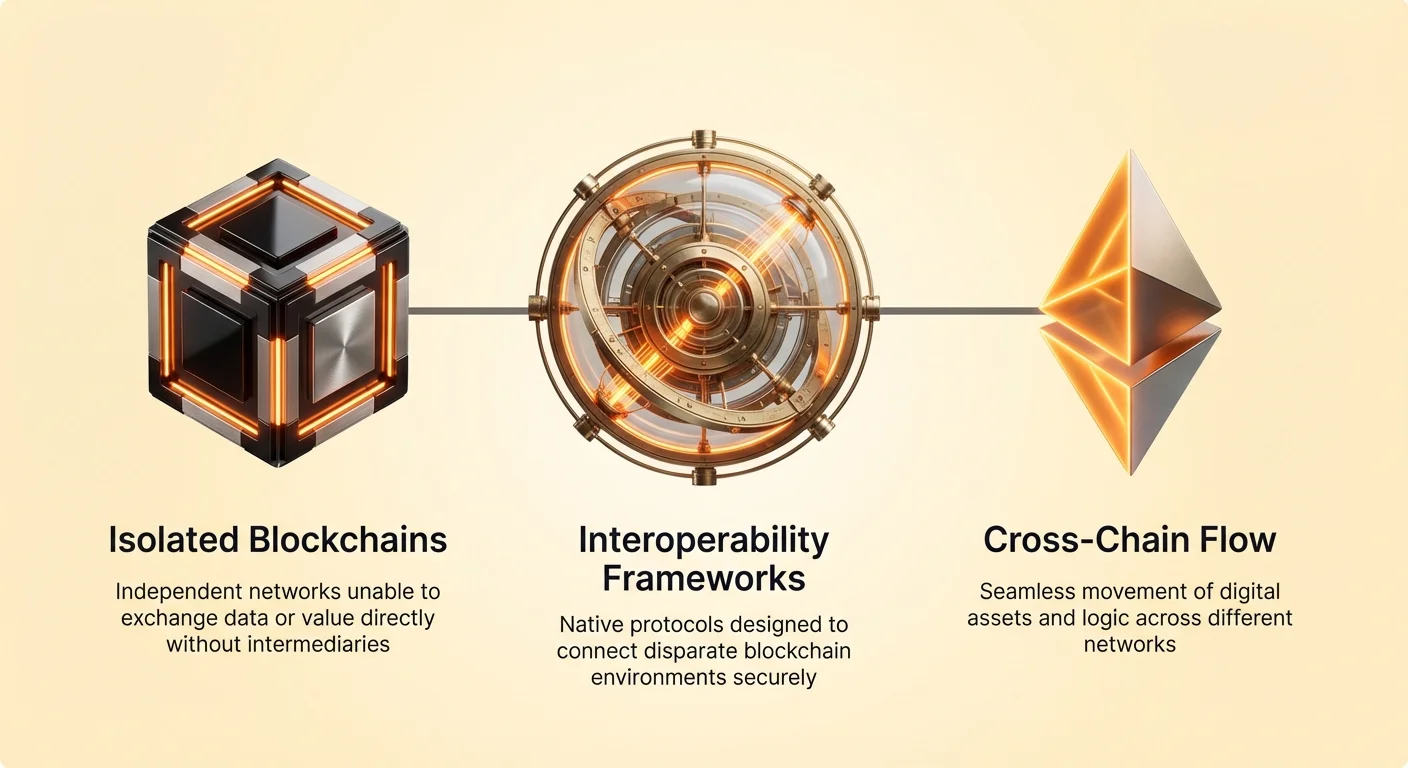
For years, the crypto economy has been defined by powerful, isolated islands: Bitcoin (BTC) handled digital gold, and Ethereum (ETH) handled smart contracts. While these individual blockchains thrive, they struggle to communicate, leading to inefficiencies, high fees, and fractured liquidity. This lack of communication—known as the "interoperability problem"—is perhaps the biggest hurdle preventing crypto from achieving true global scale.
Interoperability frameworks are the architectural solutions designed to connect these disparate blockchain worlds. They are the protocols that allow assets, data, and logic to flow securely from one sovereign chain to another. Understanding these frameworks is no longer an optional feature of crypto literacy; it is fundamental to navigating the complex landscape of Decentralized Finance (DeFi) and building robust, diversified investment portfolios.
This guide moves beyond simple definitions to analyze the two leading, competing philosophies for achieving cross-chain communication: the independent sovereignty model championed by Cosmos, and the shared security model pioneered by Polkadot. We will explore how these architectures work, how they manage risk, and what strategic implications they hold for advanced portfolio managers and self-custody adopters.
The Isolation Problem: Why Blockchains Need to Talk
To understand the solution, we must first understand the problem. Early blockchains, particularly Bitcoin, were designed primarily for internal consistency and security, not external communication. While this maximal isolation makes them incredibly secure internally, it creates rigid barriers between ecosystems.
The Siloed Digital Economy
Imagine a digital ecosystem where every application must exist on its own self-contained server, unable to share data or functionality with any other server. That is essentially how the early crypto landscape operated.
- Ethereum Apps (dApps): While Ethereum created a powerful environment for complex smart contracts, it could not natively verify transactions occurring on Bitcoin.
- Asset Inefficiency: If you hold BTC, but want to use it as collateral in a lending protocol built on Solana, you cannot simply send it over. You must rely on a third-party wrapper (like wBTC on Ethereum) or a bridging service, both of which introduce new layers of counterparty and technical risk.
- Liquidity Fragmentation: When assets and users are spread across dozens of networks, it dilutes the overall liquidity pool, leading to higher trading slippage and inefficient capital deployment.
The goal of true interoperability is to allow a developer on Chain A to seamlessly build an application that utilizes data or assets from Chain B, without requiring either chain to lower its security standards or trust an external intermediary.
Introduction to Cross-Chain Communication
Interoperability is typically achieved through two main design philosophies:
- Bridging (External Solutions): These are protocols that connect two existing, independent blockchains (e.g., connecting Ethereum to Polygon). They usually involve locking assets on the source chain and minting equivalent wrapped tokens on the destination chain. Security often relies on multi-signature groups or centralized relayers, making them frequent targets for hackers.
- Native Frameworks (Internal Solutions): These are ecosystems like Polkadot and Cosmos, which are designed from the ground up to support seamless communication between their member chains. Security is integrated into the core architecture, rather than bolted on later.
It is these native frameworks that offer the most robust and secure paths toward a truly interconnected multi-chain future.
Cosmos: The Internet of Blockchains (Independent Sovereignty)
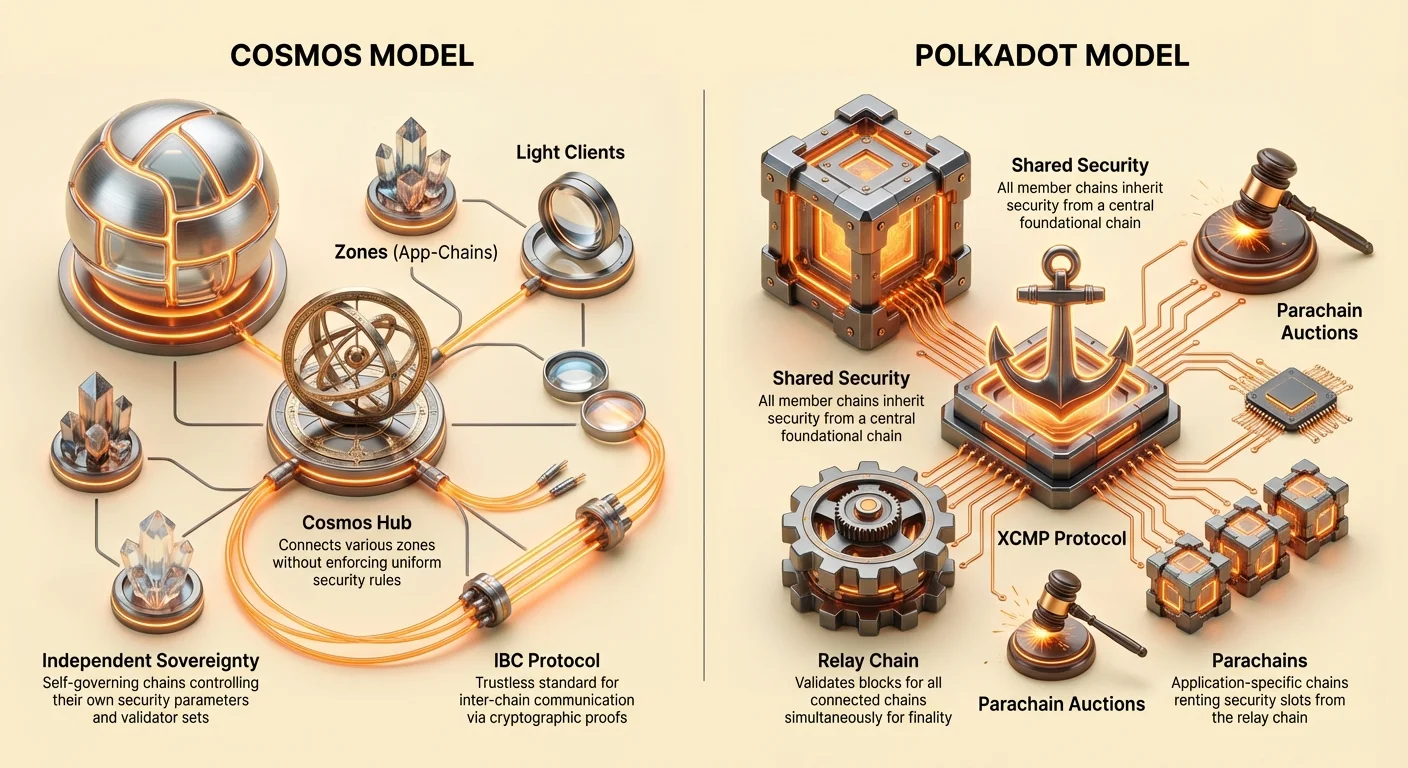
Cosmos is often described as the "Internet of Blockchains." Its core philosophy is based on the idea of sovereignty: every chain should control its own governance, validation, and economic model. Cosmos achieves interoperability by providing a set of standardized tools and a communication protocol for these independent chains to securely talk to one another.
The Cosmos Hub and Zones (Architecture)
The Cosmos ecosystem is structured around two key concepts:
- Zones (Application-Specific Chains): These are independent blockchains (often called App-Chains) built using the Cosmos SDK (Software Development Kit). Examples include Osmosis (a DEX), Cronos, or the core Cosmos Hub itself. Each Zone has its own validator set, token, and specific rules.
- The Cosmos Hub: This is the primary proof-of-stake chain responsible for connecting all the other Zones. While the Hub is critical for routing, it does not enforce security upon the Zones.
The glue that holds this independent network together is the communication layer: the Inter-Blockchain Communication Protocol (IBC).
IBC Protocol Security: The Trustless Standard
The IBC protocol is the defining feature of Cosmos. It is not a bridge in the traditional sense; it is a communication standard that allows chains to send arbitrary, authenticated data packets to each other in a trust-minimized way.
How IBC Achieves Security:
IBC security relies on light clients and relay paths.
- Light Clients: Each chain running IBC maintains a cryptographic light client of the chain it wants to communicate with. A light client only tracks the block headers and validator set, rather than downloading the entire transaction history.
- Authentication: When Chain A wants to send a token to Chain B, a relayer takes the transaction data and proves, via cryptography, that the transaction was finalized and included in the block history of Chain A.
- Verification: Chain B uses its stored light client information for Chain A to verify the cryptographic proof provided by the relayer. If the proof matches the known state of Chain A, the transaction is considered valid and the corresponding asset is minted (or unlocked) on Chain B.
Key Security Takeaway: The IBC protocol eliminates reliance on external multi-sig committees or centralized third parties. The security of the asset transfer is secured by the originating chain’s existing security mechanisms (its validator set), and the destination chain’s ability to cryptographically verify that state.
Application Composition and Use Cases
The sovereignty model offers immense flexibility for developers. Because a Cosmos chain can customize everything—from its block time and gas fees to its staking token—it can be perfectly optimized for a specific application (e.g., a high-frequency trading DEX or a private corporate ledger).
Strategic Implication for Portfolio Management:
For users, Cosmos promotes native asset utilization. Instead of swapping native ATOM for a wrapped version to access a DeFi protocol, you can interact directly with various application-specific tokens across the ecosystem via IBC, allowing seamless asset transfers between liquidity zones (Osmosis) and lending zones (Kava).
Polkadot: Shared Security and the Relay Chain Model
Polkadot operates under a fundamentally different philosophy than Cosmos: shared security. Instead of independent chains relying on their own validator sets, all member chains on Polkadot inherit the robust security provided by a central hub.
Polkadot was designed to solve the security fragmentation inherent in independent chains, where a smaller chain might be vulnerable to attack due to a less valuable staking token.
Architecture: Relay Chains and Parachains
The Polkadot ecosystem is built on a two-layer structure:
- The Relay Chain: This is the central, foundational blockchain. It is responsible solely for security, governance, and maintaining the shared state of the network. It processes limited transactions but validates and finalizes blocks for all connected chains. The Relay Chain uses the native DOT token for staking and governance.
- Parachains (Parallel Chains): These are application-specific blockchains, similar to Cosmos Zones, but with one crucial distinction: they do not have their own security and finality mechanisms. They rent a permanent slot on the Relay Chain and inherit its full security framework.
Communication between any two Parachains is handled directly through the Relay Chain using the Cross-Chain Message Passing (XCMP) protocol, which is highly efficient because the Relay Chain already knows and trusts the state of all attached Parachains.
Shared Security vs. Independent Chains
This is the core differentiator between Polkadot and Cosmos.
| Feature | Polkadot (Shared Security) | Cosmos (Independent Security/Sovereignty) |
|---|---|---|
| Security Model | All chains are secured by the Relay Chain’s massive validator set (DOT stakers). Security is aggregated. | Each chain (Zone) has its own independent validator set. Security is localized. |
| Cost | High initial cost (must win a Parachain slot auction). | Low entry barrier (anyone can launch a chain via the SDK). |
| Transfer Mechanism | Internal (XCMP). Messages are inherently trusted because the Relay Chain secures both endpoints. | External (IBC). Messages are cryptographically proven between independent chains. |
| Risk Profile | Low risk of individual Parachain exploits related to consensus, but high systemic risk (if the Relay Chain fails, all chains fail). | Low systemic risk, but high risk that smaller, less decentralized Zones could be individually exploited. |
Strategic Implication: Polkadot offers a compelling choice for projects that prioritize maximum, bulletproof security from day one, even at the expense of needing to pay to access that shared infrastructure.
The Parachain Auction Strategy
To gain a coveted Parachain slot and access Polkadot’s shared security, projects must win an auction. Parachain slots are limited and leased for fixed periods (e.g., 6, 12, or 24 months).
- Crowdloans: Projects raise capital (DOT tokens) from the community to bid in these auctions. Users temporarily lock up their DOT in support of their chosen project.
- Bidding: The project with the highest bid (most DOT locked) wins the lease for the slot.
- Reward: Supporters receive tokens from the winning Parachain project in return for lending their DOT. Once the lease expires, the locked DOT is returned to the original owner.
Advanced Applied Strategy:
Participating in Parachain auctions (crowdloans) is a form of advanced yield generation. Investors are essentially providing locked liquidity to a project in exchange for future governance or utility tokens, a strategy that requires deep research into the viability of the project and an understanding of the opportunity cost of locking up native DOT.
Direct Bridging Protocols: The Security Trade-Offs
While Polkadot and Cosmos focus on connecting chains within their own ecosystems, the vast majority of cross-chain volume still occurs between the major Layer-1 ecosystems (Ethereum, Solana, Avalanche, etc.) via direct bridging protocols.
These protocols are essential for multi-chain liquidity solutions, but they carry significantly different risk profiles than native frameworks like IBC or XCMP.
Custodial vs. Trustless Bridges
Bridges can generally be categorized by their reliance on external third parties:
- Custodial Bridges (High Risk): These bridges require a centralized entity or small group of validators (often a multi-sig wallet) to hold the locked assets and attest to the state of both chains. If the central group is compromised, assets are lost.
- Semi-Trustless (Validator-Based): These bridges use a large, external, dedicated set of validators to secure the transfer. The security relies on the economic stake of this validator set. This is safer than a small multi-sig, but still introduces a new, external layer of security risk separate from the destination chain.
- Trust-Minimized (Atomic Swaps/Relayers): These aim to use cryptography or specialized protocols to minimize the need for external trust. While more complex, they align closer with the trust-minimized ideals of IBC.
Risks Associated with Multi-Chain Liquidity Solutions
The history of crypto is littered with bridge failures. Bridges have proven to be the single greatest point of failure in the DeFi ecosystem, leading to billions in losses.
Common Bridge Risks:
- Smart Contract Risk: The bridge contract itself may contain vulnerabilities or bugs that allow attackers to drain the locked collateral pool.
- Validator Compromise: For non-custodial bridges, if a majority of the external validators are compromised or collude, they can approve fraudulent transactions and steal the locked assets.
- Asset Peg Failure: If the wrapped asset (e.g., wETH on a destination chain) loses its backing due to an exploit on the bridge, the asset becomes worthless on the destination chain, causing a "de-pegging."
Best Practice: When utilizing direct bridges, prioritize those that use audited code, have strong economic security models (high collateral requirements for relayers), and focus on maintaining low exposure to any single bridging protocol.
Best Practices for Bridge Usage
For the advanced portfolio manager, minimizing bridge risk is paramount:
- Assess the Bridge’s Design: Avoid bridges secured by small, known multi-sig addresses. Favor bridges that utilize decentralized validator sets or use a native mechanism (like IBC).
- Limit Exposure to Wrapped Assets: Wherever possible, utilize native assets within their specific ecosystem (e.g., use native ETH on Ethereum) rather than bridging assets frequently. If you must bridge, opt for protocols that facilitate native swaps rather than wrapping.
- Verify Liquidity: Ensure the wrapped asset you receive on the destination chain has deep liquidity pools to prevent significant slippage or difficulty unwrapping the asset later.
Polkadot vs. Cosmos: A Comparative Strategy Guide
While both ecosystems achieve interoperability, they cater to different strategic goals for both developers and investors. Choosing where to deploy capital or build applications depends entirely on prioritizing sovereignty versus shared security.
Security Model Comparison (Shared vs. Sovereign)
The fundamental difference dictates the long-term risk profile of the member chains:
| Metric | Cosmos Ecosystem Chains | Polkadot Parachains |
|---|---|---|
| Cost of Security | Self-funded. Must attract significant staking capital to be secure. | Paid via Parachain auction/lease fee (DOT tokens). Security is "rented." |
| Security Failure | Localized. If one chain is attacked, others are unaffected. | Systemic. If the Relay Chain security fails, the entire ecosystem is compromised. |
| Flexibility | Maximum. Can completely customize tokenomics, governance, and consensus rules. | Moderate. Must adhere to Polkadot’s consensus rules (NPoS) but can customize execution logic. |
Strategic Implication: A project requiring immediate, top-tier security for high-value operations (like a stablecoin issuance platform) may strategically prefer Polkadot. A developer seeking ultimate control over transaction costs and governance (like an NFT platform specifically designed for low fees) may prefer the sovereign flexibility of Cosmos.
Developer Flexibility and Governance
Cosmos allows developers to create truly independent nations. This means if a chain's community disagrees with the governance decisions of the Cosmos Hub, they can simply ignore them or fork their chain without impacting others. This governance freedom is a major draw.
Polkadot, conversely, enforces governance uniformity on key parameters, which ensures cohesion but limits independence. While Parachains have sovereign governance over their own application logic, they must abide by the Relay Chain’s high-level governance decisions regarding security and upgrades.
Strategic Portfolio Positioning
For the investor, these differences translate directly into portfolio positioning:
- Cosmos Strategy (The Decentralized Basket): Investing in Cosmos means treating ATOM as the core infrastructure token, but diversifying heavily across the specific application tokens (Zones). You are betting on the success of individual, specialized protocols and their specific tokenomics. Risk management focuses on evaluating the security and decentralization of each individual Zone.
- Polkadot Strategy (The Shared Security Bet): Investing in Polkadot means betting heavily on the native DOT token, as its value is tied to the collective demand for Parachain security slots. Furthermore, strategic investment involves participating in crowdloans to acquire tokens from new Parachains at an early stage. Risk management focuses on the overall health of the Relay Chain and the success of the auctioned Parachains as a whole.
Applied Strategy: Managing Cross-Chain Portfolio Risk
As the crypto world moves from single-chain dominance to a multi-chain environment, advanced risk management requires a comprehensive understanding of where liquidity lives and how assets move.
Understanding Bridge and Protocol Risk
In a multi-chain world, risk is cumulative. If you move ETH via Bridge X to use a DeFi protocol on Chain Y, your capital is now exposed to three layers of risk:
- Ethereum Risk: (Layer 1 security and smart contract risk).
- Bridge X Risk: (External validator or smart contract risk).
- Chain Y Protocol Risk: (The smart contract risk of the destination application).
The goal of utilizing native interoperability frameworks like IBC and XCMP is to collapse Layer 2 (Bridge X Risk) into Layer 3 (Protocol Risk), thereby eliminating the most frequent attack vector—the external bridge.
Actionable Tip: Favor asset transfer through native channels (like IBC between two Cosmos Zones) over external bridges whenever those options are available. The intrinsic security guarantees are superior.
Minimizing Risk Through Native Assets
When building an applied strategy across ecosystems, focus on native assets whenever possible.
Example Scenario: Using Stablecoins
- High-Risk Approach: Bridging USDC from Ethereum to a new Layer 2 via an external bridge and using a wrapped version in a new DeFi protocol.
- Low-Risk Approach: Utilizing a native stablecoin (or a stablecoin secured via a native interoperability protocol) within a Polkadot Parachain or a Cosmos App-Chain. The security is then inherent to the ecosystem, rather than relying on a separate bridging entity.
This requires careful selection of ecosystems that support capital efficiency through native, interoperable assets.
The Future of Seamless Interoperability
While Polkadot and Cosmos offer powerful competing solutions, the ultimate future will likely involve these two giants communicating with each other, and with major external chains like Ethereum.
- IBC/Ethereum Bridges: Efforts are underway to connect the IBC protocol to external chains, allowing assets to move from the Cosmos ecosystem directly onto Ethereum and vice versa, without needing a custom, centralized bridge.
- Parachain Bridges: Polkadot Parachains are often designed to serve as specialized bridges, acting as secure conduits to external ecosystems, leveraging the shared security model to protect the assets flowing in and out.
The long-term trend is toward an environment where the end-user doesn't need to know how the asset moved, only that it moved instantly and securely, allowing the focus to shift entirely back to application logic and capital efficiency.
Zaključek
Interoperabilnost je bojno polje infrastrukture naslednjega cikla kripto. Izbira med modelom deljene varnosti Polkadota in modelom neodvisne suverenosti Cosмоса ni le tehnična; strateška je odločitev, ki vpliva na vsako plast tveganja, uprave in inovacije znotraj teh ekosistemov.
Za naprednega kripto praktika je razumevanje te primerjave ključno za upravljanje diverzificiranih portfeljev. Cosmos ponuja fleksibilnost, potrebno za visoko specializirane, upravo vodene aplikacije, medtem ko Polkadot zagotavlja robustno, deljeno varnost, potrebno za transakcije visoke vrednosti, ki zahtevajo maksimalno zaupanje.
Ko se ti okviri zrelostijo in začnejo mostiti med seboj ter s tradicionalnimi plastmi 1, se bodo izolirani otoki kripto končno povezali. Obvladovanje teh okvirov danes je bistven prvi korak proti navigaciji po res decentraliziranem globalnem digitalnem gospodarstvu jutri.