
When you first enter the world of crypto, you quickly learn the most important rule: "Not your keys, not your crypto." This rule emphasizes the necessity of owning and protecting your private keys, which are the cryptographic secrets that prove ownership of your funds and authorize transactions.
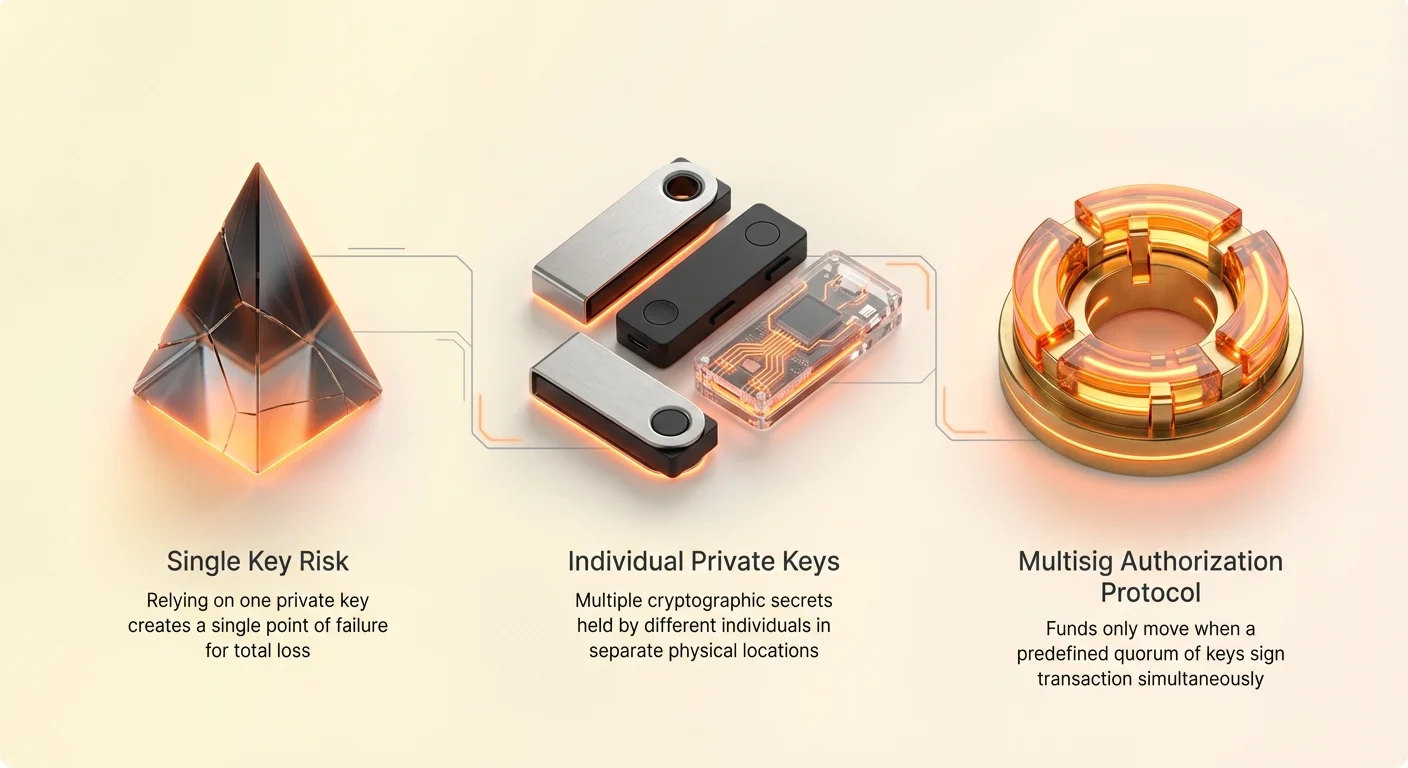
For individuals, protecting this single key often means using a hardware wallet—a highly effective security measure known as cold storage. However, for businesses, groups, large treasuries, or even sophisticated individuals planning for the future, relying on a single key stored in a single location presents an unacceptable risk. If that key is lost, stolen, or compromised, the entire fund is gone instantly.
This is where the concept of the Multisignature (Multisig) wallet emerges. Multisig is an advanced security mechanism designed to eliminate the single point of failure inherent in standard (single-signature) wallets. It shifts the paradigm from requiring one key to unlock the vault to requiring a combination of keys, held by separate individuals, to approve any action. This guide provides a definitive, comprehensive overview of multisig technology, covering its technical setup, strategic application, and crucial role in achieving true self-sovereignty and shared control over digital assets.
The Basics of Multisignature Wallets
A multisignature wallet is simply a type of cryptocurrency address that requires multiple private keys to authorize a transaction, rather than just one. Think of it like a safety deposit box in a bank that requires two separate keys, held by two different people, to open.
Private Keys, Public Keys, and the Single Point of Failure
Before diving into multisig, it’s essential to review how standard wallets work:
- The Private Key: This is the ultimate secret. It is a long string of characters (often represented by a 12- or 24-word seed phrase) that gives you the mathematical power to spend your cryptocurrency. If anyone gets this key, they control your funds.
- The Public Key/Address: This is the receiving address everyone sees (like your account number). It is mathematically derived from your private key but cannot be used to spend funds.
In a standard setup, if a hacker gains access to your private key (the single signature), they can drain your entire wallet instantly. This is the single point of failure that multisig is designed to eliminate.
How Multisig Solves the Problem of Loss and Theft
Multisig fundamentally changes the spending requirement. Instead of one signature proving ownership, the blockchain is programmed to only accept transactions that contain, for example, two out of three authorized signatures.
Protection Against Theft (External Threat): If a malicious actor compromises one key holder's computer or hardware wallet, they still cannot move the funds because they lack the necessary second (or third) signature from another key holder.
Protection Against Loss (Internal Threat): If one key holder loses their hardware device or forgets their seed phrase, the group can still recover or move the funds using the remaining keys.
Multisig ensures no single person (or single compromised device) has unilateral control, demanding cooperation and distribution of trust.
Multisig vs. MPC (Multi-Party Computation)
As security solutions evolve, a related concept called Multi-Party Computation (MPC) often appears alongside multisig. While both aim for shared control, they achieve it differently:
| Feature | Multisig (M-of-N) | MPC (Threshold Signature) |
|---|---|---|
| Technology | On-chain protocol requiring separate, full signatures from key holders. | Off-chain cryptographic process that creates a single signature from shared "key shards." |
| Transparency | The wallet address is visibly multisig on the blockchain. | The resulting transaction looks like a standard single-signature transaction on the blockchain. |
| Key Status | Each key holder possesses a full, stand-alone private key. | Key holders possess fragments or "shards" of a key; no single party holds the full key. |
| Complexity | Generally simpler, more established, and widely supported. | More complex cryptographic implementation, often required for corporate custody solutions. |
While MPC is growing rapidly for institutional use, Multisig remains the gold standard for robust, transparent, and self-custodied group governance and treasury management due to its relative simplicity and long track record.
Understanding M-of-N Security Schemes
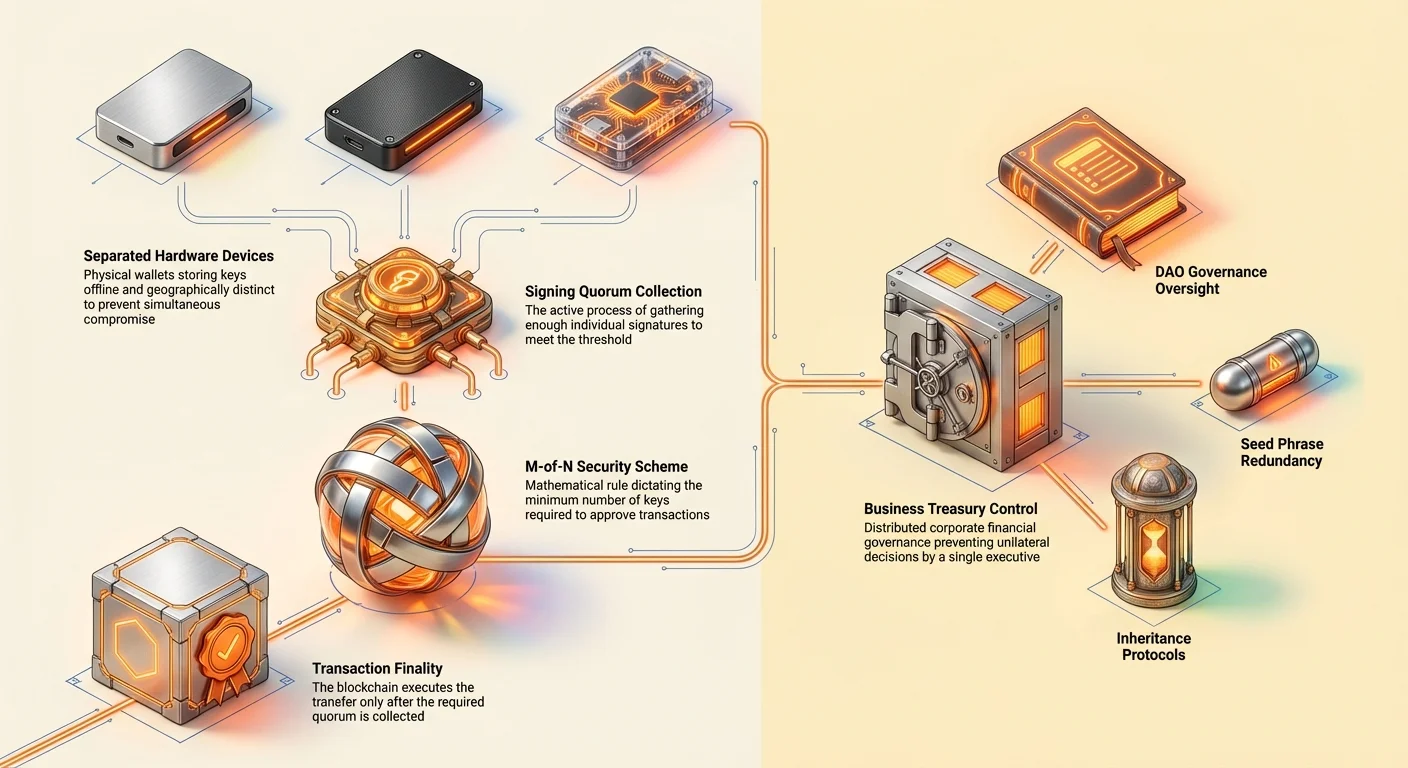
The core mechanic of any multisig wallet is the M-of-N scheme. This is the mathematical formula that dictates how many keys are required out of the total number of keys created to approve a transaction.
Defining M and N (Quorum and Key Holders)
- N (Total Key Holders): This is the total number of private keys associated with the multisig address. This determines the maximum possible security backup.
- M (The Quorum): This is the minimum number of keys required to sign and execute a transaction. This is the threshold for action.
The relationship between M and N is critical because it defines the wallet’s vulnerability profile and operational efficiency. The required signatures (M) must be collected before the transaction is broadcast to the network.
Common Configurations and Their Applications
Choosing the right M-of-N scheme depends entirely on the purpose, the level of trust among participants, and the need for operational speed.
1. The 2-of-3 Setup (High Security, High Reliability)
- Configuration: Requires 2 signatures out of 3 total keys.
- Use Cases: Small business treasuries, couples managing joint funds, or enhanced personal security.
- Why it works:
- Security: One key (or one key holder) can be compromised without losing funds.
- Reliability: One key can be lost without rendering the funds inaccessible.
In a 2-of-3 setup for a small business, Key 1 might be held by the CEO, Key 2 by the CFO, and Key 3 might be held by a corporate lawyer or stored securely off-site as a backup (an "emergency key"). Any two can authorize spending.
2. The 3-of-5 Setup (Shared Governance, Robust Backup)
- Configuration: Requires 3 signatures out of 5 total keys.
- Use Cases: Medium-to-large business treasuries, board management, or Decentralized Autonomous Organizations (DAOs).
- Why it works: This setup offers much greater resilience against collusion. If 1 or 2 keys are compromised, the funds are safe. If 1 or 2 key holders become unavailable (vacation, illness, death), the remaining 3 can still operate.
3. The 1-of-2 Setup (Dangerous but Necessary)
- Configuration: Requires 1 signature out of 2 total keys.
- Use Cases: Generally discouraged for security, but sometimes used in contracts where two parties are fighting over funds (Escrow).
- Why it works (in limited scenarios): It provides a way for either party to unilaterally release the funds. This is a low-security, high-flexibility option, not suitable for treasury management.
4. The N-of-N Setup (The Ultimate Trust Model)
- Configuration: Requires ALL signatures out of the total keys (e.g., 3-of-3).
- Use Cases: Highly specialized, high-trust scenarios where every single participant must approve every single transaction.
- Why it works: Provides absolute security against non-consensus spending. However, if any single key holder is unavailable, the funds are locked forever—making this scheme extremely difficult to manage operationally.
Risk Assessment and Scheme Selection
When deciding on M and N, you must balance two competing risks:
| Risk Profile | Description | Recommended M-of-N |
|---|---|---|
| Operational Risk (The Locking Risk): | The risk that you cannot gather enough signatures (M) because keys are lost or key holders are unavailable. | Choose a lower M (e.g., 2-of-5). |
| Collusion Risk (The Theft Risk): | The risk that the minimum number of key holders (M) conspire to steal the funds. | Choose a higher M (e.g., 4-of-5). |
Rule of Thumb: Always ensure $M$ is high enough to prevent a conspiracy among a small faction, but low enough to allow for continued operations even if one or two key holders are incapacitated or lose their keys. For most groups, a 2-of-3 or 3-of-5 scheme offers the optimal balance.
Step-by-Step Guide: Setting Up a Multisig Wallet
Setting up a multisig wallet requires careful planning, often involving multiple hardware devices and software interfaces. This process is complex by design, as its security relies on redundancy and separation of keys.
Prerequisites and Key Preparation
Before creating the multisig contract on the blockchain, you must generate the underlying keys.
1. Acquiring Hardware Wallets
Every key in the M-of-N scheme should be generated and stored on a separate, dedicated hardware wallet (e.g., Trezor, Ledger). This provides true cold storage security, meaning the private key never touches an internet-connected device.
- Action: Purchase $N$ separate hardware wallets (e.g., three wallets for a 2-of-3 setup).
2. Generating and Separating Seed Phrases
Each hardware wallet must be set up independently to generate its own unique seed phrase.
- Action: Write down each seed phrase meticulously. Crucially, these seed phrases must be stored in physically separate, geographically distinct locations. If two keys are required, ensure their recovery phrases are not kept in the same safe.
3. Assigning Key Responsibility
Formally assign each private key (and its corresponding hardware device) to a specific key holder. This assignment should be documented and agreed upon by the group.
Choosing and Interacting with a Software Interface
The multisig wallet itself is not a physical device; it is a smart contract address on the blockchain that understands the M-of-N rule. To interact with this contract, you need specialized software.
For Bitcoin, common desktop interfaces include Sparrow Wallet or Electrum. For Ethereum and related chains (which often manage business treasuries and DeFi), Gnosis Safe (now Safe) is the industry standard.
Setup Phase: Creating the Contract
- Input Public Keys: The designated setup interface (e.g., Gnosis Safe web app) will prompt the key holders to input the public key or address derived from their hardware wallet.
- Define M and N: The user specifies the total number of owners (N) and the required confirmations (M).
- Deploy the Contract: The software deploys the multisig smart contract to the blockchain. This contract now is your multisig wallet address.
Once deployed, the funds must be sent to this new, unique multisig address. Only when funds arrive at this address are they protected by the M-of-N rules.
The Signing and Execution Process
When the group decides to make a transaction (e.g., sending 5 BTC to a vendor), the process follows a strict flow:
1. Proposal and Initiation
One key holder initiates the transaction proposal using the software interface. The proposal specifies the amount, the recipient address, and the network fee. The transaction is generated but remains unsigned.
2. Review and Signing
The proposal is visible to all N key holders. Each key holder connects their hardware wallet to their interface (which is connected to the multisig software) and reviews the proposed transaction details.
- If the transaction is approved, the key holder uses their hardware wallet to generate their unique cryptographic signature for that specific transaction and broadcasts the signature to the multisig contract.
3. Quorum Reached (Execution)
The multisig contract monitors the incoming signatures. As soon as the number of signatures reaches M (the quorum), the contract automatically bundles those signatures together and broadcasts the finalized, authorized transaction to the blockchain for immediate execution.
4. Failure to Reach Quorum
If the transaction fails to reach M signatures within a set time, the proposal expires or remains pending indefinitely. The funds remain locked in the multisig address until the required number of signatures is collected.
Strategic Use Cases for Multisignature Technology
Multisig is not just a high-tech way to secure funds; it is a powerful tool for governance, risk mitigation, and systematic control. Its primary applications lie in managing large assets where distributed responsibility is mandatory.
1. Secure Business Treasury Management (The Primary Use Case)
For any company holding significant crypto reserves, security means removing unilateral control.
Centralized Control vs. Distributed Control
In a traditional company structure, the CEO or CFO might have access to the single wallet key. This creates "key-person risk"—the risk of the funds being lost due to one person’s error, malice, or unavailability.
A multisig wallet ensures that financial decisions are always collaborative:
- Expense Approval: For example, a 3-of-5 setup might involve the CEO, CFO, COO, Head of Legal, and an External Auditor. Any transaction requires consensus from three senior leaders, preventing any one person from making unauthorized transfers.
- Operational Continuity: If the CEO is traveling or incapacitated, the business can continue to pay bills and manage funds without interruption, provided the quorum (M) can still be met by the available signers.
Handling Employee Turnover and Separation
Multisig provides a clean framework for managing key access during personnel changes. When a key holder leaves the company, the remaining key holders can initiate a transaction to migrate all funds from the old M-of-N contract to a new M-of-N contract that excludes the departing employee’s public key. This procedure ensures a clean cut-off of access without relying on the integrity of the former employee.
2. Decentralized Autonomous Organizations (DAOs) and Governance
DAOs use smart contracts to automate governance, but large treasury movements often require human oversight. Multisig wallets, particularly those implemented via platforms like Gnosis Safe, are the foundational infrastructure for DAO treasury management.
- Community Oversight: While proposals might be voted on by thousands of token holders, the actual execution of spending funds (e.g., funding a new development team) is typically handled by a core group of elected multisig signers (often 5-of-7 or 7-of-9).
- Trustless Execution: This ensures that even if the DAO is attacked by a governance-manipulation scheme, the treasury funds cannot be moved without the explicit, secure, and physically separated signatures of the elected core team.
3. Advanced Personal Security and Inheritance Planning
For high-net-worth individuals, multisig is an unparalleled tool for managing personal security risks and ensuring smooth wealth transfer after death.
Reducing Personal Kidnapping Risk
In rare but serious situations, an attacker might attempt to coerce a single key holder into signing a large transaction. With multisig, this becomes impossible. The attacker would need to coerce multiple, geographically separated key holders simultaneously, dramatically increasing the operational difficulty and risk of the attack.
Secure Inheritance Planning (The "Dead Man's Switch")
One of the greatest challenges of self-custody is ensuring loved ones can access funds upon the owner's death without risking early access or theft. Multisig provides a structured solution:
The Setup (e.g., 2-of-3):
- Key 1: Held by the owner (kept in secure cold storage).
- Key 2: Held by a trusted third party, such as an estate lawyer or specialized fiduciary custodian.
- Key 3: Held by the primary heir (stored in a safe or separate location).
During Life: The owner and the lawyer/fiduciary (Keys 1 and 2) can easily transact 2-of-3, keeping the heir’s key dormant and safe.
After Death: Upon presentation of a death certificate, the lawyer/fiduciary (Key 2) and the heir (Key 3) can now coordinate the 2-of-3 signatures to unlock the funds and transfer them to the heir’s new address.
This setup prevents the heir from accessing the funds prematurely while the owner is alive, but guarantees access when the owner is deceased, fulfilling the inheritance plan without compromising the security of the funds during the owner's lifetime.
Security Best Practices and Management Tips
Implementing multisig is only the first step. Proper management, key hygiene, and disaster recovery planning are essential to maintain the integrity of the M-of-N scheme over time.
Geographic Key Distribution
The fundamental purpose of multisig is to separate keys. This separation must be physical and geographic.
- Avoid Centralization: Never store multiple seed phrases in the same physical location (e.g., two seed phrases in one safe). If that location is compromised (fire, flood, theft), the security benefit of multisig is instantly lost.
- International Spreading: For very large treasuries or high-stakes personal assets, consider distributing keys across different countries or continents. This protects against localized political risks or physical disasters.
Testing the Wallet: The "Fire Drill"
Many organizations set up complex multisig wallets but never test the recovery procedures until a crisis hits. This is a fatal mistake. You must periodically verify that all key holders can successfully sign and move funds.
- Annual Test: At least once per year, initiate a small, symbolic transaction (e.g., sending $10 worth of crypto to a designated test address).
- Mandate Participation: Require all key holders (M) to participate in signing the test transaction. This verifies that their hardware wallets, software setups, and key access methods are still functional.
- The Lost Key Simulation: Run an internal scenario where you assume one key has been lost. Can the remaining $N-1$ key holders still reach the M quorum and execute a recovery transaction to a new address? Document the steps required.
Key Rotation and Auditing
The individuals involved in key signing, the hardware devices used, and the underlying software interfaces should be subject to regular auditing.
- Signer Audit: Conduct periodic background checks or reassess trust levels for all key holders. If a key holder's role or circumstances change significantly, consider migrating the funds to a new multisig contract excluding that individual.
- Hardware Audit: If a hardware wallet device is exposed to physical risk (e.g., taken on a plane, confiscated, or handled by someone outside the group), it should be considered compromised and its associated public key should be replaced in a new multisig contract.
- Regular Seed Phrase Check: While the seed phrase should never be digitized, the physical storage container should be checked for integrity (water damage, security seals intact) on a routine basis.
Preventing "Dust Attacks" and Phishing
Because every key holder must review and sign a transaction, the review process must be meticulous. Hackers sometimes employ "dust attacks" or phishing attempts.
- Verification is Mandatory: When reviewing a transaction proposal, key holders must verify every detail: the amount, the network fee, and, most critically, the destination address. Never assume the interface is accurate; always verify the destination address through a secondary, trusted communication channel (e.g., verbally confirming the address with the recipient).
- Use Whitelists: Many multisig platforms allow the setup of "whitelists"—pre-approved addresses (like known exchange withdrawal addresses or vendor addresses). This speeds up common transactions and reduces the risk of accidental misspending.
Choosing a Multisig Solution Provider
While the underlying cryptography of Bitcoin multisig (P2SH) is standardized, the user experience and feature set vary widely depending on the software platform or service you choose.
Platform Features Comparison
The choice of provider usually boils down to the blockchain being used (Bitcoin vs. EVM chains) and the level of operational control needed.
| Platform Type | Primary Blockchain(s) | Key Features | Best Suited For |
|---|---|---|---|
| Gnosis Safe (Safe) | Ethereum, Polygon, Avalanche, etc. (EVM chains) | Highly programmable, supports NFTs, DeFi interaction, customizable access controls. | DAOs, DeFi treasuries, Web3 businesses needing complex interactions. |
| Sparrow Wallet | Bitcoin | Desktop application, excellent integration with various hardware wallets (PSBT standard), highly transparent and focused purely on Bitcoin security. | Bitcoin maximalists, individual long-term Bitcoin storage, high-security Bitcoin businesses. |
| Electrum | Bitcoin | Lightweight, older standard for Bitcoin multisig, versatile and user-friendly desktop client. | Users seeking simplicity and a well-established history on Bitcoin. |
| Custodian Services | Multi-chain | Managed services, often including MPC, insurance, and regulatory compliance. | Financial institutions, regulated corporate entities, and firms requiring complex compliance. |
Open-Source vs. Proprietary Solutions
The crypto community generally favors open-source solutions for security infrastructure, and this is especially true for multisig.
Open-Source Advantages
Platforms like Gnosis Safe and Sparrow Wallet are open-source, meaning their code is publicly viewable and auditable.
- Trust Through Verification: Anyone can inspect the code to ensure there are no backdoors, hidden fees, or vulnerabilities. This transparency is crucial when entrusting large sums of money to a smart contract or software client.
- Community Support: Bugs and security issues are often found and patched quickly by a global community of developers.
Proprietary Considerations
While some corporate multisig and custody solutions are proprietary (closed source), they often offer features like corporate liability insurance, regulatory reporting, and seamless integration with legacy banking systems.
If choosing a proprietary solution, the organization must perform intense due diligence on the vendor’s security certifications, insurance policies, and third-party audit reports, as they cannot review the source code directly. For self-custody and maximum self-sovereignty, open-source is highly recommended.
Conclusion
Multisignature technology represents a significant leap forward in digital asset security, transforming the risk profile from a single, high-stakes target into a distributed governance system. It is the necessary bridge between personal self-custody and institutional responsibility.
By implementing a well-designed M-of-N scheme, securing keys in cold storage across separate locations, and establishing clear operational procedures for signing and recovery, groups can virtually eliminate the risk of catastrophic loss due to theft, key compromise, or the unavailability of a key holder.
For businesses and sophisticated users managing high-value assets, multisig is no longer an optional feature—it is a fundamental requirement for building resilience and trust in the decentralized economy. Mastering the setup and strategic use of multisig wallets is a crucial step on the roadmap toward true digital self-sovereignty.