
Entering the world of Bitcoin and digital assets can feel daunting. As a technology designed to fundamentally disrupt global finance and established power structures, Bitcoin is constantly subjected to intense scrutiny, often manifesting as sensationalized headlines and half-truths known collectively as FUD (Fear, Uncertainty, and Doubt).
For newcomers, these narratives—concerning Bitcoin's energy usage, its alleged dominance by criminals, or the certainty of its collapse—are the primary stumbling blocks that prevent them from moving past the education phase and securing true self-sovereignty.
This guide aims to cut through the noise. By tackling the most pervasive and persistent myths surrounding Bitcoin, we provide the factual context necessary to understand the technology's true utility, limitations, and potential. Our goal is to neutralize these common objections, allowing you to focus on the profound problems Bitcoin was designed to solve.
Mit 1: Bitcoin je okoljska katastrofa
Najpogostejša in čustveno nabita kritika, usmerjena proti Bitcoinu, je njegova poraba energije. Kritiki pogosto navajajo statistike, ki kažejo, da omrežje Bitcoin porabi več elektrike kot cele majhne države. Čeprav je ta podatek resničen, je popolnoma ločen od konteksta.
Poraba energije Bitcoina je nujna funkcija njegovega varnostnega modela, analiza pa brez primerjave z obstoječimi sistemi ali upoštevanja vira energije vodi do napačnih zaključkov.
Nujnost dokaza dela (PoW)
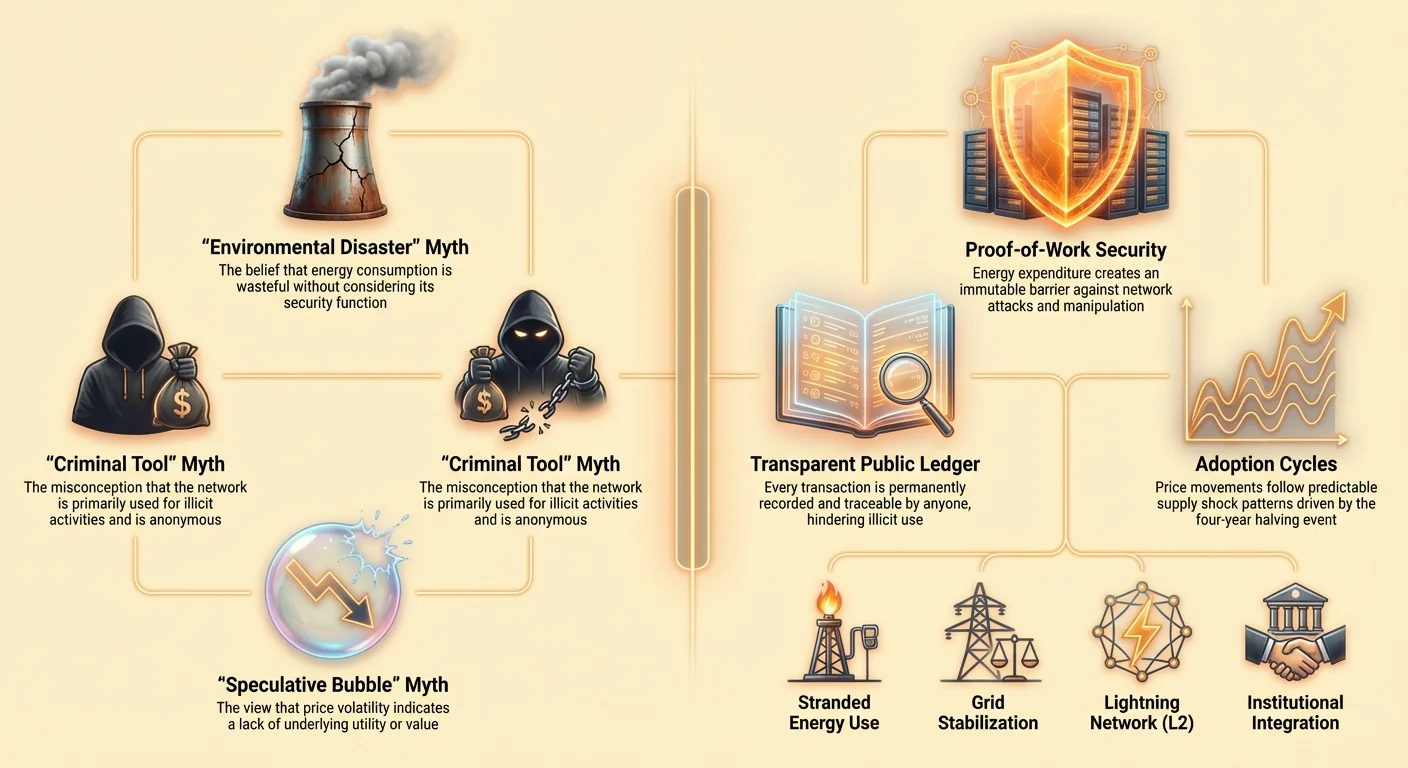
Bitcoin deluje na mehanizmu soglasja, imenovanem dokaz dela (PoW). Ta mehanizm zahteva, da »rudarji« (zmogljivi računalniki) porabijo računsko energijo za preverjanje transakcij in zavarovanje omrežja. Strošek energije deluje kot ovira za vstop, kar naredi nadzor ali onesnaženje omrežja s strani posamezne zlonamerne entitete prepotrebno drago.
Ključna ugotovitev je tukaj fundamentalna: Poraba energije ni napaka; to je strošek absolutne decentralizacije in varnosti. To je tisto, kar preprečuje, da bi omrežje zanašalo na zaupanja vredno tretjo stran (kot vlado ali banko), in zagotavlja, da njegova monetarna politika ne more biti spremenjena.
Kontekstualizacija porabe energije
Da razumemo, ali je poraba energije Bitcoina »prevelika«, ga moramo primerjati s porabo energije tradicionalnih finančnih sistemov in drugih industrij, ki ponujajo podobne ravni varnosti in prenosa vrednosti.
Pri preučevanju okoljskega odtisa globalnega bančništva je treba upoštevati:
- Fizična infrastruktura: Tisoče stekleno-jeklenih podatkovnih centrov po svetu, omrežja bankomatov, poslovnih prostorov in energija, potrebna za napajanje milijard računalnikov zaposlenih.
- Prevoz: Globalna logistika za gibanje gotovine, oklepnih vozil, zasebnih reaktivcev za izvršne direktorje in vladne zaščite.
- Rudarjenje zlata: Obsežen okoljski vpliv pridobivanja zlata, ki vključuje uporabo strupenih kemikalij (cianid in živo srebro) ter uničujoče prakse na tleh.
Študije, ki poskušajo izmeriti skupni energetski odtis tradicionalnega bančnega sistema, dosledno kažejo, da energija, potrebna samo za delovanje podatkovnih centrov, močno presega porabo Bitcoina. Bitcoin doseže superiorno raven varnosti in končne poravnave brez potrebe po obsežni fizični infrastrukturi, povezani z obstoječimi financami.
Prehod na trajnostno in zapuščeno energijo
Rastóče število raziskav kaže, da rudarjenje Bitcoina ni le breme obstoječih električnih omrežij; lahko aktivno spodbuja uvedbo obnovljivih in prej zapravljenih virov energije.
1. Monetizacija zapuščene energije: Znatni del rudarjenja Bitcoina poteka z uporabo zapuščene energije – moči, ki je proizvedena, a je ne more učinkovito dostaviti v urbana središča. Primeri vključujejo:
- Spaljeni naravni plin: Naftni vrtine pogosto sežejo odvečen naravni plin (flaring), ker ni ekonomično ga transportirati. Rudarji lahko postavijo mobilne enote na teh lokacijah, zajamejo ta plin, ga pretvorijo v elektriko in ga uporabijo za rudarjenje. To učinkovito zmanjša emisije metana (ki je daleč močnejši toplogredni plin kot CO2).
- Oddaljene obnovljive vire: Hidroelektrarne, vetrne in sončne farme včasih proizvajajo presežno moč v obdobjih nizke porabe. Ker je elektriko težko shraniti, je ta energija pogosto zapravljena (omejena). Rudarji Bitcoina delujejo kot zagotovljeni, fleksibilni kupci te presežne energije, kar naredi obnovljive projekte bolj ekonomične.
2. Stabilizacija omrežja: Rudarji Bitcoina so edinstveni, ker so prekiniteljivi kupci energije. Ne morajo delovati 24/7. Med vrhom povpraševanja (npr. vroč poletni dan, ko vsi uporabljajo klimatske naprave) lahko upravitelji omrežja sklenejo pogodbo z rudarji, da takoj ustavijo svoje operacije, kar sprosti ogromne količine elektrike za mesta. To deluje kot ključna stabilizirajoča sila za omrežje in spodbuja boljšo energetsko infrastrukturo.
Povzeto, okoljski argument proti Bitcoinu pogosto zgreši cilj z osredotočanjem izključno na skupno porabo namesto primerjave njegove uporabnosti z obstoječimi sistemi ali priznanja njegove edinstvene vloge pri spodbujanju ekonomike obnovljivih in zapravljenih virov energije.
Myth 2: Bitcoin is Only Used by Criminals and Terrorists
Sensationalized headlines often paint Bitcoin as the currency of choice for the dark web and illicit activities. While it is undeniable that criminals utilize Bitcoin, just as they use cash, gold, and wire transfers, the scope of this use is vastly exaggerated.
This myth relies on a critical misunderstanding of how the Bitcoin network operates and the relative scale of crime committed using traditional (fiat) finance.
Transparency vs. Anonymity
The biggest misconception about Bitcoin is that it is anonymous. Bitcoin is, in fact, pseudonymous.
- Anonymous (Cash): No record of who owns it or where it has been.
- Pseudonymous (Bitcoin): Every transaction ever made is permanently recorded on a public ledger (the blockchain), tied to a unique wallet address. While the address itself isn't immediately tied to a government ID, advanced forensic analysis and law enforcement tools (like Chainalysis) can track the flow of funds with high certainty, especially when criminals try to interact with regulated, centralized exchanges.
This transparency is Bitcoin’s greatest weakness for illicit actors.
Practical Consequence: If funds are stolen or used in a ransomware attack, law enforcement can track the movement of those coins across the globe, sometimes for years. This capability is virtually impossible with physical fiat cash or complex international wire transfers handled by banks.
The Scale of Illicit Activity
When analyzing the actual use cases, the data definitively shows that fiat currency remains the undisputed king of criminal finance:
| Medium of Exchange | Estimated Illicit Use (Fraction of Total Volume) | Ease of Tracking |
|---|---|---|
| Physical Fiat Cash | Billions, often untracked. Used for nearly 100% of street-level crime and much of high-level money laundering. | Impossible to track once physical change of hands occurs. |
| Traditional Banking | Trillions of dollars laundered annually through complex shell corporations and legal loopholes. | Highly dependent on bank cooperation and complex international legal frameworks. |
| Bitcoin/Crypto | Consistently less than 1% of total transaction volume. | High—transactions are permanent and visible on the public ledger. |
Major government bodies, including Europol and the U.S. Treasury, routinely acknowledge that the overwhelming majority of global money laundering still occurs within the traditional banking system. Banks frequently pay massive fines for failing to comply with Anti-Money Laundering (AML) and Know-Your-Customer (KYC) regulations, demonstrating the scale of the problem in fiat.
Criminals prefer traditional finance because it offers liquidity, regulatory opacity, and the ability to handle transaction volumes far exceeding the scope of the current crypto ecosystem without public record.
Myth 3: Bitcoin is Just a Bubble Waiting to Pop
The price volatility of Bitcoin often leads to the conclusion that it is merely a speculative bubble—a phenomenon detached from real-world value, similar to the Dutch Tulip Mania of the 17th century. While Bitcoin has experienced multiple dramatic price swings, confusing volatility with a lack of intrinsic value overlooks the fundamental technology.
Defining a Bubble vs. Disruptive Adoption
A true financial bubble is characterized by mass speculation in an asset with little to no underlying utility or tangible value. Tulip bulbs, dot-com stocks without business models, or subprime mortgages are classic examples. Once the speculation fades, the asset value drops to near zero.
Bitcoin, however, is not a stock or a commodity in the traditional sense; it is a monetary network. Its value is derived from the utility it provides:
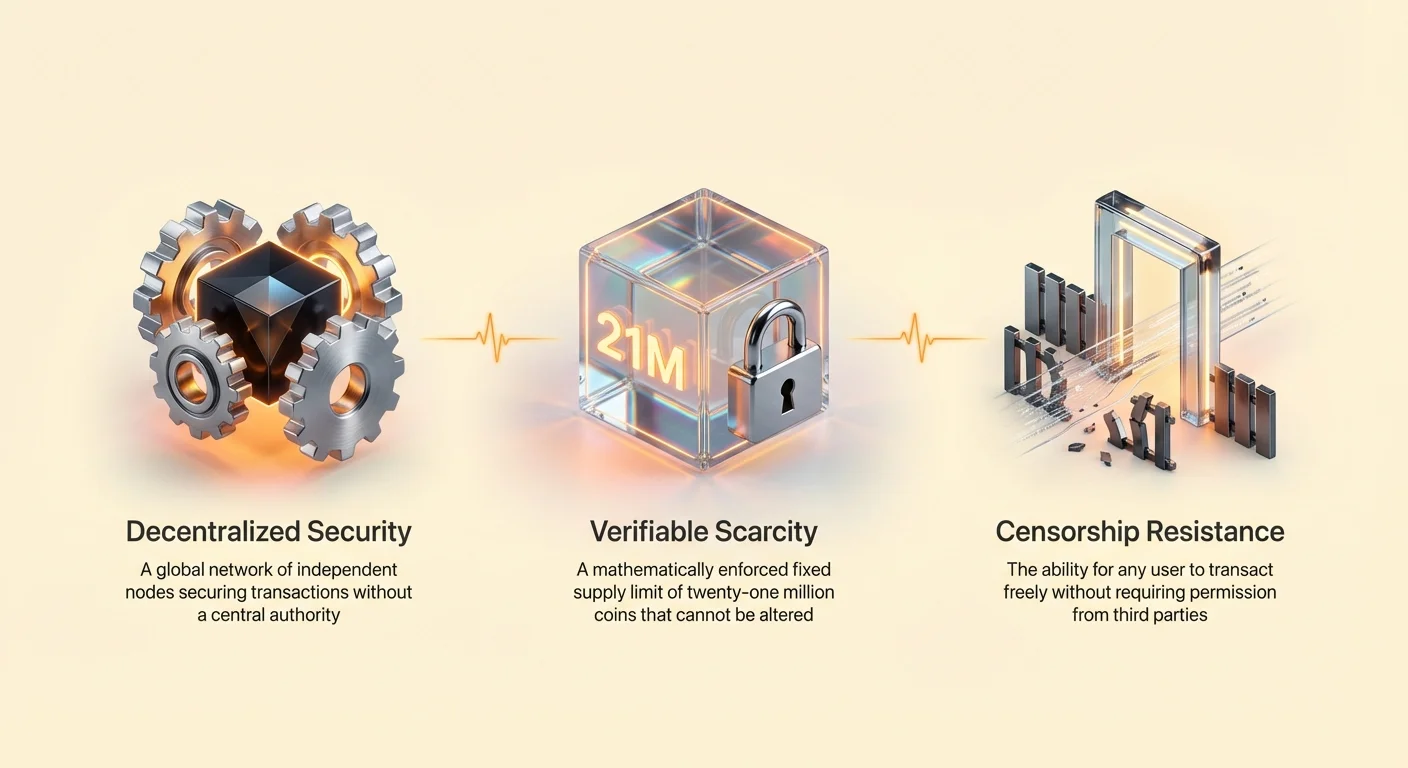
- Decentralized Scarcity: It is the first digitally native asset with a mathematically enforced supply limit (21 million coins).
- Censorship Resistance: It allows anyone, anywhere, to transact without needing permission from a bank or government.
- Final Settlement: Transactions are irreversible and settle quickly, globally.
The volatility we see is typical of any radically disruptive technology in its early adoption phase. Think of the early internet: Amazon stock, for example, dropped over 90% during the dot-com bust of the early 2000s, but the company’s underlying utility (e-commerce) ensured its eventual recovery and dominance.
The Anatomy of Bitcoin Market Cycles
Bitcoin's price movements are not random; they follow predictable, albeit intense, cycles driven by the network’s core inflation mechanism: the Halving.
- What is the Halving? Approximately every four years, the reward paid to miners for securing the network is cut in half. This reduces the supply of new Bitcoin entering the market.
- The Result: Since the demand side of the market continues to grow (more users, more institutional interest), suddenly restricting the supply creates immense scarcity pressure. This typically leads to a sharp price increase (the bull market), followed by a necessary correction (the bear market) as speculative euphoria fades.
These recurring cycles demonstrate that Bitcoin’s price behavior is linked directly to its controlled supply mechanics, not simply random speculation. Each cycle sees the “floor” of the price higher than the previous one, showing steady, foundational growth in value and adoption over the long term.
Bitcoin as Insurance Against Systemic Risk
Beyond speculation, Bitcoin is increasingly viewed by institutions and individuals as a hedge, or "digital gold." As central banks continue to expand monetary supply, devaluing traditional fiat currencies, Bitcoin offers a non-sovereign, hard-capped alternative.
The long-term value proposition lies not in its ability to generate high returns quickly, but in its guarantee of monetary integrity—the promise that no one can arbitrarily print more of it or confiscate it easily.
Myth 4: Governments Will Just Ban It and Shut It Down
A pervasive fear among skeptics and newcomers is that if Bitcoin ever becomes a large enough threat to the existing financial order, governments will coordinate a global ban, rendering the asset worthless. While regulation is inevitable and necessary, a global shutdown is virtually impossible.
The Difficulty of Decentralization
Bitcoin operates on thousands of independent nodes across the globe. It is not managed by a CEO, nor does it have a physical headquarters that can be raided or shut down. It is simply software running on the internet.
- Censorship Resistance: Even if a major government (like the U.S. or China) were to ban Bitcoin mining and transactions within its borders, the network would simply continue operating elsewhere. The history of technology shows that attempts to ban a decentralized protocol often simply push the activity underground or offshore, rather than eliminating it entirely.
- The Internet Analogy: Trying to ban Bitcoin is similar to trying to ban the BitTorrent protocol or specific types of encryption. The code exists; stopping its use globally is an impractical regulatory fantasy.
The Shift from Hostility to Integration
Global regulatory bodies have largely moved past the idea of an outright ban and are now focused on integration, taxation, and consumer protection. Why the shift?
1. Economic Reality: Banning Bitcoin means banning innovation, talent, and capital from one's jurisdiction. Governments have realized that it is far more profitable to regulate and tax the industry than to try and eliminate it.
2. Institutional Adoption: The entry of large, regulated financial firms (such as BlackRock, Fidelity, and major banks) into the crypto space via products like spot Bitcoin ETFs (Exchange-Traded Funds) has fundamentally changed the political calculus. These institutions now have a vested interest in the stability and acceptance of the asset, lobbying for clear rules rather than prohibition.
3. Sovereign Interest: A handful of countries (like El Salvador) have adopted Bitcoin as legal tender, while numerous others are exploring it as a state reserve asset or a tool for national payment infrastructure. Once sovereign states hold Bitcoin, the likelihood of coordinated global bans drops dramatically.
Regulation is Bullish, Not Bearish
For the long-term health of the network, regulation is positive. Clear rules legitimize the asset class, making it safer for finance professionals and institutional investors to allocate capital. The primary goal of current regulation is not destruction, but managing risks like money laundering and investor fraud—risks that exist in every financial market.
Dodatni ugovori in pojasnila
Čeprav so energija, kriminal in baloni trije veliki miti, nekaj drugih pogostih virov zmede zahteva hitro pojasnilo:
Mit: Transakcijske provizije so previsoke za vsakodnevno uporabo
Realnost: Osnovni sloj Bitcoina (glavna veriga blokov) je zasnovan za visoko varne, končne poravnalne prenose velikih vrednosti, ne za dnevne mikrotransakcije. Za stvari, kot je nakup kave ali majhna vsakodnevna plačila, obstaja Mreža Lightning.
Mreža Lightning je tehnologija »Sloja 2«, zgrajena na vrhu Bitcoina, ki omogoča skoraj takojšnje, praktično brezplačne transakcije. Ta dvoplastni pristop omogoča Bitcoinu, da hkrati deluje kot varen, decentraliziran shranjevalnik vrednosti (Sloj 1) in kot uporabno, hitro plačilno sredstvo (Sloj 2).
Mit: Prepočasen je (samo 7 transakcij na sekundo)
Realnost: Omejitev Bitcoina na približno 7 transakcij na sekundo (TPS) na Sloju 1 je namerna. Gre za potreben kompromis, da lahko vsako posamezno transakcijo preveri tisoče vozlišč po vsem svetu (decentralizacija). Povečanje te zmogljivosti brez drugega sloja bi zahtevalo žrtev decentralizacije, kar bi mrežo oslabilo.
Spet je rešitev v tehnologijah skaliranja Sloja 2, kot je Mreža Lightning, ki lahko obdeluje tisoče TPS brez žrtvovanja varnostnih garancij osnovne verige.
Conclusion: Focus on the Fundamentals, Not the FUD
The narrative surrounding Bitcoin often focuses on its most volatile elements—price swings and energy consumption—while ignoring the core innovation it represents: verifiable digital scarcity and censorship-resistant money.
For those serious about learning the fundamentals and achieving self-sovereignty, neutralizing these common myths is the first crucial step. By understanding that Bitcoin’s energy usage is tied to its security, that its illicit use is minimal compared to fiat, and that its volatility is characteristic of an early, disruptive asset, you can move past fear and focus on the unprecedented utility Bitcoin offers.
The future of finance is built on transparency, verifiability, and immutability. As the most secure and decentralized network in existence, Bitcoin’s technological answers to these FUD narratives demonstrate its resilience and its foundational role in the new digital economy.