
When most people think about moving money, they imagine a simple update to a central ledger: Alice’s bank account balance goes down, and Bob’s goes up. This is the simple account-based model used by centralized financial systems worldwide.
However, Bitcoin, as a decentralized digital currency, cannot rely on a central authority to keep track of everyone’s balances. Such a system would be vulnerable to fraud, single points of failure, and endless disputes about the true state of the network.
To solve this profound challenge, Bitcoin introduced a unique, robust, and highly auditable accounting structure known as the Unspent Transaction Output (UTXO) model. The UTXO model is the engine under Bitcoin’s hood, ensuring that every satoshi (the smallest unit of Bitcoin) is uniquely traceable, that double-spending is mathematically impossible, and that the entire network can verify the ledger without trusting any single party.
This guide moves beyond simply defining a transaction; we analyze the core architecture—the UTXO model—to understand why it is fundamental to Bitcoin’s security, audibility, and architectural integrity. By understanding how these digital components are created, locked, and consumed, you gain a deeper appreciation for the complex cryptography that underpins true digital sovereignty.
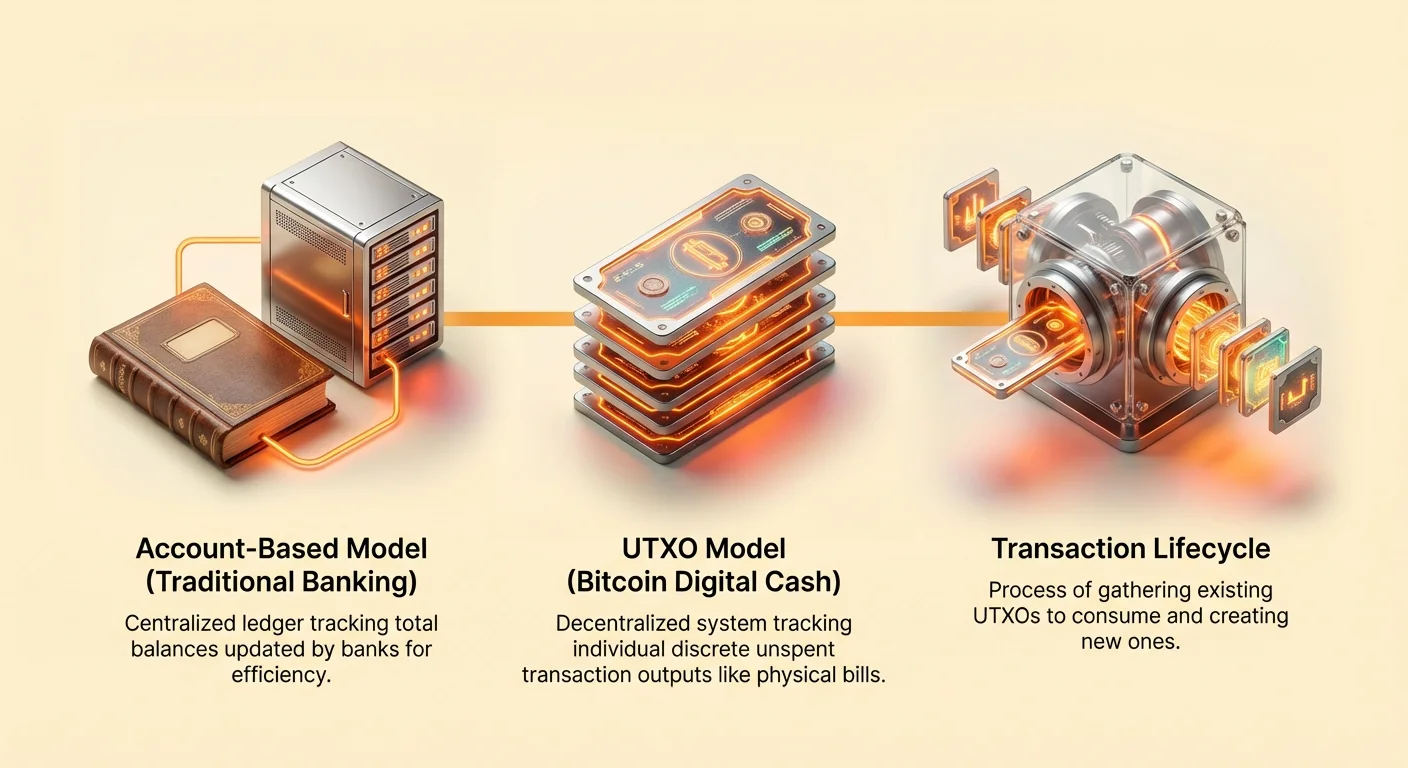
Traditional Banking vs. The Blockchain Ledger
To fully grasp the brilliance of the UTXO model, we must first understand the limitations of the traditional financial structures it replaced.
The Account-Based Model: Tracking Balances
Centralized systems, including banks, payment processors, and even centralized databases for digital games, rely on the account-based model.
In this model, the system maintains a master list of all users and their current net worth within the system. If Alice has $1,000 and sends Bob $100, the system simply performs two mathematical operations:
- Subtract $100 from Alice’s account record ($1,000 → $900).
- Add $100 to Bob’s account record ($0 → $100).
The advantage of this system is its simplicity and efficiency. Since the central bank maintains the canonical, verifiable state (the master list of balances), transactions are quick updates to existing data fields.
Why the Account Model Fails in Decentralized Systems
While efficient for centralized institutions, the account model presents critical flaws when applied to a trustless, decentralized network like Bitcoin:
- State Verification Complexity: In a decentralized network, every node must agree on the current state (i.e., everyone’s precise balance). If nodes constantly update balances, verifying the true state requires replaying every single transaction from the beginning of time or trusting an arbitrary checkpoint. This makes verification computationally heavy and susceptible to disagreement.
- Double-Spending Risk: The primary challenge in digital cash is ensuring that Alice cannot send the same $100 to both Bob and Carol. In an account model without a central referee, if Alice simultaneously broadcasts two conflicting transactions ("Send $100 to Bob" and "Send $100 to Carol"), there is no immediate, universal mechanism to determine which is valid and prevent both from being accepted.
- Audibility Issues: Account balances are constantly changing variables. While you can see the final balance, understanding how that balance was accumulated (and ensuring the system didn't err during one of the million previous updates) can be obscured behind a private corporate ledger.
The UTXO model sidesteps all these issues by abandoning the concept of a "balance" entirely and focusing instead on traceable, discrete units of value.
Decoding the UTXO Model (Unspent Transaction Output)
Bitcoin does not track how much money an address holds. Instead, the network tracks a collection of digital vouchers known as Unspent Transaction Outputs, or UTXOs.
A UTXO is, fundamentally, a record of Bitcoin that has been sent to a specific person and is now waiting to be spent. It is the fundamental building block of Bitcoin’s security and accounting system.
The Analogy of Digital Cash
The best way to understand the UTXO model is to think of it as handling physical cash, specifically banknotes, rather than managing a checking account balance.
Imagine you receive $50 from a friend. That $50 isn’t added to a running digital total; it exists as a single, physical $50 bill.
- If you want to spend $30: You cannot split the $50 bill. You must spend the entire $50 bill (the input) and, in return, receive two new things: a $30 payment for the merchant and $20 in change (a new UTXO) sent back to you.
- The $50 bill is "consumed" (spent) entirely, and new bills are created (new UTXOs).
This "consumption and creation" process is the core mechanism of the UTXO model. An address’s total "balance" is merely the sum total of all the unspent UTXOs that are currently locked to that address's cryptographic key.
Anatomy of a UTXO
Every UTXO is defined by three critical pieces of information recorded on the blockchain:
- The Source (Transaction ID and Index): A reference to the previous transaction where this UTXO was first created as an output. Since a single transaction can have multiple outputs, an index number (0, 1, 2, etc.) specifies which output is being referenced. This lineage is crucial because it ensures the network knows where the money came from.
- The Amount: The specific quantity of Bitcoin or satoshis contained within that UTXO.
- The Locking Script (ScriptPubKey): This is the cryptographic "lock" that dictates the specific conditions required to spend the UTXO in the future. In the most common scenarios (Pay-to-Public-Key-Hash or P2PKH), this script locks the funds to a specific public key hash, meaning only the person who possesses the corresponding private key can unlock it.
Once a UTXO is spent, it ceases to exist. It is marked as spent forever on the blockchain and cannot be used again, thus solving the double-spending problem.
The Concept of Change Outputs
The process of spending requires the sender to use the entire value of the selected UTXOs (inputs). If the total value of the inputs exceeds the amount the sender wants to pay the recipient, the excess amount does not simply vanish—it must be explicitly accounted for in a new output, known as the change output.
For example, Alice wants to pay Bob 0.05 BTC. She only has a single UTXO worth 0.1 BTC.
| Input (Consumed UTXO) | Output 1 (Payment) | Output 2 (Change) | Fee |
|---|---|---|---|
| 0.1 BTC | 0.05 BTC (to Bob) | 0.049 BTC (to Alice's new address) | 0.001 BTC |
In this scenario:
- The original 0.1 BTC UTXO is destroyed.
- Two new UTXOs are created: one for Bob and one for Alice (the change).
- The remainder (0.001 BTC) is implicitly claimed by the miner as the transaction fee.
This mandatory accounting for change is a core security feature, ensuring that value is conserved across the entire network and providing a natural mechanism for paying network fees.
The Bitcoin Transaction Lifecycle: From Input to Output
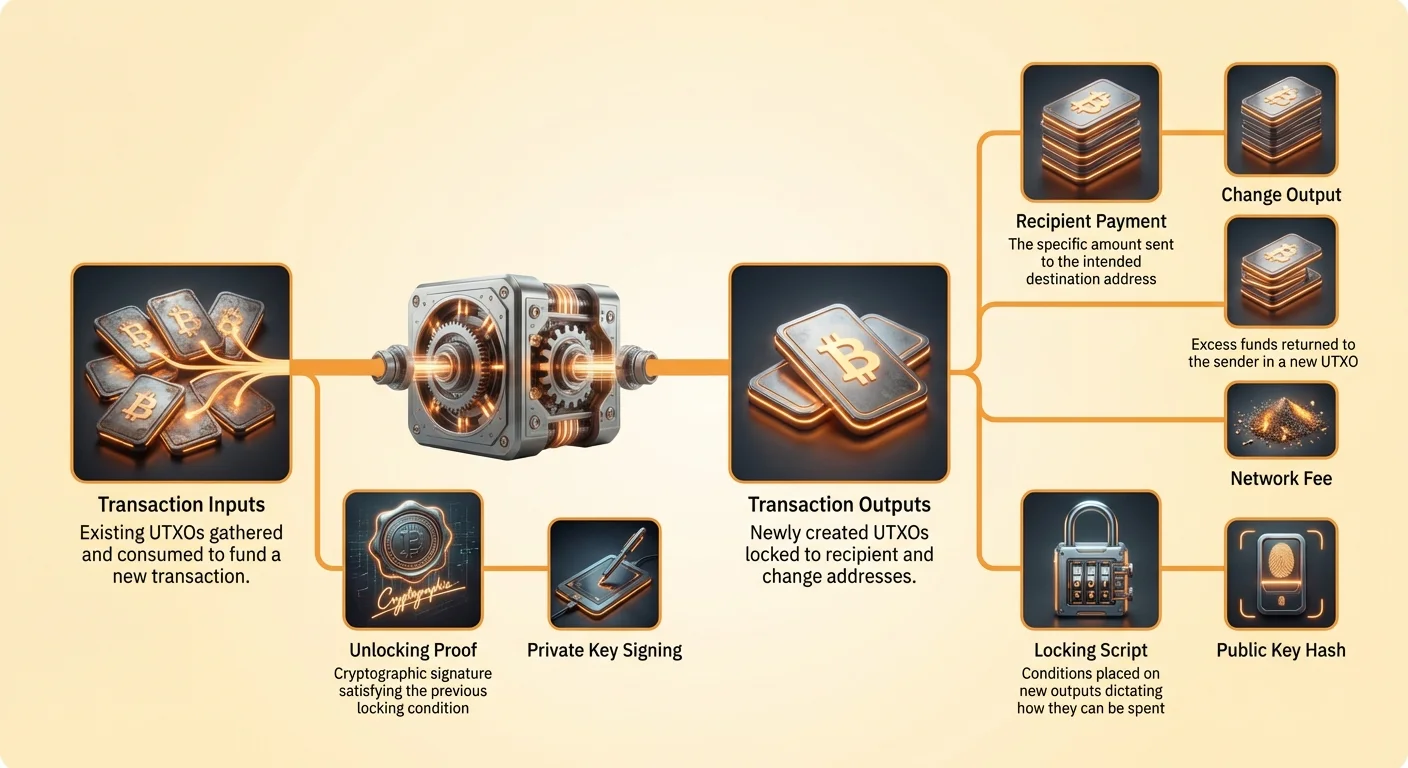
A Bitcoin transaction is not a command telling a central server to update a balance; it is a meticulously constructed message proving that the sender has the authority to unlock and consume existing UTXOs, and instructing the network on how to create new, locked UTXOs in their place.
Step 1: Gathering Inputs (The Spending Process)
Before sending any Bitcoin, a user’s wallet software must locate existing UTXOs associated with their addresses. These UTXOs serve as the inputs for the new transaction.
The Wallet’s Responsibility: When you click "Send" in your wallet, the software scans the blockchain to determine which UTXOs you possess and then calculates how many UTXOs are needed to cover the desired payment amount plus the transaction fee.
- Selection: If you want to spend 1 BTC, and you have two UTXOs (0.7 BTC and 0.4 BTC), the wallet might select both, totaling 1.1 BTC, to use as inputs.
- Unlocking Proof: For each UTXO selected as an input, the sender must provide the cryptographic proof—the digital signature—that satisfies the locking condition established by the previous transaction (the ScriptPubKey). This process proves ownership without revealing the private key.
Step 2: Defining Outputs (The New UTXOs)
The inputs are the UTXOs being destroyed; the outputs are the new UTXOs being created. There are typically two types of outputs:
A. The Recipient Output
This output defines the amount of Bitcoin the intended recipient (Bob) will receive. This new UTXO is created and locked to Bob’s specific public key hash. Once confirmed in a block, Bob can use his private key to spend this new UTXO.
B. The Change Output
If the inputs’ total value exceeds the intended payment, the excess must be returned to the sender as a new UTXO. Best practice dictates that the wallet should send this change back to a new, unique address controlled by the sender. This practice enhances privacy by breaking the explicit link between the sender's old address and their future transactions.
Step 3: Paying the Network Fee
In every valid Bitcoin transaction, the total value of all inputs must be equal to or greater than the total value of all outputs.
The difference between the total input value and the total output value is the transaction fee.
This fee is not sent to a specific address; rather, it is left unclaimed by any output, allowing the miner who successfully validates and adds the transaction to the block to claim that residual amount as a reward for their work.
Incentive Mechanism: This mechanism is critical for Bitcoin’s security model. It provides miners with an economic incentive to prioritize and confirm transactions, ensuring the network continues to operate, even as the block subsidy (newly minted coins) diminishes over time. The fee amount is generally proportional to the size of the transaction data (in bytes) and the current level of network congestion, allowing users to bid for faster inclusion. (For a deeper dive, see our related page: Mempool Dynamics: Analyzing the Bitcoin Fee Market and Congestion Pricing).
Cryptographic Security: Locking and Unlocking the Digital Vault
The true ingenuity of the UTXO model lies not just in the accounting structure, but in the cryptographic mechanisms used to govern who can spend them. This control is implemented through a simple but powerful scripting language embedded in every transaction.
The Role of Cryptographic Scripts
Bitcoin transactions are not digitally signed by the wallet software; they are processed by a stack-based, non-Turing complete scripting language. While it sounds complicated, its purpose is straightforward: to act as the "lock" and the "key" for the UTXO.
A typical transaction involves two primary scripts:
1. The Locking Script (ScriptPubKey)
This script is placed in the output of the transaction (the UTXO being created). It sets the spending condition. Essentially, it declares: "Only someone who can prove they control this public key hash can spend this money." This is the lock.
2. The Unlocking Script (ScriptSig)
This script is provided in the input when the UTXO is consumed. It provides the data necessary to satisfy the locking script—primarily the user’s digital signature and the corresponding public key. This is the key.
When a node verifies a transaction, it combines the ScriptSig (the proposed solution) and the ScriptPubKey (the challenge) and executes the combined script. If the script executes successfully (resolves to "True"), the transaction is valid, and the UTXO can be consumed.
Standard Transaction Types
While Bitcoin’s scripting language allows for complex conditions (like multi-signature requirements or time-locked funds), the vast majority of transactions use two standard forms:
Pay-to-Public-Key-Hash (P2PKH)
This is the original and most common transaction type. It locks the funds to a hash of the recipient's public key (the Bitcoin address you are familiar with). To unlock it, the spender must provide the original public key and a valid digital signature generated by the corresponding private key.
Analogy: You lock a safety deposit box with a complex biometric lock (the address hash). To open it, you must present the specific biometric identifier (public key) and a signed document proving you authorized the action (digital signature).
Pay-to-Script-Hash (P2SH)
P2SH transactions allow users to send funds to an address that is derived from a complex script (a set of custom spending rules), rather than just a public key. This is often used for multi-signature wallets (requiring 2-of-3 signatures to spend) or time-locks. P2SH simplifies the recipient's address while allowing for much greater security and complexity behind the scenes.
The Verification Process: Digital Signature and Public Key
The most critical element of the unlocking script is the digital signature.
- Signing: The sender uses their private key to digitally sign the new, proposed transaction. This signature proves that the holder of the private key authorized the spend and ensures that the transaction details (recipients, amounts, fees) cannot be tampered with after signing.
- Verification: The network uses the sender's public key (which is publicly available, often included in the ScriptSig) to mathematically verify that the digital signature was created by the corresponding private key.
Crucially, the public key allows the network to verify ownership without the private key ever leaving the owner’s control. This process is the foundational mechanism for establishing self-custody and preventing fraud in a trustless environment.
Superiority of UTXOs: Audibility, Security, and Privacy
The decision to utilize the UTXO model, rather than the more intuitive account model, was a deliberate choice that underpins the unique properties of Bitcoin’s security architecture.
Enhanced Security Through Explicit Spends
The account model must rely on consensus rules to prevent double-spending (e.g., "Whoever records the transaction first wins"). The UTXO model, however, makes double-spending mathematically impossible through the very structure of the transaction:
The Consumption Rule: An input (UTXO) can only be consumed once. Once it is included in a confirmed block, it is effectively destroyed. If a malicious user attempts to broadcast two transactions that reference the same UTXO as an input, the second transaction is automatically invalidated by the network because the referenced input no longer exists.
This consumption-and-creation structure provides a much stronger guarantee against double-spending attempts, ensuring the absolute integrity of the ledger state.
Audibility and Simplicity of State
While the account model requires tracking a constantly evolving set of balances (a dynamic state), the UTXO model tracks a static collection of spent and unspent units (a simplified state).
The global state of the Bitcoin network—the definitive list of all money currently available—is simply the aggregation of all UTXOs that exist in the world (the UTXO Set).
- Ease of Verification: For a node to verify the entire history of Bitcoin, it only needs to check that every newly mined block correctly consumes existing UTXOs and creates new ones. There is no confusion about "running balances." This transparent, auditable history is essential for decentralized systems, ensuring any participant can verify the chain’s history independently.
- Proof of Work Synergy: The UTXO model provides the precise units of account that miners, operating within the Proof of Work (PoW) consensus mechanism, compete to validate. The miner’s job is to ensure the UTXO transformations proposed in the transaction block are 100% valid before sealing the block. (For more on the underlying consensus mechanism, see: Proof of Work (PoW): Bitcoin's Economic Solution to the Byzantine Generals Problem).
Privacy and Pseudonymity Benefits
While Bitcoin is often described as "anonymous," it is more accurately defined as pseudonymous, meaning addresses and transactions are public, but they are not linked directly to real-world identities. The UTXO model naturally enhances this pseudonymity.
- Change Addresses: As discussed, when you spend a UTXO, the leftover change is typically returned to a brand-new address controlled by your wallet. This practice prevents observers from easily linking all of your Bitcoin holdings together under a single address.
- Input Consolidation: When you need to gather several small UTXOs (inputs) to make a large payment, the resulting transaction creates two brand-new, unlinked outputs (payment and change). This action effectively obscures the origin of the funds, providing stronger separation between your different Bitcoin activities.
Actionable Tip: To maximize the privacy benefits of the UTXO model, always ensure your wallet software utilizes new addresses for change outputs. This is standard for most modern non-custodial wallets, but it is a critical practice for maintaining financial pseudonymity.
Improved Parallel Processing
The UTXO model inherently allows for greater network efficiency compared to the account model.
In an account-based system (like Ethereum), if Alice and Bob are trying to transact simultaneously using the same Smart Contract or the same shared pool of funds, those transactions must be processed sequentially to prevent data conflicts.
In the UTXO model, transactions are isolated events involving the consumption of specific, unique UTXOs. As long as two transactions are not trying to consume the same input, they are entirely independent. This characteristic allows nodes to verify and process different transactions simultaneously (in parallel), significantly improving the network's potential processing throughput and resilience.
Summary of UTXO Management for Self-Custody
For users moving toward self-custody, understanding how their Bitcoin is stored—not as an aggregate balance, but as a collection of individual UTXOs—is essential for security and fee optimization.
UTXO Selection and Fee Management
The transaction fee is determined not by the dollar value of the Bitcoin being sent, but by the data size of the transaction. The primary driver of data size is the number of inputs (UTXOs) required to fund the transaction.
- Fewer UTXOs = Cheaper Transaction: If you fund a transaction using one large UTXO (e.g., 5 BTC), the transaction data is small, resulting in a low fee.
- Many UTXOs = Pricier Transaction: If you fund the same 5 BTC transaction by using fifty small UTXOs (0.1 BTC each), the transaction data size balloons because the transaction must include an unlocking script (signature and public key) for all fifty inputs. This results in a much higher fee.
Practical Use Case: UTXO Consolidation If you have accumulated many tiny UTXOs over time (sometimes called "dust"), it is financially prudent to periodically perform a "UTXO consolidation" transaction. This means sending all these small inputs to a single new address you control. While the fee for this consolidation transaction might be high initially (due to the high number of inputs), the resulting single, large UTXO will be much cheaper to spend in the future.
Script Evolution and Future-Proofing
The flexibility of Bitcoin’s scripting mechanism means the UTXO model can adapt to new cryptographic standards that enhance efficiency and lower fees.
For example, the introduction of SegWit (Segregated Witness) and Taproot technologies was specifically designed to make the cryptographic proofs (ScriptSig) required to unlock UTXOs smaller or more efficient to transmit across the network. These improvements are fundamentally dependent on the UTXO structure, proving that this accounting method is not just a legacy system, but an architecture designed for long-term cryptographic evolution.
Conclusion
The Bitcoin UTXO model represents a revolutionary approach to decentralized accounting. By discarding the centralized account balance and adopting a system based on discrete, traceable, and consumable units of value, Bitcoin solves the fundamental problems of double-spending and trust.
The transaction lifecycle, governed by explicit locking and unlocking scripts, ensures that value is preserved and that ownership is cryptographically proven in every instance. For the self-sovereign individual, the UTXO model provides unparalleled security, audibility, and the foundation for pseudonymity, cementing its place as the core engine that enables reliable digital cash for the new global economy. Understanding the UTXO structure is not merely technical knowledge; it is understanding the source code of trust in the digital age.