
When most people first hear about Bitcoin, they often hear two things: that it is revolutionary, and that it is completely anonymous. The latter point, however, is one of the most persistent and potentially dangerous misconceptions for newcomers. Bitcoin offers unprecedented financial sovereignty, but that does not automatically equate to perfect anonymity.
For users transitioning from traditional banking, the security and privacy landscape of Bitcoin can seem confusing. Banks keep your transactions private from the public but retain deep knowledge of your activity themselves. Bitcoin flips this model: your transactions are entirely visible to the world, yet your identity is—initially—hidden. Protecting your funds and your identity in this new digital economy requires a shift in mindset and the adoption of strong operational habits.
This guide clarifies the fundamental difference between Bitcoin’s inherent privacy features and true anonymity. We will lay out the essential security practices that protect your capital, followed by actionable steps—simple wallet hygiene—you can implement today to enhance your privacy and prevent your transaction history from being permanently linked to your personal identity.
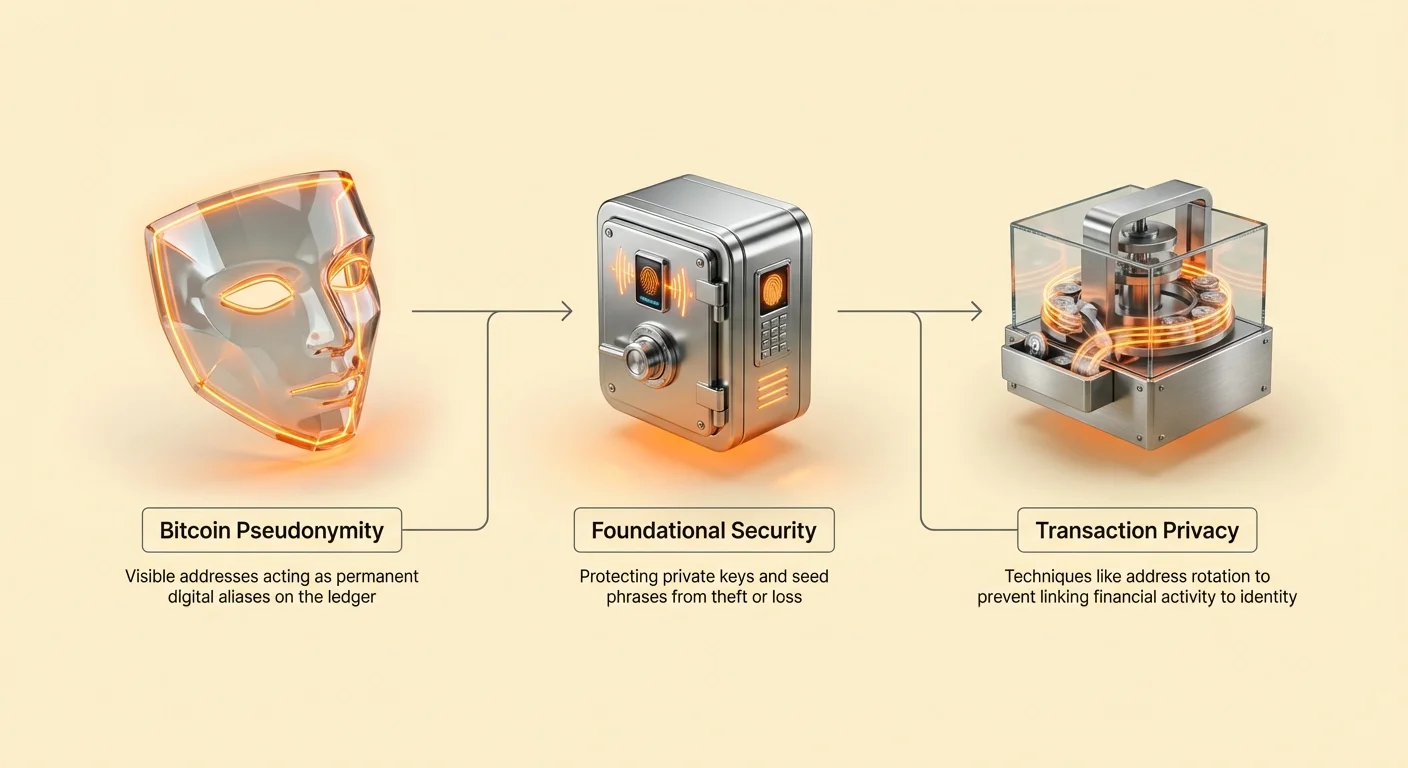
The Core Concept: Pseudonymity vs. Anonymity
Before diving into techniques, we must understand how Bitcoin functions fundamentally, specifically regarding identity. Bitcoin is not anonymous; it is pseudonymous. Understanding this distinction is the single most important lesson for any user concerned about privacy.
Defining Pseudonymity and Anonymity
Anonymity means that your identity is completely hidden and cannot be discovered by anyone. If you pay cash at a store, the transaction is anonymous—the bill is untraceable back to you.
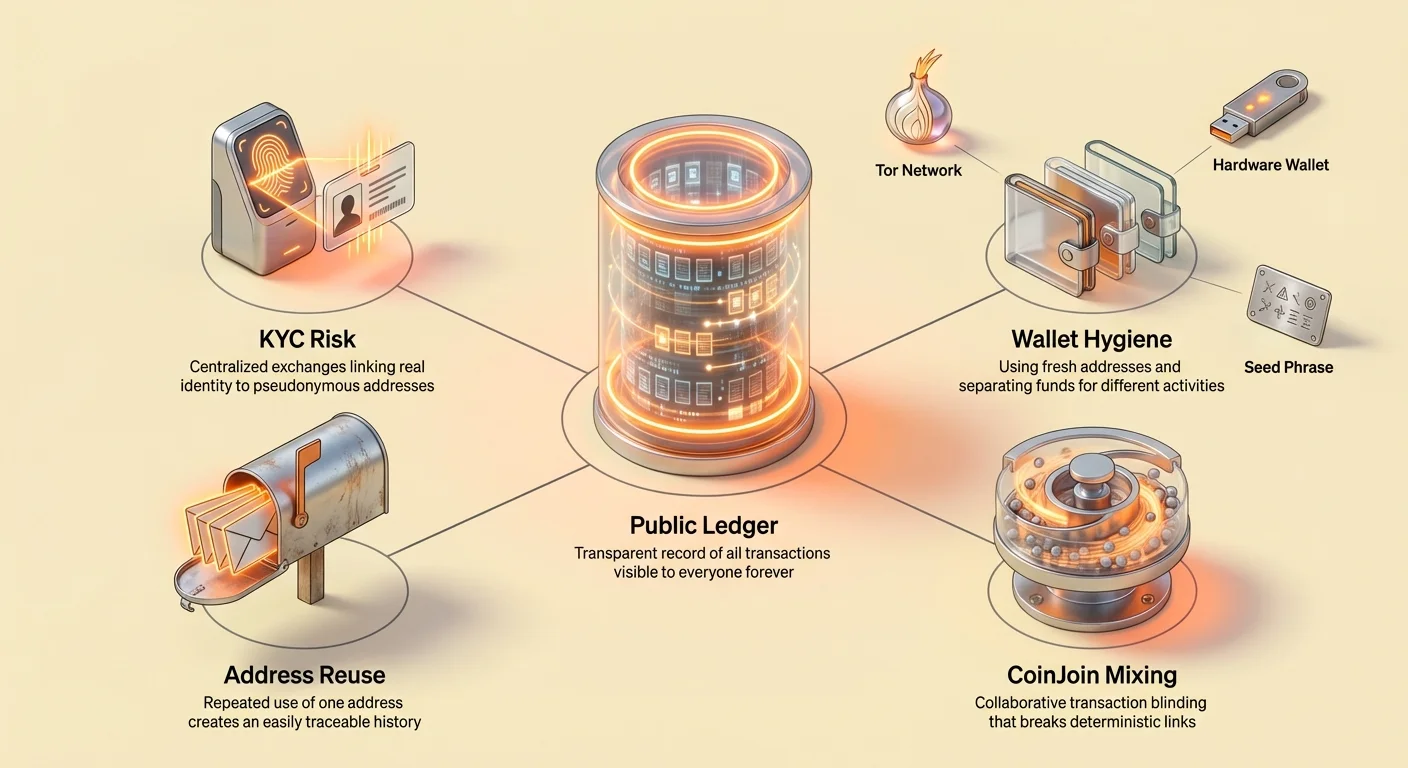
Pseudonymity means that you operate using an alias, or a pseudonym, but that this alias leaves a visible, permanent trail. Bitcoin addresses (those long strings of numbers and letters) are your pseudonyms. You can create an infinite number of these addresses, and they are not inherently tied to your real name. However, once you use an address, every transaction it is involved in is recorded forever on the public ledger.
The danger arises when your pseudonym (the Bitcoin address) is linked to your real-world identity (your name, address, or bank account). If that link is ever made, every transaction associated with that address—past, present, and future—becomes public knowledge associated with you.
What the Public Ledger Reveals
The Bitcoin blockchain is often referred to as a "distributed ledger." This ledger is transparent, meaning every single transaction ever conducted is visible to the entire world. When you use Bitcoin, you are essentially publishing your financial activity, minus your name.
What the public can see:
- The Sender’s Address: A string of letters and numbers (the pseudonym).
- The Recipient’s Address: Another string of letters and numbers.
- The Exact Amount Transferred: Down to eight decimal places.
- The Time Stamp: When the transaction occurred.
Financial surveillance companies and sophisticated blockchain analysts use this data to perform "chain analysis." They look for patterns, connections between addresses, and linkages to known entities (like large exchanges) to de-anonymize users.
The Danger of Linking Your Identity (The KYC Risk)
For most beginners, the initial link between their pseudonym and identity happens during the "Know Your Customer" (KYC) process required by centralized exchanges (CEXs) like Coinbase or Kraken.
When you sign up for these services, you must provide government-issued ID, a photograph, and sometimes proof of residence. When you buy Bitcoin on these platforms and withdraw it to your personal wallet, the exchange records which address received the funds.
Because the exchange has your real identity and the address you used, analysts can infer that any activity involving that specific address—and any subsequent addresses that interact directly with it—is likely tied to you. This single exposure can compromise your privacy indefinitely.
Foundational Security: Protecting Your Access
While privacy focuses on keeping your identity secret, security focuses on keeping your funds safe. For a beginner, security must always take precedence, as inadequate security can lead to the complete loss of your capital. These are the non-negotiable foundations of Bitcoin security.
Strong Authentication and Hardware Protection
Your first defense is protecting access to the keys that control your Bitcoin.
1. Implement Two-Factor Authentication (2FA)
Any crypto-related service you use—especially centralized exchanges—must be protected by 2FA. Do not rely on SMS 2FA, which is vulnerable to SIM-swapping attacks. Use robust authentication apps (like Authy or Google Authenticator) or, ideally, physical hardware security keys (like YubiKey). Hardware keys are the most secure method because they require physical possession to approve a login.
2. Protect Your Seed Phrase (The Master Key)
If you are using a non-custodial wallet (which is highly recommended for self-sovereignty), you will be given a recovery phrase, typically 12 or 24 words, known as a seed phrase. This phrase is the ultimate master key to your funds.
- Never store your seed phrase digitally. No photographs, screenshots, cloud backups, or typed documents.
- Write it down physically (or use a metal plate) and store it in multiple, secure, offline locations (e.g., a home safe, a bank deposit box).
- Never tell anyone your seed phrase. If anyone gains access to this phrase, they own your Bitcoin immediately, regardless of any passwords or 2FA you have set.
Malware and Phishing Prevention
Cybersecurity is crucial, as hackers frequently target Bitcoin holders.
- Verify Wallet Downloads: Only download wallet software directly from the official developer websites. Phishing sites often create exact replicas of popular wallet sites to trick users into downloading malicious software that steals their keys.
- Use Unique, Complex Passwords: Use a password manager to generate and store complex, unique passwords for every crypto account or exchange login. If one service is compromised, others remain safe.
- Isolate Sensitive Activity: Consider using a dedicated, clean computer (or a virtual machine) that is not used for general web browsing, email, or gaming solely for interacting with your Bitcoin wallet or managing large transactions.
Enhancing Transaction Privacy: Wallet Hygiene
The goal of wallet hygiene is to make it difficult for chain analysis tools to link multiple transactions or addresses to a single individual or identity. These practices require only careful attention, not complex technology.
The Golden Rule: Avoid Address Reuse
One of the most common mistakes beginners make is reusing the same Bitcoin receiving address for multiple transactions.
Why Address Reuse is Dangerous: Imagine your Bitcoin address is a public mailbox. If you tell ten different people to send money to the same mailbox, and three of those people know your identity (e.g., an employer, an exchange, and a friend), all ten transactions are instantly linked together.
Best Practice: Always generate a new receiving address for every transaction you receive. All modern non-custodial wallets (like hardware or mobile wallets) do this automatically. It is a fundamental feature of these wallets, and you should use it. While the wallet holds all your funds under one umbrella (protected by one seed phrase), the external addresses displayed to the world should constantly change.
Separate Wallets for Separate Activities (Compartmentalization)
To further confuse chain analysis, you should compartmentalize your funds by using different wallets for different activities. Think of this like separating your personal, business, and savings accounts at a traditional bank.
| Activity Category | Recommended Wallet Type | Rationale |
|---|---|---|
| Savings/Long-Term HODL | Hardware Wallet (Cold Storage) | Maximum security, minimal interaction. |
| Daily Spending/Hot Wallet | Mobile Wallet (Small amounts only) | Convenience, easy to replace if compromised. |
| Exchange/KYC Funds | Dedicated Software Wallet | Isolate funds purchased via KYC-regulated exchanges. |
| Truly Private Funds | Wallet used only with CoinJoin/Tor | Isolate funds that have never touched a KYC source. |
By separating these funds, even if one segment (like your exchange-linked funds) is de-anonymized, the rest of your funds remain structurally separate and significantly harder to trace back to you.
Understanding Transaction Change and Outputs
When you make a Bitcoin payment, you are not sending a specific number of coins from your account balance; you are spending one or more entire previous unspent transaction outputs (UTXOs) you received.
When you send $50, and the previous input you received was $100, your wallet sends the full $100 input. $50 goes to the recipient, a small fee goes to the miner, and the remaining $49.XX returns to you as "change."
The Privacy Risk: This change often goes to a new change address controlled by your wallet. However, chain analysis assumes that the recipient of the change is the original sender. If you don't use fresh, compartmentalized addresses, a single transaction can link the address you sent to and the address that received the change, building a larger profile of your activity. While complex, the takeaway is simple: trust your wallet software to manage the change correctly, but always use compartmentalization to separate activity.
Advanced Privacy Techniques (For the Dedicated User)
For users who have mastered wallet hygiene and wish to further obscure their financial trails, these techniques provide substantial privacy benefits but require more effort and often incur small fees.
Masking Your IP Address
Every time your wallet broadcasts a transaction to the Bitcoin network, your computer's IP address can be temporarily visible to the nodes that first receive and broadcast the message. If an attacker controls many nodes, they can potentially link an originating IP address to a transaction.
While this is typically a high-level surveillance vector, users can easily mitigate this by routing their connection through a privacy-focused network:
- VPNs (Virtual Private Networks): These encrypt your connection and hide your true location, making it appear as if you are broadcasting from another country.
- Tor Network: Using a wallet that supports the Tor network (The Onion Router) completely bounces your connection through numerous relays worldwide, making it nearly impossible to trace the connection back to your original IP address.
Using Transaction Mixers (CoinJoin)
CoinJoin is one of the most effective tools for breaking the links in a transaction history. It works by combining multiple inputs from multiple users into a single, large transaction.
How CoinJoin Works:
- Several users agree to spend their coins at the same time.
- All their coins are bundled into one large transaction.
- The transaction output splits the total amount back to the participants, but each participant receives their coins at new change addresses.
Since the inputs are indistinguishable from the outputs, and there are many participants, it becomes computationally difficult—if not impossible—for analysts to definitively say which output belongs to which input. This effectively "cleanses" the transaction history of the coins.
Note: While powerful, beginners should research and use reputable, open-source wallets that implement CoinJoin correctly, as poor implementations can sometimes backfire.
The Human Element: Operational Security (OpSec)
Security and privacy are often less about technology and more about behavior. Operational Security (OpSec) involves systematically analyzing your activities to identify potential risks.
Limiting KYC Exposure
For maximum privacy, the ideal scenario is to obtain Bitcoin without ever tying your identity to the transaction. While this is challenging, limiting your reliance on large centralized exchanges is key.
Alternatives to CEXs:
- P2P Exchanges: Peer-to-peer marketplaces allow you to trade fiat currency for Bitcoin directly with another person, often without sharing KYC information, depending on the platform and payment method.
- Bitcoin ATMs (with caution): Some Bitcoin ATMs allow small purchases without ID verification. Be mindful of physical security when using these machines.
- Earning Bitcoin: Receiving Bitcoin as payment for goods or services bypasses the need for initial KYC purchases entirely.
When using CEXs, only purchase the minimum required amount, and immediately withdraw the funds to a private, self-custody wallet, isolating the exchange-linked addresses from your main savings.
Air-Gapping Sensitive Data
The highest level of security involves air-gapping, which means taking a device completely offline and ensuring it never connects to the internet or any other network.
Practical Air-Gapping for Beginners:
- Hardware Wallets (True Cold Storage): If you use a hardware wallet like Ledger or Trezor, the device signs the transaction offline. Only the unsigned transaction is broadcast through the connected computer. This is the simplest and most effective way to keep your private keys air-gapped from the dangerous internet.
- Storing the Seed Phrase: As mentioned, the physical copy of your seed phrase should be air-gapped (stored safely offline) at all times.
Beware of Digital Breadcrumbs
Everything you do online leaves a data trail, or a "digital breadcrumb." For those seeking high privacy, be vigilant about connecting online behavior with your Bitcoin activity:
- Do not post your Bitcoin address on public forums or social media.
- Do not use the same email address for your Bitcoin wallet and for general correspondence, especially if that correspondence discusses your identity or location.
- Be wary of sharing the amount of Bitcoin you hold or discussing transaction details in non-encrypted channels.
Conclusion
Protecting your identity in the Bitcoin ecosystem is an ongoing practice, not a one-time setup. Bitcoin provides powerful pseudonymity, which offers significantly more privacy than traditional banking, but it requires active participation from the user.
For newcomers, the priority should be set in this order:
- Security First: Secure your seed phrase and use strong authentication (2FA/hardware keys) to protect your capital from outright theft.
- Wallet Hygiene: Practice address separation and compartmentalization immediately to prevent permanent linking of your transaction history to your identity.
- Advanced Privacy: Implement IP masking (VPN/Tor) and consider CoinJoin only once you are comfortable with the basic operations of your wallet.
By understanding that Bitcoin is pseudonymous and treating your addresses like precious, potentially identifying aliases, you can navigate the digital economy with confidence, ensuring both the safety of your funds and the preservation of your financial privacy.