
Osnova varnega upravljanja kriptovalut temelji na eni stvari: zasebnem ključu. Ta ključ je kriptografski dokaz lastništva, ki lastniku omogoča premikanje sredstev. Desetletja je bila standardna varnostna praksa preprosta samo-hramba – zaščita tega enega ključnega podatka.
Vendar pa se je z rastjo vrednosti shranjenih digitalnih sredstev zanašanje na eno točko odpovedi (en zasebni ključ) postalo vse bolj tvegano. Ne glede na to, ali ste posameznik z znatnim premoženjem, korporativna blagajna, ki upravlja milijone, ali velika borza, je potreba po sistemu, ki razporedi tveganje brez žrtvovanja uporabnosti, ključna.
Večstransko računanje (MPC) je inovativen kriptografski pristop, zasnovan za reševanje tega natančnega problema. S pomočjo napredne matematike denarnice MPC omogočajo več strankam, da skupno pooblastijo transakcijo, ne da bi katera koli posamezna stranka ali celo ponudnik denarnice kdaj poznala popoln zasebni ključ. Ta tehnologija fundamentalno spremeni naš pogled na hrambo digitalnih sredstev, od shranjevanja enega samega skrivnega podatka proti razdelitvi in izračunu s kosi tega skrivnega podatka.
The Critical Vulnerability of the Single Private Key
Before diving into MPC, it’s essential to understand the inherent risk associated with traditional wallet technology. Most standard software (hot) and hardware (cold) wallets store the private key—often represented by a 12 or 24-word seed phrase—in one physical or virtual location.
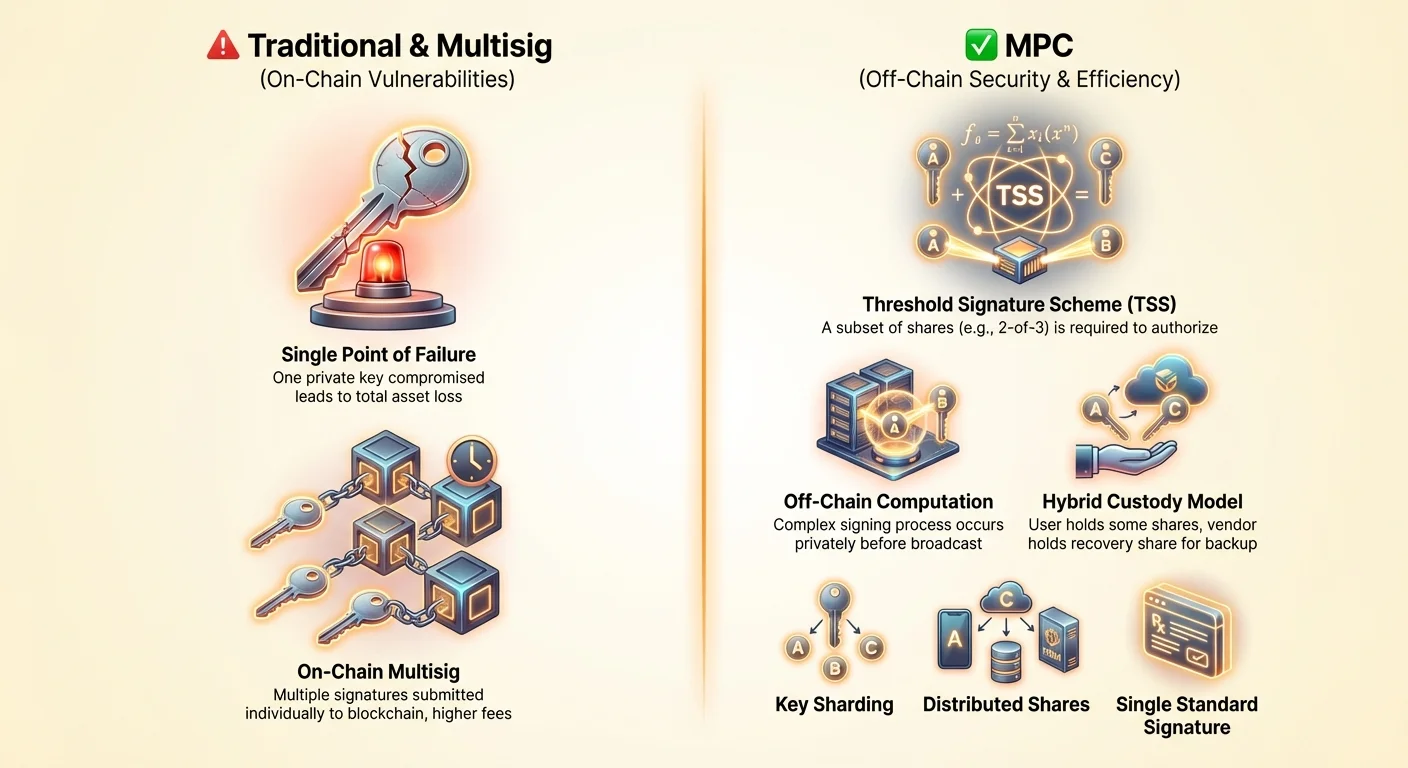
The fundamental danger here is the Single Point of Failure (SPOF).
If a hacker compromises your computer, or if an employee with access to the key goes rogue, or even if the hardware wallet itself is lost or destroyed without a backup, the entire fund is at risk. For enterprises handling billions, this risk profile is unacceptable.
Traditional custody solutions attempted to mitigate this by physically separating the key (cold storage) or by using multi-signature schemes (Multisig). While effective, these solutions often introduced complexity, slowed down transaction times, or still required that the full key be exposed at some point during the setup or recovery process. MPC technology offers a truly distributed solution that avoids ever forming the full key in one place.
What is Multi-Party Computation (MPC)? MPC Wallet Explained
Multi-Party Computation (MPC) is a subfield of cryptography that enables several parties to compute a shared function over their inputs, while keeping those inputs private. In the context of crypto wallets, the shared function is the creation of a blockchain signature, and the private inputs are the individual shards of the private key.
Think of MPC as a cryptographic handshake where multiple participants contribute a piece of the secret, and the outcome (the signature) is produced only when enough pieces are present, but the original secret (the full private key) is never revealed to anyone, including the other participants.
Key Sharding and Distribution
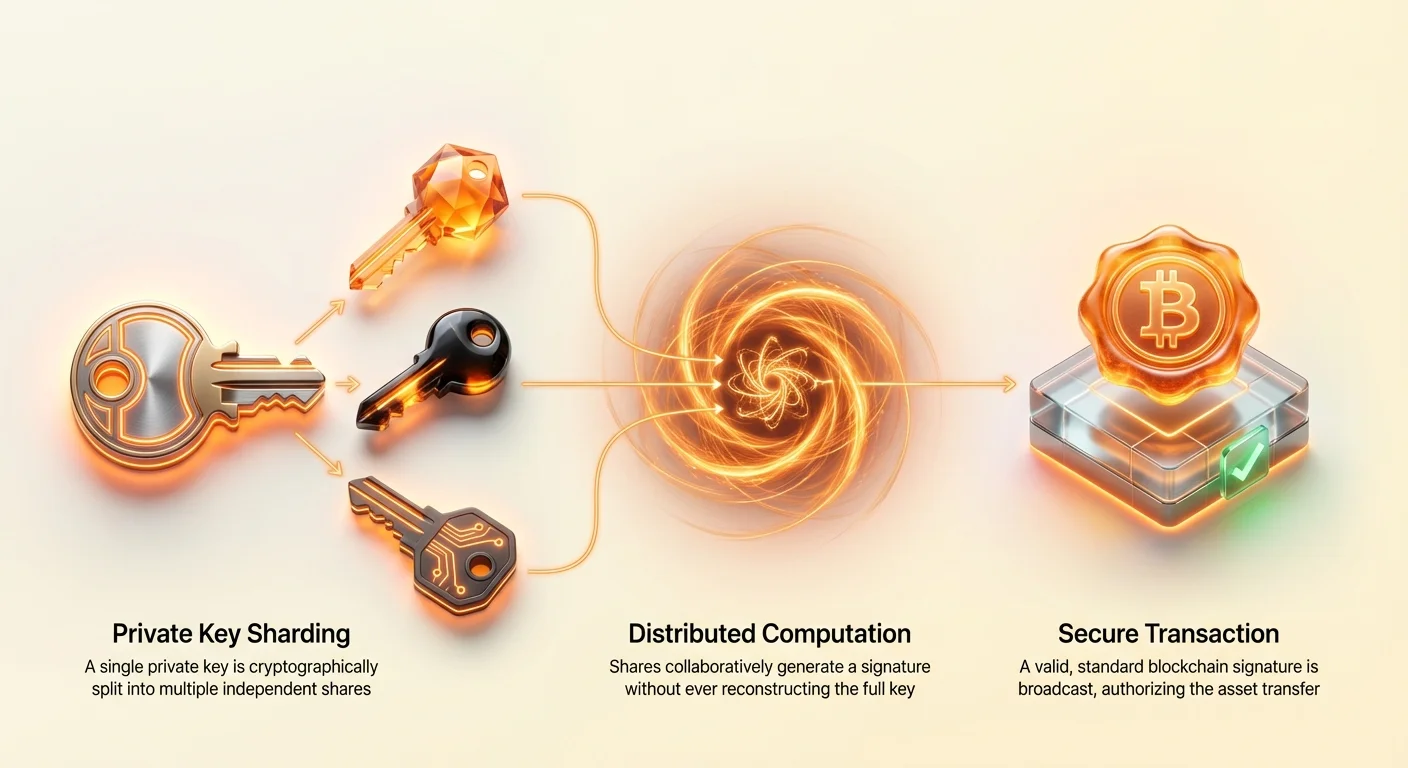
The core mechanism that differentiates MPC wallets is how the private key is handled. Instead of generating one private key (P) and backing it up as a seed phrase, the MPC protocol immediately shards or splits that key into multiple unique pieces, often called "shares."
For example, in a standard 2-of-3 configuration:
- A mathematical algorithm (the MPC protocol) generates a full private key cryptographically.
- It instantly splits that key into three independent shares (Share A, Share B, and Share C).
- These shares are then distributed to different parties and different environments (e.g., Share A on a corporate server, Share B on a security officer's mobile device, and Share C held by the MPC service provider).
Crucially, each individual share is mathematically meaningless on its own. If a hacker steals Share A, they have gained nothing, as Share B and Share C are still required for any computation.
The Threshold Signature Mechanism
MPC wallets operate using a "threshold signature scheme" (TSS). This scheme dictates how many shares are needed to collaboratively create a valid signature for a transaction.
If you have a 2-of-3 scheme, any two of the three shares (A+B, A+C, or B+C) are sufficient to authorize a transfer. If only one share is available, the transaction fails.
When a transaction needs to be signed, the required parties (e.g., Party A and Party B) use their shares to perform a complex, interactive mathematical calculation off-chain. The output of this calculation is a single, valid, blockchain-compatible signature.
The most significant detail of MPC: The private key never exists in its complete form during the signing process. The shares interact cryptographically to produce the signature, effectively opening the vault without ever assembling the master key. This dramatically limits the window of opportunity for attackers.
How a Transaction is Signed (The "Secret Ballot" Analogy)
Imagine three bank executives (A, B, and C) who must jointly approve a wire transfer. In a 2-of-3 MPC setup:
- Initiation: A transaction request (e.g., Send 1 BTC to Address X) is initiated.
- Request for Signatures (The Ballot): The system asks two required executives (say A and B) to approve.
- Local Calculation: Executive A uses their unique Share A to perform a partial calculation on the transaction data. Executive B does the same with Share B. Neither party knows the other’s share, nor the original private key.
- Exchange of Information: A and B securely exchange the results of their partial calculations.
- Final Signature Generation: The system combines these partial results (still without reconstructing the full key) to generate the final, valid signature.
- Broadcast: The complete, valid signature is sent to the blockchain to execute the transaction.
This entire process ensures that keys remain isolated in separate, secured environments, eliminating the risk of key exposure common to traditional systems.
MPC vs. Multisignature (Multisig): Technical Differences
A frequent point of confusion for newcomers is the difference between Multi-Party Computation (MPC) wallets and Multisignature (Multisig) wallets. While both achieve distributed authorization, their underlying mechanics, security profiles, and impact on the blockchain are fundamentally different.
| Feature | Multi-Party Computation (MPC) Wallet | Multisignature (Multisig) Wallet |
|---|---|---|
| Key Generation | Single private key mathematically fragmented into multiple shards. | Multiple independent private keys generated separately. |
| Key Location | Shards are distributed; the complete key never exists in one place. | Each participant holds a complete, independent key. |
| Signing Process | A collaborative, interactive, off-chain mathematical calculation. | Multiple parties apply their unique, full signature on-chain. |
| Transaction Visibility | Appears as a standard, single signature transaction on the blockchain. | Clearly visible as a multisig transaction (requires special scripting). |
| Blockchain Impact | Lightweight; standard transaction fees; enhanced privacy. | Heavier data load; higher transaction fees; less private. |
| Flexibility | Highly flexible. Thresholds can be adjusted easily. | Dependent on the underlying blockchain's scripting language. |
On-Chain vs. Off-Chain Operations
This is the most critical distinction between the two technologies.
Multisig (On-Chain): A multisig wallet is defined by the blockchain protocol itself. For a transaction to be valid, the blockchain must verify N number of unique, independent signatures (e.g., 2-of-3) against the wallet's public address requirements. This process requires all signatures to be gathered and submitted together, consuming more block space and incurring higher fees.
MPC (Off-Chain): MPC wallets handle the complex authorization process before the transaction is submitted. The collaborative calculation produces a single, conventional signature that looks identical to one generated by a traditional wallet. The blockchain simply sees a valid, single signature and doesn't need to know that multiple parties were involved in its creation. This results in faster, cheaper, and more private transactions.
Flexibility and Efficiency Advantages
Because Multisig relies on specific blockchain scripting (which varies greatly between networks like Bitcoin and Ethereum), it can limit interoperability and slow down execution. For instance, interacting with complex Decentralized Finance (DeFi) protocols is often challenging or impossible with a Multisig address.
MPC, conversely, generates a standard signature compatible with any network or protocol that uses standard elliptic curve cryptography (which is virtually all of them, including Bitcoin, Ethereum, Solana, etc.). This makes MPC inherently more versatile for use cases involving:
- High-Frequency Trading: Speed is essential, and MPC’s single-signature output is faster than a complex multisig script.
- DeFi Integration: MPC wallets can interact seamlessly with smart contracts, staking, and decentralized applications (dApps).
- Cross-Chain Operations: MPC provides a unified security layer regardless of the underlying blockchain technology.
Use Cases: When to Choose Which
While MPC is generally considered the future standard for institutional security, Multisig still holds value in specific scenarios:
- Choose Multisig when: Simplicity and transparency are paramount. Multisig is easy to audit on-chain, and it is a reliable, battle-tested technology suitable for small groups or simple organizational treasuries where high transaction speed isn't required.
- Choose MPC when: Security, speed, and cross-platform flexibility are critical. This applies to high-net-worth individuals, crypto exchanges, institutional custodians, and large corporations requiring complex security policies (e.g., requiring sign-off from two managers and one hardware module).
Advanced Security Benefits of MPC Wallets
The primary appeal of MPC lies in its enhanced security model. By never creating or exposing the full private key, MPC addresses vectors of attack that traditional single-key and even standard multisig systems cannot fully mitigate.
Eliminating the Single Point of Failure (SPOF)
The hallmark of MPC is resilience through distribution.
In a traditional setup, if a single server is compromised, the private key is exposed. With MPC, an attacker must simultaneously breach multiple, geographically and architecturally diverse environments to steal the required number of key shares (e.g., two out of three separate devices/servers).
For institutional players, this means they can store shares across their headquarters, an offshore vault, and a trusted third-party cloud provider. If any one location is breached, the attacker only obtains a useless fragment of the key.
Preventing Insider Collusion and Theft
Insider threat is one of the most significant risks for high-value asset holders. An employee with access to a master key or a system administrator managing a cold storage vault poses a constant threat.
MPC fundamentally changes the security dynamic by decentralizing trust. No single person (or single group of people holding one share) can unilaterally authorize a transaction. This mandates collusion among the required threshold of parties.
Furthermore, MPC can be configured to integrate hardware security modules (HSMs) or specialized devices to hold shares, ensuring that even if an executive is pressured to sign, they can only do so by interacting with the secure hardware, adding another layer of physical security.
Resilience Against Cyber Attacks
MPC offers particular resistance to "man-in-the-middle" and "key logging" attacks because the private key is never input or reconstructed during the signing process.
In a standard wallet: If malware intercepts the key input (e.g., when signing a transaction), the key is stolen.
In an MPC wallet: The required parties exchange only mathematical proofs and partial calculations—not the key itself. Since the full key is never assembled or transmitted, there is no master secret for an attacker to intercept, log, or steal. The only thing an attacker could obtain is a single, non-functional key share.
Practical Applications and Enterprise Use Cases
While the mathematics behind MPC are complex, the result is a system that is often easier and safer for large organizations to adopt than cumbersome cold storage setups or complex, scripting-heavy Multisig wallets.
Institutional and Enterprise Custody
For banks, exchanges, and financial institutions entering the crypto space, regulatory compliance and robust security are non-negotiable. MPC has quickly become the preferred technology for enterprise-grade custody due to its ability to enforce strict policy controls without compromising speed.
Examples of Enterprise MPC Use:
- Policy Enforcement: A corporation might require a 3-of-5 signing structure where the shares are held by: (1) CEO, (2) CFO, (3) Legal Counsel, (4) Internal HSM (Hardware Security Module), and (5) External Cloud Server. This guarantees that asset movement requires approval across multiple functional groups and physical locations.
- Disaster Recovery: If a key shareholder loses their device, the enterprise can initiate a defined recovery protocol involving the other remaining shares to generate a new set of shards, effectively replacing the lost key share without impacting the custody of the assets.
- Client Segregation: Exchanges use MPC to manage millions of client accounts. The shared calculation allows the exchange to ensure rapid, secure fund movements without having massive amounts of value controlled by a single master key stored in an internal vault.
Decentralized Finance (DeFi) and Speed Requirements
DeFi interaction often involves time-sensitive operations, such as staking, borrowing, or responding to liquidation events. The latency and complexity associated with on-chain Multisig can make participation in these protocols difficult.
MPC wallets simplify this by making enterprise-level security function like a single-user wallet in terms of speed and compatibility. Because the output is a standard signature, an MPC-secured treasury can interact with any dApp seamlessly, bridging the gap between institutional-grade security and the dynamism of the decentralized ecosystem.
Consumer-Friendly Self-Custody Solutions
MPC isn't just for billion-dollar treasuries. It is increasingly being adapted for consumer wallets to solve the "seed phrase problem."
Traditional self-custody requires the user to write down and securely store a 12/24-word seed phrase—a notorious point of failure due to loss, fire, or poor storage practices.
Next-generation consumer MPC wallets allow the user to split their key into shares, perhaps retaining one share on their mobile device, storing another encrypted share in a trusted cloud service (like Google Drive or iCloud), and keeping a third share with the wallet provider for backup/recovery purposes.
This creates a semi-custodial or hybrid custody model where the user retains the ultimate power (they hold enough shares to sign), but they have a robust, built-in mechanism for recovery if they lose one share, eliminating the existential threat posed by losing a single seed phrase.
Implementing MPC: What Users Need to Know
While MPC technology operates under the hood, users—especially organizational stakeholders and high-net-worth individuals—must understand how their specific implementation affects their risk profile and operational flow.
Understanding Custody Models (Self-Custody vs. Hybrid)
The implementation of MPC determines the wallet’s custody model:
1. Pure Self-Custody MPC (0-of-N held by vendor)
In this model, the user controls all necessary shares. For example, in a 2-of-3 setup, the user might hold Share A on a dedicated hardware device and Share B on a mobile phone, with Share C stored offline. The service provider merely supplies the software protocol.
- Pro: Maximum sovereignty and control; the service provider cannot access funds.
- Con: Responsibility for all shares falls entirely on the user; loss of the required number of shares results in permanent loss of funds.
2. Hybrid MPC (Vendor-Assisted Recovery)
This model involves the service provider holding one key share specifically for disaster recovery, often referred to as a "rescue share." For example, in a 2-of-3 model, the user holds Share A and Share B, and the vendor holds Share C.
The user is still sovereign because the vendor’s share alone is useless (it takes two shares to sign). If the user loses one of their two shares (e.g., their mobile phone), they can combine their remaining share (Share A) with the vendor’s share (Share C) to regain access or generate new key shares.
- Pro: Excellent balance of security and usability; prevents common mistakes like losing a single device or seed phrase.
- Con: Requires trust in the vendor to secure their recovery share and follow proper protocols to prevent unauthorized use. This is the most common model for corporate treasuries.
Choosing the Right Threshold
The threshold (e.g., 2-of-3, 3-of-5, 4-of-7) must be chosen carefully, balancing security against operational efficiency.
Security: A higher threshold (e.g., 5-of-7) offers stronger security, as more shares must be compromised simultaneously. Efficiency: A higher threshold increases friction. If seven people are required to sign a transaction, moving funds becomes slow and complex. If several parties are unavailable (e.g., on vacation or ill), the organization may become operationally frozen.
Best Practice Tip: For enterprises, a threshold that requires quorum across different security domains is best. A common configuration is a 2-of-3 structure where one share is held by a specialized Hardware Security Module (HSM) dedicated to automated signing, one share by a primary manager, and the third share by a secondary backup manager. This ensures automation is balanced by human oversight.
Key Takeaways and Best Practices for MPC Users
Multi-Party Computation technology represents a significant leap forward in crypto security, moving beyond outdated, single-key methodologies. By fragmenting the private key and distributing the resulting shares, MPC eliminates the most dangerous single point of failure in digital asset management.
Actionable Security Tips
- Diversify Your Shares: Never store two key shares on the same device or within the same physical environment (e.g., two shares on two separate USB drives kept in the same safe). The power of MPC is in geographical and architectural separation.
- Enforce Multi-Factor Authorization (MFA) on Shares: Even if a share is stolen, the attacker should still need a second layer of authentication (like a fingerprint or password) to activate that share for calculation.
- Audit the Protocol: While MPC is mathematically proven, implementation matters. Ensure your chosen MPC solution uses open-source, audited cryptographic libraries and has a clear, documented disaster recovery procedure.
- Understand Your Counterparty Risk (Hybrid Models): If you use a hybrid MPC model where the wallet provider holds a recovery share, treat that provider with the same diligence you would treat a bank. They are a counterparty in your security system.
MPC wallets provide the infrastructure necessary for crypto assets to transition from a niche, technically challenging investment to a mature, institutionally managed asset class. By offering unparalleled security, regulatory compliance features, and operational efficiency, MPC is rapidly becoming the standard for anyone holding substantial digital wealth.