
The transition from traditional finance to the world of cryptocurrency involves a fundamental shift in how assets are owned and managed. In the legacy banking system, a third party always stands between you and your money. They secure the vault, verify your identity, and authorize transactions on your behalf. If you lose a password, a customer support agent can reset it. If a fraudulent charge occurs, there is often a process for reversal or insurance claims. Cryptocurrency operates on an entirely different paradigm. A foundational comparison.
When you enter the crypto ecosystem, you become your own bank. This autonomy grants you absolute control over your funds, allowing you to send value anywhere in the world without asking for permission. However, this freedom comes with a non-negotiable responsibility. There is no help desk in decentralized finance. There is no "forgot password" button for a Bitcoin wallet. The security of your digital wealth depends entirely on your understanding of the underlying technology.
Mastering crypto security requires moving beyond simple price tracking and trading. It demands a deep comprehension of how wallets function, the mathematical relationship between keys, and the critical importance of backup phrases. By understanding these mechanics, you transform from a passive user into a secure sovereign of your digital assets. This guide explores the technical and practical layers of crypto security, ensuring you can navigate the decentralized landscape with confidence and safety.
The Mechanics of Cryptocurrency Wallets
How Wallets Interact with Blockchains
A common misconception among new users is that a cryptocurrency wallet stores tokens inside the application or device itself. In reality, your coins never leave the blockchain. They exist as unspent transaction outputs recorded on a public ledger distributed across thousands of computers globally. The wallet is simply a tool that manages the credentials needed to access and move those funds. Understanding crypto wallets.
Think of a blockchain as a row of transparent safety deposit boxes located in a public bank. Everyone can see inside the boxes and verify how much money is in them. However, only the person with the correct key can open a specific box and move the contents. Your wallet does not hold the money; it holds the digital key that proves your ownership to the network.
When you initiate a transaction, your wallet software constructs a digital message. This message states that you wish to move a specific amount of cryptocurrency from your address to another. The wallet then uses your private key to cryptographically sign this message. This signature is broadcast to the network, where validators check it against your public key. If the signature matches, the network approves the update to the ledger.
The Role of User Interfaces
While the underlying cryptography is complex, modern wallets provide a user-friendly interface to mask these technical details. They display your balance by scanning the blockchain for all transactions associated with your addresses and summing up the total. They format addresses into QR codes to prevent typing errors and maintain a history of your past activity.
Despite this polished appearance, the security model remains distinct from a banking app. A banking app is a remote control for an account held by a corporation. A crypto wallet is a direct interface with a decentralized protocol. If the software provider shuts down, your funds remain safe on the blockchain, provided you still possess your keys. This distinction emphasizes why the protection of keys, rather than the specific software choice, is the primary security concern.
Public and Private Key Cryptography
The Public Address
Cryptocurrency security relies on a pair of cryptographic keys generated mathematically: a public key and a private key. The public key is derived from the private key through a one-way mathematical function. This means you can easily generate a public key if you have the private key, but it is impossible to reverse-engineer the private key knowing only the public key.
Your public address is the version of the public key that you share with others. It functions similarly to an email address or a bank account number. You can safely display this address on a website, send it to friends, or use it to receive funds from an exchange. Knowing your public address allows people to send you money or view your balance on a block explorer, but it does not give them any power to withdraw or spend your funds.
The Private Key
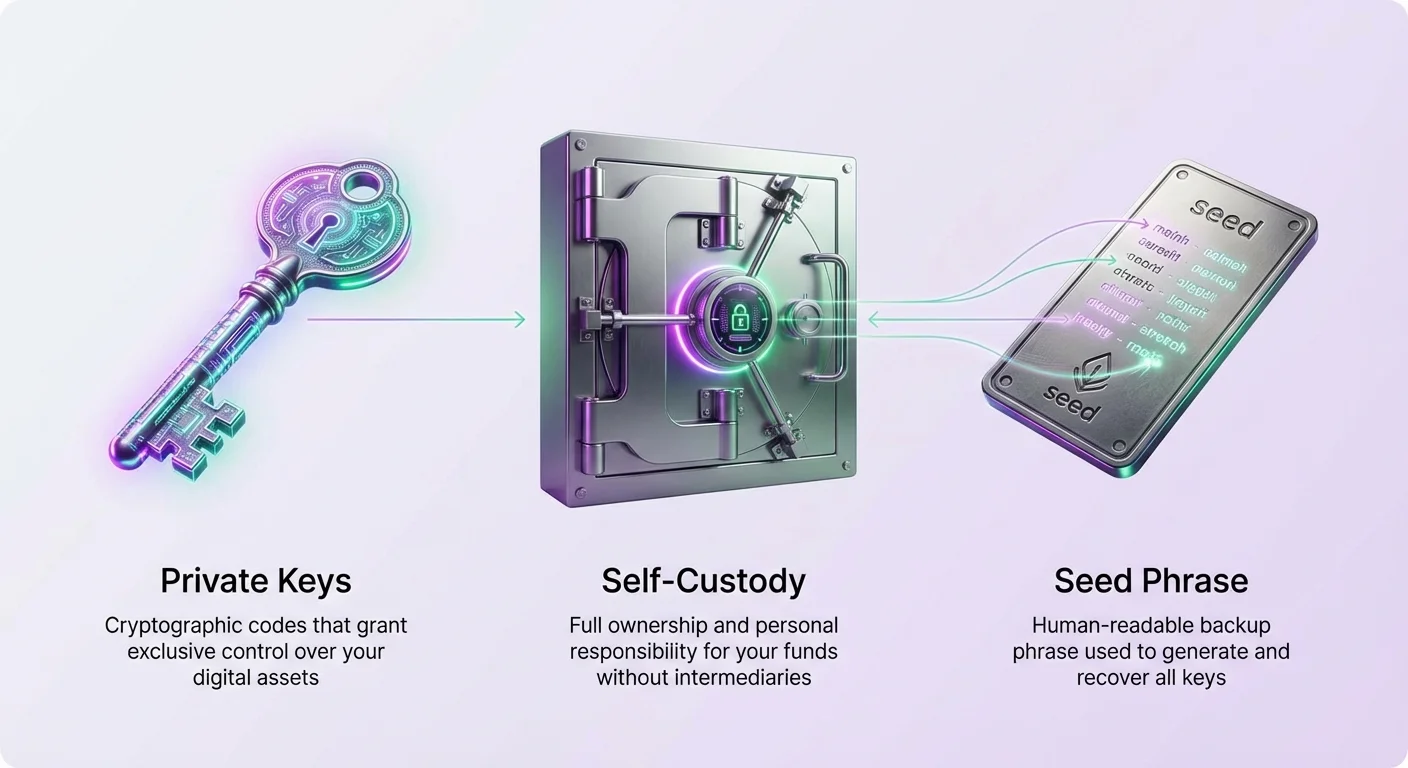
The private key is the alphanumeric string that grants absolute control over the funds associated with a public address. It acts as the digital signature for every transaction. Whoever possesses the private key is the owner of the funds, regardless of who the original owner was. If a hacker acquires your private key, they can transfer all your assets to their own address instantly.
Because transactions on most blockchains are irreversible, theft via a compromised private key is permanent. There is no central authority to freeze the hacker's account or reverse the transfer. Therefore, the private key must never be shared, typed into a public website, or stored in an insecure location. It is the single point of failure and the single point of control for your digital wealth.
Understanding Seed Phrases and Backups
The BIP39 Standard
Managing raw private keys, which look like long strings of random characters, is difficult and error-prone for humans. To solve this, the industry adopted a standard known as BIP39. This standard converts the complex binary data of your private key into a human-readable series of words, typically 12 to 24 words long. This is known as a seed phrase, recovery phrase, or mnemonic phrase. Private Key Mechanics.
The seed phrase is the master key for your wallet. From this single sequence of words, a wallet can mathematically generate all the private keys and public addresses you will ever use. This hierarchical deterministic (HD) structure means you only need to back up one phrase to secure an infinite number of future transactions and accounts within that wallet.
Best Practices for Storage
Securing your seed phrase is the most critical task in crypto hygiene. If your computer breaks, your phone is lost, or your hardware wallet is destroyed, the seed phrase is the only way to recover your funds. You simply enter the words into a new compatible wallet device or app, and your entire transaction history and balance will reappear.
However, this convenience creates a high-stakes security risk. Anyone who finds your seed phrase effectively has your wallet. Consequently, seed phrases should never be stored digitally. Do not take a screenshot, do not save it in a text file, and do not email it to yourself. Malware scanning for these specific patterns can easily harvest digital copies.
The gold standard for storage is physical media. Write the words down on paper or stamp them into a steel plate that is fire and water-resistant. Store this physical backup in a secure location, such as a safe or a locked drawer. For significant amounts of capital, some users divide the phrase or store multiple copies in geographically separated secure locations to protect against natural disasters or theft.
Hot Wallets vs. Cold Wallets
| Feature | Hot Wallet | Cold Wallet |
|---|---|---|
| Connection | Always connected to the internet | kept offline (Air-gapped) |
| Security | Vulnerable to malware/hacks | Highest level of protection |
| Convenience | High (Fast transactions) | Low (Physical confirmation) |
| Cost | Typically free software | Requires purchasing hardware |
| Best Use | Daily spending, small amounts | Long-term storage, large savings |
Software Wallets (Hot Storage)
Hot wallets are applications that run on devices connected to the internet, such as mobile phones, desktop computers, or web browsers. Examples include browser extensions used for interacting with decentralized finance (DeFi) applications or mobile apps designed for quick payments. Their primary advantage is convenience and accessibility.
Because they are online, hot wallets can easily interact with dApps, sign transactions quickly, and manage active trading positions. However, their constant connectivity makes them susceptible to online threats. If the device hosting the wallet is infected with malware, a keylogger could capture the password, or a remote attacker could manipulate the clipboard to change a destination address.
Hot wallets are best treated like a physical wallet you carry in your pocket. You would not walk around with your entire life savings in cash; similarly, you should not keep substantial crypto holdings in a hot wallet. They are tools for transit and activity, not for long-term preservation of wealth.
Hardware Wallets (Cold Storage)
Hardware wallets are physical devices designed specifically to secure private keys. They look like small USB drives and operate offline. The critical security feature of a hardware wallet is that the private keys are generated and stored inside a secure element chip within the device and never leave it. Hardware Wallet Deep Dive.
When you need to send a transaction, the wallet software on your computer prepares the unsigned transaction data and sends it to the hardware device. You verify the details physically on the device's small screen. If the details are correct, you press a physical button on the device to sign the transaction. The device then sends only the digital signature back to the computer.
This process ensures that even if the computer you are using is completely compromised by viruses, the private keys remain safe because they are never exposed to the computer's memory or the internet. This method, often called "air-gapping," provides the robust security necessary for holding significant value.
Custodial vs. Non-Custodial Solutions
The Exchange Model
Custodial wallets are accounts provided by centralized exchanges or platforms. When you create an account on a major exchange, you do not get a private key or a seed phrase. Instead, you have a login and password, much like an online bank account. The exchange manages the keys and holds the funds in their own wallets.
This model offers convenience and recourse. If you lose your password, the exchange can help you recover your account. Some platforms even offer insurance or advanced security features like "vaults" that require multiple approvals or time delays for withdrawals. For beginners, this reduces the anxiety of managing complex keys.
The Risks of Third-Party Control
The trade-off for custodial convenience is a loss of control. In the crypto industry, the phrase "not your keys, not your coins" acts as a warning. If a custodial exchange halts withdrawals due to insolvency, regulatory pressure, or technical failure, you lose access to your assets. History has seen several major platforms collapse, leaving users with nothing but a claim in bankruptcy court. The spectrum of custody risks.
Non-custodial (or self-custodial) wallets give you full ownership. You are the only person with the private key. No government, corporation, or individual can freeze your funds or prevent a transaction. This aligns with the core ethos of cryptocurrency: removing intermediaries. However, it places the full burden of security on you. If you lose your seed phrase, the funds are gone forever, and no customer support can assist you.
Navigating New Blockchains and Bridges
Understanding the Multi-Chain World
The crypto ecosystem is not a single network but a collection of diverse blockchains, each with its own rules, fees, and capabilities. You might use Ethereum for its security, Solana for its speed, or a specific Layer 2 network for low-cost trading. Moving between these chains introduces complexity and risk, requiring specific knowledge to navigate safely.
When you want to use an application on a new blockchain, you usually cannot simply send tokens from one chain to another directly. Bitcoin cannot be sent natively to an Ethereum address. To move value across these incompatible networks, users rely on bridges. Bridges are protocols that lock assets on one chain and issue a corresponding "wrapped" token on the destination chain. How to Use Bridges Safely.
Bridging Risks and Best Practices
Bridging is one of the most vulnerable moments in crypto asset management. If a bridge's smart contract has a bug or is exploited, the funds locked inside it can be stolen, rendering the wrapped tokens on the other side worthless. When entering a new chain, it is vital to use reputable bridges with a strong track record and high liquidity.
Furthermore, bridging often requires interacting with unfamiliar smart contracts. A common scam involves fake bridge websites that look identical to legitimate ones. When you connect your wallet and approve a transaction, you might inadvertently give the attacker permission to drain your funds. Always verify the URL carefully and access bridges through trusted aggregators or official project documentation rather than search engine ads.
Once you bridge assets, you will also need a small amount of the destination chain's native currency to pay for transaction fees (gas). Without this, your bridged funds may be stuck because you cannot afford the fee to move or swap them. Planning ahead for these "gas fees" is an essential part of the bridging process.
Advanced Security: Asset Segregation
The Theory of Separation
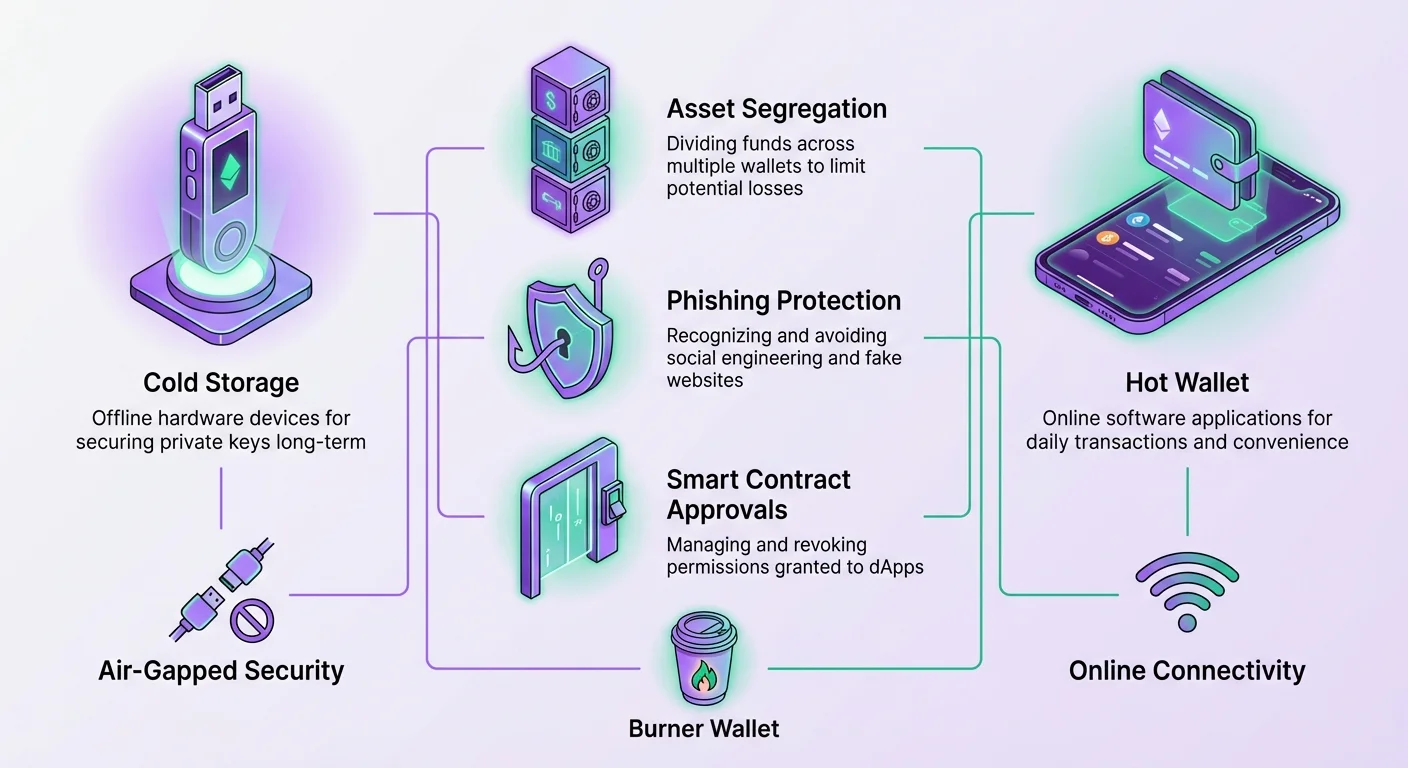
Just as military ships use watertight compartments to prevent a single leak from sinking the vessel, crypto users should segregate their assets across multiple wallets. This limits the "blast radius" if a security breach occurs. If you use a single wallet for everything—long-term savings, daily trading, and testing new apps—a mistake in one area imperils your entire portfolio.
Practical Implementation
A robust security strategy involves at least three distinct categories of wallets. First, a "Cold Storage" wallet (hardware wallet) holds the majority of your funds that you do not intend to trade frequently. This wallet rarely connects to any application and never interacts with risky smart contracts.
Second, an "Active Trading" wallet holds funds needed for near-term opportunities. This might be a software wallet or a separate account on a hardware device. It connects only to established, trusted decentralized exchanges.
Third, a "Burner" wallet is used for exploring new ecosystems, minting NFTs, or testing unproven applications. You only transfer the specific amount of crypto needed for the immediate task to this wallet. If the new application turns out to be malicious and drains the wallet, the loss is contained to that small amount, leaving your main savings untouched.
Defending Against Phishing and Social Engineering
The Human Vulnerability
Technical security measures like hardware wallets and cryptography are incredibly strong, which is why attackers often target the human user instead. Social engineering attacks manipulate users into voluntarily revealing their secrets or authorizing malicious transactions. No software patch can fix human error, making education the only defense. Advanced security.
Phishing remains the most prevalent threat. Attackers buy advertisements on search engines that appear at the top of results for popular keywords like "hardware wallet login" or "DeFi bridge." These ads lead to lookalike websites that prompt you to enter your seed phrase to "verify" or "restore" your wallet. Legitimate wallet software will never ask for your seed phrase on a website or in a pop-up window.
Verification Habits
To combat these threats, establish a strict protocol for accessing crypto services. Never click on links sent via unsolicited emails, direct messages on social media, or advertisements. Instead, use trusted market aggregators like CoinGecko or CoinMarketCap to find the official website links for projects and exchanges.
Once you verify a website is legitimate, bookmark it immediately. For all future access, use the bookmark rather than searching for the site again. This eliminates the risk of landing on a clone site created recently to trap unwary users. Additionally, be skeptical of any urgent communications claiming your funds are at risk; scammers use fear to force quick, irrational decisions.
Smart Contract Interaction Safety
The Danger of Infinite Approvals
When you use decentralized applications (dApps), you must grant them permission to spend tokens from your wallet. This is a standard blockchain function known as an "approval." However, many dApps request an "infinite approval" by default, allowing them to spend an unlimited amount of your tokens at any time in the future without asking again.
While this saves on gas fees and time, it leaves a permanent door open to your wallet. If that dApp is hacked years later, the attackers can use your old approval to drain your wallet of that specific token, even if you haven't used the site in months.
Managing Allowances
To mitigate this, you should regularly review and revoke token allowances. Tools exist that scan your wallet address and list all active permissions you have granted to various contracts. By revoking permissions for dApps you no longer use, you close these potential backdoors.
Furthermore, when a wallet prompts you to approve a token spend, most modern interfaces allow you to edit the amount. Instead of approving "unlimited" tokens, edit the number to match exactly what you intend to trade. If the transaction requires 100 tokens, approve exactly 100. This ensures that even if the contract is malicious, it cannot take more than the approved limit.
Recovery and Inheritance Planning
The Conundrum of access
The strict security of self-custody creates a unique problem for inheritance. Because your assets are not held by a bank, there is no legal procedure for your next of kin to access them with a death certificate. If you pass away without leaving instructions and access to your keys, your crypto wealth is effectively burned and lost to humanity forever.
Creating a succession plan is a vital part of crypto security. This involves more than just writing a will; it requires a mechanism for your heirs to physically locate and utilize your seed phrases or hardware wallets. However, this plan must not compromise security while you are alive.
Secure Sharing Methods
One common approach is a "dead man's switch" or a physical guide stored in a safety deposit box that designated heirs can access only upon your death. This guide should explain not just where the keys are, but how to use them. Remember that your beneficiaries may not be technical experts.
Some users utilize "Shamir's Secret Sharing," a feature supported by advanced hardware wallets. This splits the recovery phrase into multiple unique parts (shares). You might need 3 out of 5 shares to recover the wallet. You can distribute these shares among trusted family members and a lawyer. No single person can access your funds, but if you are incapacitated, they can combine their shares to recover the assets.
Conclusion
The landscape of cryptocurrency offers a compelling alternative to traditional finance, characterized by speed, autonomy, and borderless innovation. However, the price of this financial freedom is unwavering vigilance. Understanding the distinction between public and private keys, the finality of blockchain transactions, and the mechanics of seed phrases is not optional—it is the foundation of survival in this ecosystem.
By adopting a layered security approach—utilizing hardware wallets for long-term storage, segregating active funds, and remaining skeptical of every interaction—you can mitigate the vast majority of risks. The technology is robust, but it relies on the user to be the secure operator. As the industry evolves with new chains and tools, sticking to these core security principles will ensure your digital legacy remains intact.
True ownership of wealth requires you to value the security of your keys as highly as the assets they protect.