
Ko prvič vstopite v svet kriptovalut, je glavni nasvet, ki ga prejmete, preprost: "Pridobite varno denarnico." Čeprav je ta nasvet dobro mišljen, pogosto ne zadostuje, ker varnost ni nekaj, kar ustreza vsem. Kar je "varno" za posameznika, ki drži majhno količino denarja za porabo, je bistveno drugačno od tistega, kar je potrebno za institucijo ali osebo z visokim neto premoženjem, ki shranjuje svoje življenjske prihranke.
Prava finančna suverenost – jedro obljube samohrambe – zahteva premik onkraj splošnih nasvetov za varnost in sprejetje proaktivnega obrambnega pristopa. Tukaj postane bistveno Modeliranje groženj denarnic. Modeliranje groženj je strukturiran postopek, ki ga varnostni strokovnjaki uporabljajo za prepoznavanje potencialnih groženj, oceno ranljivosti in omilitev tveganj, preden se zgodijo.
Ta okvir premakne vaš poudarek z zgolj primerjanja lastnosti denarnic (npr. "Katera denarnica ima najnižje provizije?") na reševanje specifičnih varnostnih težav, prilagojenih vašim edinstvenim okoliščinam. Z razumevanjem vaših specifičnih tveganj – bodisi digitalnih (malware), fizičnih (kraja) ali regulativnih (konfiskacija) – lahko izberete in nastavite natančno pravo strategijo denarnic, zagotavljajoč maksimalno zaščito vaših digitalnih sredstev.
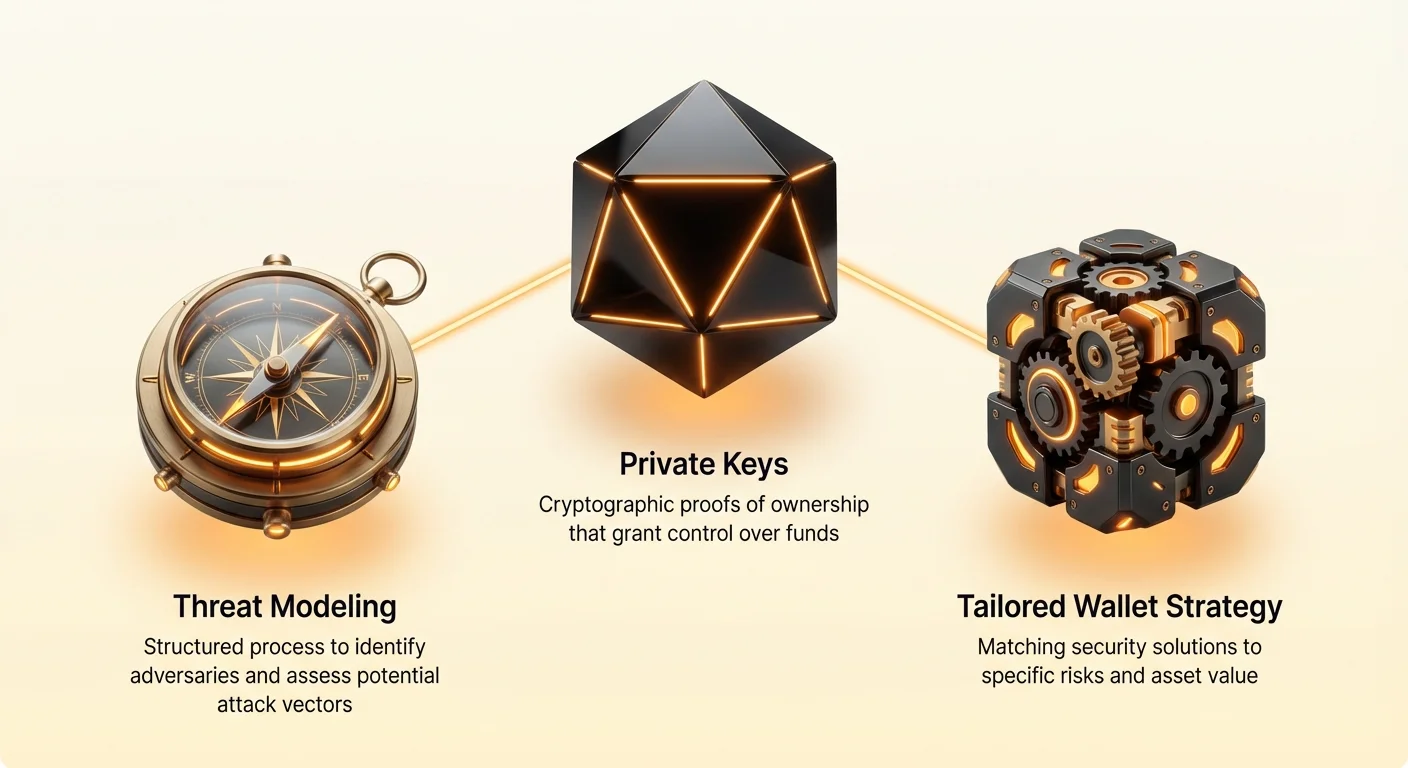
The Foundation of Wallet Security: Understanding Keys and Custody
Before building a defense strategy, we must solidify the understanding of what we are defending. Unlike traditional banks where funds are entries in a database, cryptocurrencies are controlled by cryptography, specifically the ownership of private keys.
Private Keys: The True Asset
A private key is a large, secret alphanumeric string that mathematically proves your ownership over the funds associated with a specific address on the blockchain. In practice, this key is rarely seen; instead, it is represented by a Seed Phrase (often 12 or 24 words, based on standards like BIP39).
The essential rule of crypto security is: Whoever controls the private key controls the funds. The wallet itself is simply a piece of software or hardware that manages and organizes these keys, allowing you to sign transactions. If your private keys are compromised, the funds can be moved instantly, irreversibly, and without recourse.
Self-Custody vs. Third-Party Custody
The critical first decision in securing your funds is choosing the level of custody, which directly influences your risk profile:
| Custody Type | Description | Who Holds the Keys? | Primary Risk Exposure |
|---|---|---|---|
| Custodial | Assets held by a third-party service (like a major centralized exchange). | The Exchange/Third Party | Exchange failure, regulatory seizure, hacking of the exchange, loss of access (forgotten password). |
| Self-Custodial | Assets held in a wallet where only you possess the private keys (e.g., hardware wallets, non-custodial software wallets). | You, the User | Personal error (losing the seed), digital attacks on your device (if using a hot wallet), physical coercion. |
Self-custodial wallets grant you unparalleled financial sovereignty but demand 100% personal responsibility for security. Our focus here is on mitigating the specific risks associated with this absolute ownership.
Building Your Personal Threat Model
Threat modeling requires honesty. You must define what you are protecting, who you are protecting it from, and how much effort and resource your adversary is willing to expend.
Defining Your Adversary
Security measures are worthless if they don't defend against the right threats. Identify your most likely adversaries, as this dictates the budget (time, money, complexity) you need for your security setup.
The Opportunistic Attacker: This is the most common adversary. They rely on large-scale phishing campaigns, poorly secured public Wi-Fi, or simple malware that sweeps for weak wallet files.
- Defense Focus: Basic digital hygiene, strong passwords, reputable software.
The Targeted Criminal: This includes organized crime, professional hackers, or persistent individuals who know who you are and have targeted you specifically. They will employ specialized social engineering, deep-level malware, or physical surveillance.
- Defense Focus: Asset segregation, cold storage, anti-coercion measures (plausible deniability), advanced software vetting.
The Nation-State or Regulator: This extreme adversary possesses near-limitless resources, high-level technological access, legal authority for physical seizure, and the ability to monitor telecommunications on a massive scale. This threat is relevant for individuals in politically sensitive regions or those dealing with high-stakes financial operations.
- Defense Focus: Multi-signature setups (geographically dispersed), regulatory non-compliance options (e.g., anonymous coins), use of advanced, audited hardware, digital inheritance planning.
Identifying Potential Threat Vectors
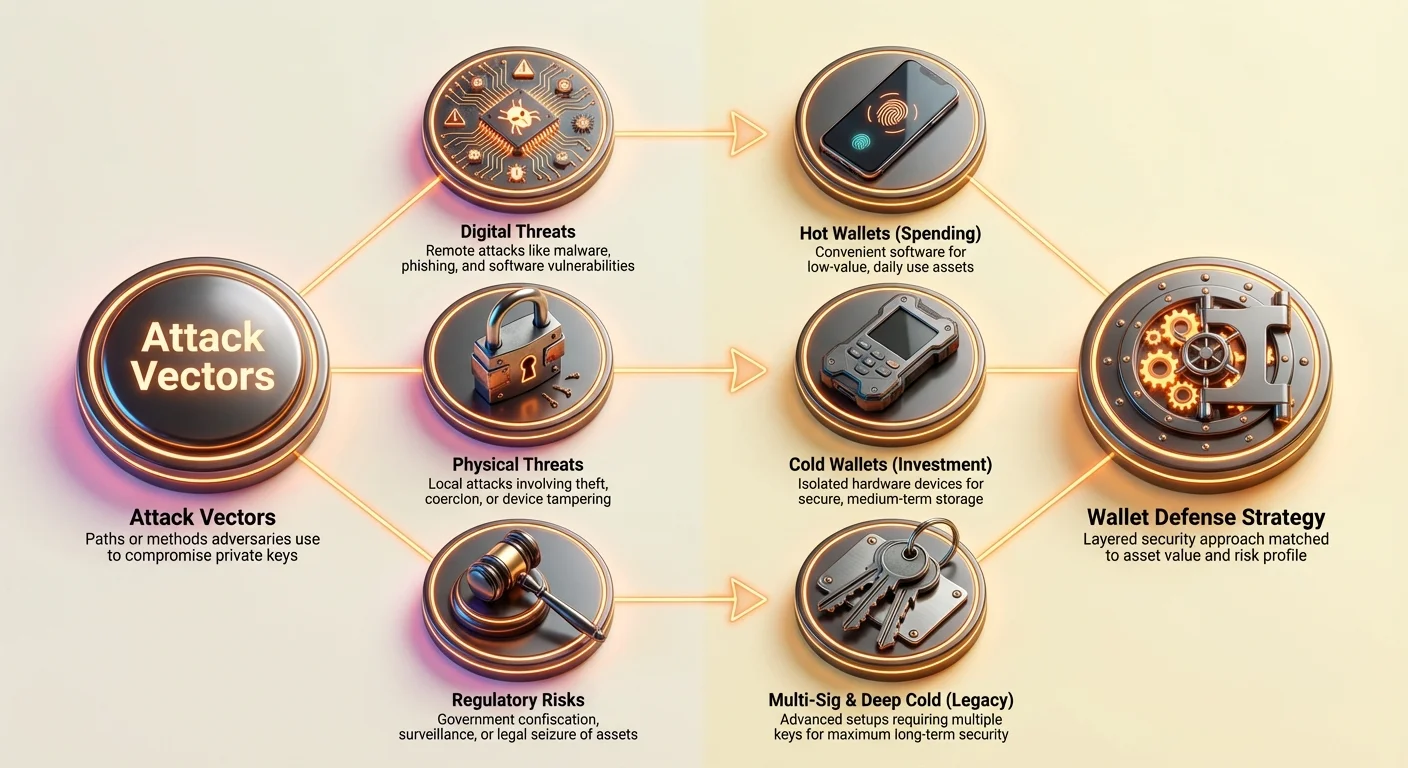
Threat vectors are the paths or methods an adversary might use to compromise your keys. These generally fall into three categories:
1. Digital Vectors (Remote Attack)
This category covers attacks originating over the internet or through compromised software.
- Malware/Spyware: Keyloggers, screen scrapers, or sophisticated clipboard-hijacking viruses designed to steal seed phrases or change wallet addresses during a transaction.
- Phishing & Social Engineering: Tricking the user into revealing their seed phrase (e.g., fake recovery emails, compromised customer support).
- Supply Chain Attacks: Targeting the software itself (e.g., a legitimate wallet update being secretly compromised by hackers).
- Operating System Exposure: If the private key is stored or generated on a device connected to the internet (a "hot" device), a vulnerability in the operating system (OS) could expose the data.
2. Physical Vectors (Local Attack)
These attacks involve direct interaction with the device or the user.
- Theft or Loss: Losing a phone or laptop containing a hot wallet.
- Coercion/Duress: Being physically forced to unlock a wallet or reveal a password (the "wrench attack").
- Tampering (5-Dollar Wrench Attack): Physically modifying a hardware wallet during transit to compromise it before it reaches the user.
- Improper Disposal: Discarding a device that still holds residual key data.
3. Regulatory and Geopolitical Vectors
These vectors are unique to individuals operating under restrictive regimes or those concerned with legal actions.
- Confiscation/Seizure: A government or law enforcement agency using legal means to demand access to funds or confiscate hardware devices.
- Surveillance: Attempts to de-anonymize transactions, trace funds, or monitor communication patterns to find key locations.
- Exit Scams (Exchange Risk): While not a risk to self-custody directly, it’s a risk when using centralized services for entry/exit points.
Assessing Asset Value and Time Horizon
The amount of money involved dictates the complexity of your defense. It is impractical and inconvenient to use a military-grade security setup for $100 worth of Bitcoin.
- Spending Capital (Low Value, Short Time Horizon): Funds needed for daily use, immediate purchases, or small transfers.
- Risk Tolerance: High convenience, moderate digital risk acceptable (Mobile Hot Wallet).
- Investment Capital (Moderate Value, Medium Time Horizon): Assets intended to be held for months or years.
- Risk Tolerance: Balance of security and accessibility (Desktop/Dedicated Hot Wallet or small Hardware Wallet).
- Legacy Capital (High Value, Long Time Horizon): The core portion of savings, inheritance, or corporate treasury.
- Risk Tolerance: Absolute security paramount, convenience is irrelevant (Advanced Hardware Wallets, Multi-Signature setups, Deep Cold Storage).
Actionable Tip: Assign a dollar value threshold (e.g., anything over $5,000) that automatically mandates segregation into a higher-security storage tier.
Mapping Threat Vectors to Wallet Types
Once you have defined your adversary and identified your most critical vectors, you can choose the appropriate technology. Different wallet types are specifically designed to neutralize specific classes of threats.
Hot Wallets (Mobile & Desktop): Convenience vs. Exposure
Hot wallets (software wallets run on devices connected to the internet) offer unparalleled convenience but inherently increase exposure to digital vectors.
| Wallet Type | Primary Strength | Primary Weakness | Neutralized Vector |
|---|---|---|---|
| Mobile Wallets | Convenience, portability, biometric access. | Susceptible to phone theft, OS updates, and malicious apps (side-loading risk). | Low-level phishing (due to biometric/pin locks). |
| Desktop Wallets | Larger interface for complex transactions, dedicated use. | Susceptible to persistent malware, keyloggers, and host machine vulnerabilities. | Basic network snooping. |
Threat Modeling Outcome: If your primary threat is convenience and your assets are low-value, a mobile wallet is acceptable. If your primary threat is targeted malware or spyware, a hot wallet (mobile or desktop) is not a suitable solution for high-value assets, as the private key interacts directly with the compromised OS environment.
Cold Wallets (Hardware): Maximizing Resistance to Digital Attacks
Cold wallets, particularly hardware wallets, are built on the principle of isolation. They keep the private key stored securely within a specialized chip that is never exposed to the internet, malware, or the host operating system. The key never leaves the device; only signed transaction data does.
- Neutralized Vectors: Digital malware, keyloggers, remote hacking attempts, OS vulnerabilities.
- Remaining Vectors: Physical theft, supply chain attacks (if the device is tampered with before you receive it), and user error (losing the seed phrase).
Threat Modeling Outcome: If the Opportunistic Attacker or Targeted Criminal using digital means is your primary concern, a reputable, open-source hardware wallet is the minimum standard for holding significant capital.
Specialized Wallets: Defense Against Physical and Regulatory Threats
For individuals facing extreme threats (Targeted Criminals, Nation-States), more complex setups are required to handle coercion or physical seizure.
Multi-Signature (Multi-Sig) Wallets
Multi-Sig wallets require multiple keys (signatures) to authorize a transaction (e.g., 2-of-3 or 3-of-5 keys are needed).
- Mitigation: Neutralizes physical coercion and single-point-of-failure risks. If a thief or authority seizes one key, they cannot spend the funds.
- Application: Excellent defense against the wrench attack or localized seizure. Keys can be geographically separated (one key in Switzerland, one in Mexico, one in a home safe).
Non-Interactive Paper Wallets (Deep Cold Storage)
While less practical than hardware wallets today, the principle of storing the seed phrase physically (etched in metal, laminated, or printed) and never digitizing it remains the absolute standard for long-term, deep cold storage.
- Mitigation: Zero exposure to all digital threats.
- Application: Suitable for Legacy Capital where the time horizon is decades, and accessibility is negligible. Requires robust physical defense (fire, water, theft protection).
Deep Dive into Wallet Security Audits and Vetting
Choosing a self-custodial wallet means taking responsibility for verifying its security claims. For high-value assets, you must look beyond brand reputation and understand the underlying technical safeguards.
The Importance of Open Source Review
In the cryptocurrency world, trust is minimized through verifiable code. An open-source wallet means the underlying programming code is publicly available for anyone to review, audit, and verify.
- Why it Matters: Closed-source wallets are "security by obscurity." You must trust the company that they haven't intentionally or accidentally included backdoors, poor encryption, or excessive logging. Open source allows the global security community to continually stress-test and patch vulnerabilities.
- Actionable Tip: For high-value funds, prioritize wallets built on widely reviewed open-source code (e.g., wallets that integrate established code bases and follow BIP standards).
Verifying Deterministic Builds and Seed Generation
A secure wallet must guarantee two things: 1) the seed phrase it generates is truly random, and 2) the software you download is the exact, publicly reviewed code and has not been tampered with.
- True Randomness: Private keys must be generated using high-quality entropy (unpredictable randomness). Hardware wallets use built-in, dedicated Random Number Generators (RNGs). Software wallets must rely on the operating system’s entropy source, which can be less reliable if the OS is compromised.
- Deterministic Builds: Many reputable wallets allow you to perform a deterministic build verification. This means you can download the source code, compile it yourself, and check that the resulting program matches the official version using cryptographic hash values. This defends against supply chain attacks where a legitimate website might distribute a compromised file.
Analyzing Wallet Permissions and Dependencies (Mobile Specific)
Mobile wallets present a unique threat surface because they live alongside potentially malicious apps and require various operating system permissions.
- Permission Audit: A legitimate mobile wallet should only require minimal permissions. Be suspicious if a crypto wallet demands access to your microphone, camera, or excessive contacts data. Excessive permissions increase your vulnerability to spyware.
- App Store Vetting: Always download wallets directly from the official Google Play Store or Apple App Store. Avoid installing
.APKfiles directly, as these are often avenues for phishing and malware distribution. - Keyboard Security: Ensure the wallet uses a native or custom keyboard interface when inputting sensitive data (like PINs or passwords) to prevent keyloggers that monitor standard software keyboards.
Practical Workflow: Segregation and Risk Tiers
The most effective strategy for managing risk is Asset Segregation—never keeping all your funds in the same type of storage. This workflow ensures that a breach in one security tier does not compromise your entire holdings.
The "Daily Spending" Wallet (High Convenience, Low Risk)
This wallet is optimized for usability and speed. It manages small, frequently used amounts.
- Wallet Type: Reputable mobile hot wallet (e.g., integrated into a trusted ecosystem).
- Setup: Protected by biometric access (fingerprint/face ID) and a short PIN.
- Risk Mitigation: The amount held here should be strictly limited to what you can afford to lose if the phone is lost or compromised. This limits the blast radius of theft or simple malware.
- Workflow: Replenished regularly with small amounts from the "Investment Capital" tier.
The "Investment Capital" Wallet (Moderate Security, Medium Risk)
This tier holds the bulk of your medium-term savings. Security outweighs convenience, but the asset must still be retrievable within hours or days if needed.
- Wallet Type: Dedicated Hardware Wallet (e.g., Ledger, Trezor) secured with a strong passphrase (25th word BIP39 standard).
- Setup: The hardware device is stored in a secure physical location (home safe). The seed phrase is stored separately and secured against fire/water.
- Risk Mitigation: Isolation from the internet neutralizes digital threats. The passphrase defends against physical coercion, as a thief seizing the device without the passphrase cannot access the funds.
The "Legacy Capital" Vault (Maximum Security, Minimal Access)
This tier is for assets intended for long-term holding or digital inheritance. Access must be difficult, requiring multiple steps and potentially multiple parties.
- Wallet Type: Multi-Signature Setup (e.g., 2-of-3 or 3-of-5) using multiple geographically separated hardware wallets, sometimes combined with a specialized custody solution.
- Setup: Keys are distributed (e.g., Key 1 secured in a bank safety deposit box in Country A, Key 2 with a trusted legal proxy in Country B, Key 3 at the owner's remote location).
- Risk Mitigation: Defends against all three major vectors: Digital (keys are isolated), Physical (requires seizing multiple globally distributed assets), and Regulatory (no single jurisdiction can unilaterally seize the funds).
Workflow Example: Managing the Transition (Hot to Cold)
Proper workflow ensures keys are never accidentally exposed during transfer.
- Acquire Hardware: Purchase a hardware wallet directly from the manufacturer to avoid supply chain tampering.
- Initial Setup: Set up the hardware wallet on a dedicated, clean computer (or air-gapped device) that will never touch the internet again. Generate and carefully record the 12/24-word seed phrase, using durable media (metal plate, waterproof paper).
- Physical Storage: Immediately store the seed phrase and any optional passphrase backups in their secure, physical location.
- Fund Transfer: Send funds from the high-convenience (hot) wallet to the newly verified cold wallet address.
- Test Recovery (Optional but Recommended): Wipe the hardware wallet and verify you can successfully restore it using the stored seed phrase before sending significant funds. This confirms the physical backup is correct—a crucial step for mitigating personal error risk.
Zaključek
Modeliranje groženj denarnic pretvori varnost kriptovalut iz ugibanja v definirano obrambno strategijo. S sistematičnim prepoznavanjem vaših verjetnih nasprotnikov – od priložnostnega avtorja zlonamerne programske opreme do virih bogate države – in razumevanjem specifičnih vektorjev groženj (digitalnih, fizičnih, regulativnih), lahko zgradite plastno obrambo, natančno prilagojeno vašemu profilu tveganja.
Samosuverenost ni lastnost; je odgovornost. Z ločevanjem vaših sredstev v stopnje tveganj, prioritetiziranjem odprtokodnih, revidiranih strojnih denarnic za visoko vrednost in strogim varovanjem vaših semenskih fraz prenehate le upati, da je vaša denarnica varna, in začnete aktivno inženiriti svoje finančne obrambe. Varnost je neprekinjen proces, periodično ponovno pregledovanje vašega modela groženj, ko se vrednost sredstev ali geopolitični kontekst spremeni, pa je ključ do ohranjanja nadzora nad vašim digitalnim bogastvom.