
Ethereum represents a fundamental shift in how value is moved globally. Unlike traditional banking systems that rely on centralized intermediaries to clear and settle payments, Ethereum operates on a decentralized network. This allows for permissionless transactions that occur 24 hours a day without downtime. When you interact with this blockchain, you are not asking a bank to update a ledger on your behalf. You are communicating directly with a global computer to alter the state of your digital ownership.
Mastering the flow of Ether (ETH) requires understanding the mechanics of the network rather than just the user interface of an application. Every interaction involves cryptographic proof of ownership and the precise allocation of network resources. Whether you are funding a decentralized finance (DeFi) position or simply paying a friend, the underlying protocols remain the same.
By moving away from centralized gatekeepers, users gain autonomy but also inherit full responsibility for their assets. There is no fraud department to reverse a mistake and no customer service to reset a lost password. Therefore, secure transaction habits are not just recommended. They are a prerequisite for participation in the Web3 economy.
The Architecture of Ownership
Custodial vs. Self-Custodial Models
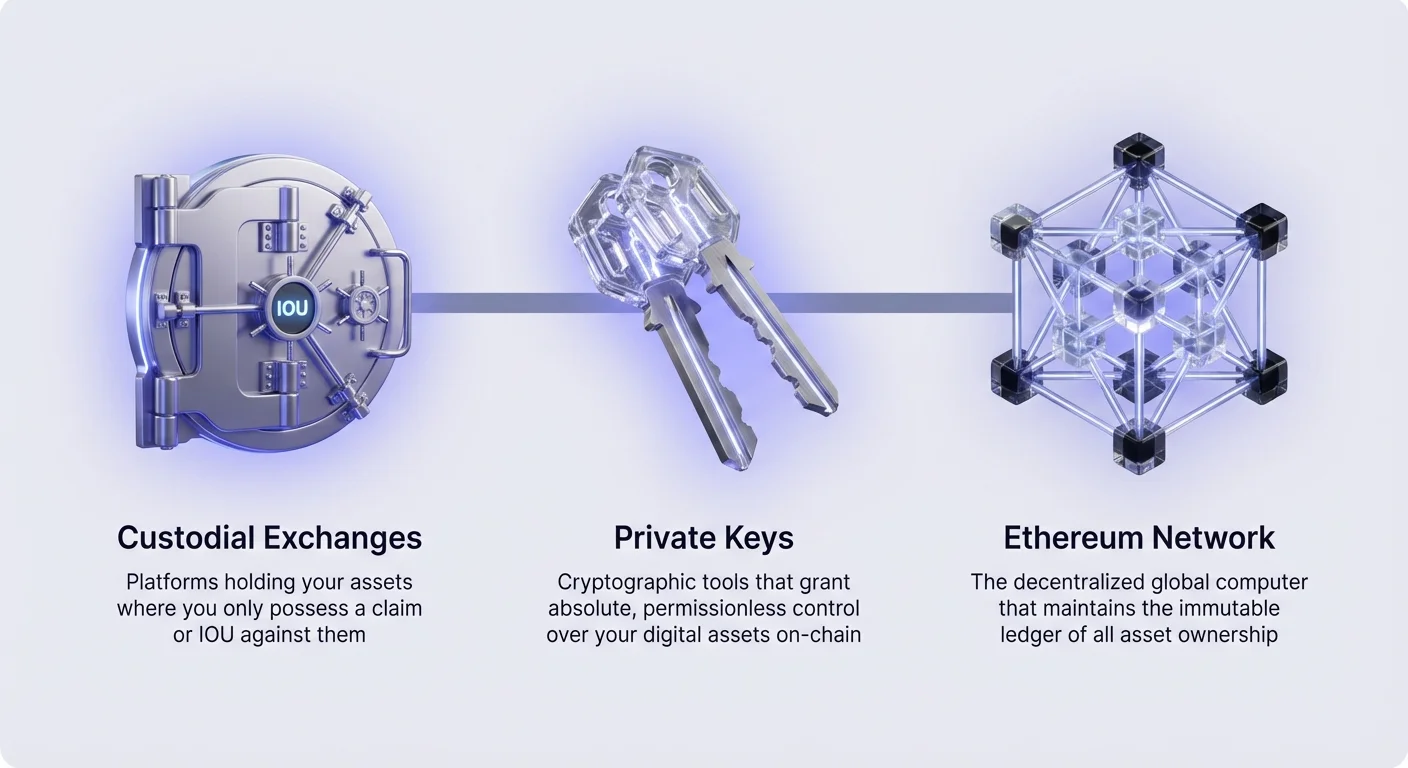
The most critical concept to master before sending or receiving funds is the difference between custodial and self-custodial storage. When you purchase Ether on a centralized exchange, you do not technically own the cryptocurrency. Instead, you hold a claim or an IOU against the exchange. The platform retains control of the private keys, meaning they dictate your ability to withdraw or move funds. This introduces counterparty risk, as the exchange could freeze accounts or suffer a security breach.
Custodial models mimic traditional banking, where a third party manages assets on your behalf. This often limits your ability to interact with decentralized applications (dApps) or move funds instantly. You are subject to the platform's withdrawal limits, processing times, and permission schemas. To truly use Ethereum as intended, one must transition to a self-custodial model.
Taking Control of Private Keys
True ownership requires a self-custodial wallet. In this model, the software generates a pair of cryptographic keys on your device. The public key creates the address others see, while the private key signs transactions to authorize the movement of funds. This setup eliminates middlemen, granting you absolute control over your assets. It also places the burden of security entirely on you.
If you lose access to your wallet backup, no support team can recover your funds. This "permissionless" nature means you can send and receive value globally without asking for approval. However, it also means that key management is the single most important aspect of digital asset security. Your wallet software is simply an interface. The actual assets live on the blockchain, accessible only by the person holding the keys.
Acquiring Ethereum Securely
For most newcomers, the journey begins with converting government-issued currency into Ether. This process, known as an "on-ramp," typically requires passing identity verification checks. Regulations regarding Know Your Customer (KYC) and Anti-Money Laundering (AML) apply to almost all compliant platforms that handle fiat currency. You will generally need to provide identification documents to link your real-world identity to your purchase method.
There are multiple avenues for acquisition. Centralized exchanges offer high liquidity and advanced trading tools but require you to withdraw funds to your own wallet for safety. Direct-to-wallet purchase options often exist within self-custodial apps, using third-party payment processors to deliver ETH directly to your address. Peer-to-peer (P2P) marketplaces allow for direct trades between individuals, often using escrow systems to ensure safety during the swap.
Regardless of the method chosen, the ultimate goal for security-conscious users is to move the assets off the platform and into a wallet they control. Holding significant amounts of capital on an exchange leaves you vulnerable to platform insolvency or hacking. The purchase is only the first step. Securing the asset in a private wallet is the necessary second step.
Decoding Ethereum Addresses
An Ethereum address functions similarly to a bank account number but with distinct technical characteristics. It appears as a long string of alphanumeric characters starting with "0x," which indicates it is a hexadecimal number. These addresses are derived from your public key and represent your identity on the blockchain. While they look random, they are mathematically generated to ensure uniqueness across the network.
When you share your address to receive funds, you are strictly sharing a location on the public ledger. It is impossible for someone to steal funds simply by knowing your address. They would need your private key to authorize an outgoing transaction. However, accuracy is paramount. Ethereum transactions are irreversible. Sending funds to a mistyped address results in permanent loss, as there is no central authority to reverse the ledger entry.
To mitigate errors, most modern interfaces provide QR codes that can be scanned to autofill the address field. Additionally, the Ethereum Name Service (ENS) allows users to map complex hexadecimal addresses to human-readable names, such as "name.eth." This abstraction layer reduces the likelihood of user error but requires the sender to verify that the name resolves to the correct underlying address before confirming the transaction.
The Mechanics of Sending
Initiating a Transfer
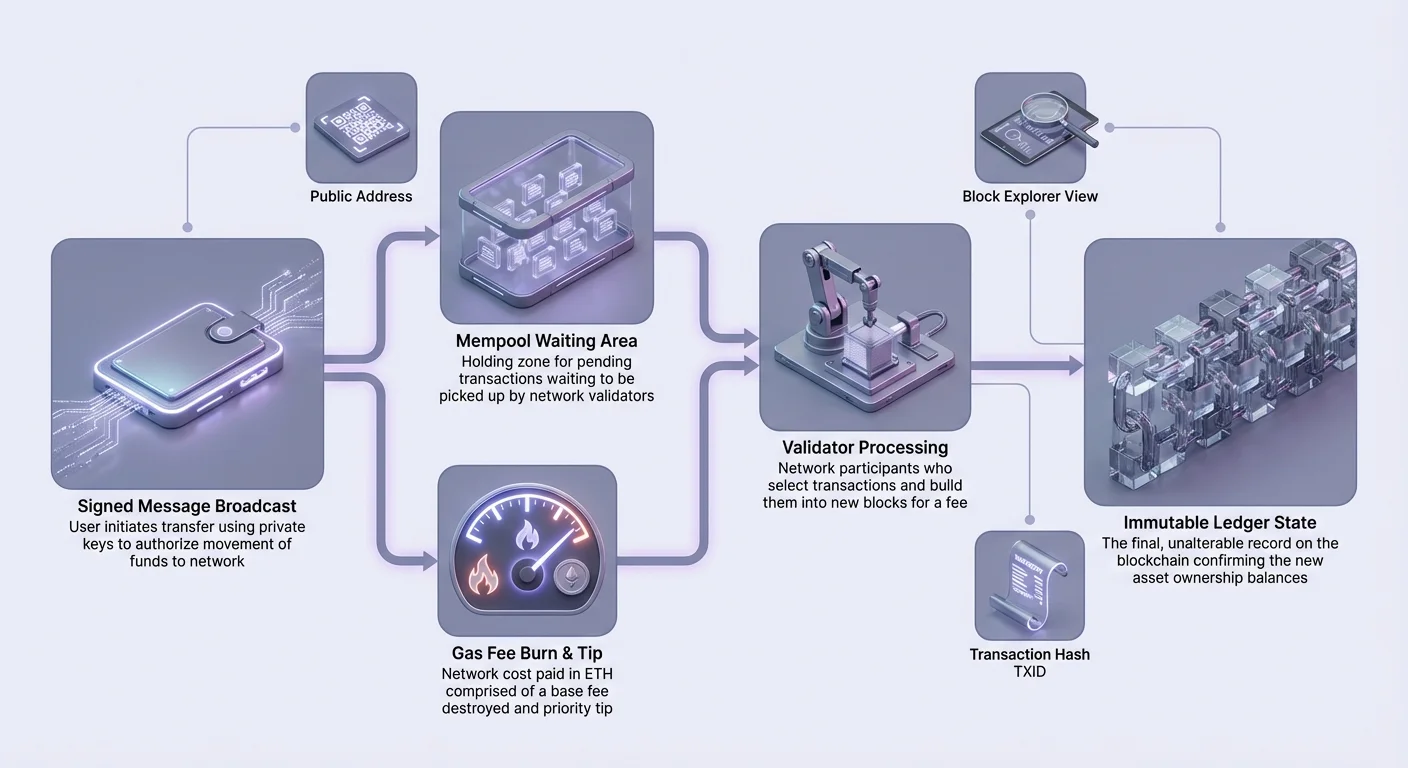
Sending Ether involves broadcasting a signed message to the network. This message contains the recipient's address, the amount to transfer, and a digital signature proving you own the funds. Modern wallet interfaces simplify this by allowing you to scan QR codes or paste addresses directly. It is vital to verify the first and last few characters of the destination address before confirming. Malware exists that can swap clipboard data, so visual verification acts as a final defense.
Once the details are entered, the wallet constructs the transaction and asks for your approval. This is the point of no return. Upon confirmation, the transaction is broadcast to the "mempool," a waiting area for pending transactions. Validators pick transactions from this pool to include in the next block. The speed at which this happens depends heavily on the network fee you attach to the transaction.
Understanding Network Fees
Every transaction on Ethereum requires a fee known as "gas." This is not paid to a wallet provider but to the validators who secure the network and process blocks. Since the implementation of EIP-1559, fees consist of a base fee and a priority fee. The base fee is algorithmically determined by network demand and is burned, permanently removing it from circulation. The priority fee acts as a tip to incentivize validators to include your transaction in the next block.
The cost of a transaction is also determined by its computational complexity. A simple transfer of ETH from one person to another requires the minimum amount of gas. However, interacting with a smart contract, swapping tokens on a decentralized exchange, or minting an NFT requires significantly more computational work. Consequently, these complex actions cost more gas. During periods of high network congestion, the base fee rises, making all transactions more expensive.
| Fee Component | Function | Recipient |
|---|---|---|
| Base Fee | Minimum network cost | Burned (Destroyed) |
| Priority Fee | Incentive for speed | Network Validator |
| Gas Limit | Maximum fuel allowed | N/A |
Receiving Funds and Privacy
Receiving Ether is a passive action that does not require you to be online. You simply provide your public address to the sender. Because the blockchain is a public ledger, anyone who knows your address can view your entire transaction history and current balance using a block explorer. This transparency is a core feature of public blockchains but poses privacy implications for users.
If privacy is a concern, it is advisable to use different addresses for different purposes. For example, you might keep a "savings" wallet separate from a "trading" wallet. Some users generate a fresh address for every significant incoming transaction to prevent outside observers from building a complete profile of their financial activity. Most non-custodial wallets allow you to generate unlimited addresses derived from the same master recovery phrase.
When receiving funds to a centralized exchange, the process differs slightly. You must navigate to the deposit section of your account to find the specific deposit address assigned to you. Exchanges often require a certain number of network confirmations before they credit your account. This means the funds might arrive on the blockchain minutes before they appear in your exchange balance, as the platform waits to ensure the transaction is final and irreversible.
Transaction Monitoring and Verification
Once a transaction is broadcast, it produces a unique identifier called a transaction hash (TXID). This string of characters acts as a receipt for the digital event. If a sender claims to have sent funds but they have not arrived, asking for the transaction hash allows you to verify the status independently. You can plug this hash into a block explorer to see the objective truth of the network.
Block explorers provide real-time data on the state of the ledger. They show whether a transaction is "Pending" (waiting in the mempool), "Success" (confirmed in a block), or "Failed" (rejected due to insufficient gas or error). Understanding how to read these explorers is a key skill for troubleshooting. If a transaction is stuck in a pending state for a long time, it usually means the gas fee set was too low for the current market conditions.
In self-custodial wallets, users often have the option to "speed up" a stuck transaction. This process involves rebroadcasting the same transaction with a higher gas fee, effectively replacing the old, low-fee request. This capability highlights the flexibility of direct blockchain interaction compared to the rigid interfaces of traditional banking. You have the power to adjust your bid for block space dynamically based on urgency.
Conclusion
Mastering Ethereum transactions moves a user from a passive observer to an active participant in the digital economy. The transition from custodial reliance to self-custodial control brings unparalleled freedom. You can transact with anyone, anywhere, at any time, without seeking permission. However, this freedom is inextricably linked to the responsibility of managing keys and understanding network mechanics.
By comprehending how addresses work, how fees function, and how to verify activity on-chain, you insulate yourself from common errors and security risks. The blockchain does not forgive mistakes, but it rewards knowledge. As the ecosystem evolves, the fundamental principles of private key security and gas dynamics remain the constants that protect your assets.
True financial sovereignty begins when you control the private keys to your assets and understand the mechanics of moving them.