
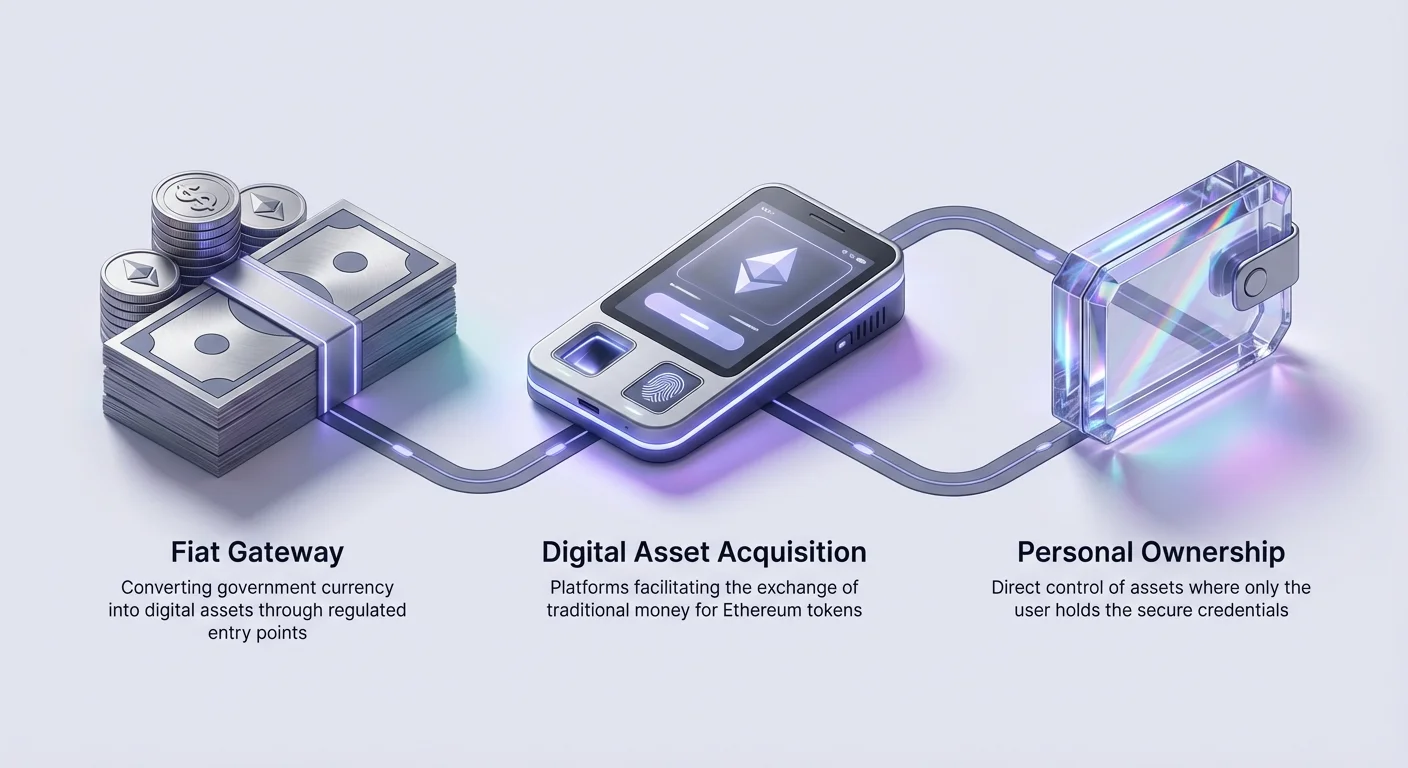
Entering the Ethereum ecosystem begins with acquiring the network's native currency, Ether (ETH). Unlike purchasing a traditional stock or bond, buying ETH involves interacting with a decentralized digital ledger. This distinction fundamentally changes how assets are stored, transacted, and secured. For a first-time buyer, the process involves navigating various entry points known as on-ramps, understanding regulatory identity checks, and managing a complex fee structure.
The primary utility of ETH extends beyond simple value transfer or speculation. It functions as the fuel for the Ethereum network, paying for computational resources required to run decentralized applications (dApps). Whether the goal is to participate in decentralized finance (DeFi), purchase digital collectibles, or simply hold the asset long-term, the initial purchase is the critical first step.
This guide examines the technical and practical aspects of acquiring ETH. It covers the difference between custodial and non-custodial ownership, the variety of platforms available for purchase, and the economic mechanics of gas fees. By understanding these components, buyers can make informed decisions about which method best aligns with their security needs and financial goals.
Understanding Asset Custody and Control
The concept of custody is central to cryptocurrency ownership. In traditional finance, a bank or broker acts as a custodian, holding assets on behalf of the client. In the crypto ecosystem, users have the unique option to act as their own custodian. This choice dictates how the ETH is stored after purchase and who ultimately controls the funds.
The Custodial Model
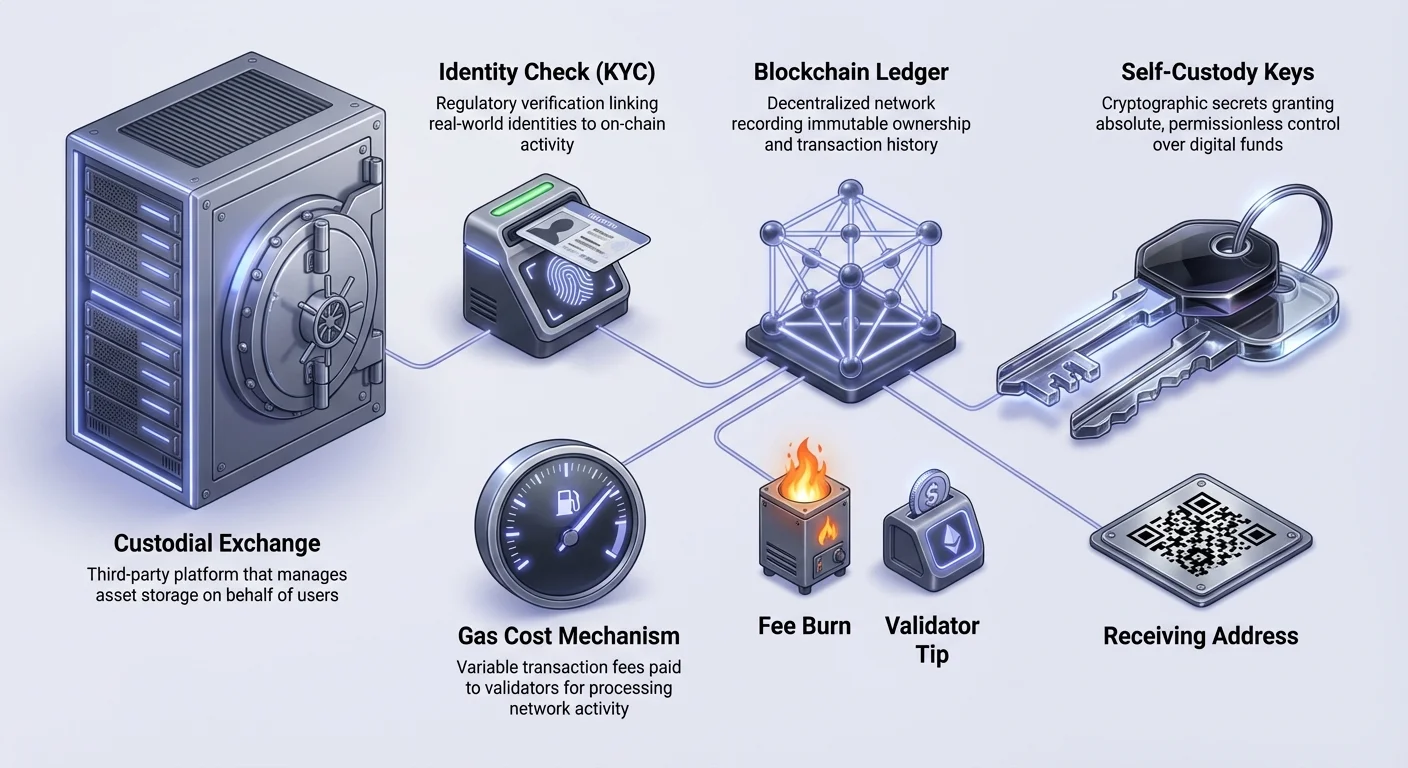
When buying ETH through a centralized exchange (CEX) or a standard financial app, the platform typically retains control of the digital assets. The user holds a claim to the assets, similar to an IOU, rather than the assets themselves. The exchange manages the private keys, which are the cryptographic proofs of ownership required to authorize transactions on the blockchain.
This model offers convenience for beginners. If a user forgets their login credentials, the platform can usually help recover the account. However, this convenience introduces third-party risk. If the platform faces insolvency, bankruptcy, or a security breach, user funds can be frozen or lost. Additionally, users must request permission to withdraw their funds, which can result in delays or administrative restrictions.
Self-Custodial Wallets
Self-custodial wallets allow users to hold their ETH directly without intermediaries. These wallets generate a private key directly on the user's device. This approach grants the user absolute control over the asset, enabling permissionless transactions 24/7. There are no withdrawal limits or freezing of accounts because there is no third party to enforce them.
With this control comes total responsibility. If a user loses their private key or recovery phrase, the funds are permanently inaccessible. There is no support team that can reset a private key. Self-custody is the preferred method for interacting with dApps, as it allows direct connection to the Ethereum network. It is the digital equivalent of holding cash in a physical wallet rather than keeping money in a bank account.
Private Keys and Security
The underlying technology of an Ethereum wallet relies on public and private key cryptography. The public address, starting with "0x," is shared with others to receive funds. The private key is the secret password that signs transactions.
In a self-custodial setup, the software encrypts this key and stores it locally. When buying ETH directly through a self-custodial wallet interface, the purchased assets are delivered immediately to an address the user controls. This minimizes the time funds sit in a vulnerable centralized pool. Users must follow best practices, such as writing down recovery phrases offline, to ensure the safety of their holdings.
Buying On-Ramps and Platforms
There are multiple avenues for converting fiat currency (government-issued money like USD or EUR) into ETH. These platforms, often called "on-ramps," vary in terms of privacy, speed, and cost. Choosing the right platform depends on whether the buyer prioritizes convenience, low fees, or control.
Centralized Exchanges (CEX)
Centralized exchanges are the most common entry point for new users. These platforms operate similarly to traditional stock brokerages. Users create an account, link a bank account or credit card, and place buy orders. Exchanges typically offer high liquidity, meaning large amounts of ETH can be bought without significantly impacting the price.
Most exchanges use an order book model or a simple conversion interface. While they are efficient for trading, they default to a custodial storage model. Users intending to hold their ETH securely or use it in Web3 applications must perform a second step: withdrawing the ETH from the exchange to a personal wallet. This withdrawal step often incurs additional fees and waiting periods.
Digital Wallet Providers
Many modern self-custodial wallets integrate buying functionality directly into their applications. Through partnerships with payment processors, these wallets allow users to buy ETH using credit cards, debit cards, or bank transfers within the app.
The primary advantage of this method is that the purchased ETH is deposited directly into the user's self-custodial address. There is no need to manually withdraw funds from an exchange, reducing the risk of user error during transfer. While this offers a streamlined experience, the processing fees for card payments can sometimes be higher than bank transfers on a dedicated exchange.
Peer-to-Peer (P2P) Marketplaces
Peer-to-peer platforms facilitate direct trades between individuals. Buyers search for sellers offering specific payment methods, such as local bank transfers, cash deposits, or digital gift cards. The platform typically acts as an escrow service to ensure safety.
During a P2P trade, the seller's ETH is locked in escrow. Once the buyer confirms payment and the seller verifies receipt, the ETH is released directly to the buyer's wallet. This method is popular in regions with limited banking access or for users seeking more privacy. However, users must be vigilant about vetting sellers based on reputation scores to avoid scams.
OTC Desks and Payment Apps
For high-net-worth individuals looking to make substantial purchases, Over-the-Counter (OTC) desks offer a personalized service. These desks facilitate large block trades without moving the market price on public exchanges.
Conversely, mainstream payment apps like PayPal or Venmo have begun offering crypto purchases. While highly accessible, these platforms often operate as "closed loops." In some cases, users cannot withdraw the ETH to an external wallet, limiting the asset's utility strictly to price speculation within the app. Users should verify withdrawal capabilities before purchasing on these platforms.
Identity Verification (KYC/AML)
When purchasing ETH with government-issued currency, users will almost always encounter Identity Verification processes. These are mandated by Know-Your-Customer (KYC) and Anti-Money-Laundering (AML regulations).
Regulatory bodies require financial institutions, including crypto exchanges and on-ramp providers, to collect personal data to prevent illicit activities. This process typically involves submitting a photo of a government ID (passport or driver's license) and a live selfie to verify the document holder is present. Some platforms may also require proof of address, such as a utility bill.
The extent of verification often correlates with the purchasing limits. Lower tiers might allow small purchases with minimal data, while higher limits require extensive documentation. While necessary for compliance, this process links a user's real-world identity to their on-chain Ethereum address if the funds are withdrawn directly. Users concerned about privacy often rotate addresses or use privacy-focused tools after the initial purchase.
Fee Structures and Network Costs
The cost of buying ETH is rarely just the market price of the asset. Buyers must navigate a layered fee structure that includes platform service charges, payment processing fees, and the Ethereum network's own transaction costs.
Platform and Processing Fees
Exchanges and wallet providers charge fees to facilitate the trade. These can manifest as a flat fee per transaction or a percentage of the total volume. Credit and debit card purchases generally incur the highest processing fees, often ranging from 3% to 5%, due to the fees charged by card networks like Visa or Mastercard. Bank transfers usually have lower fees but slower settlement times.
Another "hidden" cost is the spread. This is the difference between the actual market price of ETH and the price quoted to the buyer. Platforms may advertise "zero fees" but add a markup of 1-2% to the price of ETH. It is essential to compare the final amount of ETH received rather than just the advertised fee percentage.
Ethereum Network Fees (Gas)
Once ETH is purchased and moved on the blockchain, the network's own fee structure applies. These fees, known as "gas", are paid to network validators for processing transactions. Gas is priced in "gwei," a subunit of Ether (1 gwei = 0.000000001 ETH).
Network fees are determined by supply and demand for block space, not by the amount of value being sent. Sending $10 worth of ETH costs the same in gas fees as sending $10 million. If the network is congested with many users trying to transact simultaneously, the gas price rises.
Fee Customization and EIP-1559
Following the EIP-1559 upgrade, Ethereum fees are split into a base fee and a priority fee. The base fee is a mandatory cost that is "burned" (permanently removed from circulation), while the priority fee acts as a tip to validators to encourage faster inclusion in a block.
| Fee Component | Function | Recipient |
|---|---|---|
| Base Fee | Mandatory minimum cost | Burned (Destroyed) |
| Priority Fee | Incentive for speed | Validator |
| Platform Fee | Service charge | Exchange/Broker |
Most self-custodial wallets allow users to customize these fees. Users can select "Low," "Medium," or "High" priority depending on their urgency. Setting a fee too low may result in a stuck transaction that remains pending until network congestion drops. Conversely, exchanges often charge a fixed withdrawal fee that is set higher than the actual network cost to ensure reliability and generate profit.
Mechanics of Using ETH
After a successful purchase, managing ETH involves understanding addresses and transaction mechanics. An Ethereum address is a hexadecimal string starting with "0x," serving as the destination for funds.
Receiving and Privacy
To receive ETH, a user shares their public address. This can be done by copying the text string or showing a QR code for the sender to scan. Because the Ethereum blockchain is a public ledger, anyone who knows a specific address can view its entire transaction history and current balance using block explorers.
To maintain privacy, it is recommended to use fresh addresses for different purposes. For instance, a user might keep a "savings" wallet separate from a "trading" wallet. Advanced wallets allow the generation of unlimited addresses derived from the same master recovery phrase, helping to segregate funds and obfuscate total holdings from casual observers.
Sending and Interaction
Sending ETH requires specifying the recipient's address and the amount. Users can also send to human-readable aliases, such as names ending in ".eth," if the recipient has registered one. This simplifies the process and reduces errors associated with typing long hexadecimal strings.
Beyond simple transfers, ETH is used to pay for interactions with smart contracts. A smart contract is software running on the blockchain. Every action, such as swapping tokens on a decentralized exchange or minting an NFT, requires a transaction fee paid in ETH. Therefore, users should never swap their entire ETH balance for another token; a small amount of ETH must always remain in the wallet to pay for future gas fees associated with moving or selling those tokens.
Conclusion
Acquiring ETH is a gateway to the broader decentralized web, but it requires careful consideration of custody, security, and costs. Whether a user chooses the convenience of a centralized exchange or the control of a self-custodial wallet, understanding the underlying mechanisms is vital. The shift from traditional banking to managing digital bearer assets places the responsibility of security squarely on the owner.
Fee management remains a crucial skill for any Ethereum user. Balancing speed against cost, navigating platform spreads, and timing transactions to avoid network congestion can significantly impact the efficiency of a portfolio. As the network evolves, these economic dynamics will continue to shift, making ongoing education a priority for participants.
True ownership of Ethereum means holding your own private keys and accepting the responsibility that comes with total financial control.