
Entering the world of cryptocurrency trading marks a significant shift from traditional finance. It represents a move from centralized banking structures to a digital, often decentralized, economy. For a beginner, the first trade is more than just a transaction. It is a practical lesson in how blockchain technology, digital wallets, and market liquidity function in real time.
The process can feel intimidating due to the specialized terminology and the irreversible nature of blockchain transactions. However, breaking the procedure down into actionable steps transforms complexity into a manageable routine. Success in crypto trading relies less on luck and more on preparation, understanding the mechanics, and managing risk.
This guide outlines a comprehensive action plan for executing your first trade safely. It covers the essential groundwork of security and storage before moving into the technical details of exchange selection and order execution. By understanding the underlying systems—from order books to liquidity pools—you gain the confidence to navigate this evolving landscape.
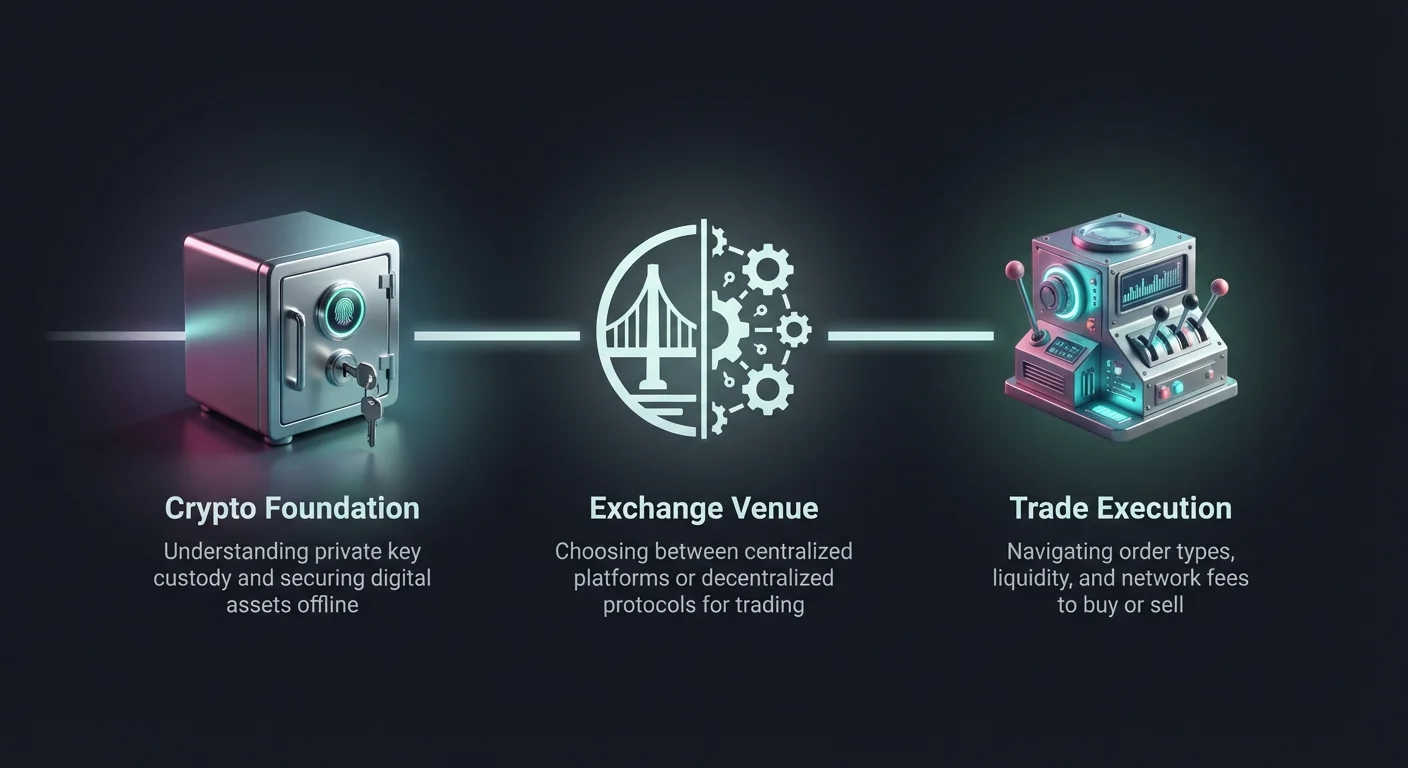
Step 1: Establishing Your Foundation
Before looking at charts or prices, you must establish a secure foundation for your digital assets. This begins with understanding the fundamental difference between holding cryptocurrency and holding money in a bank. In the crypto world, possession is defined by cryptographic keys rather than account balances managed by a third party.
Understanding Custody and Wallets
A cryptocurrency wallet does not store coins like a physical wallet stores cash. Instead, it stores the private keys that grant access to your assets on the blockchain. If you lose these keys, you lose access to your funds. This reality makes the concept of custody the most critical lesson for a beginner.
Custody falls into two primary categories: custodial and non-custodial (or self-custodial). A custodial setup involves a third party, such as a centralized exchange, holding your keys. This offers convenience, as they can help recover passwords, but it introduces counterparty risk. If the service fails or is halted, you may lose access to your funds.
Self-Custody Mechanics
Non-custodial wallets give you full control. You are the sole owner of the private keys and, by extension, the assets. This grants you immunity from third-party failures but places the entire burden of security on your shoulders. When setting up a self-custody wallet, you will generate a recovery phrase. This sequence of words is the master key to your funds.
You must secure this phrase offline. Storing it on a computer or cloud service exposes it to potential hacks. Writing it down on paper and storing it in a secure physical location is the standard best practice for beginners. This step is not optional; it is the primary security layer for your financial sovereignty.
Wallet Variations
Wallets come in various forms to suit different needs. Mobile wallets are applications that run on your phone, offering convenience for daily transactions and active trading. Desktop wallets provide similar functions on a computer. For substantial holdings, hardware wallets are recommended. These physical devices keep your private keys offline at all times, providing the highest level of security against online threats.
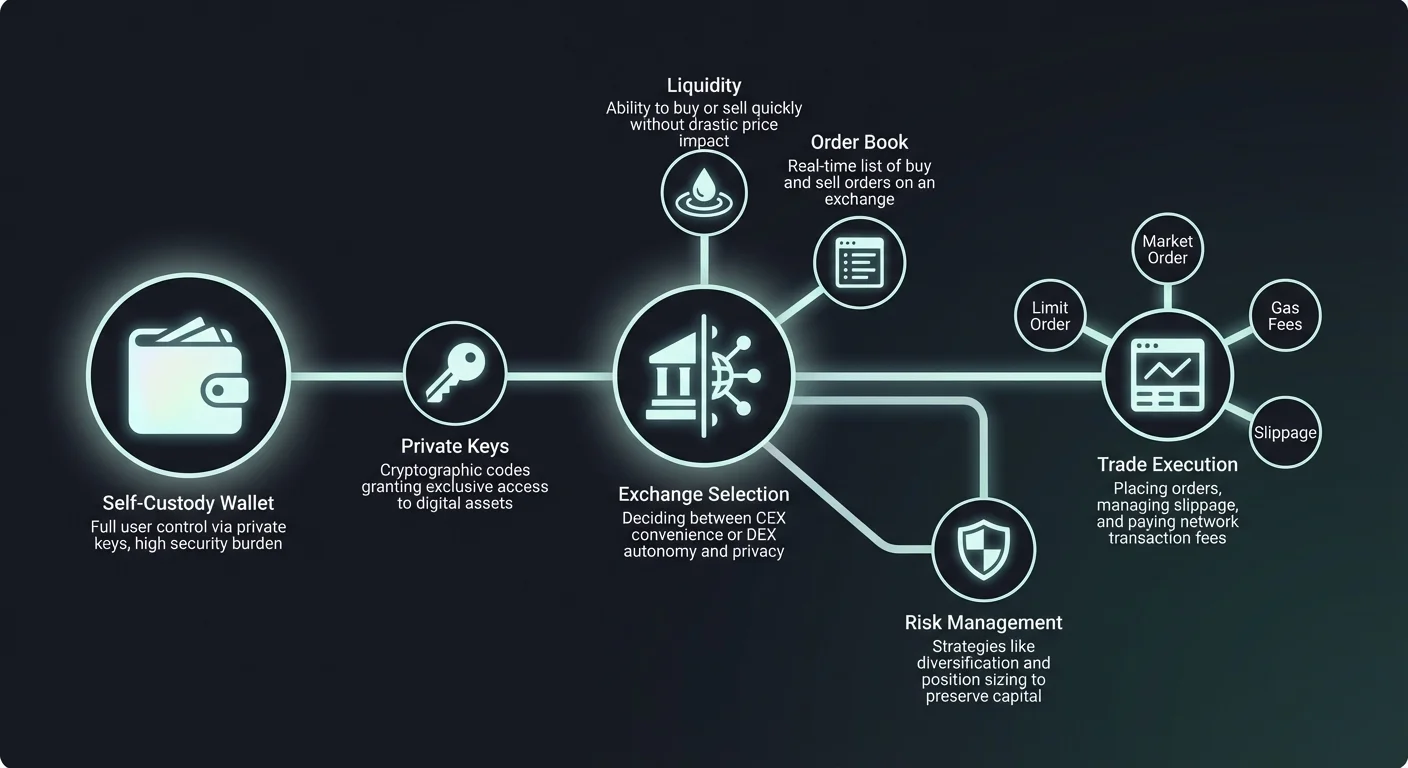
Step 2: Choosing the Right Venue
Once your security foundation is set, you must select a venue for your trade. In the cryptocurrency ecosystem, marketplaces generally fall into two categories: Centralized Exchanges (CEXs) and Decentralized Exchanges (DEXs). Each operates on different principles and serves different user needs.
Centralized Exchanges (CEXs)
A Centralized Exchange functions similarly to a traditional stock brokerage. It is a business that acts as an intermediary between buyers and sellers. To use a CEX, you typically create an account, verify your identity through a Know Your Customer (KYC) process, and deposit fiat currency or crypto. The exchange holds custody of the assets while they are on the platform.
The primary advantage of a CEX is user experience. They often provide customer support, simplified interfaces, and the ability to recover accounts if login details are lost. They also serve as the primary bridge between the traditional banking system and the crypto economy. This makes them a common starting point for users looking to convert local currency into their first digital assets.
Decentralized Exchanges (DEXs)
A DEX operates without a central authority. It is a protocol consisting of smart contracts on a blockchain that allows users to trade directly with one another. There is no account creation, no identity verification, and the platform never takes custody of your funds. You connect your self-custody wallet directly to the interface to trade.
DEXs rely on a technology called Automated Market Makers (AMMs). Instead of matching a buyer with a seller, AMMs allow users to trade against a pool of tokens known as a liquidity pool. This ensures that trades can happen 24/7 without needing a counterparty on the other side of the trade at that exact moment.
| Feature | Centralized Exchange (CEX) | Decentralized Exchange (DEX) |
|---|---|---|
| Custody | Exchange holds funds | User holds funds (Self-custody) |
| Identity | Requires KYC/ID verification | No ID required (Anonymous) |
| Speed | High-speed off-chain matching | Dependent on blockchain speed |
Evaluating Trade-offs
Choosing between a CEX and a DEX depends on your priorities. If you need to use a bank transfer to buy crypto, a CEX is usually required. If privacy and full control over your assets are your main concerns, a DEX is preferable. Many traders use a hybrid approach, using CEXs for fiat onboarding and DEXs for swapping into specific assets or maintaining privacy.
Step 3: Market Analysis and Preparation
With your wallet ready and your exchange selected, the next phase is preparation. Jumping into a trade without analyzing the market conditions is a common mistake. You need to understand not just the price of the asset, but the liquidity of the market you are entering.
The Role of Liquidity
Liquidity refers to how easily an asset can be bought or sold without causing a drastic change in its price. In a highly liquid market, you can sell a large amount of Bitcoin instantly with minimal price impact. In an illiquid market, a modest sell order could crash the price, resulting in a poor return.
Cash is the most liquid asset, while unique items like real estate are illiquid. In crypto, major assets like Bitcoin and Ethereum generally have high liquidity. Smaller, newer tokens often suffer from low liquidity. Before trading, check the 24-hour trading volume of the pair you are interested in. High volume suggests a healthy market where you can enter and exit easily.
Understanding the Order Book
On centralized exchanges, liquidity is visualized through an order book. This is a real-time list of buy and sell orders. "Makers" are traders who place limit orders that sit on the book, waiting to be filled. They provide liquidity to the market. "Takers" are traders who execute market orders, instantly accepting the prices offered by makers. Takers remove liquidity from the order book.
This distinction is important because exchanges often charge different fees for these actions. Makers usually pay lower fees because they help stabilize the market. Takers pay higher fees for the convenience of instant execution. Understanding this dynamic can help you save money on transaction costs over time.
Analytical Approaches
To decide what and when to trade, traders use two main schools of thought. Fundamental analysis involves evaluating the intrinsic value of a project. This includes looking at the network activity, adoption rates, development progress, and economic factors like scarcity. For Bitcoin, this might involve analyzing its role as a store of value or "digital gold."
Technical analysis focuses on price action and statistical trends. Traders study charts to identify patterns and potential entry or exit points. They look for support levels, where the price tends to stop falling, and resistance levels, where it tends to stop rising. Combining these approaches gives a more rounded view of the market.
Step 4: Executing the Trade
The final step is the execution. This is where your preparation meets the market mechanics. Whether you are using a simple swap interface or a complex trading dashboard, the core concepts of order types and transaction costs remain the same.
Funding Your Account
To trade, you must first fund your position. On a CEX, this involves depositing local currency via bank transfer or credit card, or transferring crypto from another wallet. On a DEX, you must already have cryptocurrency in your Web3 wallet to pay for the trade and the associated network fees.
Selecting the Order Type
The two most common order types are Market Orders and Limit Orders. A Market Order instructs the exchange to buy or sell the asset immediately at the best available current price. This guarantees that the trade will happen, but it does not guarantee the exact price. In fast-moving markets, the price could change slightly between the moment you click buy and the moment the trade executes.
A Limit Order allows you to set a specific price at which you are willing to buy or sell. The trade will only execute if the market reaches your defined price. This gives you control over your entry point but carries the risk that the order may never be filled if the market moves away from your target.
Navigating Slippage and Fees
In decentralized trading, you will encounter the concept of slippage. This is the difference between the expected price of a trade and the price at which it is actually executed. Slippage occurs when liquidity is low or volatility is high. Most DEX interfaces allow you to set a "slippage tolerance." If the price changes by more than this percentage during the transaction, the trade will fail to protect you from a bad rate.
You must also account for network fees, often called "gas." Every action on a blockchain requires computational power, which is paid for in the network's native currency (e.g., ETH for Ethereum). These fees fluctuate based on network congestion. During busy periods, a simple swap can become expensive. Always ensure you have enough extra crypto in your wallet to cover these costs.
Strategic Approaches for Beginners
Once you understand the mechanics of trading, you need a strategy to guide your decisions. Trading without a plan often leads to emotional decision-making, which is the enemy of profitability. Several established strategies cater to different risk tolerances and time horizons.
Dollar-Cost Averaging (DCA)
DCA is a strategy designed to mitigate the impact of volatility. Instead of investing a lump sum all at once, you invest a fixed amount of money at regular intervals, regardless of the asset's price. For example, buying $50 worth of Bitcoin every Monday.
When prices are high, your fixed amount buys fewer coins. When prices are low, it buys more. Over time, this averages out your entry price, reducing the risk of buying at a market peak. This passive strategy is popular among beginners because it removes the stress of trying to time the market.
The "HODL" Strategy
This term originated from a misspelling of "hold" on an early Bitcoin forum and has become a core philosophy. It involves buying an asset and holding it for a long period, ignoring short-term price fluctuations. Proponents of this strategy believe in the long-term value appreciation of the asset.
HODLing requires conviction and patience. It relies on fundamental analysis suggesting that the asset will be worth significantly more in the future. This strategy avoids the stress and fees associated with frequent trading but requires the discipline to not sell during market dips.
Swing Trading
Swing trading sits between day trading and long-term holding. Swing traders attempt to capture gains from price movements that happen over days or weeks. They rely on technical analysis to identify the bottom of a price cycle (swing low) to buy, and the top of a cycle (swing high) to sell.
This strategy requires more active management than DCA or HODLing. You must monitor charts and market sentiment regularly. It also introduces more risk, as attempting to predict market tops and bottoms is difficult even for professionals. Beginners should approach this with caution and smaller position sizes.
Upravljanje tveganj in varnosti
Potencial za dobiček v trgovanju s kripto je neločljiv od tveganja. Trg je volatilen, tehnologija pa neodpustna do napak. Učinkovito upravljanje tveganj je tisto, kar zagotavlja dolgoživost na trgu.
Ohranjanje kapitala
Nikoli ne trgujte z denarjem, ki si ga ne morete privoščiti izgubiti. To je zlato pravilo trgovanja. Kripto trg lahko doživi hitre padce, kjer vrednosti premoženosti močno padejo. Če potrebujete sredstva za najemnino ali račune, ne smejo biti na trgu.
Velikost pozicije je še en ključen koncept. Ne vložite vsega svojega kapitala v eno samo trgovino ali eno premoženost. Diversifikacija vključuje razporeditev naložbe čez različne premoženosti, da zmanjšate vpliv, če ena slabo performa.
Defenzivni varnostni ukrepi
Varnost se razteza dlje od ključev denarnice. Pri uporabi borz morate omogočiti dvofaktorsko avtentikacijo (2FA). Izogibajte se SMS-osnovni 2FA, saj se lahko telefonske številke ugrabijo. Namesto tega uporabite aplikacijo avtentikatorja na svoji mobilni napravi. Ta generira začasno kodo, potrebno za prijavo ali dvig sredstev.
Bodite previdni pred prevarami. Če projekt obljublja zagotovljene donose, je verjetno prevara. Phishing poskusi so pogosti, kjer napadalci ustvarijo lažne spletne strani, ki izgledajo kot legitimne borze, da ukradejo vaše podatke za prijavo. Vedno preverite URL, preden vnesete poverilnice.
Razumevanje volatilnosti
Volatilnost je mera tega, koliko se cena premoženosti spreminja sčasoma. Kripto je znan po visoki volatilnosti. Čeprav to ustvarja priložnosti za dobiček, ustvarja tudi stres. Cene se lahko nihajo za dvociprkovne odstotke v enem dnevu.
Sprejemanje te volatilnosti je del psihološkega vidika trgovanja. Čustvena disciplina vas prepreči panični prodaji med padcem ali nakupu v hrupu na vrhu. Imeti jasen načrt pred odprtjem trgovine vam pomaga držati se strategije, ko čustva divjajo.
Conclusion
Your first crypto trade is a learning experience that combines technology, finance, and personal discipline. By starting with a strong security setup, understanding the differences between exchange types, and analyzing liquidity, you position yourself for a safer entry into the market. The mechanics of order books, gas fees, and slippage will soon become second nature.
Remember that the learning curve does not end after the first transaction. The crypto landscape evolves rapidly, with new protocols and assets emerging constantly. Stick to your plan, manage your risk effectively, and prioritize the security of your keys above all else.
Successful trading is 90% preparation and risk management, and only 10% execution.