
The core revolutionary promise of cryptocurrency is self-sovereignty—the ability to control your wealth without relying on banks, governments, or central authorities. However, exercising this control requires making a critical, deeply personal decision: who holds the keys to your digital assets? This decision is known as custody.
In the traditional financial world, custody is simple: your bank holds your money, acting as the custodian. If you forget your password, the bank can verify your identity and restore access. In the crypto world, this choice is far more complex and carries life-changing risks.
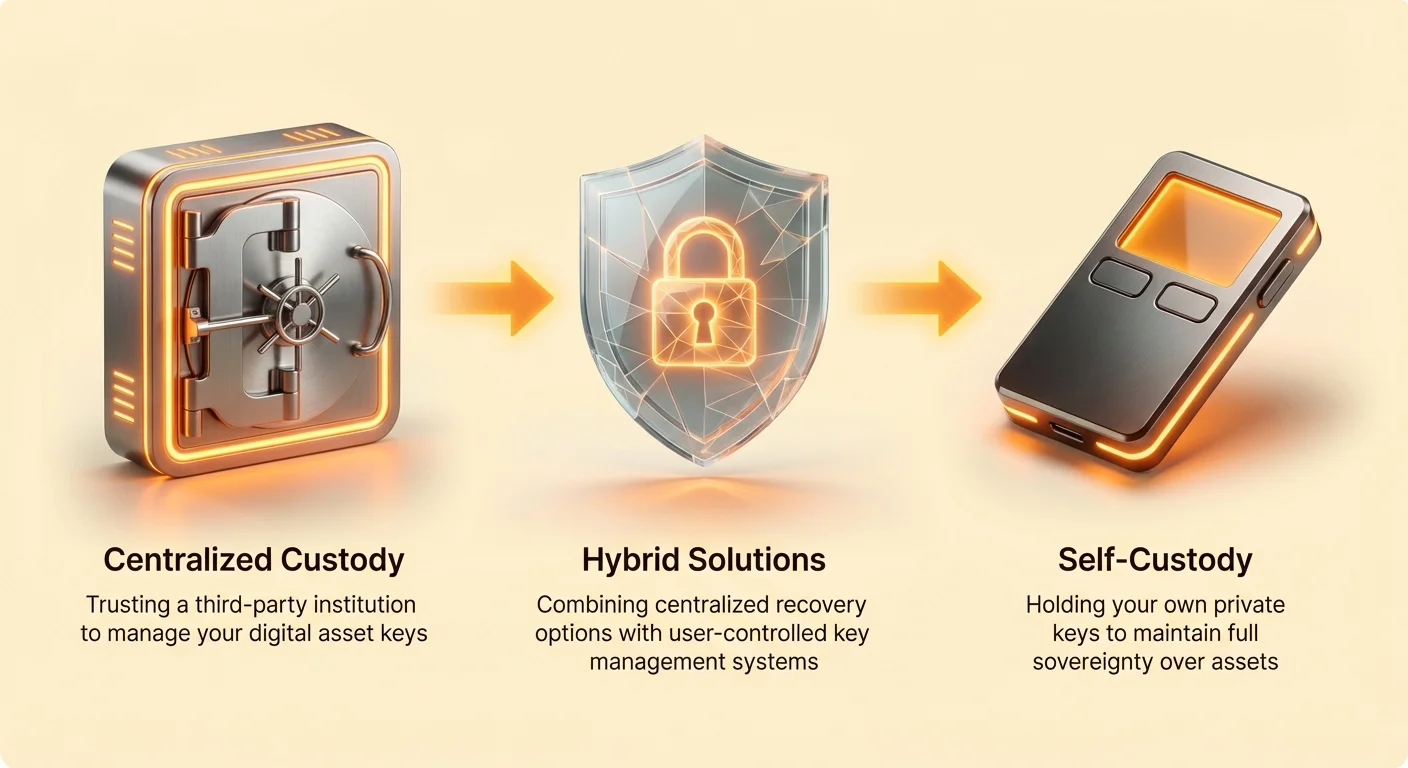
This guide moves beyond simple definitions to frame custody as a continuous spectrum. On one end is the convenience of absolute trust in a third party (Centralized Custody); on the other, the responsibility of absolute control (Self-Custody). We will analyze the fundamental trade-offs involved, explore modern hybrid solutions like Multi-Party Computation (MPC), and provide a framework for deciding where on this critical spectrum your assets should reside.
The Foundation: Understanding Crypto Ownership
To properly navigate the custody spectrum, you must first understand the underlying cryptographic mechanics of ownership. Unlike bank accounts, which are entries in a centralized database, crypto ownership relies on a pair of mathematically linked keys.
What is a Private Key?
The private key is the ultimate secret required to spend or move your cryptocurrency. Think of it as the master combination to your digital vault. It is a long, complex string of characters, mathematically impossible to guess.
If someone possesses your private key, they effectively possess your assets, regardless of who owns the associated wallet or exchange account. Therefore, the single most important decision in cryptocurrency is determining who has access to and control over this private key.
The Role of the Seed Phrase
Since memorizing or writing down a long private key is impractical and error-prone, modern wallets use a Seed Phrase (or Recovery Phrase). This is typically a sequence of 12, 18, or 24 common words (like "tree," "apple," "river," "trust").
Crucially, the seed phrase is not a password; it is the master key that can mathematically regenerate every private key and public address associated with your wallet. Losing your seed phrase means permanently losing access to your funds if you lose the device containing the wallet. Similarly, if someone else finds your seed phrase, they can instantly steal your entire portfolio.
Defining the Core Conflict: Counterparty Risk vs. Human Error Risk
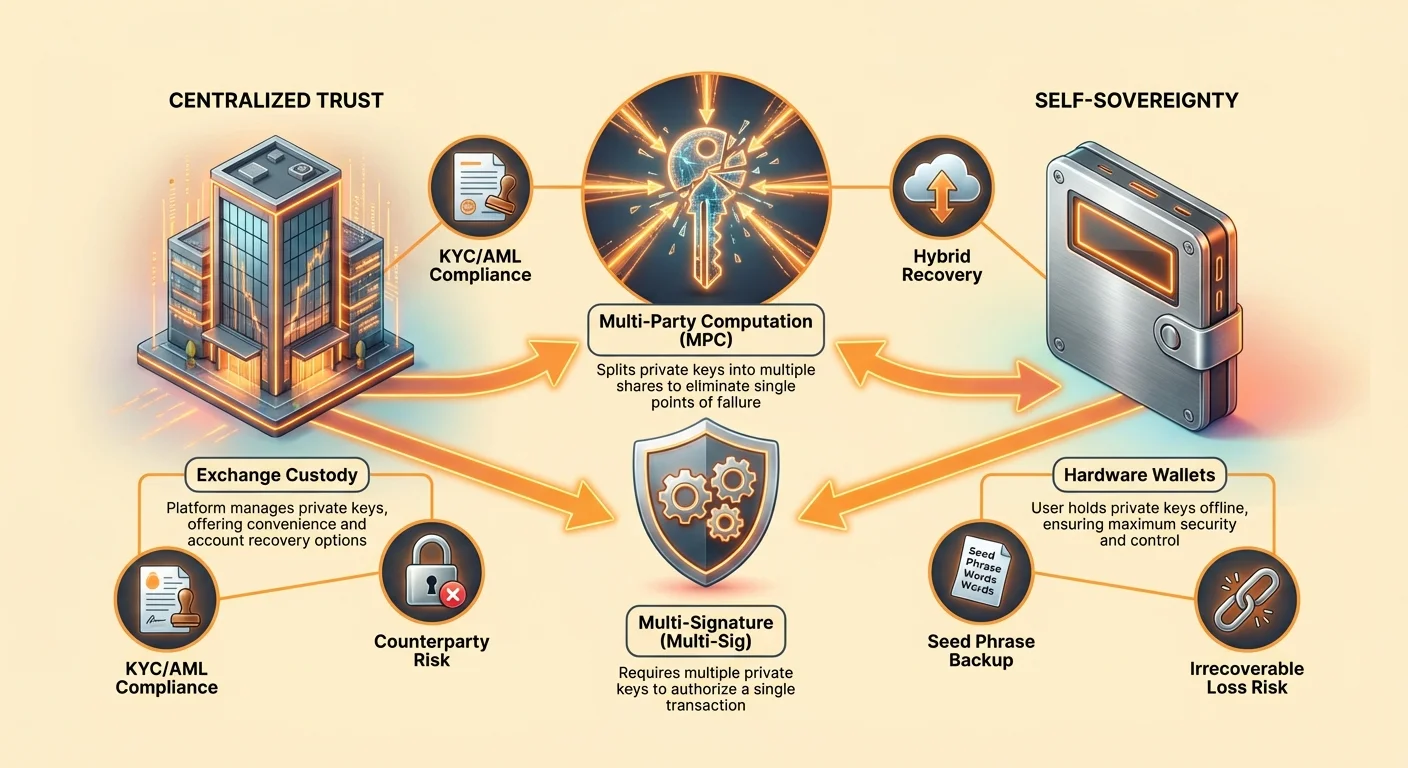
The choice between custodial and non-custodial services is, at its core, a decision about which type of risk you are best equipped to mitigate. Every model on the custody spectrum involves accepting one of these two fundamental threats.
Counterparty Risk: The Danger of Centralized Trust
Counterparty risk is the financial exposure you face when relying on a third party to fulfill a contract or protect an asset. In crypto, this means trusting a centralized entity—usually an exchange or a specialized custodian—to hold your private keys securely.
Examples of Counterparty Risk:
- Exchange Hacks: If the centralized platform is compromised (a hack, phishing, or insider theft), you could lose all assets, as the private keys were under their control.
- Regulatory Seizure/Freeze: If the platform faces legal challenges, bankruptcy, or regulatory action in a specific jurisdiction, your account might be frozen, preventing you from withdrawing your assets, even if you did nothing wrong.
- Default/Insolvency: If the custodian goes bankrupt (as seen during the 2022 market crashes), your assets might be tied up in lengthy legal proceedings, and you may only recover a fraction of your funds, if any.
Human Error Risk: The Danger of Absolute Self-Reliance
Human error risk is the threat that comes from poor execution of personal security practices. This risk is inherent in the self-custody model, where the user is solely responsible for asset security.
Examples of Human Error Risk:
- Loss of Seed Phrase: If you lose the paper backup of your seed phrase (fire, flood, misplaced document) and your device fails, your funds are permanently locked.
- Theft via Phishing: If you are tricked into entering your seed phrase into a malicious website or software, the attacker gains full control instantly.
- Poor Storage: Taking a photo of your seed phrase, saving it to a cloud drive, or keeping it in an unsecured location makes it vulnerable to digital theft or physical compromise.
The custody decision requires introspection: Are you more capable of preventing a centralized failure, or are you better at managing your own security and protecting your secrets?
Endpoint 1: Centralized Custody (The Convenience Model)
Centralized Custody is the model most familiar to newcomers. When you buy crypto on a major exchange (e.g., Coinbase, Kraken, or Binance), the platform holds the private keys on your behalf. You own the assets legally, but the exchange maintains the cryptographic control.
How Centralized Custody Works (Exchange Custody)
In a centralized model, the platform manages vast pools of crypto assets for millions of users. They typically employ highly sophisticated security teams, multi-layer encryption, and institutional-grade cold storage (disconnected from the internet) to protect these keys.
When you log in and click "Send," the exchange verifies your password and 2FA, and then internally signs the transaction using their secure, proprietary key management system. You are essentially using an account balance maintained by the platform, similar to checking a bank balance.
Pros: Convenience, Safety Nets, and Features
The major appeal of exchange custody is the drastically reduced cognitive load and barrier to entry:
- User Experience (UX): Buying, selling, and trading is instant and integrated. The process is streamlined, and customer support is generally available for common issues.
- Account Recovery: If you forget your password or lose access to your 2FA device, the exchange can verify your identity (using KYC documents) and restore your account access. This eliminates the risk of permanent loss due to a forgotten key.
- Built-in Safety Measures: Many major exchanges offer insurance (usually against internal theft or platform failure, not against market losses or user negligence) and sophisticated fraud detection systems.
- Low Cost for Transfers: Moving crypto between wallets within the same centralized exchange is often free or instantaneous, as the transaction only involves updating an internal ledger.
Cons: Security Failures, Control Loss, and Seizure Risk
The convenience of centralized custody comes at the direct cost of sovereignty and control:
- Absolute Counterparty Risk: As established, if the exchange fails, your assets are in jeopardy. The assets are liabilities on the exchange’s balance sheet, not segregated funds in your name (unless specialized custody accounts are used).
- Required KYC/AML: Nearly all centralized exchanges require extensive Know Your Customer (KYC) documentation (ID, proof of address) and conduct Anti-Money Laundering (AML) monitoring. This ties your financial history directly to your identity.
- Withdrawal Limits and Fees: Exchanges may impose daily or monthly limits on how much crypto you can withdraw, and they charge network transaction fees (plus sometimes an extra service fee) for moving assets off the platform.
- Not Your Keys, Not Your Coin: This foundational crypto principle states that without the private key, you do not truly own the asset. You merely own an IOU from the custodian.
Use Case: Active Traders and Small Holdings
Centralized custody is generally appropriate for:
- New Users: Those who are just learning to buy and sell small amounts and value the safety net of account recovery.
- Active Traders: Users who need rapid access to trading pairs, liquidity, and centralized market-making tools.
- Small Portfolios: Amounts that would not be financially devastating if lost, making the convenience of the exchange worth the counterparty risk.
Endpoint 2: Absolute Self-Sovereignty (The Responsibility Model)
Self-Custody (or non-custodial custody) means you, and only you, hold the private keys. No third party, no exchange, and no wallet provider ever has access to your seed phrase. This is the embodiment of true financial sovereignty.
How Self-Custody Works (Non-Custodial Wallets)
Self-custody relies on specialized software or hardware wallets. When you set up a non-custodial wallet (like a dedicated hardware device or a mobile software app), the device generates the private key and seed phrase offline.
The wallet app merely provides the interface for viewing your balance and creating unsigned transactions. When you click "Send," you must use your stored private key (or the hardware device) to cryptographically sign the transaction before it is broadcast to the public blockchain.
The Responsibility of the Private Key Holder
In self-custody, you become your own security officer, compliance department, and bank vault manager. This responsibility is absolute:
- Total Control: You control when, where, and how you send funds. No one can freeze your wallet or stop your transactions (barring network-level censorship).
- Zero Recovery: If you lose your seed phrase, there is no "Forgot Password" button. Your funds are permanently gone. This is the inherent cost of removing centralized trust.
Pros: Security, Privacy, and Financial Sovereignty
The advantages of self-custody directly counter the risks of centralization:
- Elimination of Counterparty Risk: Your funds are safe from exchange hacks, insolvencies, and arbitrary account freezes. The assets exist only on the blockchain, secured by the mathematical strength of your private key.
- Maximum Privacy: Since self-custody wallets do not require KYC, your ownership is decoupled from your legal identity. While transactions are public, linking the wallet address to your real identity is difficult unless you transact with a centralized, KYC-mandated entity.
- Full Access to DeFi: Self-custody is necessary to interact with decentralized finance (DeFi), NFTs, decentralized exchanges (DEXs), and various Web3 applications without relying on intermediaries.
Cons: Irrecoverable Loss and High Entry Barrier
The high level of responsibility creates new, catastrophic risks:
- Irrecoverable Loss: This is the most significant downside. If the key is lost, destroyed, or stolen due to poor security, the funds are permanently lost.
- Complexity: Securely managing a hardware wallet, encrypting backups, and following best practices requires technical discipline and constant vigilance. The initial learning curve is steep.
- Transaction Costs: Every movement of funds incurs direct network transaction fees (gas), which can be costly depending on network congestion.
Use Case: Long-Term Holders and High-Value Assets
Self-custody is the mandated choice for:
- HODLers (Long-Term Holders): Users who plan to store assets for many years and minimize exposure to short-term market volatility or centralized entity risk.
- Large Portfolios: Any amount of crypto that represents a significant portion of a user’s net worth should be moved into secure, self-custodied storage (ideally hardware wallets).
- Privacy Advocates: Users who prioritize maintaining financial privacy and decentralized access above all else.
Navigating the Middle Ground: Hybrid and Advanced Custody
The stark trade-off between convenience (custodial) and control (self-custody) has driven the development of hybrid models designed to mitigate the disadvantages of both extremes, creating safer, more flexible options on the custody spectrum.
Multi-Signature (Multi-Sig) Wallets
Multi-Sig technology requires multiple private keys to authorize a single transaction. Instead of needing one signature (1-of-1), a transaction might require three keys out of five available keys (3-of-5) to be signed.
How it Reduces Risk:
- Mitigating Human Error: If one key is lost or stolen, the funds are still safe, as the attacker cannot meet the required signature threshold.
- Corporate Governance: Ideal for businesses or families, ensuring that no single person can unilaterally move large amounts of capital.
- Decentralized Security: Keys can be distributed geographically or held by trusted partners, creating decentralized security redundancy.
While powerful, Multi-Sig requires coordinating multiple parties and is still vulnerable if the majority of keys are compromised (e.g., if three out of five keys are stored together).
Multi-Party Computation (MPC) Explained
Multi-Party Computation (MPC) is a revolutionary cryptographic approach that allows a transaction to be signed without ever creating or storing a single, complete private key in one location. This is one of the most significant advancements addressing the "crypto custody trade-offs."
The MPC Process (Breaking the Key):
Instead of generating one private key and splitting it (like Multi-Sig), MPC generates several "key shares." These shares are created simultaneously and are mathematically designed so that:
- No single key share is sufficient to spend the funds.
- The key shares never have to be reassembled into a complete private key during the signing process.
A Common MPC Use Case (Hybrid Recovery):
In a popular implementation, a user might hold two shares (one on their phone, one on their computer), and a specialized third-party service holds a third "recovery share." The transaction requires 2-of-3 shares to sign.
- If the user loses their phone, they can use their computer share and the third-party recovery share to move funds.
- The third party, holding only one share, cannot steal the funds.
- The system offers the security benefits of self-custody (the user maintains control over the majority of shares) with the recovery benefits of centralized custody (a safety net exists).
MPC wallets address the catastrophic human error risk of losing a seed phrase while maintaining true non-custodial ownership over the underlying asset. This places MPC firmly in the middle of the custody spectrum.
Trade-offs of Hybrid Solutions
While highly effective, hybrid models introduce complexity:
| Model | Benefit | Drawback |
|---|---|---|
| Multi-Sig | Excellent governance and key redundancy. | High operational complexity; costlier transactions (requires multiple signatures). |
| MPC Wallets | Eliminates the single point of failure (the seed phrase). | Relies on specialized software; often requires trust in the mathematical security of the MPC service provider. |
The Regulatory and Legal View of Custody
The choice of custody model has significant implications far beyond technological security, impacting legal compliance, privacy, and long-term inheritance planning.
KYC/AML and Custodial Services
Custodial platforms, operating as regulated financial institutions, are legally required to adhere to Know Your Customer (KYC) and Anti-Money Laundering (AML) laws. This means they report transaction data and identity information to government agencies when required.
If you are concerned about maintaining privacy or minimizing your identity footprint in the crypto space, using centralized custody fundamentally undermines that goal.
When Does Self-Custody Provide Privacy?
Self-custody wallets provide transactional privacy because they are pseudonymous (addresses are numbers, not names). However, this privacy is not absolute. If a user funds their non-custodial wallet using a withdrawal from a KYC-verified exchange, the government can easily trace that transaction and associate the wallet address with the user's identity.
True privacy requires meticulous operational security, including utilizing privacy-enhancing coins or technologies, and carefully managing the interaction points between your self-custody wallets and the regulated fiat world.
Inheritance Planning Challenges
One of the most profound challenges of self-custody is digital inheritance. Passing on a traditional financial account is simple through a will. Passing on crypto requires transferring access to the private keys.
If a key holder dies without securely communicating the location and format of the seed phrase, the crypto assets are functionally lost forever. Self-custody demands a proactive and structured inheritance plan, often involving legal escrows or specialized death-man’s-switch MPC setups, to ensure heirs can gain access without compromising security while the owner is alive.
Practical Decision Guide: Choosing Your Place on the Spectrum
Selecting the right custody model is not a one-time choice but an ongoing process that should reflect your financial circumstances, technical skills, and risk tolerance. Here is a framework to guide your decision-making.
Assessing Your Technical Skill Level
Be brutally honest about your ability to maintain digital security:
| Skill Level | Custody Recommendation | Rationale |
|---|---|---|
| Beginner/Low Skill | Centralized Custody (Exchanges) | Account recovery is critical. The cost of human error (losing the seed) is higher than the risk of platform failure for small holdings. |
| Intermediate/Developing | Software Self-Custody (or MPC) | Capable of understanding 2FA, securing devices, and basic key management, but may still benefit from hybrid recovery features. |
| Advanced/Expert | Hardware Self-Custody (or Multi-Sig) | Possesses the discipline and knowledge to manage encrypted backups, physical security, and advanced wallet interfaces. |
Assessing Your Holding Size and Time Horizon
The value and duration of your investment are the most important quantitative factors in the custody decision.
1. Small or Trading Portfolios (Hot Assets)
- Definition: Assets used for daily trading, short-term speculation, or small purchases. These funds are "hot" because they need to be readily accessible.
- Recommended Custody: Centralized Exchange.
- Reasoning: Convenience and speed outweigh the moderate counterparty risk. If the total loss is under the equivalent of a few months' rent, the risk is often tolerable in exchange for ease of use.
2. Medium to Large Holdings (Cold Assets)
- Definition: Investments intended to be held for months or years (HODLing). These funds should be "cold" (in cold storage).
- Recommended Custody: Dedicated Self-Custody (Hardware Wallets).
- Reasoning: The risk of relying on a third party to hold life-savings for five years or more significantly outweighs the risk of the user meticulously protecting a hardware device and seed phrase.
Actionable Tip: Don't Put All Your Keys in One Basket
A mature approach to crypto custody is diversification. It is rarely wise to commit 100% of your assets to one spot on the spectrum.
The 80/20 Rule of Custody:
- 80% Cold (Self-Custody): The bulk of your investment—the long-term, high-value portion—should be secured using absolute self-custody methods (hardware wallets, MPC, or Multi-Sig). This protects you from catastrophic centralized failure.
- 20% Hot (Custodial): A smaller portion, reserved for immediate trading or rapid liquidity needs, can remain on a reputable centralized exchange. This offers convenience without risking your entire portfolio.
This balanced approach provides both the self-sovereignty needed for financial security and the accessibility required for active participation in the market.
Conclusion
The decision of crypto custody is a reflection of your personal philosophy regarding trust, control, and risk management. Cryptocurrency gives you the unprecedented opportunity to remove reliance on traditional gatekeepers, but that freedom comes with absolute responsibility.
Centralized Custody offers convenience and institutional safety nets, but it subjects you to counterparty risk. Absolute Self-Custody offers sovereignty and superior security against institutional failure, but demands meticulous discipline to avoid catastrophic human error. Hybrid solutions, particularly MPC wallets, are evolving rapidly to offer a crucial middle ground, blending recovery mechanisms with decentralized control.
Your path along the custody spectrum should be dynamic. As your portfolio grows, your technical skills improve, and your understanding of the inherent risks deepens, your assets should naturally shift toward greater control and self-sovereignty. Mastering the mechanics of custody is the first and most vital step toward achieving true financial independence in the digital age.