
Navigating the world of digital assets offers unparalleled freedom, but that freedom comes hand-in-hand with regulatory responsibility. As the digital economy matures, global tax authorities are increasingly focused on ensuring compliance within the crypto space. For investors and practitioners, the most fundamental and complex challenge is determining how a specific crypto event—be it trading, staking, or mining—is classified for tax purposes.
This distinction is critical. Classification as "Capital Gain" typically means the asset is treated like property or a stock, taxed only upon disposal and often benefiting from lower long-term rates. Classification as "Income," conversely, means the asset is taxed immediately upon receipt (at its fair market value), often at much higher ordinary income tax rates. Misclassification can lead to significant penalties, making a detailed understanding of the international tax landscape essential for anyone building self-sovereignty in this new economy.
This guide moves beyond generalized advice, offering a comprehensive comparative analysis of how major global tax regimes—including the U.S., UK, Australia, and key European nations—treat common crypto transactions. We will explore country-specific thresholds, define universally taxable events, and delve into the specialized rules governing complex activities like forks, airdrops, and decentralized finance (DeFi).
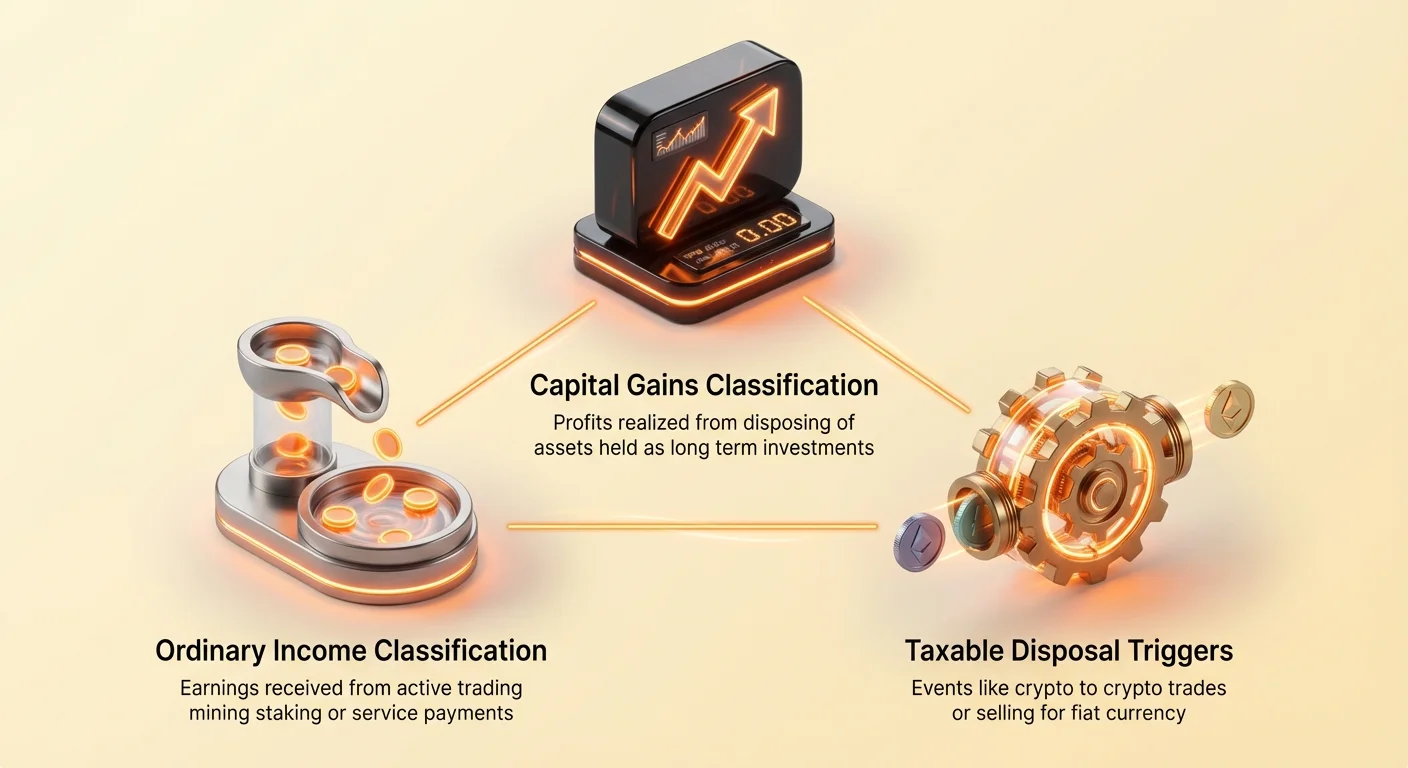
The Foundation of Crypto Taxation: Capital vs. Income
At its core, all cryptocurrency taxation hinges on the question of classification. Is your activity considered investment (leading to capital gains) or business/service compensation (leading to ordinary income)? While the specifics vary globally, the conceptual difference remains constant.
The Investor vs. The Trader: Defining Intent and Frequency
Tax regimes across the world distinguish between an individual who occasionally buys and holds assets (an investor) and an individual who conducts high-frequency transactions with the primary goal of making a profit from market fluctuations (a trader or business).
The Investor (Capital Gains): Investors typically buy assets with the intention of holding them for long-term appreciation. Their transactions are infrequent, and their primary income source is usually separate from crypto activity. For an investor, the act of buying crypto is not a taxable event. The tax trigger only occurs when the asset is disposed of—that is, when it is sold for fiat, traded for another crypto asset, or used to purchase goods or services. The profit realized upon disposal is generally subject to capital gains tax.
The Trader/Business (Income): If an individual’s crypto activity meets certain criteria—such as high volume, commercial intent, short holding periods, reliance on specialized trading equipment, and marketing efforts—authorities may deem this a "trade" or "business." In this case, profits are treated as ordinary business income, meaning they are taxed at standard income tax rates, and the trader may be required to pay self-employment or payroll taxes in addition to income tax.
Many regimes use criteria known as the "Badges of Trade" (a concept formalized in UK law but used conceptually worldwide) to determine intent, analyzing factors like frequency, organization, and profit motive.
Defining "Taxable Disposal"
The single most confusing concept for newcomers is that trading one cryptocurrency for another (e.g., trading Bitcoin for Ethereum) is universally considered a taxable event—often called a "disposal."
When you exchange BTC for ETH, you are first "selling" the BTC (realizing a gain or loss based on its initial cost) and then "buying" the ETH at its current fair market value.
Common Taxable Disposals Across Jurisdictions:
- Selling crypto for fiat currency (USD, EUR, GBP).
- Trading crypto for another crypto asset.
- Using crypto to pay for goods or services.
- Gifting crypto (this varies, but often treated as disposal if above certain thresholds).
- Converting one stablecoin to another (if their values diverge from $1).
The key point: Every transaction that moves an asset out of your possession and realizes a new value (or exchanges it for a new asset) must be tracked to determine the underlying cost basis and resulting gain or loss.
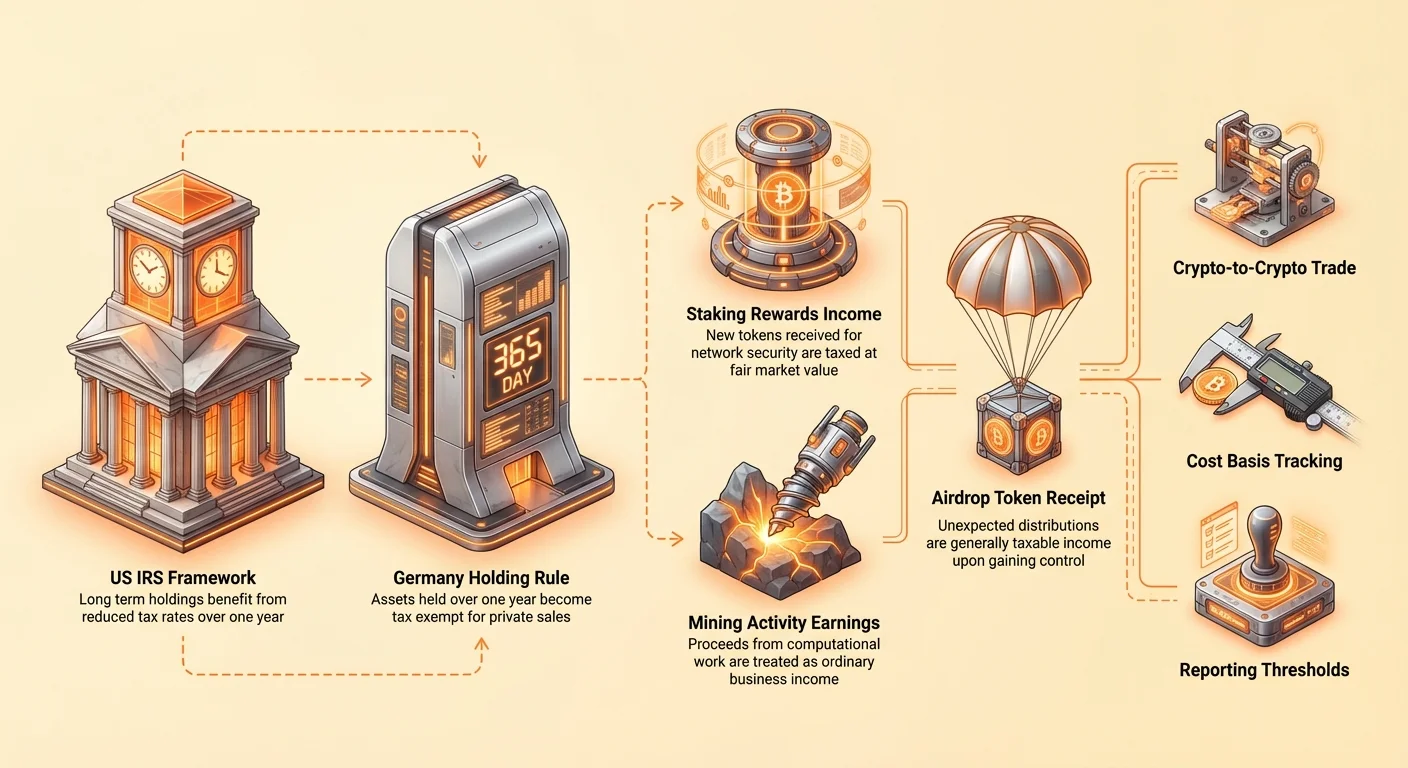
Deep Dive: The U.S. Internal Revenue Service (IRS) Framework
The U.S. approach to crypto taxation is foundational globally, primarily because the IRS classifies virtual currency as property rather than currency. This distinction dictates how capital gains are applied and defines when income is realized.
Capital Gains Treatment: Short-term vs. Long-term
The U.S. tax structure offers a significant advantage for long-term investors: reduced tax rates for assets held longer than one year.
- Short-Term Capital Gains: Applies to profits realized on assets held for 365 days or less. These gains are taxed at the taxpayer’s ordinary income tax rate, which can be as high as 37% (plus state taxes).
- Long-Term Capital Gains: Applies to profits realized on assets held for more than 365 days. These rates are typically much lower (0%, 15%, or 20%), depending on the taxpayer’s overall income bracket.
Example Use Case (IRS): A U.S. investor buys 1 BTC for $10,000.
- Scenario A (Short-Term): After 6 months, they sell the BTC for $30,000. The $20,000 gain is taxed at their ordinary income rate (e.g., 30%).
- Scenario B (Long-Term): After 14 months, they sell the BTC for $30,000. The $20,000 gain is taxed at the lower long-term capital gains rate (e.g., 15%).
Income Classification: Mining, Staking, and Services
The IRS is clear that if crypto is received as payment for services, or generated through activity that creates new economic value, it must be classified as ordinary income upon receipt.
- Mining Income: The fair market value (FMV) of the crypto received from successful mining (or transaction fees) is considered ordinary income on the day it is successfully claimed. The cost of generating that income (electricity, equipment depreciation) is deductible.
- Staking Rewards: Similar to mining, the FMV of staking rewards (new tokens generated for securing a network) is generally considered ordinary income upon receipt.
- Airdrops and Referral Rewards: If an airdrop is received without having to provide any service (a true "gift"), the IRS has historically treated it differently than an airdrop received in exchange for marketing or service. However, in most interpretations, if an airdrop or referral reward has value, its FMV is treated as ordinary income upon receipt.
Double Taxation Risk: It is vital to understand the income classification creates a dual tax liability:
- Income Tax: Paid on the FMV when the asset is received (e.g., $100 worth of ETH staking rewards).
- Capital Gains Tax: Paid later when that asset is disposed of, calculated based on the difference between the disposal price and the original income basis ($100).
Foreign Asset Reporting: FATCA and FBAR
For U.S. citizens and residents, stringent reporting requirements exist for foreign financial accounts, which can include certain crypto holdings on international exchanges. These rules apply regardless of where the individual lives.
- FBAR (Foreign Bank and Financial Accounts Report, FinCEN Form 114): Requires U.S. persons to report aggregate foreign account balances that exceed $10,000 at any point during the calendar year. While the IRS has not explicitly mandated FBAR for all non-custodial wallets, foreign centralized exchanges (CEXs) and custodial services must be reported. Failure to file can result in massive civil and criminal penalties.
- FATCA (Foreign Account Tax Compliance Act, Form 8938): Requires U.S. persons to report specified foreign financial assets if the total value exceeds high thresholds (which vary based on filing status and residency). This form includes many assets and investments not covered by FBAR, sometimes including decentralized or self-custodied assets depending on the interpretation of "financial assets."
Comparative Analysis: UK Her Majesty's Revenue and Customs (HMRC)
The UK’s tax framework treats cryptoassets as property or commodities for tax purposes, similar to the U.S., but employs unique allowances and methods for calculating gains, making it distinct from the American system.
Capital Gains Tax (CGT) Allowance and Calculation
HMRC provides a substantial tax-free annual allowance for capital gains (the Annual Exempt Amount). This means individuals can realize a specific amount of profit each year without incurring CGT liability.
Key Difference: Pooled Assets: Unlike the U.S., where Specific Identification (tracking the exact coin sold) is often the preferred method for cost basis, the UK generally requires investors to use the "Share Pooling" rule, which is akin to a complex Averaging Cost method.
Under HMRC rules, all identical crypto assets (e.g., all units of BTC) are treated as being in a single pool. When assets are sold, the cost basis is calculated by averaging the costs of all assets in that pool.
HMRC Cost Basis Hierarchy (Specific Rules apply in order):
- Same Day Rule: Assets bought and sold on the same day must match against each other first.
- Bed and Breakfasting Rule: Assets bought within 30 days after a sale must be matched against that sale. (This limits loss harvesting.)
- Section 104 Pool: Any remaining assets enter the pool, and the average cost is used for calculation.
Income Treatment and the "Badges of Trade"
HMRC uses a set of established criteria, known as the "Badges of Trade," to determine if an individual's activity constitutes a business (trade) rather than a simple investment.
If the activity is deemed a trade, the profits are subject to Income Tax and National Insurance Contributions (NIC, similar to self-employment tax).
Badges of Trade Criteria (Simplified):
- Frequency: How often are transactions performed?
- Duration of Ownership: Are assets held for years (investment) or minutes/hours (trade)?
- Organization: Is the activity carried out in a business-like manner (special accounts, dedicated website, advertising)?
- Motive: Is the main intention quick profit from price movement, or long-term growth?
HMRC is more likely to classify high-frequency, algorithm-driven trading as a business than a casual staking operation, though guidance on specific activities is constantly evolving.
Treatment of Decentralized Finance (DeFi) Activity
DeFi introduces unique complications because the underlying legal relationships are complex (is lending a loan, or a transfer of property?).
Lending and Staking:
- HMRC generally views the rewards received from staking or liquidity provision as miscellaneous income (taxable immediately upon receipt at FMV).
- However, if you transfer your principal asset to a platform (like a DeFi protocol) and regain rights to a similar asset later, HMRC may treat this as a disposal of the original asset if the transfer is considered a change in beneficial ownership. This means the investor may realize a capital gain or loss immediately upon entering the DeFi protocol, followed by income tax on the rewards received later. This makes accurate tracking of DeFi collateral transfers critically important under UK law.
The Australian Taxation Office (ATO) Model
Australia offers a comparatively clear, though detailed, framework, notable for its explicit "personal use asset" exemption and robust definition of when crypto constitutes a business venture.
Personal Use Exemption: The ATO's Unique Feature
The Australian Taxation Office (ATO) provides a substantial benefit for hobbyists: the Personal Use Asset exemption.
Cryptocurrency acquired and used primarily to purchase goods or services—and not for the purpose of profit generation—may be classified as a personal use asset. Crucially, if the cost base (original purchase price) of the asset is $10,000 AUD or less, any gain realized upon disposal is exempt from Capital Gains Tax (CGT).
Conditions for Personal Use Exemption:
- The asset must be used or intended for personal consumption (e.g., buying a coffee, paying for online services).
- It must not be part of a trading or investment scheme.
- If a loss is realized on a personal use asset, that loss is generally non-deductible.
This exemption provides welcome relief for crypto users who engage in small, everyday transactions but are not trading for profit.
Hobbyist vs. Trader vs. Business: Classification Clarity
The ATO provides clear guidelines to differentiate between investment activities (subject to CGT) and business activities (subject to income tax).
1. Hobbyist/Investor:
- Transactions are infrequent and opportunistic.
- Assets are generally held for long periods.
- Profits are subject to CGT, with a valuable 50% CGT discount available if the asset is held for more than 12 months. This is Australia's equivalent of the U.S. long-term capital gains break.
2. Crypto Business/Trader:
- The activity is conducted in a professional, systematic, and repetitive manner.
- The main intention is continuous profit from market fluctuation.
- Profits are taxed as ordinary business income, but the trader can claim business-related deductions (e.g., subscription fees, software, specialized hardware). Importantly, losses incurred in a crypto business may be offset against other income streams.
Classification of Non-Fungible Tokens (NFTs)
The ATO has issued specific guidance on NFTs, generally classifying them like other crypto assets, but their tax treatment is heavily dependent on their function:
- NFTs as Personal Use Assets: If an NFT is acquired purely for personal enjoyment (e.g., digital art for private viewing) and the cost is under $10,000 AUD, the personal use exemption may apply.
- NFTs as Investment Assets: If the NFT is held primarily for expected future appreciation (flipping), it is subject to standard CGT rules upon disposal.
- NFTs as Trading Stock: If a business creates, mints, and sells large volumes of NFTs in a sustained commercial manner, the profits are taxed as ordinary income.
Navigating the European Union Landscape
The European Union does not have a single, unified crypto tax code. Taxation is managed at the individual Member State level, leading to significant variance. However, certain countries have become recognized benchmarks due to their unique, investor-friendly or historically strict regimes.
Germany's Holding Period Advantage: The 1-Year Rule
Germany is renowned for having one of the most advantageous crypto tax regimes globally, centered around a crucial holding period exemption.
Private Sales Exemption (Non-Business): If a German resident holds a cryptocurrency asset for more than 12 months (one year and one day), any realized capital gains are entirely tax-free. This is one of the strongest incentives for long-term HODLing found in any major G7 economy.
- Short-Term Gains: Gains realized within the 1-year holding period are taxed at the individual’s ordinary income rate.
- Staking and Lending Exception: Assets used for staking or lending activities may see their tax-free holding period extended from 1 year to 10 years, depending on specific state interpretations. This is a critical nuance requiring professional advice.
Thresholds: A small tax-free threshold exists for short-term profits (€600 per year, but this is often combined with other private sales).
Portugal's Recent Shift: From Zero Tax to Specific Taxation
Historically, Portugal was famous as a "crypto tax haven." Until January 2023, crypto trading was not generally taxed unless it constituted professional or business activity. This landscape has fundamentally changed.
The 2023 Tax Reform: Portugal now implements a structure that formalizes the capital gains vs. income distinction:
- Short-Term Capital Gains (Held < 365 days): Gains from assets held for less than one year are now taxed at a flat rate of 28%.
- Long-Term Exemption (Held > 365 days): Similar to Germany, profits from assets held for more than one year remain exempt from capital gains tax. This maintains a strong incentive for long-term investment.
- Income Classification: Mining, staking, and asset sales conducted by professional traders are taxed as ordinary income, subject to standard progressive income tax brackets.
This shift highlights the global trend: early regulatory ambiguity is being replaced by formalized structures that reward long-term holding while ensuring transactional trading generates immediate revenue for the state.
MiCA and Future Harmonization Efforts
The European Union’s Markets in Crypto-Assets (MiCA) regulation, set to take full effect in 2024/2025, aims to create a harmonized regulatory framework across the EU for issuing, trading, and providing services related to crypto.
While MiCA primarily focuses on licensing, consumer protection, and operational standards (AML/KYC), it indirectly paves the way for greater tax harmonization. By standardizing definitions of issuers, providers, and exchange activities, MiCA will make it easier for member states to agree on shared tax reporting standards and potentially mandatory data sharing, reducing the capacity for regulatory arbitrage between countries.
Specialized Taxable Events: Forks, Airdrops, and Mining
Certain crypto events—where an asset is received without a corresponding transaction—pose unique challenges for tax authorities globally. The key difficulty is establishing the cost basis and the timing of realization.
Airdrops and Hard Forks: When is it Realized Income?
Airdrops and hard forks involve receiving new crypto, often unexpectedly.
Airdrops: An airdrop is the distribution of tokens to existing holders, often for promotional or governance purposes.
- Universal Classification: The prevailing global standard (IRS, HMRC, ATO) is that the fair market value (FMV) of the received tokens, at the moment they are received and under the control of the taxpayer, is considered ordinary income.
- Cost Basis: That FMV (the amount recorded as income) then becomes the cost basis for future capital gains calculations.
Example: You receive an airdrop of 100 tokens. When received, the FMV is $1 per token. You record $100 in income. Later, you sell the tokens for $500. Your capital gain is $400 ($500 sale - $100 basis).
Hard Forks: A hard fork occurs when a blockchain splits (e.g., Bitcoin and Bitcoin Cash). If you held the original coin, you now often hold an equivalent amount of the new coin.
- U.S. IRS Stance: Taxable income is realized only when the taxpayer exercises dominion and control over the new asset (i.e., when they move or spend it). The income value is the FMV at the time that control is exercised.
- HMRC/ATO Stance: Often, if the new asset is received without giving anything up and it is not a reward for services, it may not be considered income immediately. Instead, the ATO suggests the new coin may initially have a zero cost basis, meaning the entire sale price later will be treated as a capital gain.
Due to the lack of clear, unified global consensus on forks, record-keeping is crucial, noting the exact time of receipt and the specific regulatory guidance being followed.
Staking Rewards and Validator Income
Staking, where assets are locked to secure a Proof-of-Stake network, generates rewards for the validator.
- Income Timing: Authorities largely agree that staking rewards are ordinary income. However, the timing of when that income is realized differs:
- U.S. (IRS): Income is generally realized upon receipt—when the rewards are made available to the taxpayer, even if they remain locked in a protocol.
- Some Proposed Alternatives (U.S.): Some lobby groups argue that income should only be realized upon unstaking and achieving full control, arguing that until then, the rewards are not guaranteed. (While compelling, this is not current IRS guidance).
- Germany: The holding period for the original staked asset may extend to 10 years, but the staking rewards themselves are taxed as income when received.
Lending and Liquidity Pool Taxation
Providing liquidity (LP tokens) or engaging in crypto lending involves transferring assets into a smart contract or platform.
1. Is the Transfer a Disposal? This is the primary classification challenge.
- If the tax authority views the transfer of your BTC to a DeFi pool as a transfer of ownership in exchange for an LP token (a new asset), then a taxable disposal occurs immediately on the BTC.
- If the authority views the transfer as a simple loan where beneficial ownership remains with the lender, then no disposal occurs, and only the interest/fees received are treated as income.
The HMRC often leans toward the "disposal" view in complex DeFi arrangements, whereas the IRS is still developing specific guidance, often requiring taxpayers to analyze the specific contractual terms.
2. Taxation of Rewards (Yield): The interest, fees, or yield generated from lending and liquidity provision are universally treated as ordinary income upon receipt, taxed at their FMV.
Global Compliance and Reporting Mechanisms
Compliance requires more than just knowing the rules; it demands systematic record-keeping and knowledge of international disclosure laws.
Country-Specific Thresholds and Reporting Standards
Tax authorities use minimum thresholds to determine who must file and what information they must disclose.
| Jurisdiction | Minimum Reporting Threshold (Approx.) | Key Reporting Forms/Requirements |
|---|---|---|
| U.S. (IRS) | Any gain, regardless of size, must be reported. | Form 8949 (Sales & Disposals), Schedule D (Capital Gains/Losses). |
| U.S. (International) | Aggregate balance > $10,000 in foreign accounts. | FBAR (FinCEN 114) and potentially FATCA (Form 8938). |
| UK (HMRC) | Annual Exempt Amount (tax-free gains). Must report if gains exceed 4x the allowance. | CGT Summary Pages, Self Assessment Tax Return. |
| Australia (ATO) | Any gain, regardless of size, must be reported. Personal use exemption applies up to $10k AUD. | Capital gains section of the income tax return. |
| Germany | €600 threshold for short-term profits. | Anlage SO (Other Income). |
Note: Even if your capital gains fall below the tax-free allowance in the UK or Germany, you must still report the transactions if the total proceeds exceed a higher specific threshold defined by the tax authority.
Cross-Jurisdictional Reporting: U.S. Citizens Abroad
U.S. citizens are subject to global taxation, meaning they must report worldwide income to the IRS, regardless of where they live. This creates extreme complexity for Americans residing outside the U.S. who trade on local foreign exchanges.
Key Mechanisms for Relief:
- Foreign Earned Income Exclusion (FEIE): Excludes a portion of earned income (like business/mining income), but generally does not apply to capital gains.
- Foreign Tax Credit (FTC): Allows U.S. citizens to claim a credit for income taxes paid to a foreign country, mitigating the effect of being taxed twice (once by the foreign country and once by the U.S.). This is vital when the foreign country's tax rate is lower than the U.S. rate.
For these individuals, the foreign reporting requirements (FBAR/FATCA) are often required in addition to filing the standard U.S. tax return, making dual-country tax planning essential.
The Role of Tax Software and Reconciliation
Manual tracking of crypto transactions becomes impossible after even a handful of trades, especially with the complexity introduced by DeFi and the crypto-to-crypto disposal rule.
Modern crypto tax software (e.g., those mentioned in the source material like Koinly or CryptoTaxCalculator) is no longer a luxury—it is a mandatory tool for compliance.
Key Features Required in Tax Software:
- Jurisdictional Support: Must calculate gains using the specific rules of your tax authority (e.g., pooling for HMRC vs. FIFO/LIFO/Specific ID for IRS).
- DeFi and NFT Integration: Must be able to accurately classify transfers in and out of liquidity pools and smart contracts, differentiating between loans, disposals, and yield income.
- Cost Basis Methodology: Must allow the user to select approved cost basis methods (FIFO, LIFO, Specific Identification) and apply them consistently.
- Form Generation: Must generate the necessary official tax forms (e.g., IRS Form 8949 or UK CGT schedules).
Best Practices for Audit Preparation
The primary defense against a tax audit is comprehensive record-keeping and consistency. Tax authorities are less concerned with the method chosen (e.g., FIFO vs. LIFO) than they are with the fact that the method was applied consistently and supported by clear evidence.
Actionable Record-Keeping Tips:
- Capture FMV: For all income-generating events (staking, mining, airdrops), record the fair market value of the crypto in your local fiat currency at the exact time of receipt.
- Maintain Transaction Logs: Download and archive comprehensive CSV logs from all centralized exchanges, P2P platforms, and DeFi protocols used.
- Document Intent: If operating a serious trading venture, maintain records that prove you are operating as a business (e.g., separate bank accounts, business registration) to justify claiming business deductions.
- Time Stamp Transfers: Clearly label internal transfers between wallets as such, ensuring they are not mistaken for taxable sales or disposals.
Zaključek
Revolucija digitalnih sredstev je uvedla novo dobo globalnih financ, vendar ni odpravila obveznosti davčne skladnosti. Razumevanje razlike med kapitalskimi dobički in klasifikacijo običajnega dohodka je temelj regulativne skladnosti.
Kot smo videli, ZDA obravnavajo kripto kot lastnino z časovnimi prednostmi kapitalskih dobičkov; Velika Britanija uporablja edinstvena pravila združevanja in letne olajšave; države kot Nemčija pa ponujajo močne spodbude za dolgoročno držanje. Te razlike poudarjajo potrebo po iskanju navodil, specifičnih za njihovo jurisdikcijo in individualne aktivnosti – bodisi občasni vlagatelj, visokofrekvenčni trgovec ali udeleženec DeFi.
Strateško upravljanje sredstev v kriptoprostoru je neločljivo povezano s strateškim upravljanjem davkov. Z vzdrževanjem natančnih evidenc, izkoriščanjem jurisdikcijskih prednosti (kot izjeme dolgoročnega držanja) in dosledno uporabo metodologij nabavne vrednosti lahko posamezniki učinkovito navigirajo te kompleksne globalne kripto davčne režime, tlakovši pot za trajnostno samo-suverenost v digitalnem gospodarstvu.