
The cryptocurrency market has evolved significantly beyond simple spot trading, where investors buy assets hoping for price appreciation. Today, the digital asset landscape is dominated by complex financial instruments that allow for sophisticated strategies, including hedging, speculation, and yield generation. Derivatives, such as futures and options, have become the primary venue for price discovery and volume in the crypto ecosystem. These tools allow traders to manage risk more precisely and express views on market direction with greater capital efficiency.
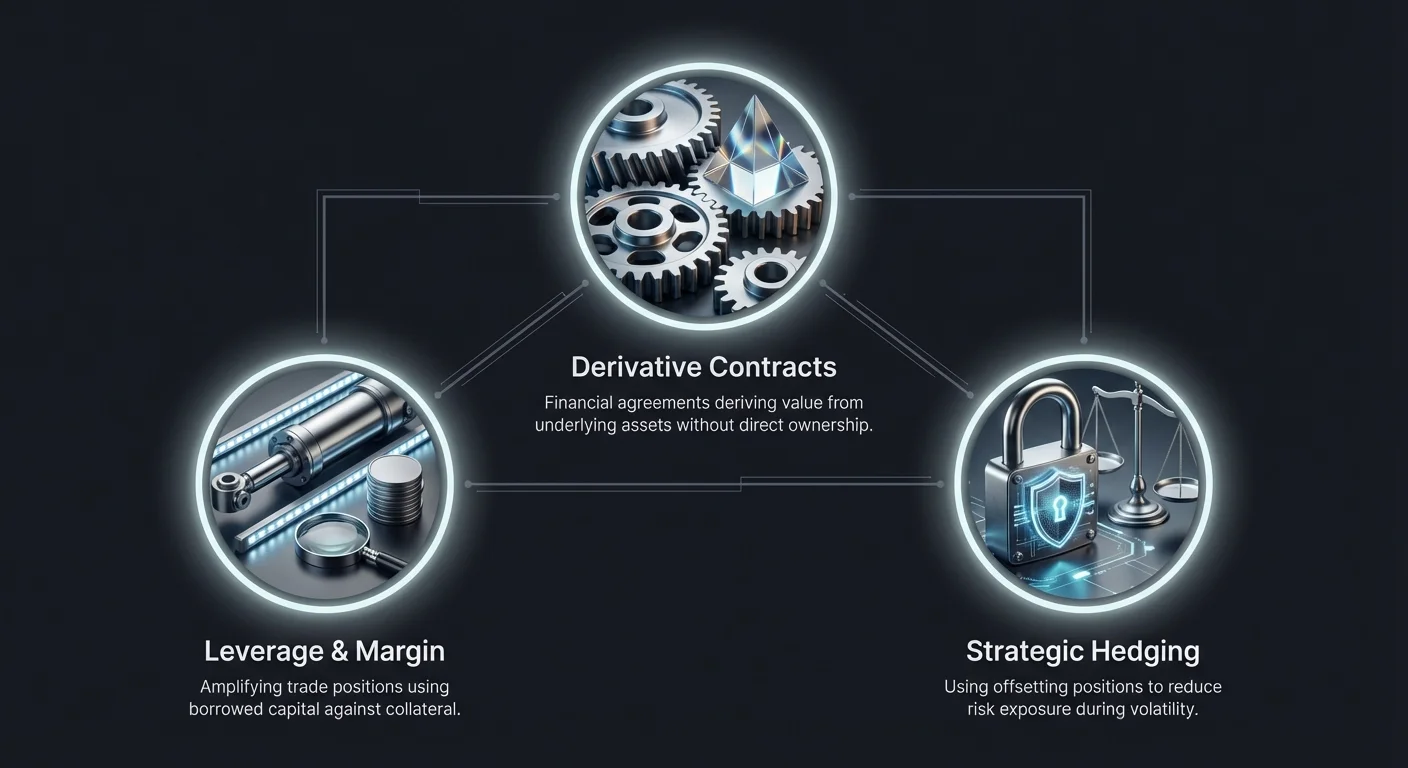
Derivatives are financial contracts between two or more parties that derive their value from an underlying asset, such as Bitcoin or Ethereum. Unlike spot trading, where immediate settlement occurs, derivatives involve agreements to buy or sell assets at future dates or under specific conditions. This structure introduces unique dynamics to the market, enabling strategies that are impossible with spot holdings alone. Understanding these instruments is essential for navigating advanced market conditions.
Traders utilize these instruments not just for speculation, but to construct portfolios that are resilient to volatility. By separating the financial exposure from the physical ownership of the asset, market participants can isolate specific risks. This capability is the foundation of modern financial engineering in the crypto space. It allows for strategies that can profit in bear markets or remain neutral while harvesting yields.
The Fundamentals of Crypto Derivatives
At the core of advanced trading lies the derivative contract. These instruments are distinct from the underlying asset but track its price performance. The most common types in the cryptocurrency market are futures, perpetual swaps, and options. Each serves a different purpose and carries a unique risk profile.
Futures contracts commit parties to transact an asset at a predetermined date and price. This rigidity provides certainty for miners or institutions looking to lock in prices for their future production or holdings. It eliminates the uncertainty of future market fluctuations for the hedger participant. However, for the speculator, it offers a way to bet on price movements without holding the coin.
Perpetual futures, often called "perps," modify the traditional futures model by removing the expiration date. This innovation allows traders to hold leveraged positions indefinitely, provided they maintain sufficient margin. To keep the contract price aligned with the spot market, perps utilize a funding rate mechanism. This periodic payment ensures convergence between the derivative price and the underlying asset price.
Options contracts introduce asymmetry to the trade. Unlike futures, which carry an obligation to transact, options grant the buyer the right, but not the obligation, to buy or sell. This requires an upfront payment known as a premium. The seller of the option takes on the obligation and collects the premium, effectively selling risk to the buyer.
| Instrument | Obligation | Expiry | Primary Cost |
|---|---|---|---|
| Futures | Yes | Fixed Date | Spread/Basis |
| Perpetual | Yes | None | Funding Rate |
| Options | No (for buyer) | Fixed Date | Premium |
Mechanics of Futures and Basis Trading
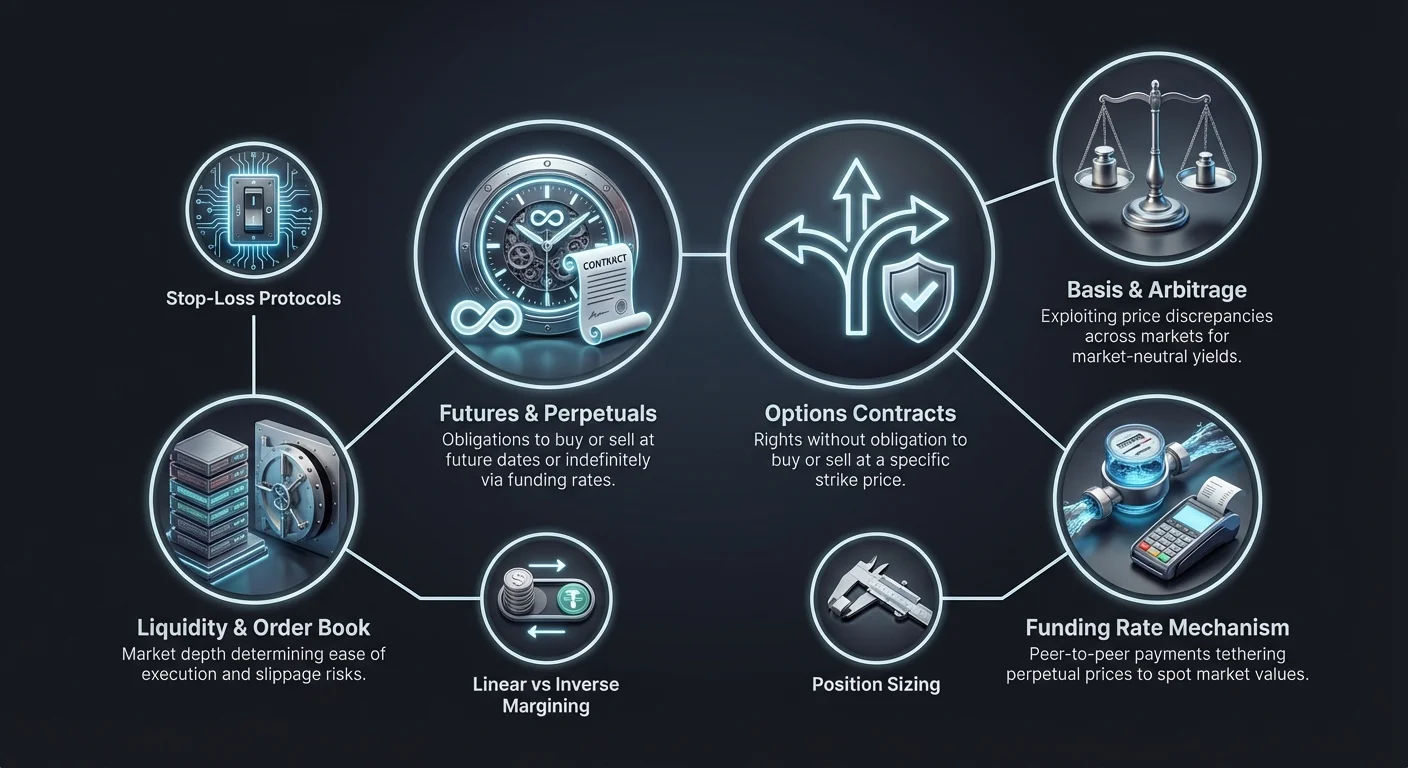
Traditional futures contracts rarely trade at the exact same price as the spot market. They typically trade at a premium or discount depending on market sentiment and the time remaining until expiration. This price difference is known as the "basis." Understanding the basis is critical for advanced traders.
When a futures contract trades higher than the spot price, the market is in a state often referred to as contango. This usually signals bullish sentiment, as traders are willing to pay a premium to lock in future exposure. Conversely, when futures trade below the spot price, the market is in backwardation, often indicating bearish sentiment or a shortage of immediate liquidity.
Basis trading involves exploiting these price discrepancies. A trader might buy the spot asset and simultaneously sell a futures contract trading at a premium. Since the futures price and spot price must converge at expiration, the trader can capture the spread as profit, regardless of market direction. This is a market-neutral strategy that relies on convergence rather than directional accuracy.
The profit in basis trading comes from the time value of money and the cost of carry. In a highly volatile crypto market, premiums can become significant, offering substantial yields to those willing to take the other side of the trade. This strategy effectively hedges out price risk while capturing the inefficiency between the two markets.
Perpetual Futures and the Funding Rate
Perpetual futures dominate crypto trading volume due to their flexibility. Without an expiry date, the mechanism that tethers the contract price to the spot price is the funding rate. This is a peer-to-peer payment exchanged between long and short traders, typically every eight hours.
When the perpetual contract trades above the spot price, the funding rate becomes positive. In this scenario, traders with long positions pay traders with short positions. This payment incentivizes longs to close positions and shorts to open positions, pushing the price down toward the spot level. It acts as a self-correcting mechanism to prevent price decoupling.
Conversely, if the contract trades below the spot price, the funding rate becomes negative. Short position holders must pay long position holders. This encourages shorts to close and longs to open, driving the price back up. Smart traders monitor these rates closely, as they represent a cost of holding a position or a potential revenue stream.
Strategies can be built entirely around harvesting funding rates. If funding is consistently positive, a trader can buy the spot asset and short the perpetual contract. The price movements cancel each other out, but the trader collects the funding payments from the short position. This is a form of arbitrage that seeks to generate yield from market bullishness.
Leverage and Margin Management
One of the defining features of derivatives trading is the ability to use leverage. Leverage allows traders to control a position size that exceeds their actual capital. For example, with 10x leverage, a trader can control $10,000 worth of Bitcoin with only $1,000 of collateral.
Leverage amplifies both profits and losses. A small percentage move in the underlying asset translates to a large percentage move in the trader's equity. While this can lead to rapid gains, it also introduces the risk of liquidation. If the market moves against the position, the exchange may close the trade to prevent the loss from exceeding the collateral.
Margin management is the primary skill required for survival in leveraged trading. Exchanges typically offer two modes: isolated margin and cross margin. Isolated margin allocates a specific amount of capital to a single trade. If that trade fails, only the allocated amount is lost, protecting the rest of the portfolio.
Cross margin utilizes the entire account balance as collateral for all open positions. This is useful for hedging, as profits in one position can offset losses in another, preventing premature liquidation. However, it carries the risk that a single disastrous trade could drain the entire account balance.
Effective leverage usage involves understanding the maintenance margin requirement. This is the minimum equity required to keep a position open. When equity falls near this level, a margin call occurs, requiring the trader to add funds or face liquidation.
Strategije kratke prodaje za padce trga
Kratka prodaja je praksa prodaje sredstva, ki ga oseba ne poseduje, z namenom ponovnega nakupa po nižji ceni. Ta strategija omogoča trgovcem dobiček iz padcev trga, kar zagotavlja način za generiranje donosov tudi v medvedjih trgih. Derivati so primarno vozilo za izvajanje kratkih strategij v kripto.
V kratkem trgovanju mehanika vključujeta izposojo sredstva (ali vstop v pogodbo, ki to simulira) in prodajo po trenutni tržni ceni. Če cena pade, trgovec ponovno kupi sredstvo po novi, nižji ceni za vrnitev izposojenega zneska. Razlika med prodajno in nakupno ceno predstavlja dobiček.
Kratka prodaja nosi drugačna tveganja v primerjavi z dolgimi pozicijami. Pri nakupu sredstva je maksimalna izguba omejena na vloženi znesek (če cena pade na ničlo). Vendar pri kratki prodaji je potencialna izguba teoretično neomejena, ker ni omejitve, kako visoko lahko cena sredstva naraste. Hitro zvišanje cene lahko prisili kratkoprodažnike k ponovnemu nakupu sredstev za zaprtje pozicij, kar cene še dodatno dviguje v »short squeeze«.
Trgovci uporabljajo kratko prodajo ne le za špekulacijo, temveč za zavarovanje obstoječih portfeljev. Če vlagatelj drži veliko količino altcoinov, vendar se boji kratkoročnega padca trga, lahko proda Ethereum ali Bitcoin za kompenzacijo potencialnih izgub. Če trg pade, dobički iz kratke pozicije pomagajo nevtralizirati devalvacijo sredstev na kovancih.
Options Trading: Calls and Puts
Options trading offers a non-linear payoff structure that differs from the linear gains and losses of futures. Options are contracts that give the holder the choice to execute a trade at a specific "strike price" on or before a certain date. There are two primary types: calls and puts.
A call option gives the buyer the right to purchase the asset. Traders buy calls when they expect the price to rise. If the market price exceeds the strike price at expiration, the option is profitable. If the price remains below the strike, the option expires worthless, and the trader only loses the premium paid.
A put option gives the buyer the right to sell the asset. Traders buy puts when they expect prices to fall or to protect a portfolio against downside. If the market price drops below the strike price, the put option gains value. This makes puts an excellent tool for insurance.
Options can be "American" or "European" style. American options can be exercised at any time before the expiration date, offering maximum flexibility. European options can only be exercised on the specific expiration date. Most crypto options platforms specify which style they utilize, affecting strategic planning.
Sellers of options, also known as writers, take on the obligation to fulfill the contract. They receive the premium as compensation for this risk. Option selling strategies are often used to generate income in sideways markets where prices are not moving significantly enough to justify directional trades.
Napredne tehnike zavarovanja
Zavarovanje je praksa zmanjševanja izpostavljenosti tveganjem z jemanjem nasprotne pozicije. V volatilnem svetu kriptovalut je zavarovanje ključno orodje za ohranjanje kapitala. Cilj zavarovanja ni nujno dobiček, temveč preprečevanje izgube.
Pogosto zavarovanje vključuje uporabo terminskih pogodb za zaščito portfelja na kovancih. Če trgovec poseduje 10 BTC in želi zaščititi pred potencialnim padcem brez prodaje sredstev (morda zaradi davčnih razlogov ali dolgoročne prepričanosti), lahko odpre kratko pozicijo enake vrednosti na trgu terminskih pogodb.
Če cena Bitcoina pade, sredstva na kovancih izgubijo vrednost, vendar kratka terminska pozicija pridobi vrednost. Ti dve gibi se izničita, kar učinkovito zaklene dolar vrednost portfelja ob času postavitve zavarovanja. Ta strategija učinkovito ustvari sintetično stabilcoin pozicijo z uporabo volatilnih sredstev.
Opcije ponujajo bolj dinamično obliko zavarovanja. Nakup zaščitnih putov omogoča trgovcu vzpostavitev »tla« za portfelj. Če cene strmoglavijo, put opcija poveča vrednost, kar kompenzira izgube na kovancih. Za razliko od zavarovanja z terminskimi pogodbami, ki omejuje potencial rasti, zaščitni put omogoča trgovcu še vedno sodelovanje v dobičkih, če trg naraste, minus strošek opcijske premije.
Arbitrage Opportunities in Crypto Derivatives
Arbitrage is the strategy of profiting from price differences of the same asset across different markets. The fragmented nature of the crypto landscape creates numerous arbitrage opportunities, particularly within the derivatives sector.
Funding rate arbitrage involves capitalizing on the difference between the perpetual contract price and the spot price. When funding rates are extremely high, arbitrageurs can buy spot and short the perpetual. They earn the funding rate yield with minimal price risk. This is often referred to as "cash and carry" in the perpetual market.
Cross-exchange arbitrage exploits price variances between different platforms. A futures contract might trade at a higher price on Exchange A than on Exchange B. A trader can short the contract on Exchange A and go long on Exchange B, capturing the spread. This requires careful management of transfer times and withdrawal fees.
Spot-futures arbitrage relies on the convergence of dated futures. If a quarterly futures contract is trading at a significant premium to spot, a trader buys spot and sells the future. They hold both positions until expiry, when the prices must match. This captures the basis spread as a guaranteed return, assuming counterparty risks are managed.
Risk Management Protocols
Engaging in advanced futures and options trading requires strict risk management protocols. The high volatility of crypto combined with leverage creates an environment where capital can be depleted rapidly. Successful traders focus as much on defense as they do on offense.
Stop-loss orders are the first line of defense. These are automated orders that close a position when the price reaches a specific level. A stop-loss prevents a manageable loss from turning into a catastrophic one. Trailing stops are a variation that moves the stop price up as the market moves in the trader's favor, locking in profits.
Position sizing is crucial. Traders should never risk a significant portion of their portfolio on a single leveraged trade. Calculating the risk per trade ensures that a string of losses does not result in ruin. This often involves determining the distance to the stop-loss and adjusting the position size so that the dollar loss is within acceptable limits.
Understanding liquidation prices is mandatory. Before entering a trade, a trader must know the exact price at which their collateral will be exhausted. Maintaining a buffer above this price is essential to avoid being wiped out by momentary wicks or "flash crashes" that are common in crypto markets.
| Risk Tool | Function | Best Use Case |
|---|---|---|
| Stop-Loss | Auto-close at loss | Preventing large drawdowns |
| Trailing Stop | Auto-adjusting stop | Locking in profits during trends |
| Take-Profit | Auto-close at gain | Securing target returns |
Vloga likvidnosti
Likvidnost se nanaša na sposobnost hitrega nakupa ali prodaje sredstva brez povzročanja znatnega vpliva na njegovo ceno. V trgovanju s derivati je likvidnost ključna. Določa enostavnost vstopanja in izstopanja iz pozicij, širino razpona ter natančnost izvedbe trgovanja.
Visoka likvidnost zagotavlja, da je vedno na voljo protistranka, pripravljena ujemati posel. V nelikvidnih trgih se lahko trgovec znajde v nemožnosti zapiranja pozicije med paničnim padcem trga ali trpi zaradi »zdrsa«, kjer je izvedena cena veliko slabša od pričakovane cene.
Za terminske pogodbe in opcije je likvidnost razdeljena glede na iztek pogodbe in izvedbeno ceno. Pogodbe »prednjega meseca« ali z najbližjim iztekom običajno imajo najvišjo likvidnost. Pogodbe z oddaljenim iztekom ali opcije z izvedbenimi cenami daleč od trenutne cene (globoko izven denarja) lahko imajo zelo tanke knjige naročil.
Trgovci morajo pred vstopom v velike pozicije oceniti globino knjige naročil. Pomanjkanje globine pomeni, da lahko tržno naročilo pomete skozi več nivojev cen, kar rezultira v slabi povprečni vstopni ceni. Napredni trgovci pogosto uporabljajo limitna naročila za zagotavljanje likvidnosti namesto njenega odvzemanja, kar pogosto vodi tudi v nižje strukture provizij.
Razumevanje trgovskih pristojbin in stroškov
Stroški v trgovanju z derivati segajo dlje od vidne cene sredstva. Pristojbine lahko znatno erodirajo dobičkonosnost, zlasti za visokofrekvenčne strategije ali vzvodne pozicije. Razumevanje strukture pristojbin platforme je sestavni del razvoja strategije.
Trgovskega pristojbine so običajno razdeljene na »maker« in »taker« pristojbine. Makerji so trgovci, ki postavijo limitna naročila v redno knjigo, dodajo likvidnost. Pogosto so nagrajeni z nižjimi pristojbinami ali celo povraćili. Takerji postavijo tržna naročila, ki se izvedejo takoj, odstranijo likvidnost. Običajno plačajo višje pristojbine.
V perpetual futures je funding rate spremenljiv strošek. Čeprav lahko je vir dohodka, lahko je tudi znaten strošek. Držanje pozicije proti večinski sentimentu (npr. biti dolg, ko je trg bikovski) običajno prinaša stroške fundinga. Sčasoma lahko ta plačila zmanjšajo neto dobiček posla.
Obrestovanje marže je še en dejavnik stroškov. Pri izposoji sredstev za kratko prodajo ali vzvode se obresti kopičijo sčasoma. To je posebej relevantno za trgovanje z maržo na spot trgih, kjer se obresti zaračunavajo na uro ali dnevno. Trgovci morajo izračunati, ali potencialni donos pretehta strošek izposoje kapitala.
Analiza trga za derivate
Analiza trga derivatov zahteva ogled podatkovnih točk, ki se razlikujejo od analize spot trga. Open Interest (OI) je ključna metrika. Predstavlja skupno število odprtih derivatnih pogodb, ki še niso poravnane.
Rастvi Open Interest, spremljan z rastmi cen, pogosto potrjuje močan vzpon, kar kaže, da nov denar vstopa na trg za podporo gibanju. Nasprotno, če cene rastejo, vendar Open Interest pada, lahko to nakazuje, da gib spodbudijo kratki pokrivki (kratki kupujejo nazaj za zaprtje) namesto agresivnih novih nakupov, kar potencialno signalizira šibek trend.
Razmerje dolg/krajši daje vpogled v tržno razpoloženje. Pokaže razmerje neto dolgih pozicij proti neto kratkim pozicijam. Ekstremne vrednosti v katero koli smer lahko delujejo kot kontra indikator. Če je trg pretežno dolg, lahko padec cen sproži kaskado likvidacij, znano kot »long squeeze«.
Implied Volatility (IV) je ključna za trgovce z opcijami. Meri pričakovanje trga glede prihodnjih cenovnih nihanj. Visoka IV poveča premije opcij, kar naredi nakup drag in prodajo lukrativno. Nizka IV nakazuje, da trg pričakuje stabilnost, kar naredi opcije cenejše za nakup.
Regulatory and Platform Safety
The venue chosen for trading derivatives introduces its own set of risks and considerations. Platforms range from fully regulated centralized exchanges to decentralized protocols running on smart contracts. Each has advantages and trade-offs regarding security and access.
Centralized exchanges generally offer higher liquidity, faster execution speeds, and customer support. However, they require users to deposit funds into custodial wallets, introducing counterparty risk. If the exchange fails or is hacked, user funds can be lost. These platforms also enforce strict KYC (Know Your Customer) and AML (Anti-Money Laundering) regulations.
Decentralized derivative platforms allow users to trade directly from their private wallets, maintaining custody of their assets. This eliminates centralized counterparty risk but introduces smart contract risk—the possibility of bugs or exploits in the code. Liquidity on decentralized platforms may be lower, and execution speeds are limited by the underlying blockchain's performance.
Regulatory environments vary globally. Some jurisdictions ban crypto derivatives entirely, while others have strict frameworks. Traders must ensure they are using platforms that are legally accessible in their region to avoid account freezes or legal complications.
Advanced Order Types
To execute complex strategies effectively, traders rely on advanced order types beyond simple buy and sell buttons. These tools allow for precision in entry and exit, automating responses to market movements.
Limit orders allow traders to set a specific price at which they are willing to buy or sell. The trade will only execute if the market reaches that price. This guarantees the price but not the execution. If the market never reaches the limit, the trade is missed.
Market orders execute immediately at the best available price. They guarantee execution but not the price. In volatile markets, the final price might differ significantly from the last displayed price due to slippage.
Stop-limit orders combine the features of a stop loss and a limit order. When the stop price is triggered, a limit order is placed. This gives the trader control over the execution price after a trigger event, preventing a stop loss from filling at a disastrous price during a flash crash, though it risks the order not filling at all.
Psihologija trgovanja z vzvodi
Uvedba vzvoda znatno spremeni psihološko podobo trgovanja. Pojačanje dobičkov in izgub lahko sproži povišane čustvene stanja, ki vodijo v iracionalno odločanje. Strah in pohlep sta povečana, ko so vložki višji.
Preveliko vzvajanje je najpogostejša psihološka past. Skrivnost, da majhno količino kapitala hitro spremenite v bogastvo, pogosto vodi trgovce k pretiranemu tveganju. Ko je pozicija močno vzvita, celo običajni tržni »šum« izgleda kot velik preobrat trenda, kar povzroči panično prodajo ali predčasno zapiranje pozicij.
Potrditvena pristranskost je lahko nevarna na trgih derivatov. Trgovci lahko ignorirajo podatke, ki nasprotujejo njihovi smeri, še posebej, če so finančno zavezani k vzviti poziciji. Ohranjanje objektivnosti zahteva disciplino in strogo spoštovanje predhodno določenega trgovalnega načrta.
Uspešni trgovci z derivati trgovanje pogosto obravnavajo kot posel, ne kot kockanje. Osredotočajo se na verjetnosti in razmerja tveganje-dobiček namesto na absolutni dolarjev znesek potencialnega dobička. Čustvena odmaknjenost od posameznih trgov omogoča boljše dolgoročno odločanje.
Scalping and Swing Trading with Derivatives
Derivatives are versatile tools used by traders across different timeframes. Two popular approaches are scalping and swing trading, each requiring different strategies and risk management techniques.
Scalping involves making numerous trades throughout the day to capture small price movements. Scalpers often use high leverage to magnify these small gains. Perpetual futures are ideal for scalping due to their high liquidity and low fees for maker orders. Speed is of the essence, and scalpers rely heavily on technical analysis and order flow data.
Swing trading focuses on capturing larger moves that play out over days or weeks. Swing traders are less concerned with minute-by-minute fluctuations and more focused on broader trends. They typically use lower leverage than scalpers to withstand intraday volatility without being liquidated.
Swing traders often utilize dated futures or options. Dated futures allow them to take a position without worrying about fluctuating funding rates that might eat into profits over time. Options allow swing traders to position for a move with a defined risk (the premium) while keeping exposure open for the duration of the contract.
Contract Trading Specifications
Every derivative instrument has a contract specification that defines its rules. Traders must understand these details to avoid costly mistakes. Key specifications include the contract size, tick value, and settlement method.
Contract size refers to the amount of the underlying asset covered by a single contract. For example, one Bitcoin futures contract might represent 1 BTC, or it might be a "micro" contract representing 0.1 BTC. This determines the minimum position size and the granularity of position management.
Tick value is the minimum price movement allowed for the contract and the value of that movement per contract. Understanding this helps in calculating potential profit and loss. If the tick size is $0.50, the price moves in $0.50 increments.
Settlement method is crucial. Contracts can be physically settled or cash-settled. In physical settlement, the trader actually receives the cryptocurrency upon expiration. In cash settlement, the profit or loss is credited to the account in stablecoins or the base asset, but no actual exchange of the underlying asset occurs. Most crypto derivatives are cash-settled.
Inverse vs. Linear Contracts
Crypto derivatives come in two primary distinct structures regarding how margin is posted and how profits are paid out: inverse contracts and linear (or vanilla) contracts.
Inverse contracts are margined in the cryptocurrency itself (e.g., BTC-margined). The trader deposits Bitcoin to trade Bitcoin futures. If the price of Bitcoin rises, the value of the collateral rises, and the trader earns more Bitcoin. This provides a compounding effect in a bull market. However, in a bear market, the value of the collateral drops while losses are incurred, increasing liquidation risk.
Linear contracts are margined in stablecoins like USDT or USDC. The profit and loss are calculated in stablecoins. This structure is more intuitive for traders accustomed to fiat markets. It makes calculating returns easier and protects the collateral value during market downturns.
Linear contracts have become the industry standard for many retail traders due to their simplicity. They allow traders to keep their powder dry in stable assets during volatility. Inverse contracts remain popular among miners or long-term holders who want to accumulate more of the specific coin regardless of its dollar value.
Zaključek
Pokrajina trgovanja s kriptovalutami ponuja globino finančnih instrumentov, ki tekmuje s tradicionalnimi trgi. Od neprekinjene likvidnosti perpetualnih swapov do strateške asimetrije opcij ti orodji omogočajo trgovcem, da z natančnostjo krmarijo skozi volatilnost. Napredne strategije, kot sta trgovanje z bazami in arbitraža stopenj financiranja, pretvorijo tržne neučinkovitosti v priložnosti, kar omogoča generiranje donosa prek preproste špekulacije o ceni.
Vendar moč vzvoda in kompleksnost derivatnih struktur zahtevata discipliniziran pristop k upravljanju tveganj. Mehanizmi likvidacije, stopenj financiranja in specifikacij pogodb ustvarjajo strmo učno krivuljo, kjer se napake kaznujejo finančno. Uspeh na tem področju zahteva ne le mnenje o smeri gibanja cene, temveč popolno obvladovanje instrumentov, ki se uporabljajo za izražanje tega mnenja. Obvladovanje teh konceptov udeležencem na trgu omogoča prehodek od pasivnega zadrževanja do aktivnega upravljanja portfelja.
Derivati so močna orodja, ki ločijo finančno izpostavljenost od lastništva sredstev, kar omogoča natančno upravljanje tveganj in generiranje dobička v katerih koli tržnih razmerah.