
Solana burst onto the blockchain scene promising speed—a monumental shift from the often slow, expensive transaction environments of earlier networks. While Bitcoin pioneered digital scarcity and Ethereum introduced smart contracts, Solana focused on scaling transaction velocity to an industrial level, achieving speeds that rival centralized financial infrastructure.
For newcomers, this speed is exciting, offering instantaneous swaps and rapid interaction with decentralized applications (dApps). For advanced users and financial professionals, however, Solana’s architecture presents a distinct set of operational challenges and opportunities. Operating in a high-throughput environment requires a different strategic approach, particularly regarding transaction timing, failure mitigation, and system stability.
This guide moves beyond the basics of "what is Solana?" to analyze the operational complexities inherent in its high-speed design. We will explore the parallel processing mechanics that make this speed possible and, crucially, detail the risks—such as latency, maximal extractable value (MEV), and network congestion—that practitioners must understand to build effective, low-risk strategies within this dynamic ecosystem.
Understanding Solana's Engine: Parallel Processing
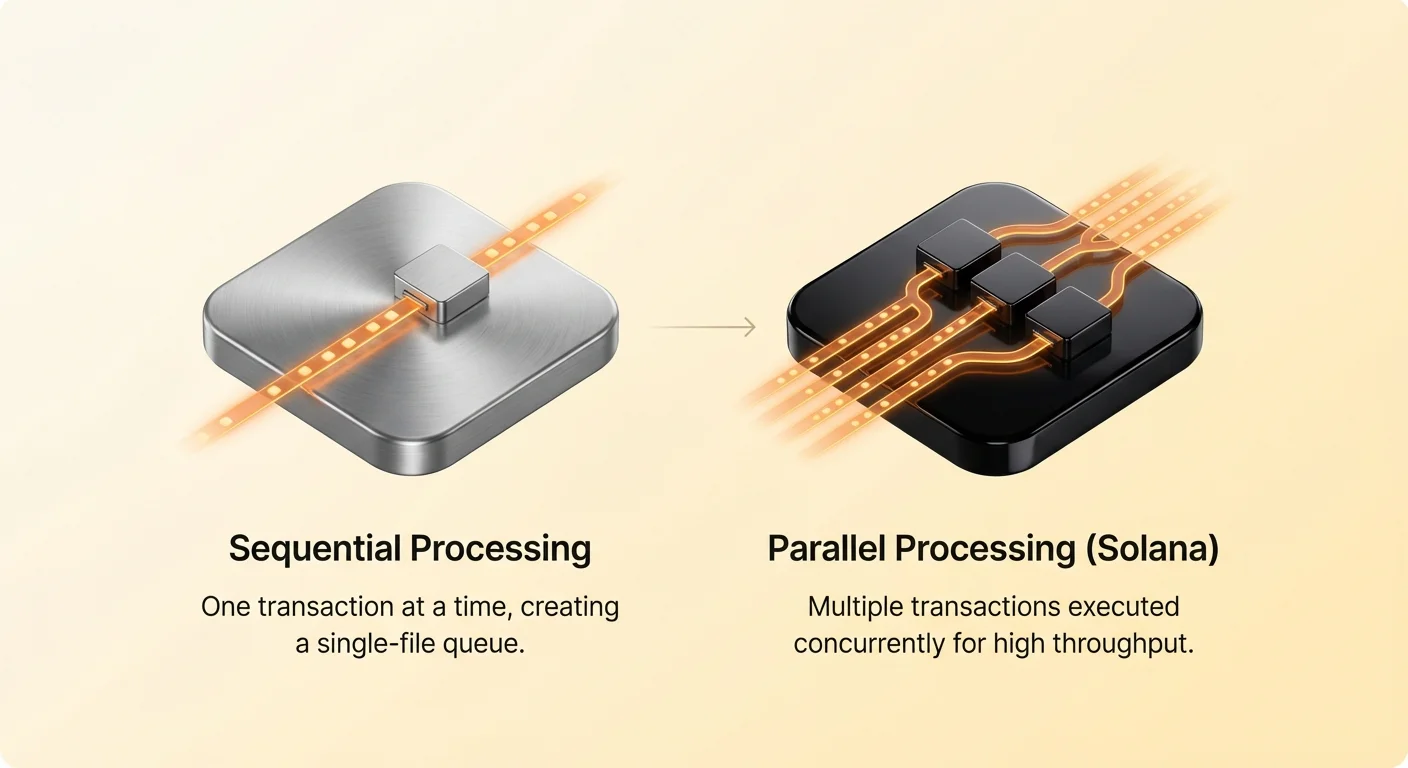
Most traditional blockchains process transactions sequentially: Transaction A must fully complete before Transaction B can begin. Imagine a single checkout line at a busy supermarket; everyone waits in one queue. Solana radically alters this paradigm through its parallel processing capabilities, drastically improving throughput (the sheer number of transactions handled per second).
This ability to execute multiple actions simultaneously is the core innovation that enables Solana’s speed, but it requires developers and users to think differently about how transactions interact.
The Difference Maker: Sealevel
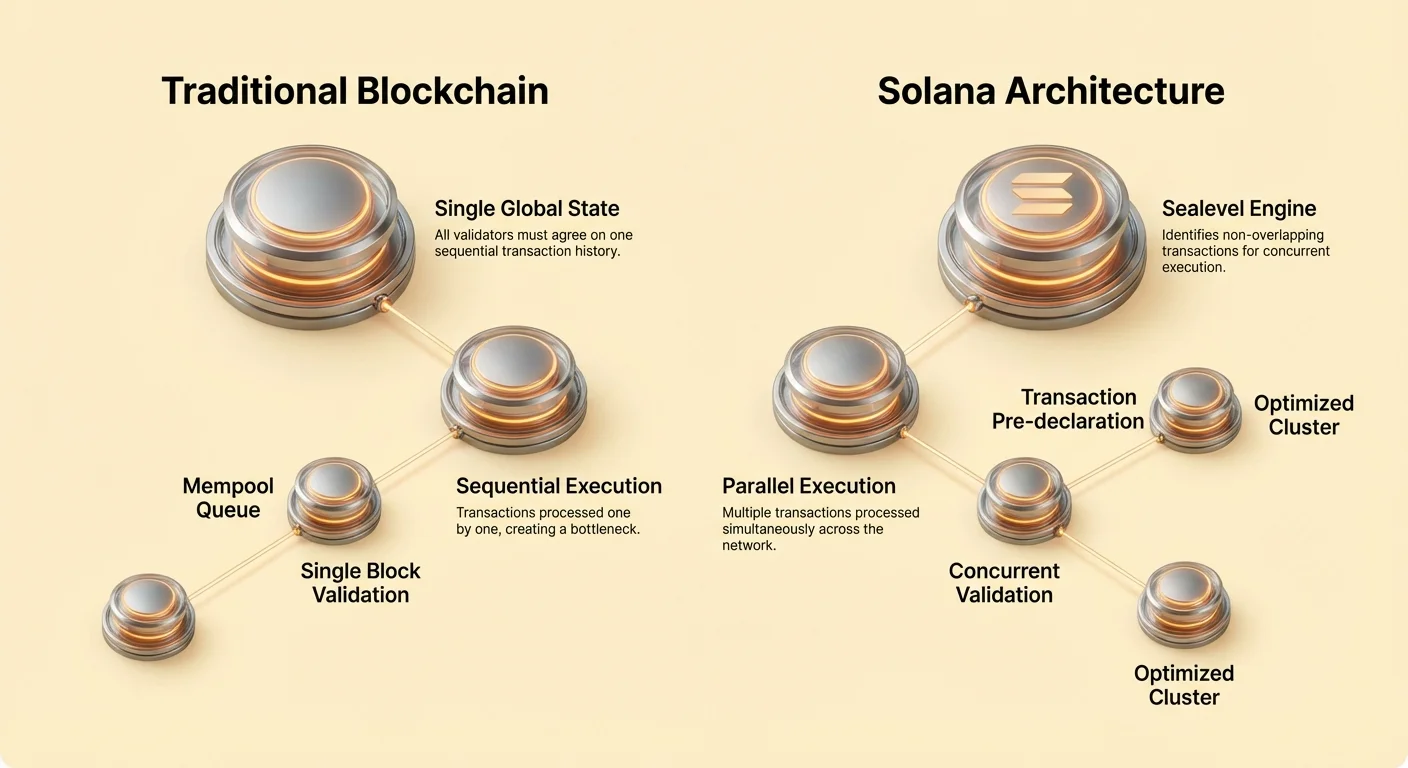
The backbone of Solana’s parallel processing is an execution engine called Sealevel. In essence, Sealevel allows the network to identify non-overlapping transactions and execute them concurrently.
How does it achieve this? When a transaction is submitted to the Solana network, it must explicitly declare which accounts (or pieces of the blockchain state) it intends to read from and write to.
Example: Imagine two DeFi users executing swaps at the exact same moment:
- User A: Trades SOL for USDC. (Interacts only with the SOL and USDC pools).
- User B: Trades ETH for BONK. (Interacts only with the ETH and BONK pools).
Because these two transactions do not touch the same underlying state (they use different pool accounts), Sealevel recognizes them as independent and processes them simultaneously. If User A and User B were both trading the exact same pool pair, they would have to be processed sequentially to prevent data inconsistencies (like double-spending). This pre-declaration mechanism is what allows the network’s resources to be used far more efficiently than chains that must assume every transaction depends on the previous one.
The Role of Cluster Optimization and Validators
The Solana network is often referred to as a "cluster," which consists of many decentralized computers (validators) working together. These validators are responsible for receiving, verifying, and adding transactions to the ledger.
For high-throughput execution, the role of the validator becomes critical. Validators utilize a leader rotation system, where a specific validator is elected as the "leader" for a fixed period (called a slot) to compile the block. Optimized hardware and excellent connectivity are essential for validators to handle the enormous flow of data and execute the parallel transactions efficiently.
From a strategic perspective, understanding cluster health means recognizing that transactions are not just verified once; they must achieve finality across the entire cluster. Any degradation in validator performance or connectivity can impact the speed and reliability of confirming transactions, even if the overall system is technically fast.
The Mechanics of High-Speed Transactions
In a typical crypto environment, a transaction is confirmed if it is included in a block. On Solana, confirmation happens rapidly, but getting the transaction included quickly during peak demand requires sophisticated knowledge of the fee market and the way transactions are handled by the leader.
Latency and Congestion Management
Latency—the delay between submitting a transaction and it being received and processed by the validator leader—is the primary bottleneck for high-frequency trading (HFT) on Solana.
In a physical sense, if a trader is located geographically closer to the validator leader, their transaction will arrive faster. While the speed of light limits this, server proximity to key validator hubs is a real factor in HFT strategies.
However, the more frequent risk is network congestion. Despite high overall throughput, sudden bursts of activity (such as a popular new token launch or an unexpected liquidation event) can overwhelm the network’s ability to process all incoming messages instantaneously. When this happens, validators prioritize transactions based on fee structure and resource consumption.
Transaction Fees and Priority Fees
Unlike Ethereum, which primarily uses a monolithic gas fee based on complexity, Solana uses a low, fixed base fee plus an optional priority fee.
For the everyday user, the base fee is usually negligible. For the high-throughput strategist or HFT participant, the priority fee is essential. When congestion hits, transactions without adequate priority fees are likely to be dropped or delayed by the validator leader, resulting in failure.
Actionable Tip: Priority Fee Calculation When designing an automated trading strategy or executing a time-sensitive swap, the priority fee must be dynamically adjusted based on current network load. A competitive strategy involves analyzing recent blocks to determine the prevailing priority fee required for immediate inclusion. Blindly submitting low-fee transactions during peak volatility guarantees transaction failure risk.
Solana Transaction Failure Risk: This refers to the high probability of a submitted transaction failing to confirm (being dropped by the leader) due to network congestion or insufficient priority fees, despite the network itself not being technically "down."
Identifying and Mitigating Transaction Failure Risk
The biggest challenge in working with high-throughput systems like Solana is managing the rate of transaction failure. Because the network allows for such massive volume, a sudden spike in demand can temporarily flood the pipeline, leading to a high rejection rate for improperly constructed or under-funded transactions.
Analyzing Failure Modes
A failed Solana transaction can happen for several reasons, and identifying the cause is crucial for optimization:
- Resource Overload (Congestion): The validator leader’s buffer is full, and the transaction was dropped because it wasn't prioritized (low priority fee).
- Invalid State (State Conflict): The transaction attempted to write to an account that was changed by a previously confirmed transaction in the same block. This often happens in automated systems that execute multiple actions based on stale data.
- Simulation Failure (Execution Error): The transaction failed during the initial simulation phase because it lacked sufficient SOL for rent or fees, or the specified instructions were flawed (e.g., trying to swap from an empty account).
- Transaction Expiration: The transaction took too long to reach a final confirmation and expired based on its specified blockhash lifespan.
Cluster Transaction Optimization
To minimize failure, developers and advanced users must optimize their transactions at the structural level. This is where the concept of "cluster transaction optimization" comes into play:
- Jito Bundling: Tools and services focused on MEV mitigation (discussed below) often allow users to "bundle" transactions, giving them preferential inclusion treatment by certain validators for a fee.
- Recent Blockhash Management: Solana transactions require a recent blockhash to prevent replay attacks. However, a transaction expires if the referenced blockhash is too old. Strategies must involve aggressively updating the blockhash before submitting, especially in HFT scenarios where speed is paramount.
- Custom RPC Nodes: Relying on public Remote Procedure Call (RPC) nodes—the endpoints used to submit transactions—introduces significant latency. Advanced strategies demand dedicated, low-latency, or geographically optimized RPC connections to ensure the transaction reaches the validator leader as fast as possible.
Advanced Strategy: Navigating Latency and MEV
For financial operators accustomed to traditional markets, Solana offers fertile ground for high-frequency strategies. However, these strategies must contend with the unique decentralized challenges of latency and Maximal Extractable Value (MEV).
Defining MEV in a High-Speed Environment
Maximal Extractable Value (MEV) is the profit that can be extracted by validators (or searchers collaborating with validators) through their ability to arbitrarily include, exclude, or reorder transactions within a block.
On slow, sequential chains, MEV often takes the form of "sandwich attacks" (front-running a large swap). On Solana, the concept is amplified by speed. The window of opportunity is milliseconds.
Solana High Frequency Trading (HFT): HFT on Solana is less about manual execution and more about highly sophisticated bots that monitor the mempool (the queue of pending transactions) and calculate the optimal priority fee and timing to execute an action (arbitrage, liquidations) before anyone else. This competition fuels the rise in priority fees during volatile periods.
Strategies to cope with MEV include:
- Using MEV-Resistant Infrastructure: Employing wallets and protocols that route transactions through validators that promise not to front-run or sandwich users (often leveraging specialized RPCs).
- Private Transactions: Submitting transactions directly to a block-builder (if available on the specific implementation) rather than broadcasting them publicly to the mempool, thereby concealing the trade intent from front-running bots.
Practical Steps for Reducing Latency
Latency reduction is the key competitive edge in high-throughput crypto ecosystems.
- Geographic Proximity: If operating an automated trading system, ensuring the server running the bot is physically close to the primary validator cluster location can shave off critical milliseconds.
- Infrastructure Scaling: Utilizing powerful, dedicated hardware for RPC nodes that can handle rapid, persistent connections without throttling. Throttling is a common issue with public nodes when dealing with high-frequency submission volumes.
- Efficient Code Execution: Smart contracts (programs) must be written with parallel processing efficiency in mind. Developers should strive to minimize cross-program invocations and ensure the instructions are as lightweight as possible to minimize execution time on the validator. The faster the transaction executes, the quicker it achieves finality.
System Stability and Network Health Analysis
Solana’s commitment to high speed has historically led to trade-offs regarding network stability. While reliability has improved significantly, strategists must maintain awareness of system health, as temporary outages or severe congestion events can halt automated processes and impact self-custody operations.
Analyzing Network Downtime
When a traditional blockchain experiences extremely high demand, the primary user impact is high fees and slow transaction times. When Solana has historically faced stress tests, the outcome has sometimes been a temporary halt of block production, often referred to as downtime.
The root cause of these outages is typically not a malicious attack, but a failure of the parallel processing architecture to handle an unprecedented, sustained flood of data or specific instruction types. For example, a sudden influx of unoptimized, resource-intensive transactions can overwhelm validator memory or processing limits, causing the network to lag and ultimately require a restart (a coordinated effort by validators).
Risk Mitigation for Strategists:
- Diversified Infrastructure: Do not rely solely on Solana for time-critical operations. If market events (like major liquidations) are anticipated, hold assets on multiple chains or centralized exchanges as a contingency.
- Health Monitoring: Implement real-time monitoring of key network metrics, including the current transaction per second (TPS) count, current block height, and slot progression. A slowdown in slot progression is an early indicator of impending congestion or stress.
Decentralization vs. Throughput Trade-offs
Solana's architecture requires powerful, well-connected validators to maintain its high throughput. This requirement can create a centralizing pressure, as fewer entities possess the resources necessary to run competitive nodes.
From a self-custody and risk management perspective, understanding this trade-off is essential:
- Custody Risk: While speed is attractive for trading, self-custody adopters should be aware that a network relying on a smaller pool of high-resource validators introduces a different profile of systemic risk compared to networks that prioritize extreme validator diversity (even if slower).
- Security Through Speed: Solana’s argument is that its speed enables a secure, high-utility environment, preventing certain congestion-related attacks seen on slower chains. However, users must weigh the benefits of rapid finality against the technical complexity required for stable validation.
For the user, the best practice is to support multiple, geographically dispersed validators via staking, ensuring the network remains robust even if single points of failure arise.
Conclusion
Solana represents a paradigm shift in blockchain architecture, providing the throughput necessary for complex financial applications and high-frequency trading. However, this speed is not a passive advantage; it requires proactive strategic management.
To succeed in this ecosystem, users must master the mechanics of parallel processing, aggressively manage latency risks, and adopt dynamic strategies for priority fees. The key differentiator between a novice user and an advanced operator on Solana lies in the ability to anticipate and navigate the high rate of potential transaction failure caused by network congestion and MEV competition.
By understanding the technical underpinnings of Sealevel, optimizing transaction structure, and maintaining constant vigilance over network health, practitioners can effectively leverage Solana's high-throughput capabilities to build robust, competitive strategies in the new digital economy.