
The landscape of digital asset trading has evolved significantly beyond simple buy and sell orders. Modern investors and traders increasingly seek platforms that offer more than just exchange services. They demand robust ecosystems capable of generating yield, providing deep liquidity, and ensuring asset security through advanced technological frameworks.
These sophisticated environments, often referred to as trading hubs, integrate various financial services into a single interface. They bridge the gap between traditional financial mechanisms and the innovative potential of decentralized finance. Understanding the mechanics of these platforms is essential for anyone looking to maximize capital efficiency in the crypto market.
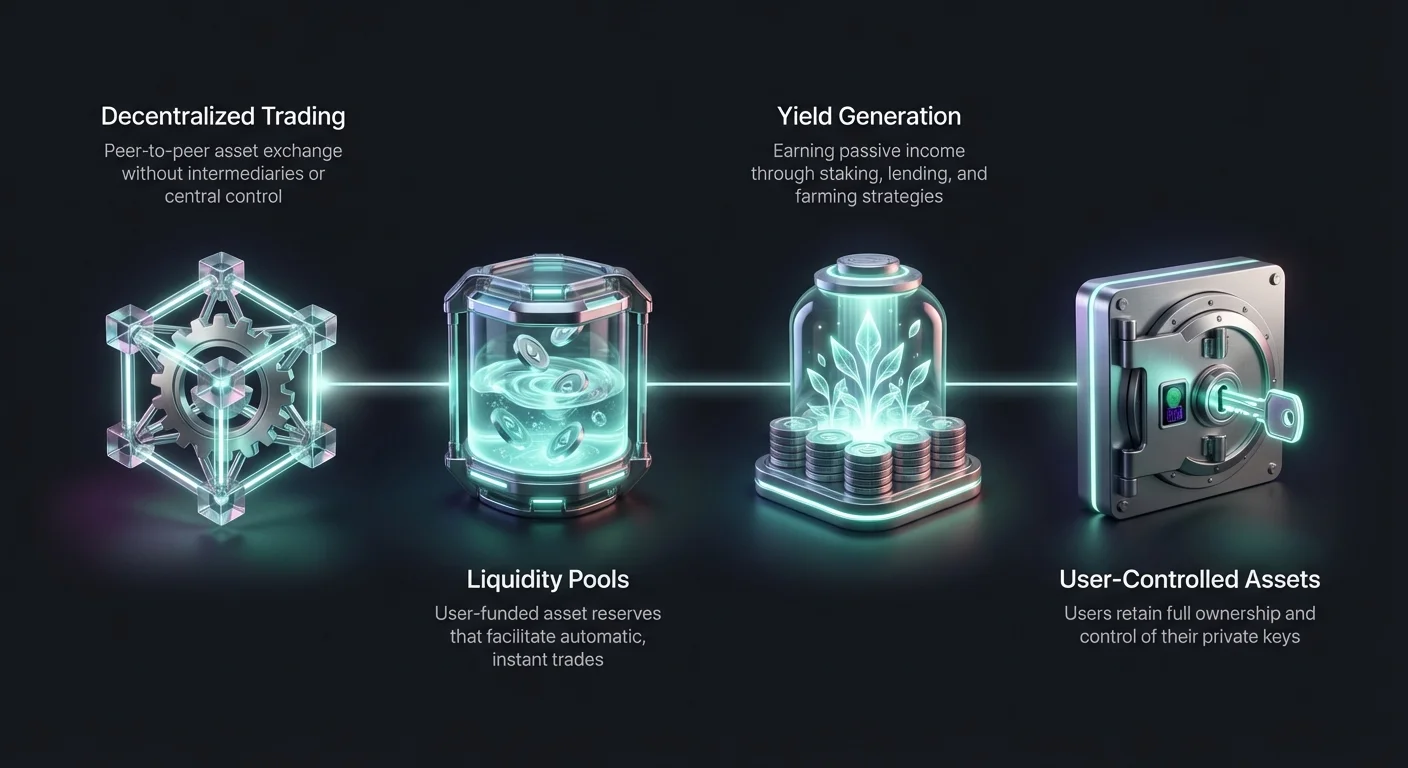
The shift toward decentralized exchange (DEX) platforms represents a fundamental change in how liquidity is managed. Unlike their centralized counterparts, these hubs rely on peer-to-peer protocols and smart contracts. This structure allows for direct interaction between participants, removing the need for intermediaries and often reducing the friction associated with asset transfers.
As the market matures, the distinction between simple trading terminals and comprehensive financial hubs becomes clearer. Advanced platforms now incorporate lending, borrowing, staking, and liquidity provision directly into the trading experience. This integration allows users to put their idle assets to work, generating passive income streams while maintaining exposure to market movements.
The Evolution of Decentralized Trading
Decentralized exchanges have transformed from experimental protocols into essential infrastructure for the crypto economy. Early iterations were often slow and difficult to use, suffering from low liquidity and complex interfaces. Today, high-performance DEXs rival centralized exchanges in speed and user experience while maintaining the core ethos of decentralization.
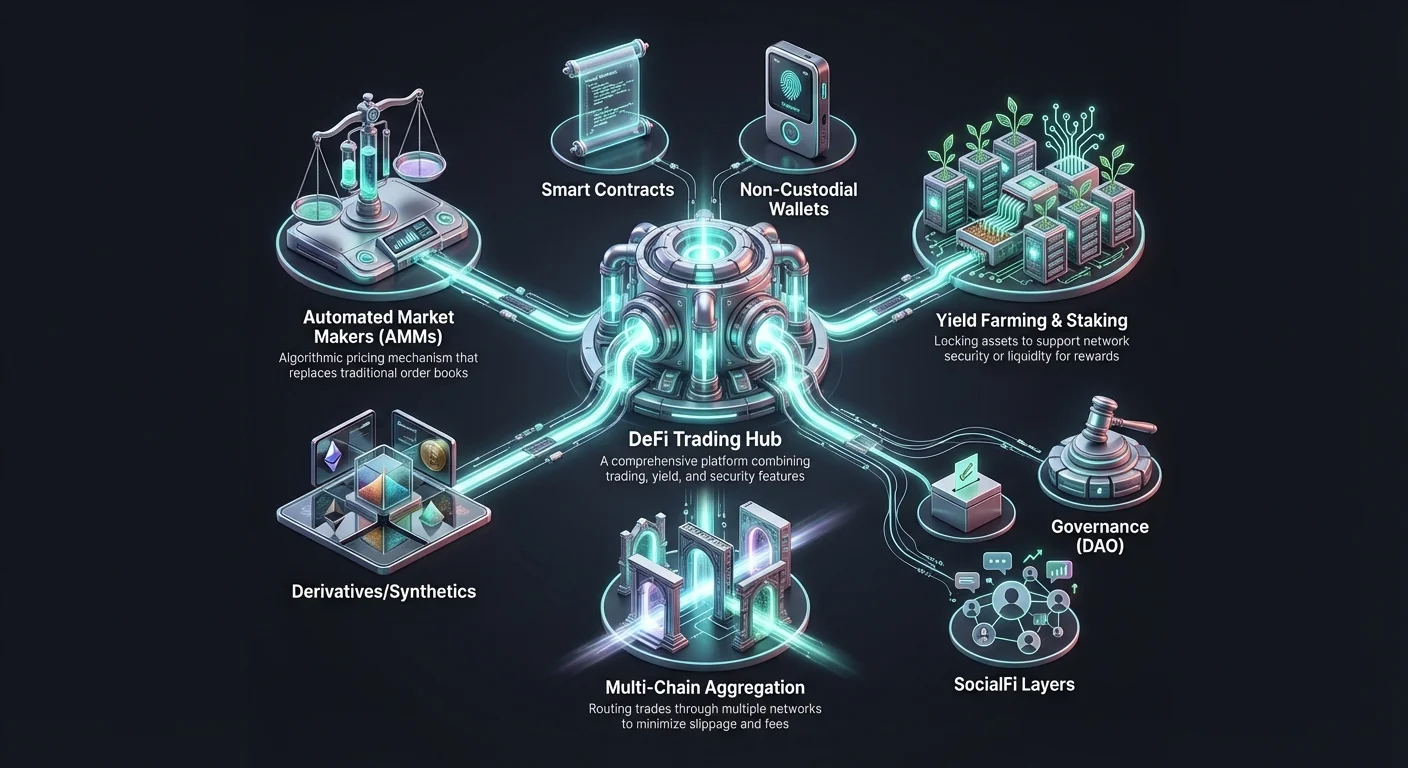
The primary driver of this evolution is the development of Automated Market Makers (AMMs). These systems replaced traditional order books with liquidity pools, allowing digital assets to be traded automatically using a pricing algorithm. This innovation solved early liquidity issues by incentivizing users to deposit funds into pools in exchange for trading fees.
Current iterations of DEX platforms, such as those built on Layer-2 networks, offer lightning-fast transactions and negligible fees. For instance, platforms utilizing the Base network demonstrate how scaling solutions can enhance the user experience. These hubs combine the security of the main Ethereum chain with the efficiency required for high-frequency trading and micro-transactions.
Furthermore, the user interface of decentralized platforms has improved dramatically. Modern DEXs often feature intuitive dashboards that rival top-tier financial apps. They provide clear data visualization, easy wallet connection, and streamlined transaction processes. This accessibility has lowered the barrier to entry, allowing a broader range of participants to engage with DeFi protocols.
| Feature | Early DEXs | Modern Trading Hubs |
|---|---|---|
| Liquidity Source | Thin Order Books | Deep AMM Pools |
| Speed | Block-time Dependent | Instant L2 Execution |
| User Interface | Developer Focused | Consumer Friendly |
Understanding Liquidity Provision Mechanics
Liquidity is the lifeblood of any trading platform. In the context of advanced DeFi hubs, liquidity provision is a participatory activity rather than a service provided solely by institutions. Users who deposit their assets into smart contracts act as liquidity providers (LPs), facilitating trades for other market participants.
When a trader executes a swap on a DEX, they are trading against the funds held in a liquidity pool. The smart contract automatically adjusts the price of the assets in the pool based on the ratio of tokens remaining. This mechanism ensures that there is always a counterparty for a trade, provided there is sufficient liquidity in the pool.
In return for locking their assets, LPs earn a portion of the trading fees generated by the pool. This creates a symbiotic relationship where the platform gains the liquidity needed for smooth operations, and users generate yield on their holdings. The depth of liquidity directly impacts the efficiency of the market, reducing slippage and ensuring stable pricing for large orders.
However, liquidity provision comes with specific risks, primarily impermanent loss. This occurs when the price of the deposited assets changes relative to when they were deposited. Advanced trading hubs often provide tools and analytics to help LPs track this metric. They may also offer incentivized pools where additional tokens are distributed to offset potential losses and boost overall yield.
Yield Farming and Staking Opportunities
Yield generation in DeFi goes beyond simple fee sharing. Advanced trading hubs act as gateways to a variety of earning strategies, collectively known as yield farming. This involves moving assets between different protocols to maximize return on investment.
Staking is a foundational component of yield generation. It involves locking up a specific cryptocurrency to support the security and operations of a blockchain network. In return, stakers receive rewards in the form of additional tokens. Many trading hubs simplify this process, allowing users to stake directly from their interface without managing complex technical requirements.
Flexible savings products are another feature found in sophisticated trading environments. These allow users to deposit assets and earn interest while retaining the ability to withdraw funds at any time. This flexibility is crucial for traders who need to maintain liquidity for market opportunities while still earning a return on idle capital.
Some platforms have introduced "vault" mechanisms. These are automated strategies that manage asset allocation to optimize yield. A vault might automatically reinvest earnings, shift capital between lending protocols to find the best rates, or employ hedging strategies. This automation democratizes access to sophisticated financial strategies that were previously available only to professional fund managers.
Vzpon negostujočega trgovanja
Načelo »ni tvoji ključi, ni tvoji kovanci« ostaja osrednji tenet kriptovalutne filozofije. Negostujoča trgovalna središča se tega držijo z zagotavljanjem, da platforma nikoli ne prevzame v posest uporabniških sredstev. Trgovanje se izvaja neposredno iz uporabnikove denarnice prek pametnih pogodb.
Ta model znatno zmanjša tveganje izgube sredstev zaradi vdorov v izmenjavo ali slabega upravljanja. Ker izmenjava ne drži uporabniških sredstev, ni centralnega medula za napadalce. Uporabniki ohranjajo popoln nadzor in lastništvo svojih sredstev ves čas, z protokolom interagirajo le v trenutku transakcije.
Platforme, kot sta Swapuz in ChangeNOW, ponazarjata ta pristop. Omogočata izmenjavo tisočih digitalnih sredstev brez zahteve po ustvarjanju računov ali depozitu sredstev v denarnico platforme. Sistem usmeri trgovanje po najbolj učinkoviti poti in dostavi zamenjane žetone neposredno v ciljno denarnico uporabnika.
Ta arhitektura tudi izboljša zasebnost. Ker ni računov za upravljanje, je zbiranje osebnih podatkov minimizirano. Uporabniki lahko sodelujejo v finančnih aktivnostih brez razkrivanja občutljivih osebnih informacij, kar je v skladu z vrednotami zasebnosti, osredotočenimi na blockchain skupnost.
Multi-Channel Exchange Systems
To handle the fragmentation of liquidity across different blockchains, advanced hubs employ multi-channel exchange systems. These systems act as aggregators, scanning multiple liquidity sources to find the best rates for a trade. This ensures that users receive the most efficient execution regardless of which blockchain the assets reside on.
Cross-chain compatibility is a critical feature of these systems. Early DeFi ecosystems were often siloed, making it difficult to move value between networks like Ethereum, Solana, and Bitcoin. Modern hubs integrate bridges and cross-chain protocols, allowing for seamless swaps between disparate blockchain architectures.
The technology behind these swaps is complex. It involves monitoring pricing across hundreds of decentralized exchanges and routing orders through the path of least resistance. For the user, this complexity is abstracted away. They simply select the input and output tokens, and the system handles the intricate routing in the background.
This interconnectivity creates a more unified market. It prevents price disparities between networks and ensures that liquidity can flow freely across the entire crypto ecosystem. For yield seekers, this means access to opportunities on emerging networks without the technical headache of manually bridging assets.
Social Layers in Trading Platforms
The integration of social features into trading platforms represents a new frontier in DeFi. Known as "SocialFi," this trend combines financial speculation with social interaction. Platforms like BaseApp are redefining user engagement by merging wallet functionality, trading, and content creation into a single application.
In these ecosystems, users can interact with each other, share trading strategies, and even tokenize their content. A creator might earn rewards based on the engagement their posts receive, or a trader might gain a following by sharing successful portfolio moves. This adds a layer of community vetting to trading strategies.
Copy trading is a specific application of this social layer. It allows less experienced users to automatically replicate the trades of seasoned investors. This feature is common in hybrid and centralized hubs but is increasingly appearing in decentralized contexts. It democratizes access to expert knowledge and allows successful traders to monetize their skills.
These platforms often feature encrypted messaging and community groups. This fosters a collaborative environment where information flows freely. In a market driven by information and sentiment, having direct access to a community of peers can provide a significant competitive advantage.
Security Protocols in DeFi Hubs
Security is the cornerstone of any financial platform. In the absence of a central authority, decentralized hubs must rely on code auditability and robust architectural design to protect users. Smart contract risk is the primary concern in DeFi, necessitating rigorous testing and third-party audits.
Leading platforms employ multi-signature wallets for protocol management. This requires multiple key holders to approve any changes to the system, preventing a single compromised administrator from altering the code maliciously. This distribution of control is essential for maintaining the trustless nature of the system.
Time-locks are another security feature used by advanced hubs. When a change to the protocol is proposed, it enters a waiting period before execution. This gives the community time to review the change and withdraw their funds if they disagree with the new direction or identify a potential security flaw.
Additionally, many platforms now incorporate insurance funds or decentralized insurance protocols. These mechanisms provide a safety net for users in the event of a smart contract failure or exploit. While not as comprehensive as traditional FDIC insurance, these community-led initiatives represent a significant maturation of the risk management landscape in DeFi.
| Security Measure | Function | User Benefit |
|---|---|---|
| Smart Contract Audits | Code Verification | Reduces Bug Risk |
| Multi-Sig Governance | Distributed Control | Prevents Admin Abuse |
| Time-Locks | Delayed Execution | Exit Opportunity |
Privacy and Anonymity Considerations
For many traders, privacy is a functional requirement rather than a mere preference. Anonymous trading hubs cater to this need by minimizing data collection. Unlike traditional financial institutions that require extensive Know Your Customer (KYC) documentation, these platforms allow functionality based solely on cryptographic proof.
This privacy preserves the fungibility of assets. When transaction histories are linked to real-world identities, certain assets can become tainted or flagged. By breaking the link between identity and transaction, anonymous hubs ensure that all tokens remain equal and tradable.
However, achieving privacy on a public ledger is technically challenging. Advanced hubs may integrate privacy-enhancing technologies such as coin mixers or zero-knowledge proofs. These tools obscure the origin and destination of funds, providing a layer of confidentiality similar to physical cash transactions.
It is important to distinguish between privacy and illicit activity. Privacy is a tool for personal security, protecting users from targeted attacks and financial surveillance. Legitimate traders use privacy features to prevent front-running, where other market participants see a large pending order and trade against it before it executes.
The Role of Hybrid Exchanges
Hybrid exchanges attempt to capture the best aspects of both centralized and decentralized models. They offer the high performance, deep liquidity, and customer support of centralized platforms while integrating non-custodial features for asset security. This middle ground appeals to traders who want speed without sacrificing control.
In a hybrid model, the matching engine—the software that pairs buy and sell orders—is often centralized to ensure speed. However, the settlement of the trade occurs on-chain. This ensures that the exchange never actually holds the user's private keys, mitigating the risk of a platform-wide hack.
These platforms often provide advanced order types that are difficult to implement fully on-chain, such as stop-loss, take-profit, and trailing stop orders. By handling the logic off-chain and settling on-chain, they provide the sophisticated tools professional traders require.
Furthermore, hybrid exchanges often serve as fiat on-ramps. They allow users to convert traditional currency into cryptocurrency using bank transfers or cards, a feature that pure DEXs struggle to offer due to regulatory constraints. This bridge is essential for onboarding new capital into the DeFi ecosystem.
Fee Structures and Cost Efficiency
Cost efficiency is a major factor in the profitability of trading and yield farming. Transaction fees in crypto can vary wildly depending on the network and the complexity of the interaction. Advanced trading hubs focus on minimizing these costs to maximize user returns.
On decentralized platforms, users typically pay two types of fees: a trading fee paid to liquidity providers and a network fee (gas) paid to miners or validators. High gas fees on networks like Ethereum have driven the adoption of Layer-2 solutions and alternative blockchains like Solana or Polygon, where fees are a fraction of a cent.
Trading hubs often employ "gasless" transaction models or meta-transactions. In this setup, the platform pays the gas fee on behalf of the user or allows the user to pay the fee in the token being traded rather than the network's native coin. This removes a significant friction point for users who may not hold the specific native asset required for gas.
Slippage is another hidden cost. This is the difference between the expected price of a trade and the executed price. Advanced hubs use smart routing to split orders across multiple pools, reducing the price impact of large trades. By minimizing slippage, these platforms preserve the value of the user's capital.
Dynamika P2P trgovanja
Peer-to-peer (P2P) trgovanje ostaja vitalni sestavni del decentraliziranega gospodarstva. P2P središča omogočajo neposredno trgovanje med posamezniki, pogosto z zagotavljanjem escrow storitve za varnost transakcije. Ta metoda je posebej uporabna za pretvorbo kripto v fiat valuto v regijah z omejeno bančno podporo.
V P2P transakciji kupec in prodajalec neposredno dogovorita pogoje. Platforma zaklene kripto prodajalca v escrow pametne pogodbe. Ko prodajalec potrdi prejem plačila (prek bančnega nakazila, digitalne denarnice ali gotovine), se kripto sprosti kupcu. To popolnoma zaobide avtomatizirane tvorce trga in knjige naročil.
P2P platforme ponujajo neprimerljivo fleksibilnost plačilnih metod. Uporabniki lahko transaktirajo z uporabo stotin različnih lokalnih plačilnih možnosti, ki bi jih centralizirana entiteta ne mogla neposredno integrirati. Ta vključujočnost naredi kripto dostopno globalni publiki.
Zasebnost je tudi ključna značilnost P2P trgov. Ker je trgovanje neposreden dogovor med dvema strankama, se pogosto izvede z manj izpostavljenosti podatkov kot centralizirane alternative. Vendar morajo uporabniki biti budni, saj pomanjkanje avtomatizirane cenitve pomeni, da morajo biti pozorni na poštene tržne vrednosti, da se izognejo neugodnim pogojem.
Derivatives and Synthetic Assets
The maturation of DeFi has led to the emergence of decentralized derivatives. These are financial contracts that derive their value from an underlying asset, such as Bitcoin or Ethereum. Trading hubs now offer perpetual futures, options, and synthetic assets, allowing traders to hedge risk or speculate on future price movements.
Synthetic assets are particularly powerful. They are tokenized representations of real-world assets, such as gold, stocks, or fiat currencies. By trading synthetics, users can gain exposure to traditional financial markets without leaving the blockchain ecosystem. This creates a truly borderless global financial market.
Decentralized leverage is another advanced feature. Users can borrow against their collateral to increase their position size. Unlike centralized leverage, which is managed by the exchange's risk engine, decentralized leverage is managed by smart contracts. Liquidation parameters are transparent and hard-coded.
These advanced instruments require deep liquidity to function correctly. Trading hubs that support derivatives often incentivize liquidity provision heavily, offering higher yields to LPs willing to support these complex markets. This creates opportunities for sophisticated yield farmers to earn significant returns.
Selecting the Right Platform
Choosing the optimal trading hub depends on individual goals and risk tolerance. For users prioritizing yield, analyzing the Annual Percentage Yield (APY) and the sustainability of the reward token is crucial. High yields often come with high risks, including smart contract vulnerabilities or volatile token economics.
For active traders, liquidity and interface responsiveness are paramount. A platform with low fees but poor execution speed can end up costing more in missed opportunities and slippage. Checking the depth of the order book or liquidity pool for specific pairs is a necessary due diligence step.
Security should never be compromised. Users should prioritize platforms with a track record of reliability, completed audits, and transparent operations. The presence of bug bounty programs—where ethical hackers are paid to find vulnerabilities—is a positive sign of a project's commitment to security.
Finally, accessibility features such as mobile support and fiat integration can dictate the choice of platform. The best technology is useless if it cannot be easily accessed when needed. Users should look for hubs that balance advanced functionality with a seamless user experience.
Asset Management and Tracking
As users engage with multiple liquidity pools, staking contracts, and lending protocols, tracking performance becomes a challenge. Advanced trading hubs often include portfolio management tools. These dashboards aggregate data from across the user's wallet to provide a unified view of their net worth.
These tools calculate metrics such as total value locked, impermanent loss, and accrued interest in real-time. This visibility is essential for making informed decisions about rebalancing a portfolio. Without accurate data, yield farming can become a guessing game.
Some platforms integrate tax reporting tools. Given the complexity of DeFi transactions, generating accurate tax reports is a significant pain point for users. Hubs that export transaction history in standardized formats simplify compliance with local regulations.
Moreover, analytics tools help identifying trends. By visualizing historical yield rates and pool volume, users can identify which strategies are performing well and which are degrading. This analytical capability transforms data into actionable intelligence.
The Role of Governance
Governance is a defining feature of decentralized trading hubs. Most DeFi platforms are governed by a Decentralized Autonomous Organization (DAO). Token holders vote on proposals that shape the future of the protocol, from fee structures to new feature integrations.
Participating in governance allows users to have a say in the platform's direction. It aligns the interests of the developers, the community, and the liquidity providers. Active governance can lead to a more resilient and adaptable platform that evolves to meet user needs.
Governance tokens often carry monetary value and can be staked for yield. This adds another layer to the economic model of the hub. Users are incentivized not just to provide liquidity, but to actively participate in the stewardship of the ecosystem.
However, governance systems can be complex. Understanding voting power, quorum requirements, and proposal lifecycles requires effort. Advanced hubs provide clear interfaces for governance, making it easier for the average user to review proposals and cast their votes.
Conclusion
The ecosystem of advanced DeFi trading hubs has fundamentally altered the financial landscape. By combining the speed and utility of trading with the income-generating potential of liquidity provision and yield farming, these platforms offer a comprehensive solution for modern digital asset management. They empower users to take control of their financial destiny, moving from passive holders to active participants in the global economy.
The transition from centralized intermediaries to decentralized protocols offers enhanced security, transparency, and efficiency. While risks associated with smart contracts and market volatility remain, the tools available to manage these risks are becoming more sophisticated. From non-custodial swaps to social trading layers, the innovation within this sector continues to accelerate.
As technology matures, the line between traditional finance and DeFi will likely blur further. Hybrid models and cross-chain solutions are paving the way for a unified financial fabric. For the astute investor, mastering these advanced trading hubs is no longer optional; it is a requisite skill for navigating the future of value exchange.
True financial sovereignty is achieved when you control both the execution of your trades and the custody of your assets.