
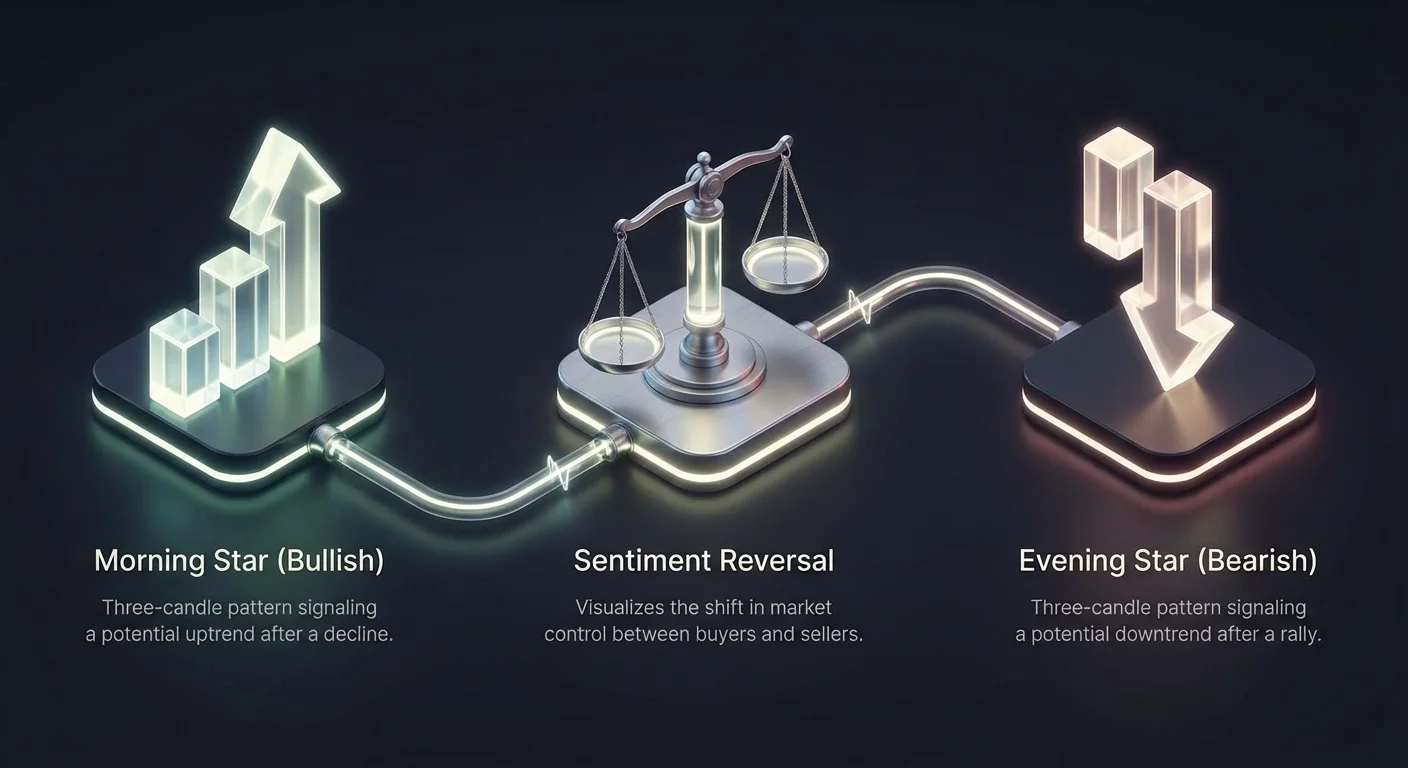
Technical analysis in the cryptocurrency market relies heavily on identifying shifts in market sentiment before they become obvious trends. Among the various tools available to traders, candlestick patterns remain a primary method for visualizing the battle between buyers and sellers. While single-candle formations like Hammers or Shooting Stars provide immediate alerts, multi-candle patterns often carry greater weight regarding trend exhaustion. The Star patterns, specifically the Morning Star and Evening Star, stand out as three-candle formations that define market reversals with a distinctive structure of trend, indecision, and counter-attack.
Understanding the reliability of these formations requires more than just recognizing their shape on a chart. It involves analyzing the specific context in which they appear, the volume profiles accompanying them, and their relationship with key market levels. The "reliability index" of a Star pattern is not a fixed number but a dynamic value derived from how well the formation aligns with broader market conditions. Traders who can distinguish between a high-probability Star setup and a false signal often have a distinct edge in navigating volatile crypto assets.
This article provides a comparative analysis of Morning and Evening Star formations. We will dissect their structural components, evaluate the psychological shifts they represent, and identify the factors that enhance or diminish their success rates. By examining these patterns through the lens of risk and confirmation, market participants can better gauge when a trend is truly reversing or simply pausing before continuation.
Structural Anatomy of Star Formations
To evaluate the reliability of Star patterns, one must first understand the strict criteria that define them. These are not subjective shapes but specific sequences of price action that narrate a change in control. Both the Morning and Evening Star patterns unfold over three distinct sessions. This three-step process provides more data points than single-candle signals, which is a key factor in their perceived reliability.
Deconstructing the Morning Star
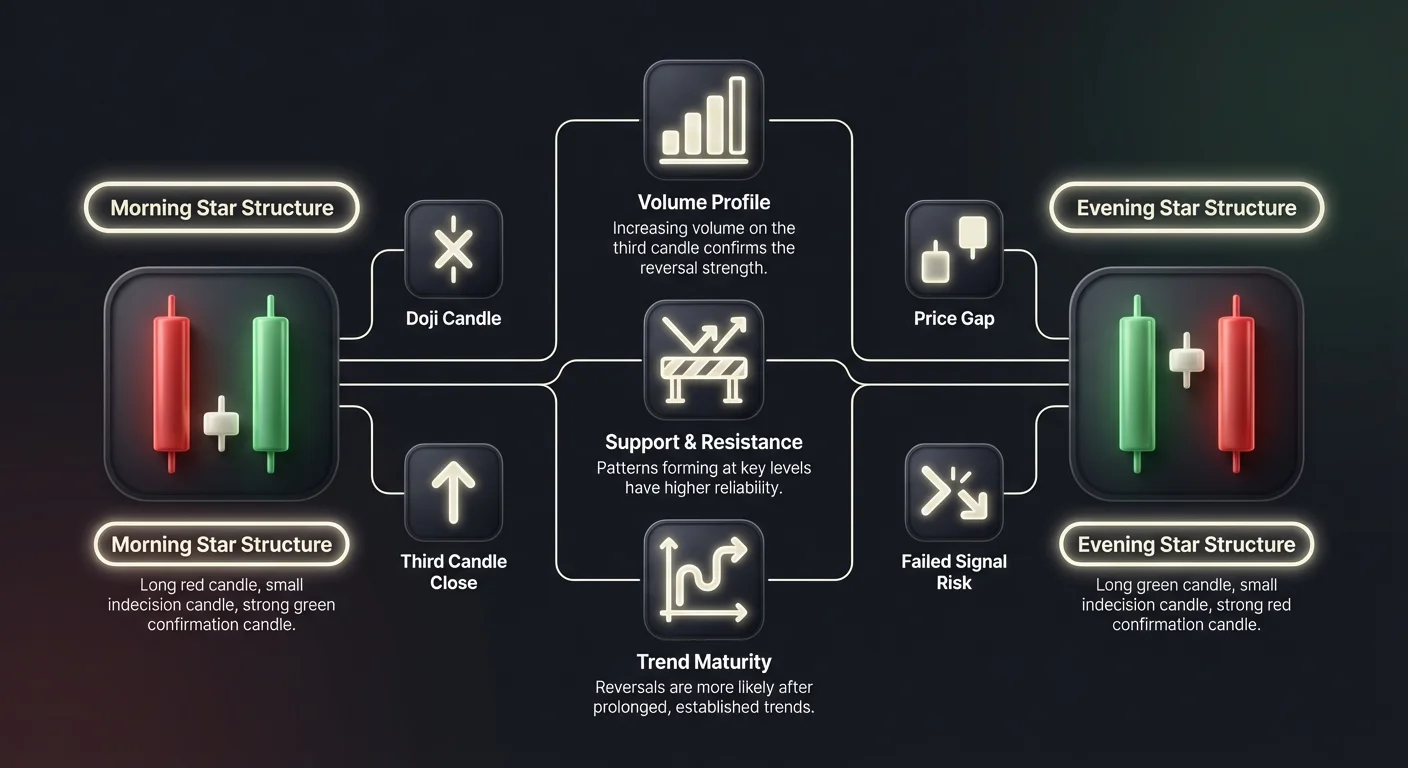
The Morning Star is a bullish reversal pattern that appears at the bottom of a downtrend. Its formation begins with a long red candle, which confirms that bears are currently in control and selling pressure is dominant. This first candle extends the existing decline, often inducing panic or capitulation among holders. The market sentiment at this stage is overwhelmingly negative.
The second component is the "star" itself. This is a small-bodied candle that signals a sudden drop in volatility and momentum. It indicates that while sellers are still present, they are no longer driving the price down aggressively. The color of this middle candle does not matter as much as its size. A small body reflects indecision, suggesting that the selling pressure has met equilibrium.
The final component is a strong green candle that closes well into the body of the first red candle. This third session is critical as it confirms that buyers have seized control from the sellers. Ideally, this candle should close above the midpoint of the first candle. This deep penetration signals a conviction to reverse the trend rather than just a temporary bounce.
Deconstructing the Evening Star
The Evening Star acts as the bearish mirror image, appearing at the peak of an uptrend. The pattern commences with a large green candle, reflecting strong buying interest and potentially over-enthusiastic market sentiment. During this first session, bulls are firmly in charge, often pushing prices to new local highs.
The middle candle reveals the first crack in the bullish armor. It is a small-bodied candle that gaps away from the previous close, indicating that despite the initial momentum, buyers cannot push the price significantly higher. This hesitation at the top of a trend is a warning sign. It suggests that demand is drying up or that supply is beginning to enter the market to absorb orders.
The completion of the pattern comes with the third candle, which is a long red candle. This session confirms the reversal by closing deep within the body of the first green candle. It demonstrates that sellers have overpowered the remaining buyers and are driving the price down. The structure signals that the uptrend has likely terminated and a move to the downside is imminent.
The Psychology of the Star Gap
A defining feature of high-reliability Star patterns is the "gap" or separation between the bodies of the candles, particularly involving the middle star. In traditional markets, true gaps are common due to market closes. In crypto, which trades 24/7, gaps are rarer and often manifest as distinct shifts in trading ranges rather than empty price space.
The middle candle represents a psychological truce. After a period of intense directional movement, the market pauses. This pause is not merely a lack of activity but a transfer of inventory. In a Morning Star, "smart money" may be accumulating positions from panic sellers. In an Evening Star, institutional players may be distributing assets to late-arriving retail buyers.
The reliability of the pattern increases when this middle candle is a Doji or has an extremely small body. A Doji signifies near-perfect equality between open and close prices, representing total indecision. When total indecision follows a strong trend, it implies the prevailing momentum is completely exhausted, making the subsequent reversal candle far more potent.
Factors Influencing Success Rates
Not all Star patterns result in profitable reversals. The success rate of these formations depends heavily on where they occur on the chart. Context is the primary filter for reliability. A Star pattern that forms in the middle of a sideways range is often noise, whereas one that forms at a trend extreme commands attention.
Trend Maturity and Location
For a Star pattern to be valid, a prior trend must exist. A Morning Star must follow a tangible decline, and an Evening Star must follow a clear rally. The maturity of this trend plays a role in the pattern's potential success. A pattern appearing after a prolonged, multi-week trend is generally more reliable than one appearing after a short, two-day move.
Support and resistance levels act as force multipliers for these signals. A Morning Star that forms precisely on a long-term support zone or historical low has a much higher probability of success. The technical support provides a floor for the price, while the candlestick pattern confirms that the floor is holding.
Conversely, an Evening Star forming at a known resistance level or a previous all-time high suggests a strong rejection. The confluence of a structural barrier with a reversal pattern creates a "double verification" of the signal. Traders often look for these confluences to filter out lower-quality setups that occur in "no man's land" between key levels.
Volume Profiles and Confirmation
Volume analysis is crucial for validating the strength of a Star pattern. Reliability increases significantly if the volume profile aligns with the price action. During the first candle of the pattern, volume should ideally be high, consistent with the prevailing trend. This shows that the trend is still active but potentially nearing a climax.
The middle "star" candle often sees a drop in volume, reflecting the hesitation and lack of conviction from either side. However, the most critical volume signal occurs on the third candle. For a Morning Star, the third green candle should be accompanied by a surge in buying volume. This proves that new capital is entering the market to support the reversal.
If the third candle moves price significantly but on low volume, the reliability index drops. It suggests a lack of genuine interest, warning that the move might be a "bull trap" or "bear trap." High volume on the reversal candle serves as the fuel that confirms the engine has switched directions.
Primerjalna analiza: Zvezde v primerjavi z enosvečnimi svečami
Medtem ko so zvezdni vzorci močni, se pogosto primerjajo z enosvečnimi obračuni, kot sta kladivo ali padajoča zvezda. Razumevanje razlik v njihovih profilih zanesljivosti trgovcem pomaga izbrati pravo orodje za specifične tržne razmere.
| Značilnost | Zvezdni vzorci (jutranja/večerna) | Enosvečne sveče (kladivo/padajoča zvezda) |
|---|---|---|
| Trajanje | 3 seje | 1 seja |
| Složenost | Visoka (trend + premor + obračun) | Nizka (intradnevna zavrnitev) |
| Potrditev | Vgrajena (tretja sveča) | Zahteva naslednjo svečo |
Robustnost signala
Primarna prednost zvezdnih vzorcev pred enosvečnimi formacijami je vgrajeni mehanizem potrditve. Vzorec kladiva, ki signalizira bikovsk obračun, sestavlja ena sama sveča z dolgim spodnjim fitilom. Čeprav kaže, da kupci stopajo noter, ne zagotavlja, da bodo linijo držali v naslednji seji.
Nasprotno jutranja zvezda vključuje potrditev znotraj samega vzorca. Tretja sveča služi isti funkciji kot potrditvena sveča po kladivu. S čakanjem na dokončanje celotne trisvečene sekvence trgovec učinkovito filtrira mnoge lažne signale, na katere bi enosvečev trgovec morda deloval prezgodaj.
Vendar ta robustnost prinaša strošek: vstopno ceno. Ker zvezdni vzorec zahteva zaprtje tretje sveče, se je cena pogosto še dodatno oddaljila od dna (ali vrha) v primerjavi z enosvečnim vstopom. Trgovci zamenjajo nekoliko slabši vstopni ceni višjo verjetnost nadaljevanja trenda.
Filtriranje tržnega šuma
Kripto trgi so zloglasno hrupni, z nenadnimi cenovnimi skoki, ki so pogosti na nižjih časovnih okvirih. Enosvečni vzorci, kot je padajoča zvezda, so lahko včasih rezultat začasnih anomalij ali „debelskoprstnih“ trgovanj, ki pustijo dolge fitile. Ti se lahko pojavijo brez resnične spremembe tržnega sentimenta.
Trisvečna struktura zvezdnih vzorcev deluje kot naravni filter za ta šum. Naključnemu tržnemu šumu je veliko težje naslikati koherentno trisvečko sliko trenda, premora in obračuna. Zahteva po vzdržljivem cenovnem gibanju v treh obdobjih nakazuje bolj premišljeno spremembo tržne psihologije, kar naredi zvezdno formacijo manj dovzetno za naključne volatilnostne skoke.
Ta filtrirna sposobnost naredi zvezdne vzorce posebej uporabne na višjih časovnih okvirih, kot so 4-urni, dnevni ali tedenski grafi. Na teh časovnih okvirih „zgodba“, ki jo pripovedujejo tri sveče, predstavlja pomembne premike v pretoku kapitala, medtem ko na 1-minutnem grafu isti vzorec morda predstavlja le začasen premor v algoritmih visokofrekvenčnega trgovanja.
Common Failure Scenarios
Even the most reliable technical patterns fail. Understanding why Morning and Evening Stars fail is just as important as knowing why they work. False positives can lead to significant losses if risk management is not applied.
The Shallow Retracement
One of the most common causes of failure is a lack of penetration by the third candle. In a Morning Star, if the third green candle fails to close above the midpoint of the first red candle, the signal is weak. It indicates that while buyers showed up, they lacked the strength to undo the damage of the initial sell-off.
Similarly, in an Evening Star, if the third red candle is small and does not push deep into the first green candle's territory, the bearish reversal is suspect. This "shallow" reversal often results in a consolidation or pennant formation rather than a true trend change. Traders often wait for a fourth candle to confirm if the third candle was insufficient.
Counter-Trend Trading Risks
Trading Star patterns often means trading against the prevailing trend. A Morning Star attempts to pick a bottom, while an Evening Star attempts to pick a top. In strongly trending markets, these reversal signals can be overrun by sheer momentum.
A "failed" Morning Star occurs when the price momentarily pauses and prints the pattern, only for the downtrend to resume immediately after. This is known as a continuation pattern disguised as a reversal. This risk is highest when trading against strong fundamental news or during capitulation events where technical logic is temporarily suspended by panic.
To mitigate this, traders rarely rely on the pattern alone. They look for the pattern to form at a logical area where the trend should theoretically pause or reverse, such as a Fibonacci extension level or a historical demand zone.
Povečevanje zanesljivosti z indikatorji
Da bi zgradili pravi „indeks zanesljivosti“ za trgovalno nastavitev, profesionalni trgovci nanj nanizajo dodatne tehnične indikatorje. Ta orodja zagotavljajo objektivne podatke za podporo subjektivni interpretaciji grafikonskega vzorca.
Oscilatorji zagonov
Oscilatorji, kot je relativni indeks moči (RSI), so odlični spremljevalci zvezdnih vzorcev. Jutranja zvezda je bistveno zanesljivejša, če se tvori, ko je RSI v pregretem območju (običajno pod 30). To potrjuje, da je prodajni pritisk dosegel ekstrem in da je reverzija k povprečju verjetna.
Nasprotno večerna zvezda nosi veliko večjo težo, če se pojavi, ko je RSI v prekupljenem območju (nad 70). Če se večerna zvezda tvori, vendar je RSI zataknjen v nevtralnem območju (okoli 50), trg morda le počiva pred nadaljnjim vzponom. Konvergenca prekomernega branja zagonov z obračunskim vzorcem ustvari nastavitev z visoko prepričanostjo.
Drseča povprečja kot dinamična podpora
Drseča povprečja lahko služijo tudi kot dinamične linije potrditve. Jutranja zvezda, ki se tvori ravno takrat, ko cena dotakne naraščajočega 50-dnevnega ali 200-dnevnega drsnega povprečja, je klasična nastavitev „kupi padec“. Drseče povprečje potrjuje, da je dolgoročni trend navzgor, medtem ko zvezdni vzorec signalizira konec kratkoročne korekcije.
Za večerne zvezde zavrnitev pri padajočem drsem povprečju validira medvedjo tezo. Nakazuje, da je bil vzpon le ponovni test povprečja in da dominantni padajoči trend nadaljuje. Ko se vzorec in dinamični upor ujemata, se verjetnost uspešnega trgovanja poveča.
Potrditev z divergenco
Bikovsk ali medvedji divergenca je morda najmočnejše potrditveno orodje. Če cena naredi nižji dno med tvorbo jutranje zvezde, vendar RSI naredi višji dno, ta bikovsk divergenca signalizira osnovno moč. Razkriva, da medtem ko cena pada, zagon za padcem slabi.
Medvedji divergenca deluje podobno za večerno zvezdo. Če cena doseže nov vrh med tvorbo vzorca, vendar oscilator ne doseže novega vrha, nakazuje prazno kupno moč. Zvezdni vzorec, sprožen med divergenco, pogosto velja za „razred A“ nastavitev med tehničnimi analitikami.
Execution and Risk Management
Identifying a high-reliability Star pattern is only half the battle. Executing the trade with proper risk parameters is what determines long-term profitability. The structure of Morning and Evening Stars provides clear invalidation points, which simplifies trade management.
For a Morning Star, the standard stop-loss placement is just below the lowest point of the pattern, typically the low of the middle "star" candle. If price breaks this level, the pattern is invalidated, and the downtrend is likely continuing. There is no reason to stay in the trade if the reversal low is breached.
For an Evening Star, the stop-loss goes above the highest point of the formation. If buyers manage to push price above the "star," the bearish signal has failed. Keeping stops tight to these structural levels allows for favorable risk-to-reward ratios. Since the entry is taken after the third candle closes, the distance to the stop-loss is defined, allowing traders to calculate exact position sizes.
Some conservative traders wait for even more confirmation, such as a break of the third candle's high (for Morning Star) or low (for Evening Star). While this reduces the chance of a false start, it also widens the stop-loss distance and reduces the potential reward. Balancing the need for confirmation with the need for a good entry price is a constant negotiation in crypto trading.
Conclusion
The comparative success of Morning and Evening Star formations lies in their ability to narrate a complete story of market sentiment. Unlike single-candle patterns that offer a snapshot of intraday rejection, these three-candle structures illustrate the entire process of trend exhaustion, indecision, and counter-attack. Their reliability is not inherent but is derived from context—specifically their location relative to support and resistance, the volume accompanying the reversal, and the maturity of the preceding trend.
While broadly effective, neither pattern is a guarantee of future price action. The Morning Star serves as a beacon for potential accumulation zones during corrections, while the Evening Star warns of distribution at market peaks. The most successful applications of these patterns occur when they are used not as standalone triggers, but as part of a comprehensive trading system that includes momentum indicators, volume analysis, and strict risk management.
Success in trading Star patterns comes from waiting for the third candle to fully close and confirming the signal with volume.