
The landscape of digital asset management has evolved significantly, moving beyond simple buy-and-hold strategies to encompass complex transaction mechanisms. Among the most critical decisions a trader must make is selecting the right method for exchanging one cryptocurrency for another. This process, generally referred to as swapping, can occur through various channels that differ fundamentally in their architecture, security models, and cost structures.
Understanding the nuances between centralized exchange swaps and non-custodial or atomic swaps is essential for optimizing portfolio performance. These methods cater to different user needs, ranging from the high-frequency trader seeking speed to the privacy-focused investor prioritizing control. The choice between them often dictates the efficiency, security, and profitability of a transaction.
At its core, a swap is the conversion of one digital asset to another without necessarily reverting to fiat currency. This allows for portfolio rebalancing, risk management, and capitalization on market trends. However, the underlying technology facilitating these trades varies. One path relies on trusted intermediaries and aggregated liquidity, while the other leverages code and peer-to-peer protocols.
Evaluating these options requires a deep dive into how they function, their fee schedules, and the protections they offer. By examining the mechanisms of custodial platforms alongside decentralized alternatives, traders can better align their execution strategy with their financial goals.
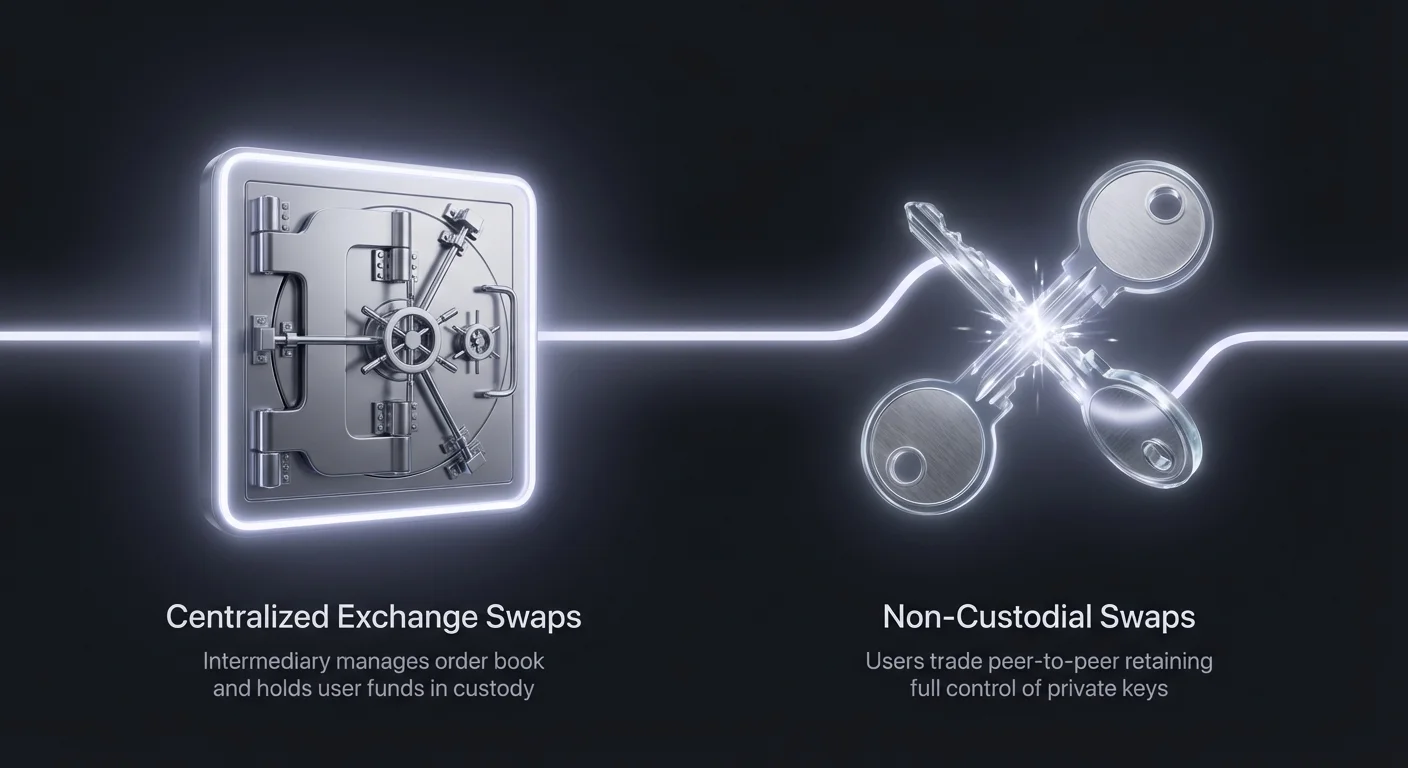
The Mechanics of Centralized Exchange Swaps
Centralized exchanges (CEXs) function as the traditional hubs of the cryptocurrency market. They operate similarly to traditional stock markets, where a central authority manages the order book, matches buyers with sellers, and clears transactions. When a user initiates a swap on a CEX, they are not trading directly with another user on the blockchain in real-time. Instead, they are trading against the exchange's internal ledger.
Understanding the Order Book Model
In a centralized environment, liquidity is aggregated into an order book. This digital list records buy and sell orders organized by price level. When a trader executes a market order to swap Bitcoin for Ethereum, the exchange's matching engine instantly pairs that request with the best available sell order.
This process happens off-chain, meaning the transaction is recorded on the exchange's private database rather than immediately on the public blockchain. This allows for incredibly fast execution speeds, often measured in milliseconds. The speed is a primary advantage for day traders who need to react to price volatility instantly.
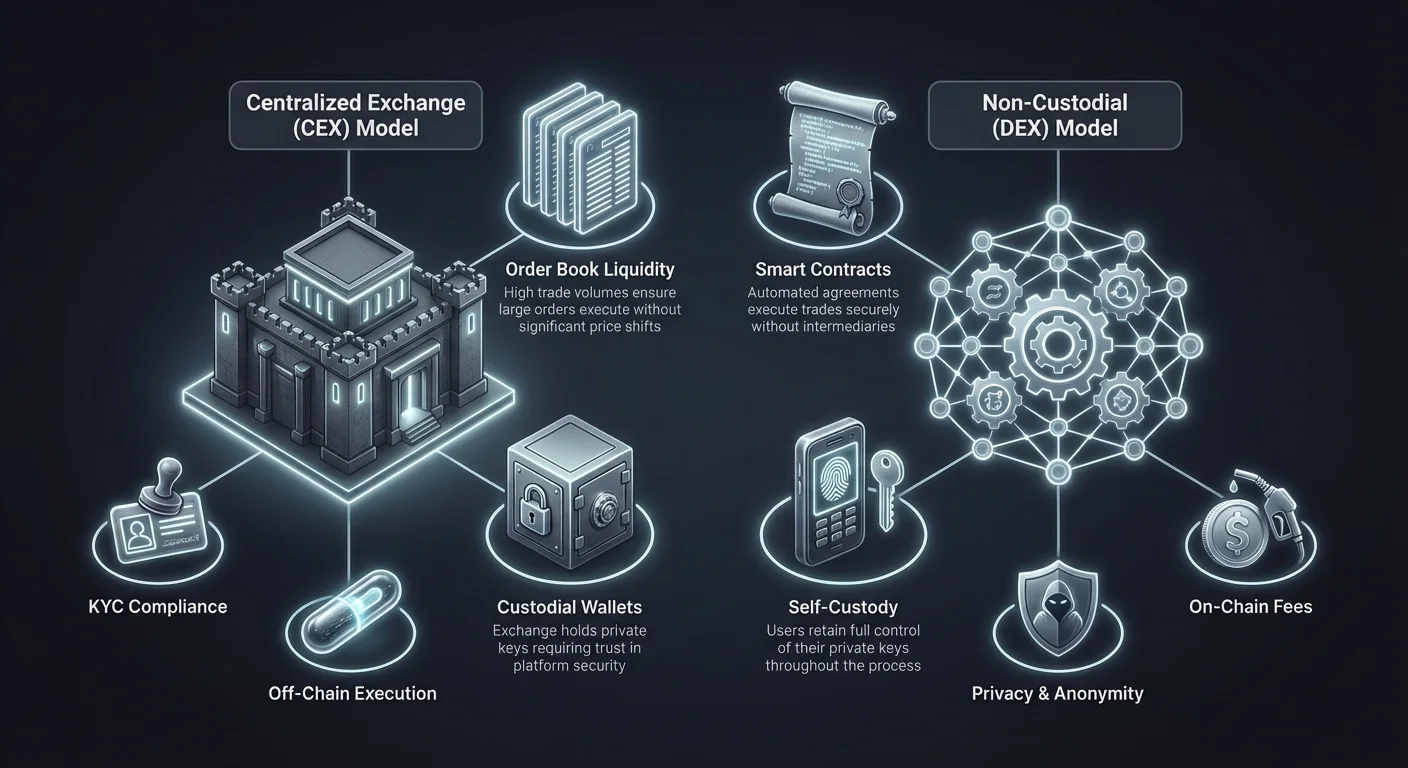
However, this efficiency comes with a trade-off regarding custody. To use the order book, users must deposit funds into the exchange's wallets. The exchange effectively holds the private keys to these assets until the user decides to withdraw. This custodial relationship requires trust in the platform's security infrastructure and solvency.
Liquidity and Market Depth
A major strength of centralized platforms is their ability to provide deep liquidity. High trade volumes ensure that large orders can be executed without causing significant price shifts. This depth is maintained by market makers and the sheer number of participants on the platform.
For standard retail traders, this means that the price seen on the screen is likely the price they will get. Slippage, the difference between the expected price and the executed price, is typically minimal on major pairs. This reliability is crucial for those moving significant amounts of capital who cannot afford unpredictable rate changes during execution.
Furthermore, centralized entities often have relationships with institutional liquidity providers. This ensures that even during periods of high volatility, there is usually someone on the other side of the trade. This stability is a key reason why beginners often start with centralized swaps.
Exploring Non-Custodial and Atomic Swaps
In contrast to the centralized model, non-custodial and atomic swaps represent a peer-to-peer approach to trading. These mechanisms eliminate the need for a trusted third party to hold funds or clear trades. Instead, they rely on smart contracts and cryptographic protocols to ensure that the exchange of value happens securely and simultaneously.
The Principle of Self-Custody
The defining feature of this approach is self-custody. Users retain full control of their private keys throughout the entire process. Funds are not deposited into a central wallet; they are moved directly from the user's wallet to the recipient or a smart contract.
This model appeals to those who adhere to the "not your keys, not your coins" philosophy. By removing the intermediary, the risk of exchange insolvency or account freezing is virtually eliminated. The user is the sole custodian of their assets, responsible for their own security.
Platforms facilitating these trades often act as interfaces rather than custodians. They connect users to liquidity pools or other traders but never take possession of the cryptocurrency. This structure significantly reduces the attack surface for hackers, as there is no central "honeypot" of funds to target.
Direct Execution and Privacy
Atomic swaps utilize technology like Hash Time Locked Contracts (HTLCs) to enable cross-chain trading. This ensures that a trade is an all-or-nothing event. Either both parties receive the agreed-upon assets, or the transaction fails and funds are returned to their original owners.
This method offers a higher degree of privacy compared to centralized counterparts. Since there is no central authority requiring account verification, trades can often be conducted anonymously. This is particularly valuable for users who wish to protect their financial data from third-party surveillance.
However, execution times can be slower than centralized databases. Because transactions must be confirmed on their respective blockchains, network congestion can lead to delays. Users must wait for block confirmations, which varies depending on the specific cryptocurrencies involved in the swap.
The Role of OTC Trading in High-Volume Swaps
For institutional investors and high-net-worth individuals, standard exchange mechanisms may not suffice. Over-the-counter (OTC) trading serves this segment by facilitating direct exchanges of large volumes of cryptocurrency. This method is distinct from both standard order book trading and automated decentralized swaps.
Minimizing Market Impact
When a trader attempts to buy or sell millions of dollars worth of an asset on a public order book, it can drastically skew the market price. This phenomenon, known as slippage, results in a worse execution price for the trader and volatility for the market. OTC desks solve this by negotiating the price privately.
In an OTC transaction, the buyer and seller agree on a fixed price for the entire block of assets. This price is locked in, shielding the trader from the fluctuations that would occur if they tried to execute the trade piecemeal on an open exchange. The transaction occurs off the public books, preventing panic or excitement in the broader market.
This discretion is vital for whales and institutions. It allows them to enter or exit large positions without signaling their intent to the market. OTC desks act as the silent facilitators, sourcing liquidity through their networks to fulfill these massive orders.
Personalized Service and Settlement
Unlike the automated nature of retail exchanges, OTC trading is a high-touch service. Clients often have access to dedicated account managers who assist with trade execution and strategy. This personalized support extends to settlement processes, which can be tailored to the specific needs of the client.
Settlement in OTC deals is designed to be swift and secure. Major desks offer same-day settlement on wire transactions and crypto transfers. This efficiency is critical for institutions that need to manage cash flow and balance sheets accurately.
Furthermore, OTC platforms often provide access to a wider range of assets than standard spot markets. If a client needs to acquire a large amount of a specific altcoin, the OTC desk can utilize its network to find sellers, sparing the client the difficulty of sourcing liquidity across multiple fragmented exchanges.
| Feature | OTC Trading | Retail Exchange Swap |
|---|---|---|
| Target Audience | Institutions/Whales | Retail Traders |
| Volume | Very High | Low to Medium |
| Price Mechanism | Negotiated/Fixed | Market/Limit Orders |
Fee Structures and Economic Efficiency
Cost is a primary consideration in any financial transaction. The fee structures for crypto swaps vary significantly depending on the platform and the mechanism used. Understanding the difference between spreads, transaction fees, and network costs is essential for maximizing profitability.
Zero-Fee Trading Models
Some exchanges promote "zero-fee" trading to attract users. In this model, the platform does not charge a direct commission on the trade. This can be highly beneficial for high-frequency traders or scalpers who execute many trades per day. Eliminating the commission drag allows for tighter profit margins.
However, "zero-fee" does not always mean the trade is free of cost. Platforms may monetize these trades through the spread—the difference between the buying and selling price. A wider spread means the user is buying at a slightly higher price or selling at a slightly lower one than the market rate.
Additionally, specific pairs might be eligible for zero fees while others are not. It is common for exchanges to offer fee incentives on stablecoin pairs or major assets like Bitcoin to boost liquidity. Traders should carefully verify which pairs qualify for these promotions.
Network Fees and Service Charges
In non-custodial swaps, the user is responsible for blockchain network fees. These are paid to miners or validators to process the transaction. During times of high network congestion, these fees can skyrocket, making small trades economically unviable.
Centralized exchanges often absorb these network fees for internal swaps or bundle them into a flat withdrawal fee. This can make small transactions cheaper on a CEX compared to a direct on-chain swap. However, for large transactions, the percentage-based fee of a CEX might exceed the flat network fee of a decentralized swap.
Tiered fee structures are also common. Exchanges reward high-volume traders with lower percentage fees. This encourages activity and loyalty. Institutional clients using OTC desks often negotiate all-inclusive pricing where fees are built into the final execution price, providing cost certainty.
Security Models: Custody vs. Control
The security architecture of a swap platform is perhaps its most critical attribute. The distinction lies primarily in who holds the keys to the digital vault. Both centralized and decentralized models carry unique risks and protective measures that users must weigh.
Centralized Security Measures
Reputable centralized exchanges employ enterprise-grade security protocols. The industry standard involves keeping the vast majority of user funds in cold storage. Cold storage refers to offline wallets that are not connected to the internet, making them inaccessible to remote hackers.
Additionally, these platforms often carry insurance policies to cover potential losses from security breaches. This provides a safety net for users that does not exist in the decentralized world. Regulatory compliance also mandates strict security audits and financial reserves.
User accounts are protected by features like two-factor authentication (2FA), withdrawal whitelisting, and anti-phishing codes. While the exchange holds the keys, these tools give users layers of defense against unauthorized access to their specific accounts.
Non-Custodial Risks and Benefits
Non-custodial platforms mitigate the risk of a central breach. Since the platform does not hold funds, there is no central treasury for hackers to attack. Security depends almost entirely on the user's ability to protect their own private keys and wallet seed phrases.
However, this model introduces smart contract risk. If the code governing the swap contains a bug or vulnerability, it can be exploited. Users must rely on the quality of the code audits and the reputation of the protocol developers.
Furthermore, there is no customer support to recover lost funds in a non-custodial setting. If a user sends funds to the wrong address or loses their private key, the assets are irretrievable. This unforgiving nature requires a higher level of technical competence and vigilance from the user.
Liquidity Concerns and Slippage
Liquidity refers to the ease with which an asset can be converted into another asset without affecting its price. In the context of swaps, liquidity determines the speed of execution and the stability of the price.
Order Depth in Centralized Venues
Centralized exchanges generally offer superior liquidity for major trading pairs. The concentration of traders and market makers in a single venue creates deep order books. This depth acts as a buffer against volatility, absorbing large orders smoothly.
For obscure or new altcoins, however, centralized liquidity can be thin. If an exchange has not attracted enough market makers for a specific token, spreads can widen significantly. In these cases, the cost of trading increases due to poor price execution.
Aggregators have emerged to solve this by routing orders through multiple liquidity sources. These tools scan various order books to find the best available price, mimicking the benefits of a decentralized aggregator but within a custodial environment.
Automated Market Makers (AMMs)
Decentralized swap platforms often use Automated Market Makers (AMMs) instead of traditional order books. AMMs rely on liquidity pools funded by users. The price is determined by a mathematical formula based on the ratio of assets in the pool.
While innovative, AMMs can suffer from high slippage if the pool is small relative to the trade size. Large trades can significantly unbalance the pool, causing the price to move against the trader.
To combat this, users can set slippage tolerance limits. If the price changes by more than the set percentage during the transaction, the trade fails. This protects the user but can lead to frustration during volatile market conditions when transactions revert.
Privacy, Anonymity, and Regulation
The regulatory environment for cryptocurrency is tightening globally. This shift has created a clear divide between compliant, verified trading environments and privacy-centric protocols.
The KYC Standard
Centralized exchanges are increasingly required to implement Know Your Customer (KYC procedures). This involves collecting personal data, government IDs, and proof of address from users. These measures are designed to prevent money laundering and ensure compliance with local laws.
For many users, this provides a sense of legitimacy and safety. Dealing with a regulated entity offers legal recourse in disputes. It also simplifies the process of connecting with traditional banking systems for fiat deposits and withdrawals.
However, this compromises privacy. Users leave a digital footprint linking their identity to their financial history. For those living in regimes with strict capital controls or privacy concerns, this is a significant drawback.
Privacy in Decentralized Swaps
Non-custodial swaps often operate without KYC requirements. Because they are software protocols rather than financial intermediaries, many do not collect user data. Trades are identified only by wallet addresses, offering a layer of pseudonymity.
This privacy is a core tenet of the crypto ethos for many early adopters. It allows for permissionless financial interaction. Anyone with an internet connection can participate without needing approval from a compliance department.
However, this sector faces increasing scrutiny. Regulators are exploring ways to apply rules to decentralized finance (DeFi) interfaces. Users should be aware that the regulatory landscape for non-custodial trading is in flux and could change.
User Experience and Accessibility
The complexity of executing a swap varies greatly between platforms. User experience (UX) is often the deciding factor for beginners entering the space.
The Convenience of Centralized Interfaces
Centralized exchanges invest heavily in UX design. They offer intuitive dashboards, clear buy/sell buttons, and integrated educational resources. Concepts like gas fees and private keys are often abstracted away, making the process feel like using a standard banking app.
Mobile applications for these platforms are highly polished. They allow users to manage portfolios, execute swaps, and contact support from anywhere. Features like "convert" buttons simplify trading into a single click, handling all the backend complexity automatically.
Customer support is another major advantage. If a transaction gets stuck or a user makes an error, there is a human support team to contact. This safety net is invaluable for those less confident in their technical abilities.
The Learning Curve of DeFi
Non-custodial swapping requires a steeper learning curve. Users must understand how to manage a Web3 wallet, handle seed phrases, and pay network fees in the native currency of the blockchain.
Connecting a wallet to a decentralized application (dApp) introduces potential security risks if the user interacts with a malicious site. The user interface is often more technical, displaying raw data about gas limits and contract interactions.
However, innovation is rapid. Modern non-custodial platforms are improving their interfaces to rival centralized apps. "Gas-less" transactions and simplified wallet connections are lowering the barrier to entry, though it remains higher than custodial alternatives.
Tax and Financial Implications
Regardless of the mechanism used, swapping cryptocurrency triggers tax obligations in many jurisdictions. It is a common misconception that only cashing out to fiat currency is a taxable event.
Reporting Requirements
In most tax systems, exchanging one crypto asset for another is treated as a disposal of property. The trader must calculate the capital gain or loss based on the value of the asset at the time of the swap compared to its original cost basis.
Centralized exchanges often provide tax documents and transaction history exports. This makes it easier to calculate liabilities and file reports. Some even integrate with tax software to automate the process.
Complexity in Decentralized Reporting
Tracking cost basis across multiple non-custodial wallets and decentralized protocols can be difficult. Without a central entity to issue a consolidated 1099 or transaction report, the burden falls entirely on the user to keep meticulous records.
Every on-chain interaction is a taxable event. High-frequency trading on a DEX can generate thousands of transactions, creating a nightmare for tax reporting if not managed with specialized software.
Traders must be disciplined in their record-keeping. Using portfolio tracking tools that sync with blockchain addresses is essential for anyone frequenting the decentralized swap ecosystem.
Conclusion
The choice between atomic swaps and centralized exchange swaps is not a binary one of "better" or "worse," but rather a question of fit. Centralized platforms offer speed, high liquidity, and a user-friendly experience that mimics traditional finance. They provide a safety net through customer support and insurance, making them ideal for newcomers and institutional investors who require reliability and recourse. The trade-off is the necessity of trust, the loss of privacy through KYC, and the surrender of asset custody.
Conversely, atomic and non-custodial swaps uphold the original vision of cryptocurrency: decentralized, permissionless, and private. They empower users with full control over their assets and eliminate counterparty risk. This freedom comes with the responsibility of self-custody and the technical requirement to navigate network fees and wallet management. For the privacy-conscious and the technically adept, this mechanism offers superior alignment with the ethos of blockchain technology.
Ultimately, a balanced crypto strategy may involve utilizing both mechanisms. A trader might use a centralized exchange for fiat on-ramps and high-volume liquidity, while utilizing decentralized swaps for accessing long-tail assets and preserving privacy for specific holdings. By understanding the distinct advantages and risks of each, investors can navigate the digital asset ecosystem with confidence and precision.
The optimal swap method depends entirely on whether you prioritize the convenience and speed of managed services or the absolute control and privacy of self-custody.