Kriptovalutni trg se je od svojih zgodnjih dni enostavnega trgovanja na mestu močno razvil. Ko se ekosistem zrel, so se sofisticirani finančni instrumenti, znani kot derivati, premaknili v ospredje strategij digitalnih sredstev. Ti instrumenti trgovcem omogočajo navigacijo po tržnih razmerah, ki presegajo enostavno rast cen. Med temi orodji izstopa trgovanje z opcijami kot vsestranska metoda za upravljanje tveganj in špekuliranje o prihodnjih gibanjih cen. Z razumevanjem mehanizmov teh pogodb lahko trgovci odklenejo strategije, ki delujejo tako v bikovih kot v medvedjih okoljih.
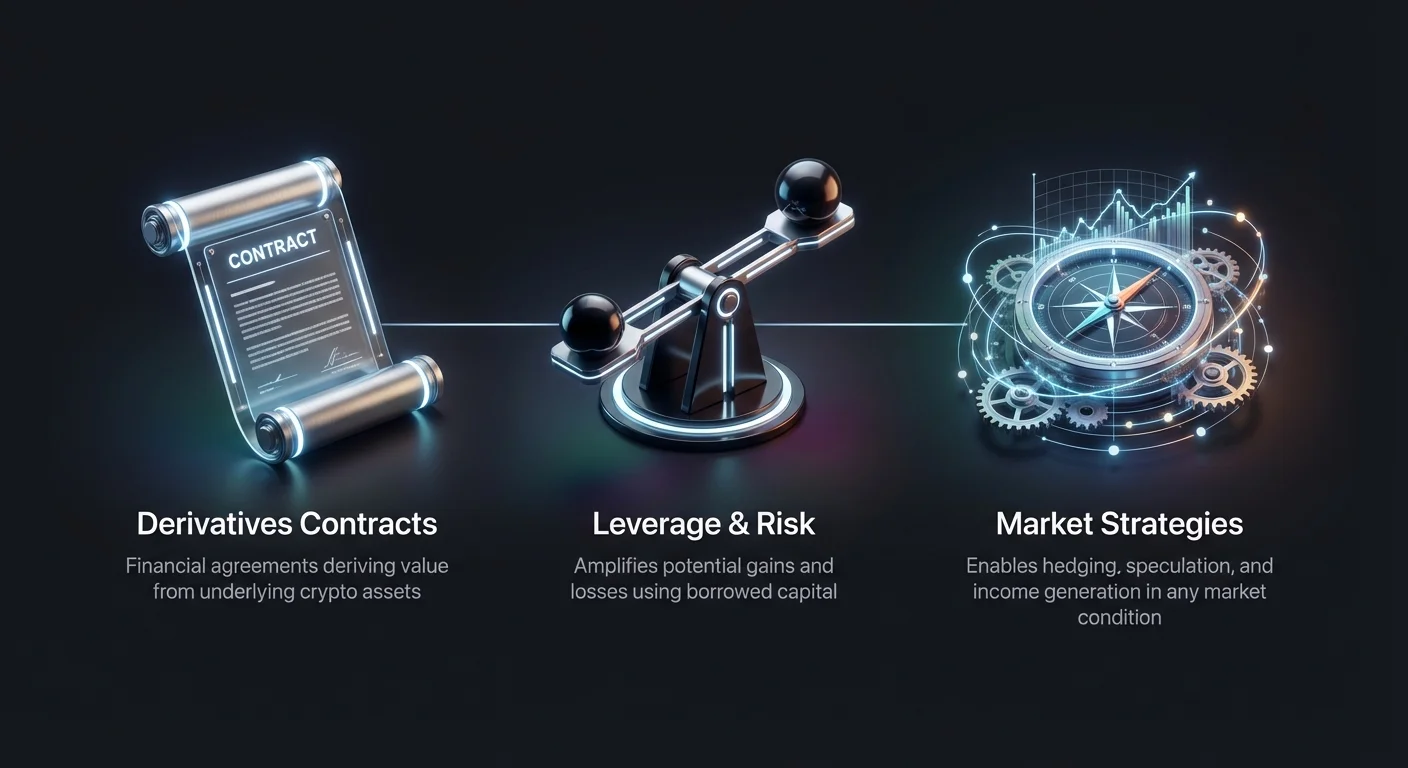
Derivati so finančne pogodbe, ki črpajo svojo vrednost iz osnovnega sredstva, kot sta Bitcoin ali Ethereum. Za razliko od trgovanja na mestu, kjer takoj izmenjate lastništvo same kriptovalute, derivati vključujejo dogovor med strankami za nakup ali prodajo tega sredstva v prihodnjem datumu ali pod določenimi pogoji. Ta razlika je ključna za napredne trgovalne strategije. Omogoča ločitev izpostavljenosti cenam od lastništva sredstva.
Glavna privlačnost teh instrumentov je v njihovi fleksibilnosti. Tržnim udeležencem omogočajo zaščito pred volatilnostjo, vzvrtanje kapitala za večjo izpostavljenost ali dobiček iz tržne stagnacije. Medtem ko trgovanje na mestu zahteva rast cene sredstva za dobičkonosnost dolgih pozicij, derivati odpirajo vrata dobičkom iz padajočih trendov ali pomembnih nihanj cen v obe smeri. Ta zmožnost spremeni pristop trgovcev k upravljanju portfelja in omilitvi tveganj.
Obvladovanje teh orodij zahteva poglobljeno raziskavo specifičnih vrst razpoložljivih pogodb in spremenljivk, ki vplivajo na njihovo cenitev. Od osnovnih definicij klicnih in prodajnih opcij do kompleksnih interakcij implicirane volatilnosti ima vsaka komponenta ključno vlogo. Uspeh na tem področju je odvisen od razumevanja ne le tega, kako izvesti posel, temveč zakaj je določen instrument primeren za določen tržni scenarij.
The Fundamentals of Crypto Derivatives
Defining the Contract Structure
At the core of every derivative is a contract between two or more parties. This agreement dictates the terms under which the underlying asset will be bought or sold. In the crypto space, these contracts often track the price of major assets like Bitcoin closely, though they can distinctively differ from the spot price depending on market sentiment and time to expiry.
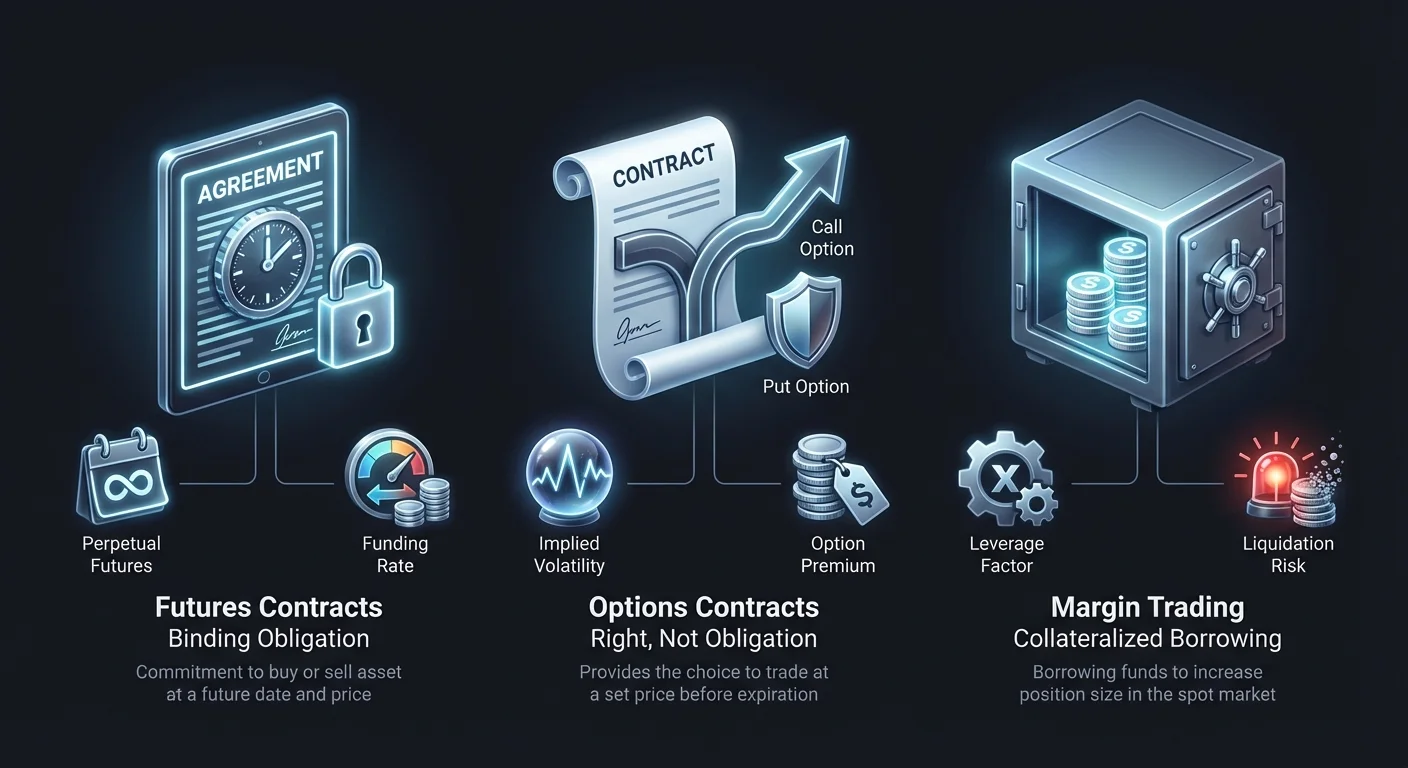
The most common derivatives are futures and options. Futures commit the parties to a transaction at a set date, regardless of the market price at that time. This creates a binding obligation. If you enter a futures contract to buy Bitcoin at a specific price on a specific date, you must fulfill that trade. The rigidity of this structure makes it a powerful tool for locking in prices but removes the flexibility found in other instruments.
Perpetual Futures and Continuous Trading
A specific subset of futures, known as perpetual futures or "perps," dominates much of the crypto trading volume. Unlike traditional futures, these contracts do not have an expiry date. Traders can hold these positions indefinitely, provided they can maintain the required margin to keep the position open. This lack of an expiration date aligns the trading experience more closely with the spot market.
To ensure the price of the perpetual contract stays tethered to the spot price of the underlying asset, exchanges utilize a mechanism called the funding rate. This is a periodic payment between long and short traders. If the contract price is higher than the spot price, longs pay shorts. If it is lower, shorts pay longs. This financial incentive naturally corrects price deviations.
Mechanics of Options Trading
Call Options: Betting on Upside
Options contracts differ fundamentally from futures by offering a choice rather than an obligation. A call option gives the buyer the right to purchase a specific amount of cryptocurrency at a predetermined price, known as the strike price, before or on a specified expiration date. The buyer pays a fee, called a premium, for this privilege.
If the market price of the asset rises above the strike price, the call option becomes valuable. The trader can exercise the option to buy the asset below market value or sell the contract for a profit. If the market price stays below the strike price, the trader simply lets the option expire. The loss is limited strictly to the premium paid, providing a defined risk profile for bullish strategies.
Put Options: Hedging Against Decline
Conversely, a put option gives the buyer the right to sell a cryptocurrency at a specific strike price within a set timeframe. This instrument is primarily used by traders who anticipate a decline in asset prices. By purchasing a put, a trader secures a floor price for their asset, protecting them from severe market downturns.
If the market price falls significantly below the strike price, the put option increases in value. The holder can sell the asset at the higher strike price, avoiding the losses seen in the spot market. Like call options, the risk for the buyer is limited to the premium paid. This makes puts an essential tool for hedging existing portfolios against volatility without liquidating the underlying holdings.
The Role of the Option Seller
While buyers enjoy limited risk, option sellers (writers) take on a different profile. The seller receives the premium upfront but assumes the obligation to fulfill the contract if the buyer exercises it. If a trader sells a call option, they must sell the asset at the strike price if requested, even if the market price has skyrocketed.
This dynamic means sellers can face substantial losses if the market moves aggressively against them. However, in flat or neutral markets, selling options allows traders to generate income through the collection of premiums. It is a strategy often used when a trader believes volatility will remain low and prices will not swing significantly past the strike price.
Option Styles and Settlement Methods
American vs. European Options
The flexibility of an options contract often depends on its style. American options allow the holder to exercise their right to buy or sell at any point up until the expiration date. This provides maximum flexibility, enabling traders to react to sudden market spikes or drops immediately. Due to this added utility, American options often command higher premiums.
European options, in contrast, can only be exercised on the specific date of expiration. The holder cannot act early, even if the market moves favorably in the interim. While this reduces flexibility, European options are common in institutional crypto markets and may carry lower premiums compared to their American counterparts. Traders must understand which style their platform offers to manage their exit strategies effectively.
Binary Options Dynamics
Binary options represent a simplified, high-risk variation of the standard options market. These contracts operate on a "yes or no" proposition. The trader predicts whether the price of an asset will be above or below a certain level at a specific time. The outcome is binary: either the trader receives a fixed payout, or they lose their entire investment.
There is no middle ground with binary options. Unlike standard options where profitability scales with the magnitude of the price move, binary options pay a fixed amount regardless of how far the price moves past the strike. This structure appeals to traders looking for quick, defined outcomes, often settling in minutes. However, the all-or-nothing nature requires precise prediction of market direction and timing.
Implied Volatility and Premium Pricing
Understanding Market Volatility
Volatility refers to the intensity of price fluctuations in a market. In the cryptocurrency space, volatility is a constant companion, with prices often swinging dramatically over short periods. This characteristic is a primary driver of the value of options contracts. When the market is calm, price movements are small and predictable. When volatile, prices can deviate wildly from the current mean.
Derivatives are inherently more volatile than the underlying assets because they are often leveraged and time-sensitive. Traders analyze historical volatility to gauge how an asset has moved in the past. However, for pricing options, the anticipation of future movement is far more critical than past performance.
The Impact on Option Premiums
The price, or premium, of an option is heavily influenced by the market's expectation of future volatility. This expectation is known as Implied Volatility (IV). When traders anticipate significant price swings—perhaps due to an upcoming regulatory announcement or a macroeconomic event—implied volatility rises.
Higher IV leads to more expensive option premiums. Sellers demand more compensation for the increased risk that the price will swing past the strike price, and buyers are willing to pay more for the potential of large profits. Conversely, in periods of low expected volatility, IV drops, and options become cheaper. Mastering the relationship between IV and premiums is essential for knowing when to buy or sell contracts.
Advanced Options Strategies: Straddles and Spreads
The Straddle Strategy
A straddle is a strategy designed to profit from volatility itself, regardless of the direction the market moves. To execute a straddle, a trader simultaneously purchases a call option and a put option for the same asset, with the same strike price and expiration date. This creates a neutral position regarding price direction.
The logic behind a straddle is that if the market moves massively in either direction, one of the options will generate significant profit while the other expires worthless. For the strategy to be profitable, the price movement must be large enough to cover the cost of both premiums paid. This is a favored strategy during uncertain times when a major breakout is expected but the direction is unclear.
Using Spreads for Risk Management
Spreads involve buying and selling options of the same class (calls or puts) on the same underlying asset but with different strike prices or expiration dates. By combining a long position (buying an option) with a short position (selling an option), traders can lower the net cost of the trade. The premium received from the sold option offsets the premium paid for the bought option.
This approach limits both potential profit and potential loss. For example, in a bullish spread, a trader might buy a call at a lower strike and sell a call at a higher strike. The profit is capped at the difference between the strikes, but the initial investment is reduced. Spreads are excellent tools for traders who have a moderate market outlook and wish to mitigate the impact of time decay and volatility.
Vzvrt v kripto trgovanju
Kako vzvrt ojača izide
Vzvrt trgovcem omogoča nadzor pozicije, ki presega njihovo dejansko stanje na računu. Z izposojo sredstev od borze ali likvidnostnega bazena lahko trgovec pomnoži svojo izpostavljenost gibanjem cen. Na primer uporaba 10-kratnega vzvrta pomeni, da 5 % gibanje cene osnovnega sredstva rezultira v 50 % spremembo lastniškega kapitala trgovca.
Ta ojačitev deluje tako za dobičke kot izgube. Čeprav lahko vzvrt majhna tržna gibanja spremeni v znatne dobičke, hkrati poveča tveganje hitrega izčrpanja kapitala. Na volatilnem kripto trgu visoki vzvrtni razmerji lahko vodijo v popolno izgubo začetne marže že z manjšim neugodnim gibanjem cene.
Izračun dobička in izgube
Izračun izidov z vzvrtom zahteva upoštevanje izposojenega zneska. Če trgovec vloži 1000 $ v Bitcoin z 10-kratnim vzvrtom, je celotna velikost pozicije 10.000 $. Če se cena Bitcoina dvigne za 10 %, vrednost pozicije naraste na 11.000 $. Trgovec vrne 9000 $ izposojenega, ostane 2000 $. Po odštetju začetnih 1000 $ je dobiček 1000 $ – 100 % donos na lastniški kapital iz 10 % tržnega gibanja.
Vendar pa je treba od tega odšteti tudi provizije. Obresti na izposojena sredstva, provizije za odprtje in zaprtje vse skupaj zmanjšajo končni dobiček. Če bi se trg premaknil navzdol za 10 %, bi vrednost pozicije padla na 9000 $. Po odplačilu posojila bi lastniški kapital trgovca padel na nič. To poudarja natančno in nevarno matematiko, vključeno v trgovanje z vzvrtom.
Shorting Mechanics and Strategies
The Mechanics of a Short Trade
Shorting is the practice of profiting from a decline in an asset's price. In a standard short trade, the trader borrows the cryptocurrency from an exchange or lender and immediately sells it at the current market price. The trader now holds cash (or a stablecoin) and owes the lender the cryptocurrency.
The goal is to wait for the price to drop. Once the price falls, the trader uses the cash to repurchase the same amount of cryptocurrency at the lower rate. They return the borrowed assets to the lender and pocket the difference between the selling price and the repurchase price. This process converts a bearish market view into a profitable opportunity.
Inverse Futures and ETPs
Beyond direct borrowing, traders can use derivatives like inverse futures or Inverse Exchange-Traded Products (ETPs) to short the market. Inverse futures are contracts settled in the cryptocurrency itself (e.g., Bitcoin) rather than a stablecoin. As the price drops, the value of the contract increases, allowing the trader to accumulate more of the underlying coin.
Inverse ETPs are designed to move in the precise opposite direction of the target asset. If Bitcoin falls by 3%, the inverse ETP rises by roughly 3%. These products simplify the shorting process by removing the need to manage margin loans directly, offering a more accessible route for traders who prefer traditional exchange interfaces or wish to avoid complex loan management.
Margin Trading Dynamics
Borrowing for Market Exposure
Margin trading is distinct from futures trading, though both utilize leverage. In margin trading, the trader borrows funds directly to buy or sell the actual asset on the spot market. The borrowed funds act as a loan that must be repaid with interest. This differs from futures, where the leverage is inherent in the contract structure.
This method allows for flexible strategies, such as scalping or swing trading, using borrowed capital. Traders can open long positions by borrowing cash to buy crypto, or short positions by borrowing crypto to sell for cash. The "margin" refers to the collateral the trader must lock in their account to secure the loan.
Interest Costs and Maintenance
One of the critical components of margin trading is the cost of borrowing. Interest rates on margin loans can fluctuate based on demand and market liquidity. These fees are typically charged hourly or daily. For short-term trades like scalping, interest costs may be negligible. However, for positions held over days or weeks, interest can significantly reduce profitability.
Traders must also be aware of the maintenance margin. This is the minimum equity percentage that must be maintained in the account. If the value of the collateral drops below this threshold due to adverse price movements, the exchange will issue a margin call, demanding more funds. Failure to add funds results in forced liquidation.
Risk Management in Derivatives
Liquidation Protocols
Liquidation is the automatic closure of a trader's position by the exchange. This occurs when the trader's remaining equity is no longer sufficient to cover the potential losses and secure the borrowed funds. In a leveraged environment, liquidation can happen rapidly.
When a position is liquidated, the exchange sells the collateral to pay off the loan. This often results in the total loss of the initial investment. Furthermore, many exchanges charge a liquidation fee, which is an additional penalty added to the loss. Avoiding liquidation requires strict adherence to stop-loss strategies and conservative leverage usage.
Using Stop-Loss Orders
A stop-loss order is a defensive tool that automatically executes a trade when the price reaches a specific level. For a long position, a stop-loss would sell the asset if the price drops to a certain point, limiting the loss. In a short position, it would buy back the asset if the price rises too high.
Effective risk management involves placing stop-loss orders at technical invalidation points. This ensures that a bad trade is cut short before it threatens the entire account balance. In volatile derivatives markets, relying on manual execution is risky due to the speed of price changes. Automated orders provide a necessary safety net.
Diversification and Position Sizing
Risk is also managed through position sizing. Traders should never commit their entire capital to a single trade, especially when leverage is involved. By allocating only a small percentage of the portfolio to high-risk derivative trades, the impact of a single loss is minimized.
Diversification across different assets or strategies can further reduce risk. For example, running a grid trading bot on one asset while holding a long-term spot position in another spreads exposure. Using hedging strategies, such as buying put options to protect spot holdings, effectively locks in portfolio value without requiring the sale of the underlying assets.
Fee Structures and Costs
Transaction and Maker/Taker Fees
Trading on derivatives platforms incurs various costs that can erode profits if not monitored. The most common are transaction fees, which are charged every time a trade is executed. These are often split into maker and taker fees. Makers, who add liquidity to the order book by placing limit orders, typically pay lower fees. Takers, who remove liquidity by executing market orders, pay higher fees.
High-frequency strategies like scalping are particularly sensitive to these fees. If the profit per trade is small, transaction costs can consume a significant portion of the gains. Traders should seek platforms with tiered fee structures that reward higher volume with lower rates.
Option Premiums and Spreads
In options trading, the primary cost is the premium. This is the market price of the contract itself. The premium is determined by intrinsic value (the difference between strike and spot price) and time value (volatility and time to expiry). Understanding fair value is key to not overpaying for a contract.
Additionally, traders must navigate the spread, which is the difference between the highest price a buyer is willing to pay (bid) and the lowest price a seller is willing to accept (ask). Illiquid markets often have wide spreads, meaning a trader enters a position at a disadvantage. Trading on platforms with high liquidity ensures tighter spreads and better entry prices.
Funding Rates and Rollovers
For perpetual futures, the funding rate is a recurring cost or rebate. If the market is bullish and the funding rate is positive, long traders pay short traders. In a strong bull market, this fee can be substantial over time. Conversely, shorts earn this fee. Ignoring funding rates can turn a profitable price move into a net loss if the position is held for too long.
In traditional futures, traders face rollover costs if they wish to extend their position beyond the expiry date. This involves closing the expiring contract and opening a new one for a later date. Slippage and fees during this transition must be calculated into the long-term strategy.
Comparing Futures and Options
| Feature | Futures Contracts | Options Contracts |
|---|---|---|
| Obligation | Must buy/sell at expiry | Right to buy/sell (no obligation) |
| Cost | Margin (Collateral) | Premium + Transaction Fees |
| Risk Profile | Linear (Unlimited loss potential) | Asymmetric (Limited risk for buyers) |
Strategic Differences
Futures are generally used for direct directional bets or hedging with a linear payoff. If Bitcoin moves up $1,000, a long futures position gains a proportional amount relative to its size. The mechanics are straightforward, making futures popular for day trading and simple hedging.
Options offer non-linear payoffs and are used for more complex strategies. Because the buyer has the right but not the obligation to trade, they can construct strategies that profit from volatility or time decay. Options allow for "insurance" style hedging where the trader protects against downside but keeps upside potential, something futures cannot do effectively.
Expiry and Time Decay
Time functions differently in these two instruments. In futures, time is simply the duration until settlement. In options, time is a critical component of value. As an option approaches expiration, its "time value" erodes, a phenomenon known as time decay or Theta.
Options buyers lose value as time passes if the market remains static. This makes options a "wasting asset." Futures positions do not suffer from time decay in the same way, although perpetuals face funding rate charges over time. Traders must decide if their strategy relies on a specific timing window (options) or a general price target (futures).
Platform Selection Factors
Centralized vs. Decentralized Exchanges
The choice of venue is critical for derivative traders. Centralized Futures Exchanges (CFE) typically offer deep liquidity, high-speed execution, and advanced order types. They hold custody of user funds and require identity verification. These platforms are generally more user-friendly and offer customer support.
Decentralized Futures Exchanges (DFE) operate on blockchain networks. They allow traders to retain control of their private keys, enhancing security against exchange hacks. While they historically lacked liquidity, the rise of DeFi has created viable decentralized alternatives. However, smart contract risk and potentially higher on-chain transaction fees are factors to consider.
Security and Regulation
Security should be the paramount concern. Top platforms implement cold storage for the majority of assets, multi-signature wallets, and two-factor authentication. Users should look for exchanges with a clean security track record and proof of reserves.
Regulatory compliance is also becoming increasingly important. Platforms that adhere to local regulations offer a layer of legal protection and stability. However, this often comes with stricter Know Your Customer (KYC) requirements. Traders must balance their need for privacy with the safety provided by regulated entities.
User Interface and Tools
A clean, intuitive interface is essential for executing complex derivative trades. The best platforms provide real-time charting software, technical indicators, and seamless toggle between different instrument types. For mobile traders, a robust app is non-negotiable.
Advanced traders may require API access for algorithmic trading. The availability of historical data and analytical tools can also be a deciding factor. Platforms that integrate educational resources and demo accounts provide significant value for those still learning the ropes of leverage and options.
Zaključek
Svet kripto derivatov ponuja močno zbirko orodij za trgovce, ki želijo preseči preprosto kopičenje sredstev. Z obvladovanjem opcij, terminskih pogodb in trgovanja z maržo lahko udeleženci trga prilagodijo svojo izpostavljenost natančnim pogledom na trg. Najsi gre za uporabo straddle za zajem preboja, prodajo put opcij za generiranje dohodka ali uporabo večnih terminskih pogodb za zaščito portfelja, strateške možnosti so ogromne.
Vendar pa sofisticiranost teh instrumentov prinaša povečana tveganja. Poluga, lastna derivatov, povečuje tako uspeh kot neuspeh. Implicitna volatilnost lahko dramatično spremeni cenitev, stopnje financiranja pa lahko erodirajo dobičke sčasoma. Discipliniran pristop k upravljanju tveganj z uporabo stop-lossov in skrbnega določanja velikosti pozicij je edina ovira pred znatno izgubo kapitala.
Uspeh je v neprestanem izobraževanju in previdni izbiri trgovalnih platform. Z razumevanjem mehanike pogodb, nianse cenitve in struktur pristojbin borz lahko trgovci samozavestno plujejo skozi kripto volatilnost. Prehod iz gotovinskega trgovanja na derivate označuje korak proti profesionalnemu finančnemu upravljanju v prostoru digitalnih sredstev.
Derivati so močna finančna orodja, ki pretvorijo tržno volatilnost v priložnost, pod pogojem da spoštujete vpletena tveganja.