
For decades, the global financial system has operated on a simple premise: centralized authority. Whether you are transferring money, saving for retirement, or paying for goods, you rely on banks, payment processors, and government regulators to act as trusted intermediaries. While this system has facilitated global trade, it has also introduced fundamental pain points—risks, costs, delays, and exclusionary practices—that impact billions of people worldwide.
If you are new to the world of cryptocurrency, the technical details of blockchain and cryptography can seem overwhelming. But before diving into the 'how,' it is crucial to understand the 'why.' Why are millions of people adopting Bitcoin, and why might it be essential for your own financial future? The answer lies not in technology, but in addressing the systemic failures and inefficiencies that plague traditional finance (TradFi).
This guide focuses on the practical benefits of using Bitcoin, framing it as a solution to real-world economic challenges like inflation, restricted access, and the high cost of moving money across borders. Bitcoin is fundamentally a tool for achieving financial self-sovereignty, allowing individuals to escape the pain points inherent in trusting central authorities with their wealth.
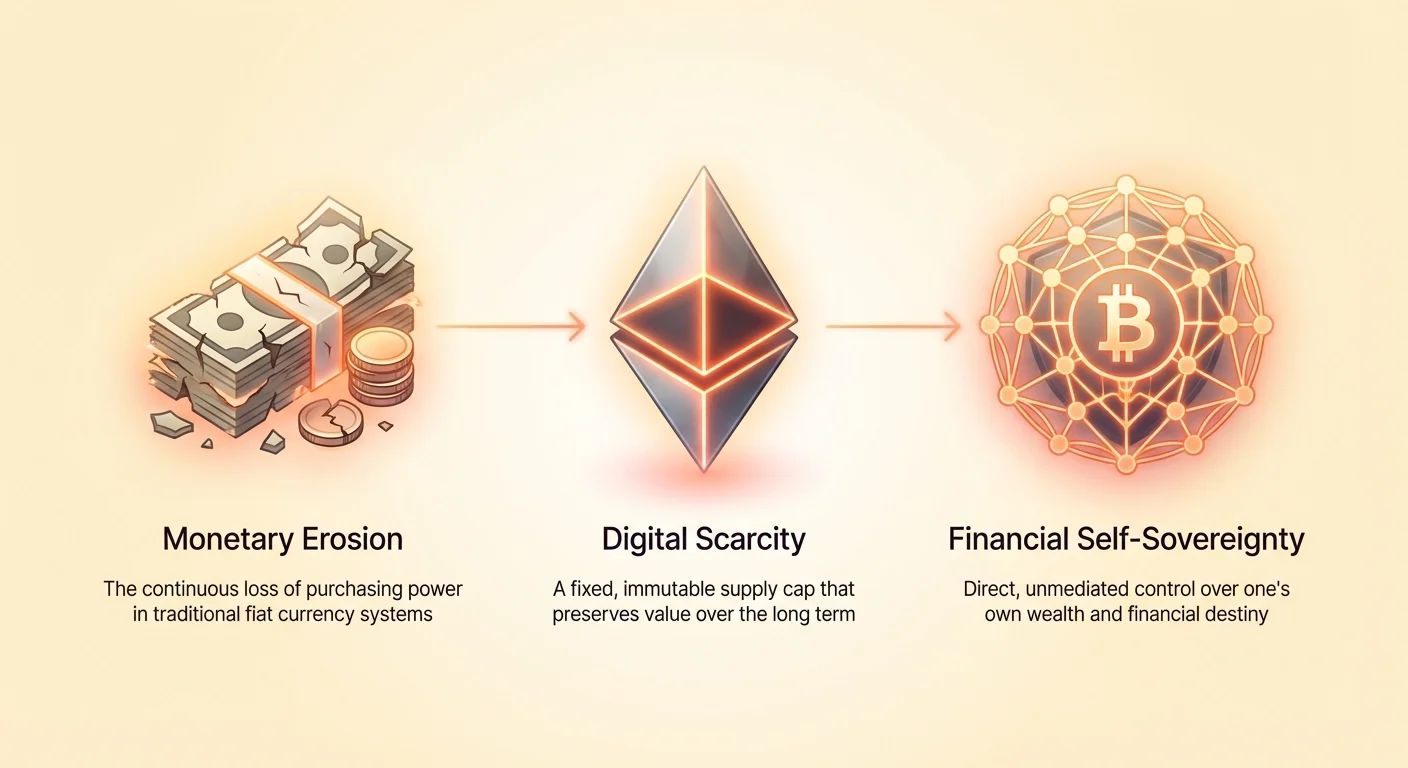
The Erosion of Value: Confronting Inflation and Monetary Policy
The single greatest threat to the wealth of the average person is the loss of purchasing power over time. This erosion is the direct result of inflation, a phenomenon central banks often manage but rarely eliminate.
The Hidden Tax: Understanding Fiat Inflation
The currencies used globally today—dollars, euros, yen—are known as fiat currencies. They are not backed by a physical commodity like gold; instead, their value is derived purely from government decree. Governments and central banks have the power to create more fiat currency whenever they deem necessary, typically to stimulate the economy or cover national debts.
While printing money sounds like a quick fix, it has a severe consequence: it increases the total supply of money without increasing the total supply of goods and services. This dilutes the value of every existing unit of currency. For you, this means your savings buy less every year. Inflation acts as a "hidden tax" on cash holders, constantly reducing your standard of living if your wages or investments don't outpace the rate of monetary expansion. This slow, predictable loss of purchasing power is the primary pain point that leads many people to seek assets with predictable scarcity.
Predictable Scarcity: Bitcoin’s Fixed Supply Cap
One of the most revolutionary concepts introduced by Bitcoin is its fixed and predictable supply schedule. There will only ever be 21 million Bitcoin (BTC). This limit is mathematically enforced by the code and cannot be changed by any single government, bank, or corporation.
This characteristic makes Bitcoin the opposite of fiat currency in terms of supply. Fiat currency is elastic and inflationary; Bitcoin is inelastic and deflationary (in relation to its supply schedule). Knowing that the maximum supply is capped offers unparalleled certainty. When you decide to use Bitcoin, you are choosing an asset designed to preserve value over the long term, directly addressing the pain point of fiat inflation.
Decentralized Control: Removing the Middleman
In the traditional system, a handful of powerful institutions control the monetary levers: setting interest rates, determining reserve requirements, and deciding when to print money. These decisions are made behind closed doors, often in response to political pressures or temporary crises, and they affect everyone globally.
Bitcoin operates without a central governing body. It is run by a global network of computers (nodes). No single entity can decide to increase the supply, reverse a transaction, or freeze an account. This decentralized structure means that control over your money is removed from the political domain and placed directly in your hands. This is the core benefit of decentralized money: it provides an objective, rules-based system rather than a subjective, trust-based one. When you use Bitcoin, you trust mathematics and code, not fallible human institutions.
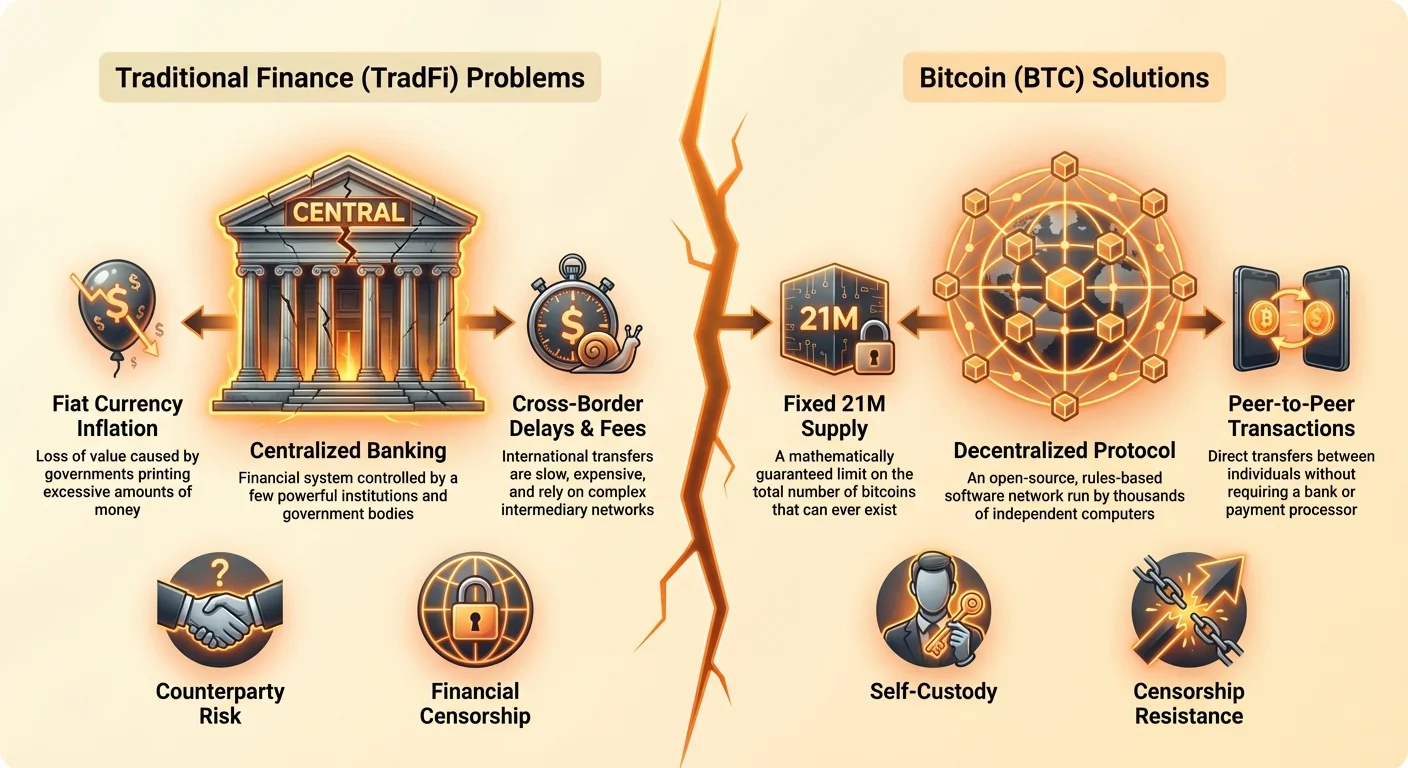
Freedom of Movement: Eliminating Financial Borders and Delays
In an increasingly globalized world, moving money across borders should be simple. Yet, international finance remains archaic, expensive, and frustratingly slow. For individuals, small businesses, and especially migrant workers sending remittances, these fees and delays constitute a major pain point.
Cross-Border Transfers: Cheaper and Faster Remittances
Consider the process of sending money internationally through traditional channels, such as banks or wire transfer services. The fees can range from 3% to 10% of the total amount, and the transfer can take several days to complete, especially if time zone differences or bank holidays are involved. These costs disproportionately affect those who rely on remittances (money sent home by migrant workers), where every percentage point lost to fees represents food, medicine, or tuition denied to a family member.
Bitcoin solves this by treating every transaction equally, regardless of geography. Sending $1,000 across the street or across an ocean involves the same fundamental process and incurs low network transaction fees (which vary based on network congestion, but are often significantly less than 5%). The transaction finalizes in minutes, not days. This capability is why use bitcoin is a powerful choice for anyone engaged in global commerce or supporting family abroad. It bypasses the slow, proprietary infrastructure of the legacy system entirely.
Solving the Correspondent Banking Problem
Traditional international transfers rely on a complex web of "correspondent banks" that must maintain accounts with each other to settle transactions. This structure is slow, expensive, and requires a high degree of mutual trust and regulation. The entire process introduces multiple points of failure and opacity.
Bitcoin eliminates the need for this layered system. The Bitcoin network itself is the settlement layer. Instead of bouncing money between three different banks in three different countries, you are simply broadcasting a transaction onto a single, global ledger. This simplification dramatically reduces overhead, speeds up settlement times, and, crucially, lowers the capital required for small businesses to participate in international trade.
24/7 Availability: No Bank Holidays or Business Hours
When was the last time you tried to make a significant bank transfer after 5 PM on a Friday? Chances are, the transfer won't fully process until Monday morning. Traditional banks operate on restricted business hours and observe national holidays, creating bottlenecks in global commerce.
The Bitcoin network is open 24 hours a day, 7 days a week, 365 days a year. It operates independently of national borders, time zones, and public holidays. This continuous operation ensures that liquidity is always available and transactions can be initiated and finalized anytime, offering predictable reliability that traditional financial systems cannot match.
The Challenge of the Unbanked and Underbanked
A staggering 1.4 billion adults worldwide remain "unbanked," meaning they lack access to basic financial services like savings accounts or credit. Millions more are "underbanked," relying on expensive, predatory services like payday lenders or check-cashing stores. This financial exclusion is a significant economic and social pain point, often trapping individuals in poverty.
Access with a Smartphone: Financial Inclusion
Traditional banking requires extensive documentation (utility bills, government IDs, physical addresses) that many people in developing nations or marginalized communities simply do not possess. Bitcoin and cryptocurrencies, however, require only a cheap smartphone and internet access.
A person can download a non-custodial wallet (a software application) and immediately access the global financial system. There are no forms to fill out, no minimum balances, and no background checks. This dramatically lowers the barrier to entry, offering secure savings and transaction capabilities to individuals previously excluded by geographical location or documentation requirements. For the unbanked, this transition from financial invisibility to having a functional, secure digital bank account is one of the most powerful benefits of decentralized money.
Establishing Economic Identity Without Government ID
In many unstable or developing countries, maintaining reliable documentation can be impossible. Without official government identification, it is extremely difficult to establish a formal economic identity, which prevents access to loans, insurance, or formal employment.
Bitcoin provides a path toward establishing economic identity through ownership of private keys (the cryptographic proof of ownership). While this is not a perfect substitute for traditional ID, it allows individuals to participate in digital commerce, receive wages, and save money securely outside the confiscatory reach of unstable regimes. Bitcoin empowers individuals to build a digital financial history and footprint without needing permission from a bureaucratic authority.
The Cost of Exclusion
Being unbanked is expensive. Without access to bank accounts, individuals must rely on physical cash, making them vulnerable to theft, or pay high fees to use informal lending services. The lack of savings infrastructure means that even small emergency expenses can destabilize a family's financial future.
Bitcoin offers these individuals an alternative—a robust, globally accepted, and highly secure digital savings vehicle that is easily divisible (you can own fractions of a Bitcoin, known as Satoshis) and requires virtually zero maintenance fees. It transforms a mobile phone from a communication tool into a financial device capable of engaging with the global digital economy.
Protection and Privacy: Securing Your Wealth Against Seizure
In a world increasingly characterized by political volatility and rapid changes in regulation, the ability to protect one's assets from arbitrary seizure or censorship is paramount. Traditional financial assets are fundamentally exposed to "counterparty risk"—the risk that the entity holding your money (the bank or payment processor) fails, freezes your account, or is instructed by a government to confiscate your funds.
Censorship Resistance: The Power of Self-Custody
The pain point of central control is that any central authority—a bank, a company, or a government—can decide to freeze your assets or block a transaction. This is known as financial censorship. Whether due to sanctions, political dissent, or simple error, accounts are routinely restricted.
Bitcoin is censorship-resistant because it is not held or managed by an intermediary. When you hold your Bitcoin in a self-custodial wallet (meaning you control the private keys), no bank, corporation, or government can physically stop you from spending, receiving, or holding your funds. The transaction may be recorded on a public ledger, but the control over the spending key remains solely with the owner. This is one of the foundational benefits of decentralized money: it offers absolute control over your private property.
Reducing Counterparty Risk (The "Not Your Keys" Principle)
The 2008 financial crisis highlighted the immense counterparty risk inherent in the banking system. When banks fail, depositors are reliant on government guarantees (like FDIC insurance in the US) to recover their funds.
Using Bitcoin properly allows you to eliminate counterparty risk entirely. When Bitcoin is held in a wallet where you possess the private keys, the risk of failure shifts from a centralized institution to the user's personal security practices. This transition from "trusting a bank" to "trusting yourself" is the core concept of self-custody and provides an unprecedented level of security against institutional collapse or interference.
Protecting Assets in Times of Crisis or Political Instability
For those living under authoritarian regimes or in regions experiencing hyperinflation or political upheaval, holding all wealth in local banks or local fiat currency is dangerous. Governments facing instability often resort to capital controls, currency devaluation, or outright seizure of assets.
Bitcoin offers a lifeline. Because it is decentralized and non-physical, wealth stored in Bitcoin can be carried across borders simply by memorizing a 12 or 24-word seed phrase (the key to the wallet). This portability and seizure resistance makes Bitcoin an essential tool for refugees, political dissidents, and anyone seeking a safe, secure store of value that cannot be easily confiscated, directly addressing the ultimate financial pain point: the loss of property rights.
Bitcoin as a New Standard for the Digital Economy
While many people approach Bitcoin primarily as an investment vehicle (addressing the pain point of inflation), its true long-term importance lies in establishing a new, open-source protocol for value transfer that parallels the revolutionary impact of the internet protocol (TCP/IP) for information transfer.
Programmable Money and Innovation
Bitcoin is more than just a digital currency; it is a foundational layer upon which complex financial services can be built—often referred to as programmable money. Its underlying technology, the blockchain, allows for layers of innovation that solve additional complexity pain points.
For instance, the Lightning Network, built on top of Bitcoin, solves the minor pain point of transaction speed and high fees during periods of network congestion, allowing for instant, high-volume micropayments. This layered approach enables Bitcoin to function both as a slow, secure settlement layer (like transferring large sums between continents) and as a fast, cheap payment rail (like buying a coffee). This flexibility facilitates future financial innovation that is inherently trustless and open-source.
Transparency Through the Public Ledger
While Bitcoin grants individual control over funds, it achieves its security through radical transparency. Every single transaction ever made is recorded on the public, immutable ledger (the blockchain). This solves the traditional pain points of opacity and hidden risk that characterize fractional reserve banking and derivative markets.
Anyone can audit the total supply of Bitcoin (verifying the 21 million cap) and see the flow of funds across the network. While the identities of the wallet owners are pseudonymous (known only by their public address), the transactional integrity is fully transparent. This level of auditability provides a robust defense against fraud and corruption within the system itself, offering certainty that fiat systems lack.
A New Definition of Digital Property
Ultimately, Bitcoin solves the modern digital pain point of defining and controlling scarcity in the digital realm. Before Bitcoin, digital items—whether money, songs, or documents—were easily copied and duplicated. This made true digital ownership impossible.
Bitcoin introduced a system that mathematically enforces digital scarcity. When you own a Bitcoin, you possess the only cryptographic key that allows that specific unit of value to move. This capability has profound implications for digital rights, intellectual property, and establishing the foundation for all future digital assets. It transforms digital data from an infinitely reproducible resource into unique, self-owned property.
Conclusion: The Path to Self-Sovereignty
The decision to explore Bitcoin is often driven by a fundamental dissatisfaction with the status quo. Whether you are concerned about your savings being eroded by inflation, frustrated by high fees and slow transfers, or worried about financial access in an unstable world, Bitcoin offers tangible, mathematical solutions.
Bitcoin matters now because it is the first widely adopted system that allows individuals to opt out of the centralized, trust-based financial system and transition to an open, rules-based system. It provides inflation resistance through absolute scarcity, enables borderless and cheap transactions, guarantees financial access regardless of identity, and protects wealth against seizure through self-custody.
Understanding these "Why's" is the essential first step on the Crypto Roadmap. Once the motivations are clear, the next logical step is to understand the mechanics of the system: what a Bitcoin (or a Sat) actually is, how the network operates, and most importantly, how to safely secure your first piece of digital property.