
The journey from cryptocurrency novice to skilled practitioner involves more than just selecting the right assets; it requires mastering the mechanics of the market itself. For those transitioning into strategic, high-volume, or frequent trading, efficiency in execution becomes paramount. A fraction of a percent lost on every trade, when multiplied across hundreds of transactions, can significantly erode profits.
This guide focuses on two critical, interconnected concepts: liquidity and slippage. Understanding how these forces interact in both centralized (CEX) and decentralized (DEX) environments is the key to optimizing your asset flow and ensuring you execute trades at the price you expect, rather than the price the market dictates. We will move beyond simple buying and selling to explore the microstructure of the market, offering tangible strategies for minimizing unwanted costs, protecting large orders, and achieving execution precision in crypto’s highly volatile ecosystem.
1. The Foundations of Market Liquidity
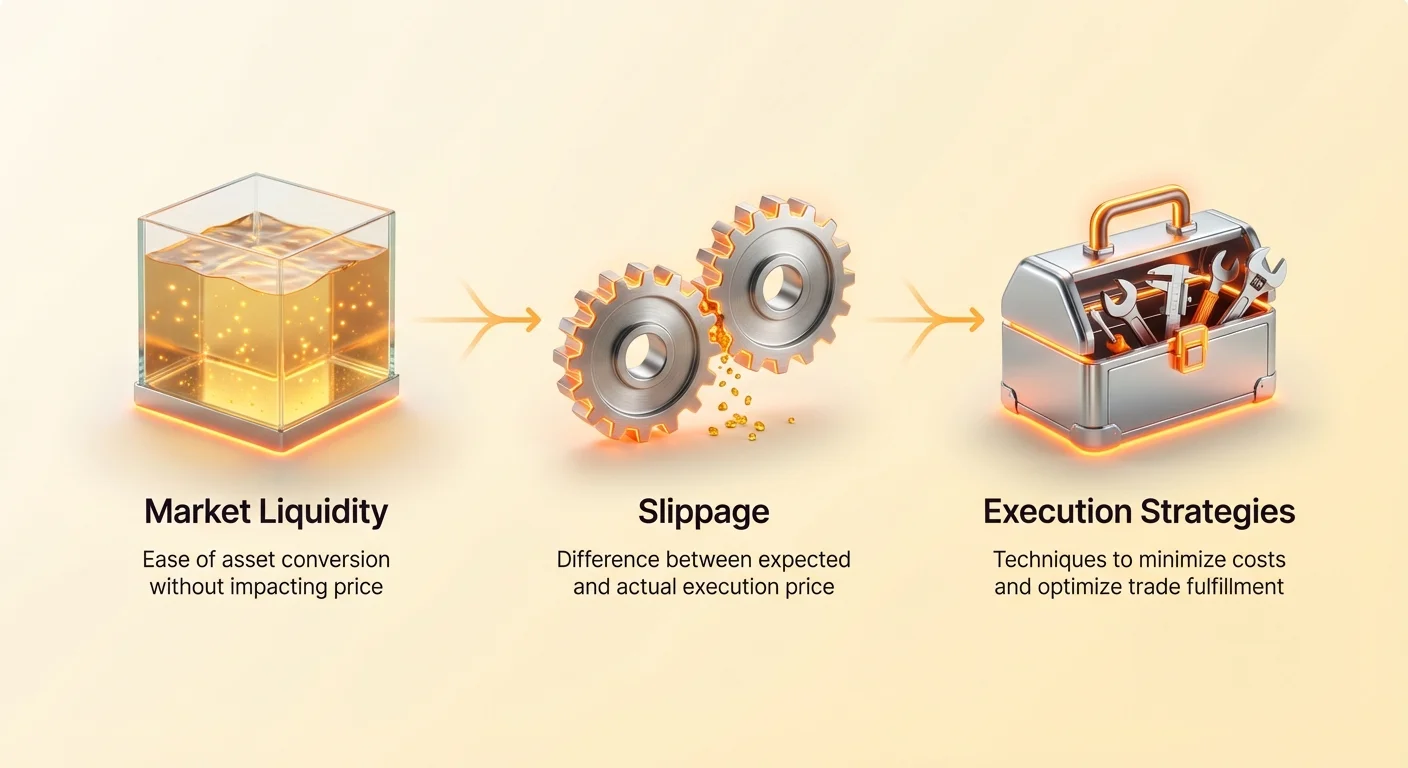
Liquidity fundamentally refers to how easily an asset can be converted into cash (or another asset) without affecting its price. In the cryptocurrency world, high liquidity means a deep, healthy market where large orders can be filled quickly and cheaply. Low liquidity means the opposite: executing a large trade is likely to move the price significantly against you.
Understanding Bid-Ask Spreads and Depth
The primary indicator of liquidity on a centralized exchange (CEX) is the order book, which lists all active buy and sell orders.
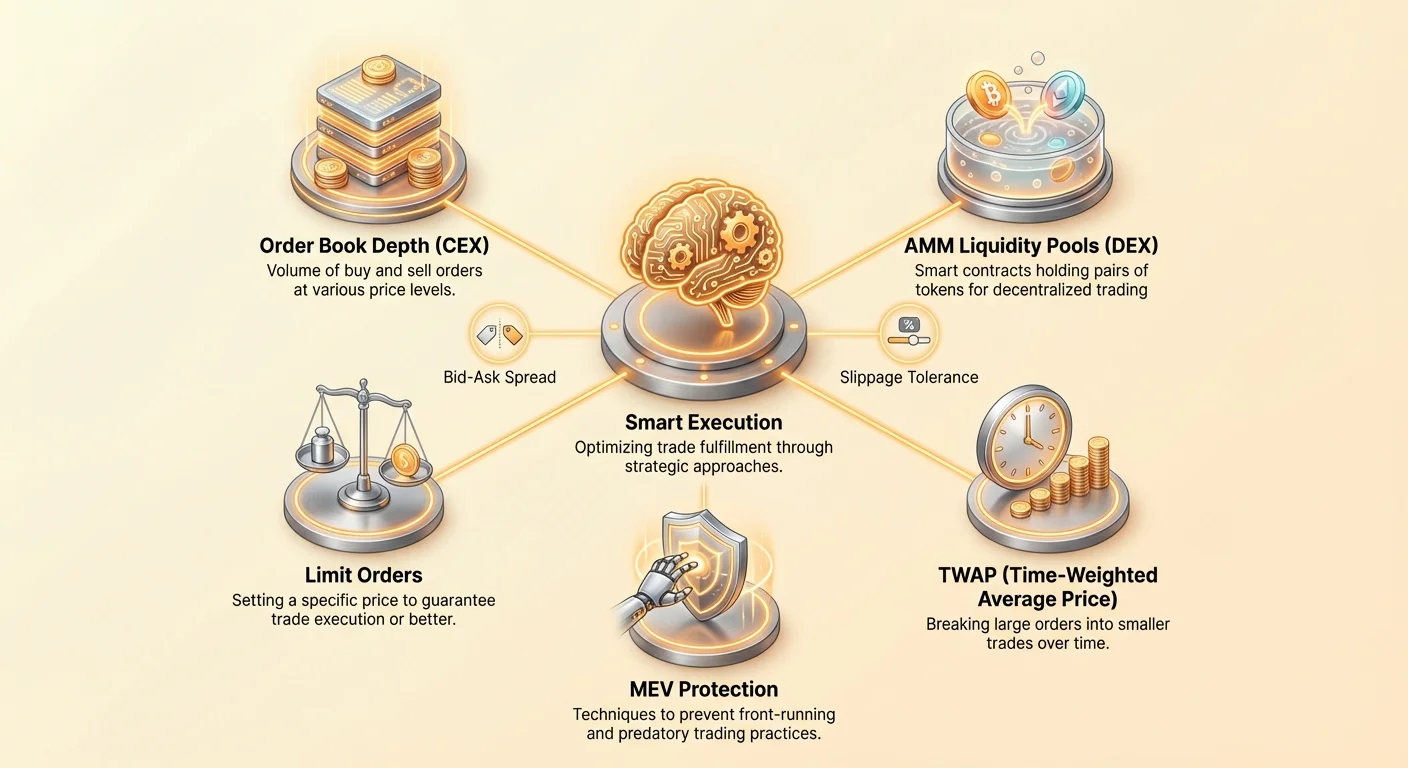
The bid is the highest price a buyer is willing to pay. The ask is the lowest price a seller is willing to accept. The difference between these two prices is the bid-ask spread.
- Tight Spread (Low Slippage Risk): A small gap between the bid and ask indicates high liquidity. Buyers and sellers are closely aligned, and competition is fierce. You can execute trades near the current market price easily.
- Wide Spread (High Slippage Risk): A large gap suggests low trading activity. If you place a market order, you must cross that wide gap, potentially fulfilling your order at a much worse price.
Depth refers to the total volume of orders waiting to be filled at various price levels beyond the immediate bid and ask. For example, if you want to sell 100 BTC, you need the order book to have enough buying interest across subsequent price levels to absorb that volume. If the depth is shallow, your sell order will consume all immediate bids and force the price down rapidly.
Why Liquidity Matters for Efficiency
In traditional finance, large institutional players spend millions optimizing trade execution because efficiency directly translates to returns. In crypto, where volatility can easily hit 10% in a single day, poor execution is magnified.
For the intermediate crypto user, focusing on liquidity allows you to:
- Reduce Transaction Costs: Trading in liquid assets and on liquid exchanges means tighter spreads and lower implicit costs.
- Ensure Timely Exits: During sudden market crashes, liquidity often dries up. If you are holding a highly liquid asset, you are much more likely to be able to sell quickly before the price bottoms out completely.
- Support Larger Trades: Any trade that significantly exceeds the current best bid or ask will incur high slippage. By selecting venues with proven deep order books, you can execute larger positions without disrupting the spot price.
2. Decoding Slippage: The Hidden Cost of Execution
Slippage occurs when the final execution price of your trade differs from the expected price (the price shown on the screen when you clicked "execute").
While slippage is often associated with negative outcomes (i.e., you bought higher than expected or sold lower than expected), technically, it is simply a difference between expectation and reality. However, for strategic traders, it is almost always managed as a risk factor.
Defining Expected vs. Actual Execution Price
When you submit a market order to instantly buy 10 ETH, the exchange attempts to fill that order using the best available prices on the order book.
Example Scenario (CEX):
- Expected Price: The last traded price is $3,000.
- Order Book Depth:
- 1 ETH available at $3,000.00
- 2 ETH available at $3,000.50
- 7 ETH available at $3,001.00
- Execution: Your 10 ETH order consumes all three levels.
- Actual Execution Price (Weighted Average): The average price you paid is $3,000.75.
- Slippage: The difference between $3,000.00 (expected) and $3,000.75 (actual) represents slippage. This happens because your order had to "walk up" the order book to find sufficient sellers.
This slippage represents a direct, often overlooked, cost that subtracts from your potential profit.
Setting the Slippage Tolerance Threshold
Most decentralized exchanges (DEXs) and some advanced CEX platforms require you to manually define a slippage tolerance. This is the maximum percentage deviation from the expected price you are willing to accept before the transaction fails and is reverted.
Practical Application:
- Low Tolerance (e.g., 0.1%): Recommended for highly liquid pairs (like BTC/USD or ETH/USDC) and small-to-medium trade sizes. This maximizes price protection but increases the risk of the transaction failing if the market moves even slightly while the transaction is pending.
- High Tolerance (e.g., 3.0%): Sometimes necessary when trading extremely low-liquidity altcoins or newly launched tokens. While it ensures the trade executes, you expose yourself to severe price deterioration.
For strategic execution, the goal is always to use the lowest feasible tolerance to ensure the desired price, while accepting that large trades often require slightly higher tolerance to guarantee filling the order.
3. Market Microstructure: CEX vs. DEX Execution
The strategies needed to mitigate slippage depend entirely on the venue you are using, as centralized and decentralized platforms handle execution mechanics fundamentally differently.
Impact of Order Book Depth (Centralized Exchanges)
Centralized Exchanges (CEXs) use the traditional Limit Order Book (LOB) model described above. Strategies for managing slippage here rely on understanding and utilizing the available depth:
- Limit Orders: The primary tool against slippage on a CEX is the limit order. By setting a limit price, you guarantee that your trade will not execute at a worse price than specified. The drawback is that the order may not execute immediately, or at all, if the market moves away from your price.
- Market Takers vs. Market Makers: A slippage-conscious trader aims to be a Market Maker (placing limit orders, adding depth to the book) rather than a Market Taker (placing market orders, removing depth and causing slippage).
Automated Market Makers (AMMs) and Impermanent Loss
Decentralized exchanges (DEXs) utilize Automated Market Makers (AMMs), popularized by platforms like Uniswap and SushiSwap. AMMs do not use order books; instead, they rely on liquidity pools—smart contracts holding pairs of tokens (e.g., ETH and USDC).
The price of the token is determined by a mathematical formula, most famously $X * Y = K$, where $X$ is the quantity of the first token, $Y$ is the quantity of the second, and $K$ is a constant total liquidity value.
How AMM Slippage Works:
When you trade on an AMM, you are not matching against another person's order; you are adjusting the ratio within the pool.
- If you buy a large amount of ETH using USDC, you increase the amount of USDC in the pool and decrease the amount of ETH.
- To keep the $K$ constant, the pool must automatically adjust the price to make ETH more expensive and USDC cheaper.
- The larger the trade, the more the ratio is skewed, and the higher the price change—this immediate price change is slippage.
For traders utilizing DEXs, slippage is unavoidable on large orders unless the pool's $K$ value (the total liquidity) is enormous. Furthermore, the act of trading causes a temporary price imbalance that opens the door to arbitrage, where external bots instantly correct the price imbalance, costing the original trader efficiency.
4. Advanced Execution Strategies to Minimize Slippage
Mastering execution involves moving beyond simple "Buy Market" orders and employing systematic approaches, especially when dealing with significant capital.
Large Order Execution: Splitting and Time-Weighted Averaging (TWAP)
Executing a multi-million-dollar order instantly is guaranteed to incur significant slippage and disrupt the market. Strategic traders employ techniques to disguise their intent and absorb liquidity slowly.
1. Order Splitting (Iceberging)
This is the simplest strategy for high-volume traders. Instead of executing one massive order, the trader splits it into many smaller limit orders.
Example: Instead of selling 50 BTC at market, you place 50 separate limit sell orders for 1 BTC each, spaced out slightly down the order book. This approach requires patience but ensures your trade fills at optimal average prices by not overwhelming the immediate bids.
2. Time-Weighted Average Price (TWAP)
TWAP is an execution algorithm that automates order splitting over a set time period. If you want to buy $1 million worth of BTC over the next four hours, the TWAP algorithm will automatically break that order into hundreds of micro-orders, releasing them to the market at regular intervals.
Benefits of TWAP:
- Mitigation of Volatility: By trading continuously over time, you smooth out the effects of temporary market spikes or dips.
- Disguising Intent: No single large order signals your volume, preventing other high-frequency traders or bots from anticipating your moves.
These algorithmic strategies are typically available through professional trading interfaces, dedicated brokers, or institutional crypto platforms.
Leveraging Specialized Platforms (OTC and Dark Pools)
When volumes are too high for even sophisticated TWAP strategies (e.g., $500,000+), trading on a public exchange becomes inefficient due to the cost of slippage.
Over-the-Counter (OTC) Trading
OTC desks facilitate direct, peer-to-peer trades without involving the public order book of a CEX.
- Slippage Reduction: When you trade OTC, the desk locks in a single, guaranteed price for the entire transaction. Since the trade happens off-exchange, it has zero impact on the spot price and therefore zero slippage.
- Ideal Use Case: Institutions, venture funds, or individual whales looking to buy or sell massive quantities of assets (e.g., converting corporate treasury funds).
Note: For a detailed understanding of the advantages and access requirements for these private venues, refer to our dedicated guide on [Understanding OTC Trading and High-Volume Institutional Access].
5. Protecting Your Trade: Dealing with Volatility and Front-Running
In the world of blockchain, especially on DEXs, the concept of slippage is complicated by the transparency of pending transactions and the emergence of predatory trading practices.
The Menace of Miner/Maximal Extractable Value (MEV)
MEV refers to the profit miners (or validators in Proof-of-Stake systems) and transaction relayers can extract by reordering, including, or censoring transactions within a block. The most common form of MEV extraction relevant to slippage is front-running.
Front-Running Scenario (DEX):
- A large trader submits a transaction to buy $100,000 worth of Token X on a DEX pool. This transaction is visible in the blockchain's memory pool (mempool) before it is confirmed.
- A specialized bot sees this large transaction and immediately knows it will significantly increase the price of Token X (causing the original trader slippage).
- The bot quickly submits a buy order for Token X with a slightly higher gas fee than the original trader, ensuring the bot's transaction executes first.
- The bot buys Token X, causing the price to jump slightly.
- The original trader's $100k trade executes next, but at the now-higher price (incurring extra slippage).
- The bot then immediately sells Token X for a guaranteed profit.
This practice is parasitic and directly increases the slippage cost for the strategic trader.
Tools and Platforms for Front-Running Protection
Combating MEV requires utilizing execution methods that bypass the public mempool or rely on specialized mechanisms.
1. Private Transaction Bundling (e.g., Flashbots)
Tools like Flashbots enable users to submit transactions directly to mining or validating pools, skipping the public mempool entirely. This hides the order from front-running bots.
- Mechanism: Your transaction is bundled privately with the block, ensuring that no one can see it or jump in front of it before it confirms.
- Goal: To achieve a private execution path, significantly reducing the risk of hostile slippage and ensuring price integrity.
2. Specialized DEX Aggregators
Modern DEX aggregators (like 1inch or Paraswap) automatically route your trade across multiple liquidity pools to find the best price and deepest liquidity. Furthermore, many now incorporate MEV protection by utilizing private relay networks, automatically submitting orders in a way that is less likely to be front-run. When using a DEX, choosing an aggregator that offers protection is a critical execution strategy.
6. Mastering Liquidity Analysis and Compliance
Strategic execution requires continuous monitoring of market conditions and disciplined record-keeping to manage regulatory risks.
Monitoring Real-Time Liquidity Metrics
A skilled intermediate trader does not rely solely on the CEX interface but actively seeks external data to gauge the health of a crypto asset's market.
Key Metrics to Track:
| Metric | Definition | Importance for Execution |
|---|---|---|
| 2% Market Depth | The total volume available within 2% of the mid-price. | A high volume indicates you can move the price by less than 2% when executing a large order. (High is better). |
| Liquidity Score | A composite score often provided by data sites (e.g., CoinMarketCap, CoinGecko) that combines volume, spread, and depth metrics. | Use this to compare the true tradability of different assets before making an investment. |
| Trading Volume History | Look at volume trends over the last 24 hours and 7 days. | Consistent high volume suggests persistent liquidity, whereas volatile volume spikes may indicate temporary activity or manipulation. |
Actionable Tip: Always check the 2% market depth before executing any trade that exceeds 10% of the asset's current 24-hour volume. If your trade is larger than the 2% depth, prepare for high slippage.
The Role of Tax Reporting in High-Frequency Trading
While execution efficiency focuses on profit maximization, effective asset management requires acknowledging the implications of your trading activity on compliance. High-frequency or high-volume execution strategies, particularly those involving automated splitting or multiple DEX transactions (which generate high transaction counts), exponentially increase the complexity of tax reporting.
Every split order, every micro-trade, and every failed transaction (due to tolerance breach) must be tracked accurately to calculate the cost basis, capital gains, and potential income events.
- Complexity: Strategies like TWAP or complex routing across multiple DEX pools can generate hundreds of taxable events daily.
- Mitigation: Strategic traders must integrate robust crypto tax software or utilize accounting firms specializing in digital assets from the outset. Ensuring every transaction is accurately logged prevents future compliance headaches and ensures that the efficiency gained in execution is not lost to regulatory scrutiny.
Conclusion: The Path to Optimized Execution
Mastering liquidity and slippage is the crucial intermediate step between being a casual buyer and becoming an efficient, strategic asset manager. It shifts the focus from "Can I buy this coin?" to "Can I execute this trade at a minimal cost and optimal price?"
By employing the strategies outlined—understanding the fundamental differences between CEX and AMM structures, using limit orders and order splitting for large volumes, leveraging OTC desks when appropriate, and defending your trades against MEV—you gain a decisive advantage. In the volatile digital economy, minimizing slippage is not merely a detail; it is a discipline that directly translates to enhanced portfolio returns and optimized transactional flow, building the foundation for true self-sovereignty in your financial operations.