
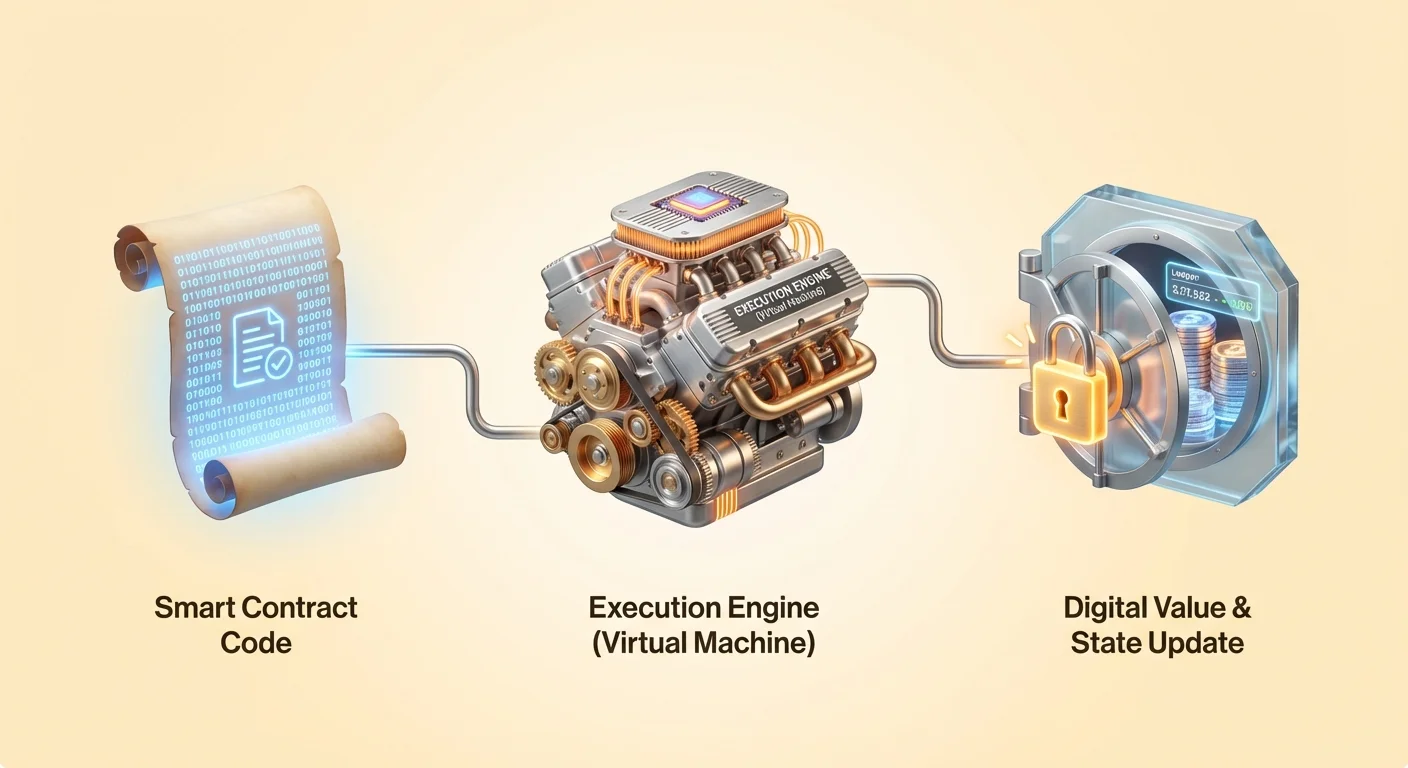
At the heart of every functional blockchain network lies a powerful mechanism responsible for processing transactions and updating the digital ledger. While the distributed ledger records the history of ownership, it is the execution engine that determines how the state of the network changes from one block to the next. This component, often referred to as a virtual machine, acts as the decentralized computer that processes the code developers write. Without this engine, a blockchain would simply be a static list of entries rather than a dynamic platform for applications.
The most famous of these engines is the Ethereum Virtual Machine, or EVM. However, as the cryptocurrency landscape evolves, new architectures and execution environments are emerging to challenge the status quo. These modern systems aim to solve inherent limitations in earlier designs, particularly regarding speed and cost. Understanding how these virtual machines function is essential for grasping the technical capabilities of different crypto assets. It explains why some networks are slower but more secure, while others prioritize rapid throughput.
The Digital Sandbox Environment
A virtual machine in the context of blockchain operates as a sandboxed environment. This means it is completely isolated from the rest of the network's infrastructure. When a smart contract is executed, the code runs inside this protective container. The isolation ensures that a malicious program cannot access the file system of the node running it or interfere with other distinct processes. This security feature is critical for maintaining the integrity of a decentralized network where anyone can deploy code.
The primary function of the execution engine is to interpret bytecode. Developers write smart contracts in higher-level languages, but machines cannot read this human-readable text directly. The code is compiled into bytecode, a low-level language that the machine interprets instruction by instruction. When a user initiates a transaction that interacts with a smart contract, the virtual machine reads the bytecode associated with that contract and performs the requested operations. This process results in a state change, such as updating a token balance or changing the owner of a digital asset.
Turing Completeness and Logic
One of the defining characteristics of advanced execution engines like the EVM is Turing completeness. This computer science concept means that the system can theoretically solve any computational problem, given enough time and resources. In practical terms, it allows developers to write complex logic, loops, and conditional statements into their smart contracts. This programmability is what separates platforms like Ethereum from the original Bitcoin network, which uses a more limited scripting language focused primarily on simple value transfers.
However, this flexibility introduces significant complexity. Because the machine allows for loops and intricate calculations, there is a risk that a poorly written program could run forever, clogging the network. To prevent this, execution engines rely on strict resource metering. Every operation, from a simple addition to a complex storage update, is assigned a specific cost. This ensures that the network remains operational even when users attempt to run heavy or malicious code.
The Economics of Execution
The computational resources required to run these virtual machines are not free. In the blockchain ecosystem, this cost is quantified through a system known as gas. Gas serves as the fuel that powers the execution engine. It measures the specific amount of computational effort required to process a transaction or execute a smart contract function. Just as a car requires fuel to move from one point to another, a blockchain transaction requires gas to push data through the virtual machine.
This mechanism serves two vital purposes. First, it allocates scarce network resources by charging users based on the complexity of their requests. A simple transfer of cryptocurrency requires relatively little computational power and therefore costs less gas. In contrast, interacting with a decentralized exchange or minting a non-fungible token (NFT) involves writing significant amounts of data to the blockchain. These complex operations consume more gas units, resulting in a higher transaction fee for the user.
Market-Driven Fee Dynamics
While the amount of gas units required for a specific action is generally constant, the price of that gas fluctuates based on supply and demand. This creates a dynamic fee market. When many users compete to have their transactions included in the next block, they must offer a higher price per unit of gas to incentivize validators. This is why fees can skyrocket during periods of network congestion. Users essentially bid against one another for the limited space available in the execution block.
The calculation of the total fee is straightforward but variable. It is the product of the gas used multiplied by the gas price. On networks like Ethereum, this price is often denominated in gwei, a smaller unit of the native currency. This granular pricing allows for precise adjustments in cost. During quiet periods, the cost to execute code drops significantly, making the network more accessible for complex operations. Conversely, high activity turns the execution engine into a premium resource reserved for high-value transactions.
Spam Prevention and Security
Beyond resource allocation, the fee system acts as a critical security barrier. By attaching a real-world cost to every computational step, the network makes spam attacks prohibitively expensive. A malicious actor attempting to flood the network with infinite loops or junk data would deplete their funds rapidly. The execution engine tracks the gas consumption in real-time during processing. If a transaction runs out of the allocated gas limit before completing, the machine halts the operation and reverts any changes, but the fees paid are still forfeited to the network.
Consensus vs. Execution
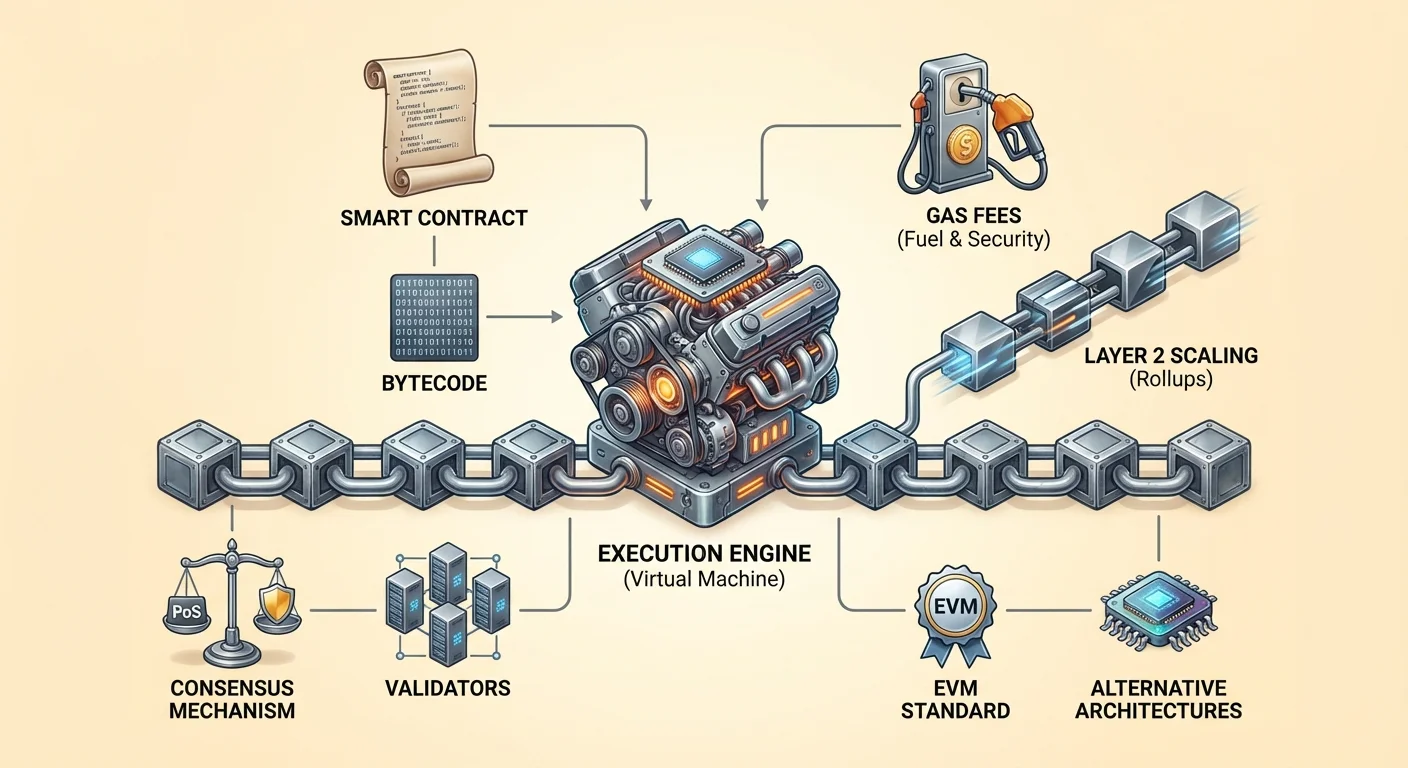
It is important to distinguish between the consensus mechanism and the execution engine, although they work in tandem. The consensus mechanism, such as Proof of Stake (PoS), is responsible for ordering blocks and agreeing on the validity of the ledger. The execution engine is responsible for processing the transactions within those blocks. In a PoS system, validators are chosen to propose new blocks based on the amount of cryptocurrency they have staked. This highlights the foundational difference between the mechanisms of trust and the computational layer.
When a validator is selected to create a block, they take a bundle of pending transactions and run them through the virtual machine. This process verifies that the transactions are valid according to the protocol's rules. For example, the engine checks that the sender has sufficient funds and that the digital signatures match. Once the execution is complete and the new state is calculated, the block is propagated to the rest of the network. Other validators then re-execute the transactions to confirm the result before appending the block to the chain.
The Role of Validators
Validators play a dual role in this ecosystem. They secure the network financially through staking, and they provide the hardware infrastructure to run the execution engine. If a validator acts maliciously or fails to maintain their node, they risk losing a portion of their staked assets. This financial guarantee ensures that the entities running the virtual machine have a vested interest in its accurate operation.
The transition of major networks to Proof of Stake has maintained the functionality of their execution engines while drastically reducing energy consumption. The actual processing of smart contracts remains the same; only the method of selecting the processor has changed. This highlights the modular nature of blockchain architecture, where the execution layer can be preserved even as the underlying consensus security model evolves.
The Dominance of the EVM Standard
The Ethereum Virtual Machine has established itself as the de facto standard for smart contract execution. Its early mover advantage created a massive network effect, leading to a vast ecosystem of developer tools, documentation, and existing codebases. Because of this dominance, many competing blockchains have chosen to adopt EVM compatibility. This allows them to execute smart contracts written for Ethereum without modification.
Networks like BNB Smart Chain, Polygon, and Avalanche implement the EVM to leverage this existing infrastructure. By doing so, they allow developers to deploy applications to their networks using the same languages and tools they use on Ethereum. This strategy significantly lowers the barrier to entry for new blockchains, as they do not need to convince developers to learn a new programming language or build a new set of tools from scratch.
Benefits of Compatibility
The primary benefit of this standardization is interoperability at the code level. A decentralized application (dApp) built for one EVM-compatible chain can be ported to another with minimal effort. This fosters a multi-chain environment where users can access similar services across different networks, often with varying cost and speed profiles. For instance, a user might use a high-speed, low-cost EVM chain for frequent trading while using the main Ethereum network for high-value settlement.
However, compatibility also means inheriting the limitations of the architecture. The original design of the EVM prioritizes security and decentralization, sometimes at the expense of raw performance. As a sequential processing machine, it handles transactions one after another. This design choice can become a bottleneck during periods of extreme demand, leading to the congestion and high fees previously discussed.
| Feature | EVM Compatible Chains | Non-EVM Chains |
|---|---|---|
| Language | Solidity, Vyper | Rust, Move, C++ |
| Portability | High (Copy/Paste code) | Low (Rewrite required) |
| Tooling | Mature (Metamask, Remix) | Emerging/Custom |
Alternative Architectures and Speed
In response to the scalability constraints of the traditional EVM, alternative execution models have emerged. These systems often prioritize high throughput and parallel processing. For example, networks like Solana utilize a different architecture that allows for the processing of multiple transactions simultaneously. By breaking away from the sequential model, these engines can handle a significantly higher volume of activity per second.
These high-performance chains often forego the strict "gas" terminology, though they still require native tokens to pay for transaction fees. The focus in these architectures is on maximizing the efficiency of the hardware running the node. Instead of a general-purpose engine that runs on consumer-grade hardware, these networks often require validators to use enterprise-grade servers to keep up with the sheer speed of execution.
The Trade-off Spectrum
The choice between execution engines often comes down to a trade-off between compatibility and performance. Adopting a novel architecture allows a blockchain to optimize for specific use cases, such as high-frequency trading or massive-scale gaming, which might be cost-prohibitive on a standard EVM chain. However, this comes with the cost of a fragmented developer ecosystem. Building on a non-EVM chain requires learning new programming languages and using different wallet standards, which can slow down adoption.
Despite these differences, the core goal remains the same: to provide a reliable, deterministic environment for digital agreements. Whether the engine is processing transactions sequentially or in parallel, the objective is to ensure that every node in the network reaches the exact same conclusion about the state of the ledger.
Scaling Through Layers
As blockchain adoption grows, the limitations of running all execution on a single base layer have become apparent. This has led to the development of Layer 2 solutions. These protocols operate on top of the main blockchain (Layer 1) and are designed specifically to handle execution more efficiently. By moving the heavy lifting of computation off the main chain, Layer 2s can offer faster speeds and lower costs while still relying on the security of the base layer.
In this model, the execution engine runs on the second layer. It processes thousands of transactions, bundles them together, and then posts a summary or proof of this activity to the Layer 1 blockchain. This technique, often called a "rollup," allows the main network to focus on consensus and data availability, while the Layer 2 focuses on high-speed execution.
Modular Blockchain Architecture
This shift represents a move toward a modular blockchain architecture. Instead of a single chain trying to do everything—execution, consensus, and data storage—these functions are separated into different layers. The execution layer becomes a specialized environment optimized solely for processing code. This specialization allows for rapid innovation, as Layer 2 teams can upgrade and improve their execution engines without requiring a hard fork of the entire main network.
Users interacting with these layers often enjoy a seamless experience. To them, the application feels responsive and cheap to use. Behind the scenes, the Layer 2 execution engine is batching their transaction with many others, compressing the data, and settling the final result on the secure Layer 1. This collaborative approach allows the ecosystem to scale to millions of users without sacrificing the decentralized nature of the underlying technology.
Visibility and Verification
One of the most powerful aspects of blockchain execution engines is their transparency. Because every operation is recorded on a public ledger, users can verify the exact outcome of any smart contract interaction. Blockchain explorers act as the window into this data. These tools function like search engines for the blockchain, indexing every block, transaction, and address.
Through an explorer, a user can view the input data sent to the execution engine and the resulting output. They can trace the flow of tokens, view the gas fees paid, and confirm that the smart contract executed exactly as intended. This level of visibility is unprecedented in traditional finance or computing, where the internal logic of a system is usually hidden behind closed servers.
Decoding the Data
For developers and advanced users, explorers provide critical insights into the inner workings of the virtual machine. They can see which specific functions were called and analyze the logs generated during execution. If a transaction fails, the explorer can often show the specific point in the execution where the error occurred, such as running out of gas or hitting a logic error in the code.
This transparency builds trust. Users do not need to blindly believe that a protocol works; they can verify the execution history independently. It also aids in security, as the community can monitor the network for suspicious execution patterns or large movements of funds. The combination of a deterministic execution engine and a public explorer ensures that the rules of the system are applied equally to everyone.
Conclusion
The execution engine serves as the heartbeat of the modern blockchain, transforming static data into a programmable economy. From the pioneering design of the EVM to the high-performance architectures of newer chains, these virtual machines define what is possible within the crypto ecosystem. They balance the competing needs of security, decentralization, and speed, constantly evolving to meet the demands of a growing user base.
As the technology matures, we are seeing a shift toward modular scaling and specialized execution environments. Whether through Layer 2 rollups or alternative Layer 1 designs, the goal remains to provide a reliable, global computer that anyone can access. Understanding these engines removes the mystery of how digital assets function, revealing the logic and economics that drive the decentralized web.
The virtual machine is the engine that turns code into value, powering the entire decentralized economy.