
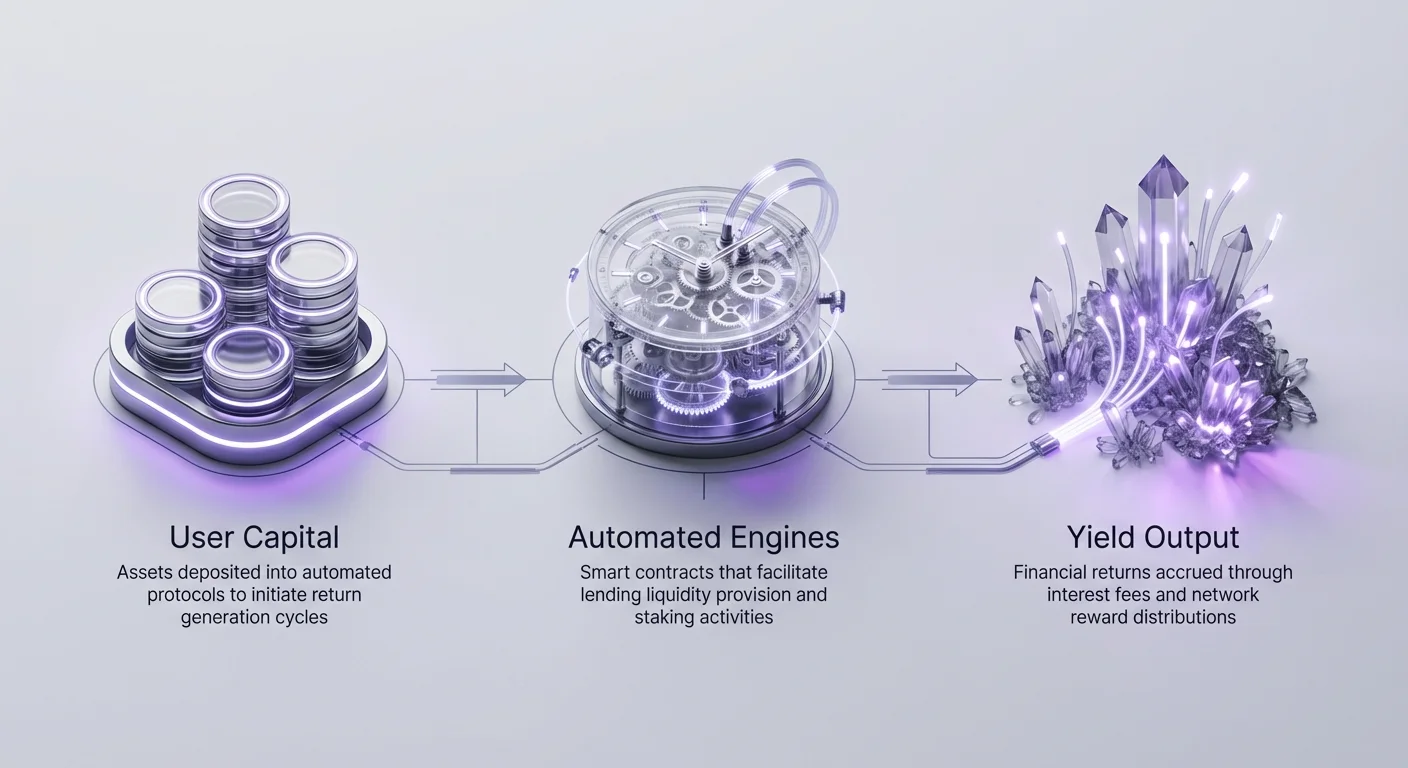
Decentralized finance represents a fundamental shift in how capital is organized and how returns are generated. Unlike traditional financial systems where yield is determined by central bank policies and institutional intermediaries, DeFi relies on code. Smart contracts automate the relationship between capital providers and users. This automation allows for a transparent and verifiable flow of value, defining a new architecture of trust.
The ecosystem is built on permissionless networks like Ethereum. These networks allow anyone with an internet connection to participate. You do not need to provide identification or pass credit checks to interact with these protocols. The yield generated in DeFi comes from specific on-chain activities.
These activities usually fall into distinct categories based on the service provided. Participants essentially act as the bank, exchange, or insurer. In return for locking assets to facilitate these services, the protocol distributes fees or token rewards. This creates a direct link between the utility provided and the interest earned.
While the terminology can mimic traditional finance, the mechanics are vastly different. Custody remains with the user or the smart contract rather than a corporate entity. This reduces counterparty risk related to human error or corporate malfeasance. However, it introduces technical risks unique to software-based financial systems. Understanding these engines requires looking at how they generate value.
Smart Contract-Based Lending
The most widely understood yield engine in DeFi is lending. It functions similarly to a high-yield savings account but with distinct operational differences. In this model, users deposit cryptocurrencies into a liquidity pool managed by a smart contract. These funds become available for other participants to borrow.
The interest paid by borrowers is distributed directly to the lenders. The protocol takes a small cut for reserve factors or governance treasuries. The rates are rarely fixed. Instead, they fluctuate block-by-block based on supply and demand. When demand for a specific asset is high, the interest rate rises to attract more deposits.
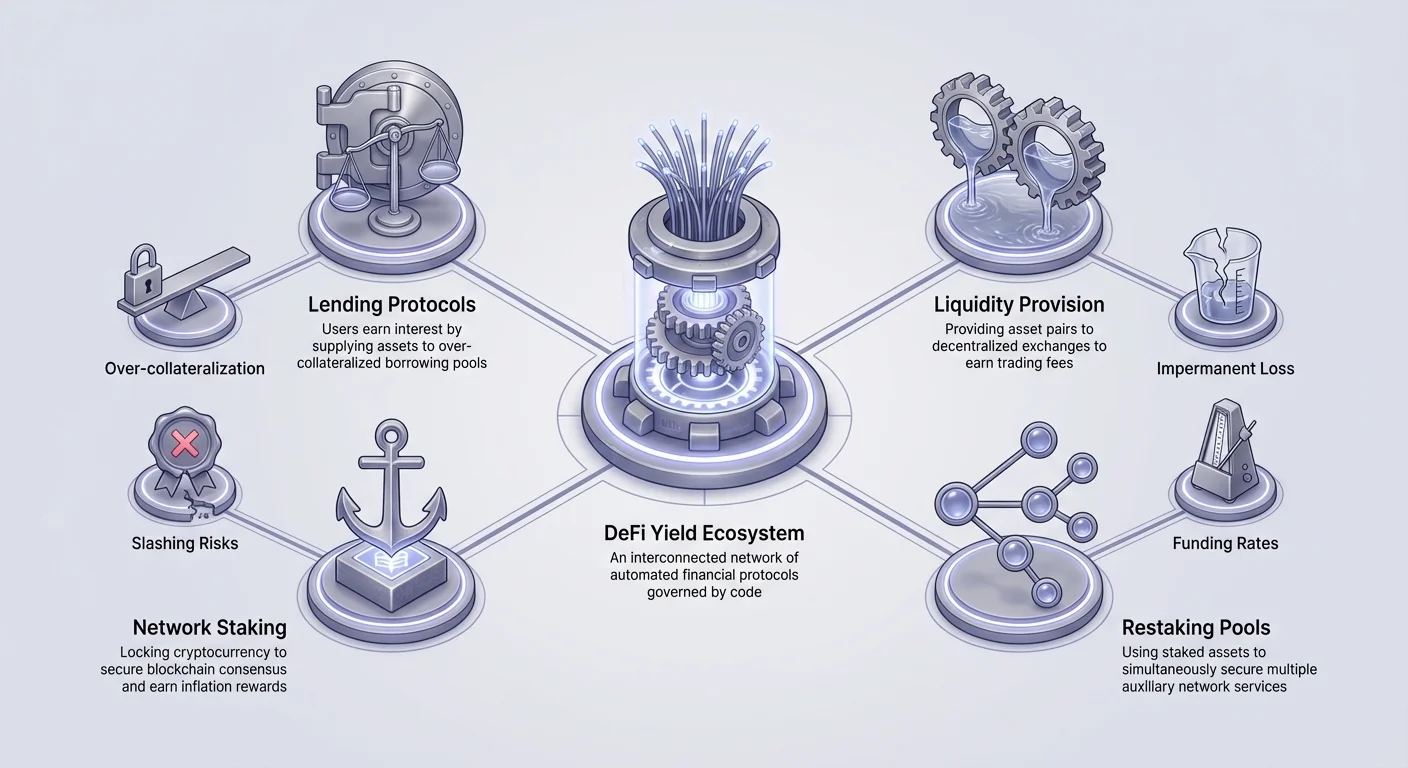
Risk management in DeFi lending relies on over-collateralization. Since there are no credit scores or legal enforcement for repayment, borrowers must deposit more value than they withdraw. A typical scenario might involve a user depositing Ethereum to borrow a stablecoin pegged to the US Dollar.
The Collateralization Mechanism
Consider a smart contract that requires a collateralization ratio of 2:1. To borrow 500 USD worth of an asset, the borrower might need to deposit 1,000 USD worth of Ethereum. This buffer protects the lender. The smart contract holds the collateral in escrow for the duration of the loan, fundamental to understanding collateralization ratios.
If the value of the collateral drops significantly, the system takes action. For instance, if the Ethereum price falls and the ratio approaches a dangerous threshold, the contract triggers a liquidation. This process sells the collateral to repay the debt automatically. This ensures the lending pool remains solvent without human intervention.
Algorithmically Determined Yields
The yield for lenders is directly tied to the utilization rate of the pool. If a pool has 10 million USDC and only 1 million is borrowed, the interest rate will be low. This encourages borrowers to take loans and discourages lenders from depositing more capital.
Conversely, if 9 million USDC is borrowed, the utilization rate is high. The smart contract will automatically spike the interest rate. This incentivizes borrowers to repay their loans to avoid high costs. Simultaneously, it attracts new lenders seeking high yields. This constant balancing act ensures there is always liquidity available for withdrawal or borrowing.
Liquidity Provision and Decentralized Exchanges
Decentralized exchanges (DEXs) operate differently from centralized counterparts like the New York Stock Exchange or Binance. Centralized exchanges rely on order books where buyers and sellers list specific prices. DEXs often use a model called the Automated Market Maker (AMM).
In an AMM, trading happens against a pool of assets rather than a specific counterparty. Liquidity providers (LPs) deposit pairs of assets into these smart contracts. For example, an LP might deposit equal values of ETH and USDC. These funds create the market depth required for traders to swap tokens.
Whenever a trader executes a swap, they pay a trading fee. This fee is distributed proactively to the liquidity providers based on their share of the pool. This process transforms static assets into productive capital. It effectively crowdsources the role of a market maker.
The Role of Incentives
To attract deep liquidity, protocols often layer additional incentives on top of trading fees. This is frequently called yield farming. The protocol issues its own native governance tokens to LPs. This serves two purposes: it boosts the effective annual percentage yield (APY) and distributes ownership of the protocol to its users.
However, high yields in liquidity provision often come with complex risks. The primary concern is impermanent loss. This occurs when the price of the deposited assets changes purely relative to one another.
Mechanics of Impermanent Loss
When an asset's price rises significantly, the AMM algorithm sells that asset to maintain the pool's ratio. The liquidity provider ends up with more of the less valuable asset and less of the appreciating one. If they withdraw their funds, they may have less total value than if they had simply held the assets in a wallet.
The trading fees earned must outweigh this potential loss for the strategy to be profitable. LPs must constantly evaluate market volatility. Stablecoin pairs often offer lower yields but carry effectively zero impermanent loss risk. Volatile pairs offer higher fees to compensate for the increased danger of asset devaluation.
Derivatives and Synthetic Exposure
As the market matures, DeFi has expanded into derivatives. These are financial instruments that derive their value from an underlying asset. In the crypto space, the most dominant form is the perpetual future.
Perpetual futures allow traders to speculate on the price of an asset without owning it. Unlike traditional futures, these contracts do not have an expiry date. Traders can keep a position open indefinitely as long as they maintain sufficient margin.
Yield in this sector is generated through funding rates. This mechanism anchors the price of the derivative to the spot price of the underlying asset. If the contract price is higher than the spot price, those holding "long" positions pay those holding "short" positions.
Generating Yield via Funding Rates
For a yield seeker, this opens up "delta-neutral" strategies. An investor might buy Spot Bitcoin and simultaneously open a Short position on a perpetual exchange. If the market is bullish, the short position earns funding fees from the long traders.
Because the investor holds the asset and shorts it simultaneously, price movements cancel out. The profit comes strictly from the funding rate payments. This strategy attempts to capture yield while neutralizing exposure to market volatility.
Prediction Markets
Another form of derivative engine is the prediction market. Here, users trade on the outcome of future events. These operate as binary option markets. An event share trades between 0 and 100 percent, reflecting the market's estimated probability.
Liquidity providers in prediction markets facilitate this trading. They earn fees from the volume of bets placed. This sector creates a unique yield source uncorrelated with crypto asset prices. The volume depends on real-world events like elections or sports results rather than Bitcoin's price action.
The Foundation of Staking
Staking differs fundamentally from the strategies mentioned above. It is tied to the consensus mechanism of the blockchain itself. In Proof of Stake (PoS) networks, validators replace miners. They lock up cryptocurrency to secure the network and process transactions.
This process is less energy-intensive than Proof of Work. It does not require solving complex mathematical puzzles with electricity. Instead, security is derived from the economic value committed to the network. Validators are selected to add blocks based on their stake size.
Rewards come from two sources: protocol inflation (newly minted coins) and transaction fees paid by network users. This is often considered the "risk-free rate" of the crypto economy. It is the baseline yield for contributing to network security.
Liquid Staking Innovations
A major limitation of traditional staking is illiquidity. Assets locked in a validator cannot be sold or used in DeFi. Liquid staking protocols solve this. When a user deposits ETH into a liquid staking provider, they receive a receipt token.
This token represents their claim on the staked asset and its accrued rewards. The receipt token is fully transferable. It can be used as collateral in lending protocols or as liquidity in DEXs. This unlocks capital efficiency. A user can earn staking rewards and DeFi yields simultaneously.
The Evolution into Restaking
Restaking is a newer concept that amplifies the utility of staked assets. It allows validators to use their staked cryptocurrency to secure multiple protocols at once. This creates a shared security marketplace.
In a standard model, a new decentralized application (dApp) or oracle network would need to bootstrap its own set of validators. This is expensive and difficult. With restaking, these services can "rent" security from existing validators on a major chain like Ethereum.
Native and Liquid Restaking
Validators can opt into these additional duties. By running additional software, they agree to secure these auxiliary services. In exchange, they receive additional staking rewards from those services. This layers multiple yield streams on top of a single capital deposit.
Restaking can occur natively or through liquid tokens. In the liquid model, the LSTs mentioned earlier are deposited into restaking smart contracts. The protocol then delegates the security power to various Actively Validated Services (AVSs).
Amplified Risks
While restaking boosts yield, it compounds risk. Validators are now subject to slashing conditions from multiple protocols. If they misbehave or fail to validate correctly on any of the secured networks, they lose a portion of their stake. Users must assess whether the incremental yield justifies the exponential increase in smart contract and operational risk when utilizing the advanced staking stack.
This interconnectivity means a failure in a smaller protocol could impact the security of the underlying stake. Users must assess whether the incremental yield justifies the exponential increase in smart contract and operational risk.
| Feature | Lending | Liquidity Provision | Staking/Restaking |
|---|---|---|---|
| Primary Source | Borrower Interest | Trading Fees | Inflation & Network Fees |
| Key Risk | Bad Debt/Liquidation | Impermanent Loss | Slashing |
| Complexity | Low | High | Medium to High |
Governance and DAO Participation
Decentralized Autonomous Organizations (DAOs) oversee many of these yield engines. Governance tokens grant holders the right to vote on critical parameters. This includes setting interest rate models, collateral factors, and fee distributions.
Active governance participation can sometimes generate yield itself. Some protocols reward voters for participating in decision-making. This ensures the community remains engaged in the protocol's management.
DAOs replace corporate boardrooms. Rules are enforced by code rather than law. This structure allows for global coordination but introduces voting apathy and plutocracy risks. Large token holders can dominate decision-making processes.
For the average user, DAOs represent transparency. Proposals and changes are visible on-chain before implementation. This allows capital providers to exit if they disagree with a proposed change in risk parameters.
Analyzing the Risk Landscape
While DeFi offers novel yield opportunities, the risks are distinct from traditional finance. The most prevalent threat is smart contract failure. Code can contain bugs or logic errors. Hackers exploit these vulnerabilities to drain liquidity pools.
Unlike a bank, there is no federal insurance to replace lost funds. Once assets leave a wallet, the user relies entirely on the integrity of the code. Audits by security firms reduce this risk but do not eliminate it.
Human Error and Phishing
The human element remains a critical vulnerability. Phishing attacks are common. Users may click on a link that mimics a legitimate financial application. Connecting a wallet to a malicious site can grant attackers permission to drain funds.
Users must verify URLs and contract addresses. The immutability of the blockchain means transactions cannot be reversed. A mistake in sending funds or approving a malicious contract is permanent.
Regulatory and Economic Risk
DeFi operates in a regulatory gray area. Governments are increasingly scrutinizing these protocols. Changes in laws regarding stablecoins or securities could impact the viability of certain yield engines.
Economic risks also persist. Market volatility can trigger cascading liquidations. If the price of collateral crashes too fast, the protocol may fail to sell it in time to cover the debt. This can leave the protocol with bad debt, reducing the value of deposits for all lenders.
Conclusion
The landscape of decentralized finance offers a diverse array of engines for generating returns on capital. Lending protocols provide a foundational layer similar to debt markets, allowing for interest accrual through over-collateralized borrowing. Decentralized exchanges and liquidity provision introduce a peer-to-contract model where fees replace intermediary profits. Staking and the emerging sector of restaking anchor these financial products to the security of the blockchain itself.
Each mechanism carries a unique profile of risk and reward. The transparency of smart contracts allows for verification, but the technical complexity demands diligence. As the ecosystem matures, these primitives are likely to become more efficient, yet the responsibility for security and strategy remains firmly with the individual.
DeFi shifts financial power to the individual, requiring you to audit code and manage risk personally to earn yield.