
The landscape of cryptocurrency trading has evolved significantly over the last decade. In the early days, enthusiasts monitored price charts manually, executing trades based on gut feeling or basic analysis. As the market matured, the volatility and 24/7 nature of digital assets exposed the limitations of human endurance. Sleep, emotions, and reaction times became liabilities in a market that never closes. This realization paved the way for the adoption of automated trading strategies.
Automation in cryptocurrency involves using software to execute trades based on pre-defined criteria. It moves beyond simple buy and hold strategies. It introduces a systematic approach to capitalizing on market movements. For traders in 2025, understanding these tools is no longer a luxury. It is often a necessity for maintaining a competitive edge.
The core appeal of automation lies in its ability to process data faster than any human. Algorithms can analyze price action across multiple exchanges simultaneously. They can execute orders in milliseconds. This speed is crucial in an environment where prices can fluctuate by double-digit percentages in minutes. Furthermore, automation removes the emotional component of trading. Fear and greed are the primary drivers of poor investment decisions. Software follows the plan without hesitation, regardless of market panic or euphoria.
The Mechanics of Automated Trading
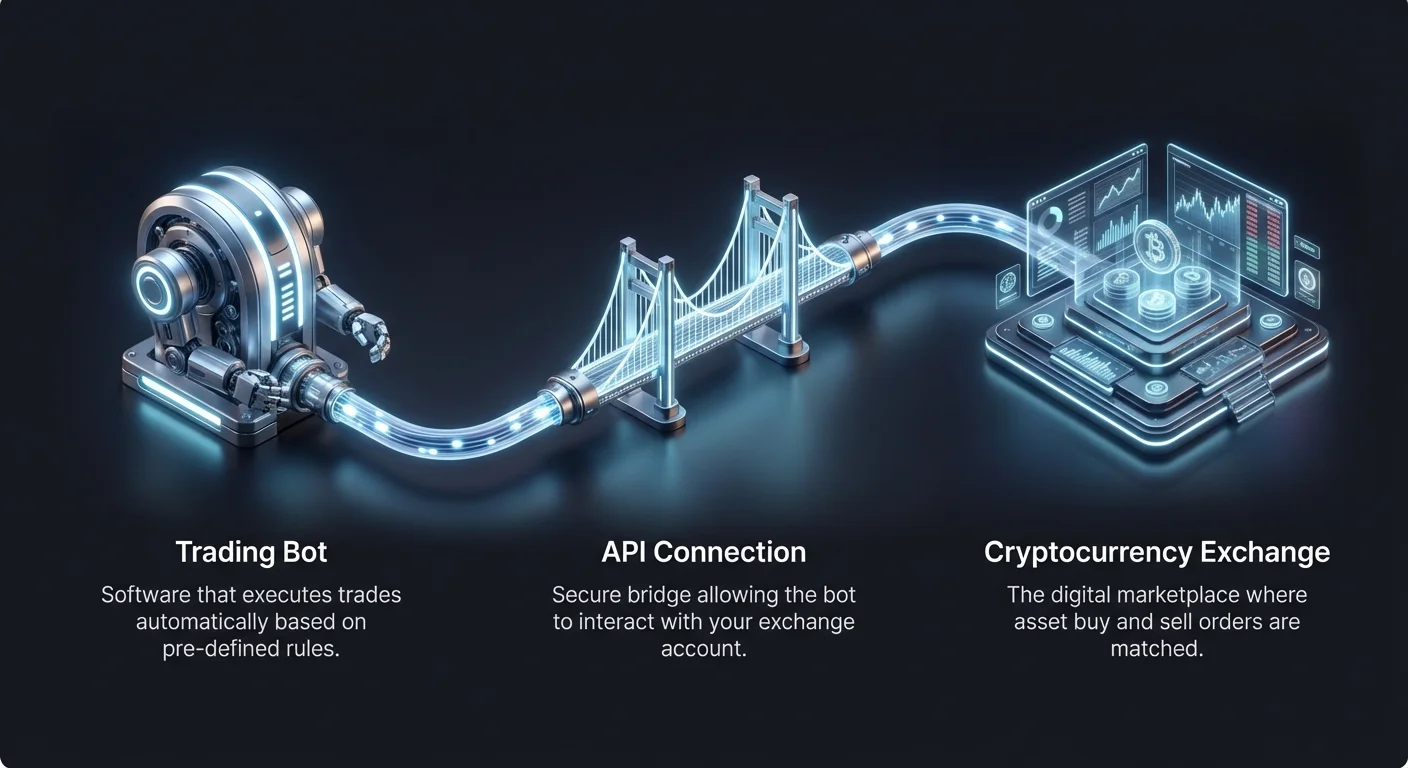
At the heart of crypto automation sits the trading bot. A bot is a software program designed to interact directly with financial exchanges. It does this through an Application Programming Interface, or API. The API acts as a bridge. It allows the bot to send buy and sell instructions to the exchange without the user needing to be logged into the website.
These bots operate based on specific algorithms. An algorithm is simply a set of rules. For example, a rule might be to buy Bitcoin when its price drops by five percent and sell it when it rises by ten percent. While this is a simplistic example, modern bots use complex mathematical models. They utilize technical indicators like Moving Averages, the Relative Strength Index (RSI), and MACD to identify trends.
The effectiveness of a bot depends entirely on the strategy it is programmed to follow. The software itself is merely a tool for execution. If the underlying strategy is flawed, the bot will execute losing trades just as efficiently as winning ones. Therefore, successful automation requires a deep understanding of market mechanics. Traders must configure their bots to align with current market conditions.
Distinguishing Between Investment and Trading
Before diving into specific automated strategies, it is vital to understand the difference between investing and trading. Automation applies differently to each approach. Investing typically involves a long-term outlook. Investors buy assets with the intention of holding them for months or years. They believe in the fundamental value of the project.
Trading, conversely, focuses on short-term price movements. Traders aim to profit from volatility. They may not care about the long-term viability of a project, only its price action over the next hour or day. Automated systems are primarily designed for trading. They thrive on the rapid price swings that characterize the crypto market.
However, automation can also assist investors. Strategies like Dollar-Cost Averaging (DCA) are automated investment techniques. They help accumulate assets over time without trying to time the market. Understanding your primary goal is the first step in selecting the right automation tool. A strategy designed for high-frequency scalping will be disastrous for a long-term investor looking for stability.
The Role of Cryptocurrency Exchanges
Automated trading cannot exist without the infrastructure provided by cryptocurrency exchanges. These platforms serve as the marketplace where digital assets are bought and sold. In 2025, the variety of exchange types offers different benefits for automated strategies. The choice of exchange directly impacts the performance of a trading bot.
Centralized Exchanges (CEX) remain the most popular venue for automated trading. These platforms are operated by a central authority or company. They function similarly to traditional stock exchanges. They offer high liquidity, which is the ability to buy or sell an asset quickly without causing a drastic change in its price.
For a trading bot, liquidity is paramount. If a bot attempts to sell a large amount of Bitcoin on an exchange with low liquidity, it may suffer from slippage. Slippage occurs when the final execution price is worse than the expected price. Centralized exchanges typically provide the deep order books necessary to minimize this risk. They also offer robust API support, making them easy to integrate with third-party bot software.
Decentralized and Hybrid Alternatives
Decentralized Exchanges (DEX) operate without a central authority. They facilitate peer-to-peer trading directly on the blockchain. While they offer enhanced privacy and security by allowing users to retain custody of their funds, they often present challenges for automation. Transaction speeds on a DEX are limited by the block time of the underlying network.
This latency can be a disadvantage for high-frequency bots that rely on split-second execution. Additionally, liquidity on DEXs can be fragmented. However, for arbitrage strategies that exploit price differences between platforms, DEXs are an essential part of the ecosystem.
Hybrid exchanges attempt to combine the best of both worlds. They aim to offer the liquidity and speed of a centralized platform with the security of a decentralized one. As the industry evolves, these platforms are becoming more viable for automated strategies. They reduce the counterparty risk associated with leaving funds on a centralized server while maintaining the performance needed for algorithmic trading.
Security Considerations on Exchanges
Security is the foundation of any trading activity. When using automated tools, you often have to keep funds on an exchange to be ready for trading. This introduces risk. Centralized exchanges mitigate this through various protocols. The most standard measure is Two-Factor Authentication (2FA). This adds a layer of protection beyond just a password.
Cold storage is another critical security feature. This involves storing the majority of user funds in offline wallets that are not connected to the internet. This makes them inaccessible to hackers. Top-tier exchanges employ cold storage for the vast majority of their assets. They only keep a small percentage in "hot wallets" to facilitate immediate withdrawals and trading.
When connecting a bot to an exchange via API, users must handle permissions carefully. API keys should be generated with trade-only access. They should never have withdrawal permissions enabled. This ensures that even if a malicious actor gains access to the bot or the API key, they cannot remove funds from the account.
Grid Trading Strategies
Grid trading is one of the most popular automated strategies for the cryptocurrency market. It is particularly effective in sideways or ranging markets. A ranging market occurs when the price of an asset fluctuates between a consistent high and low price without establishing a clear upward or downward trend.
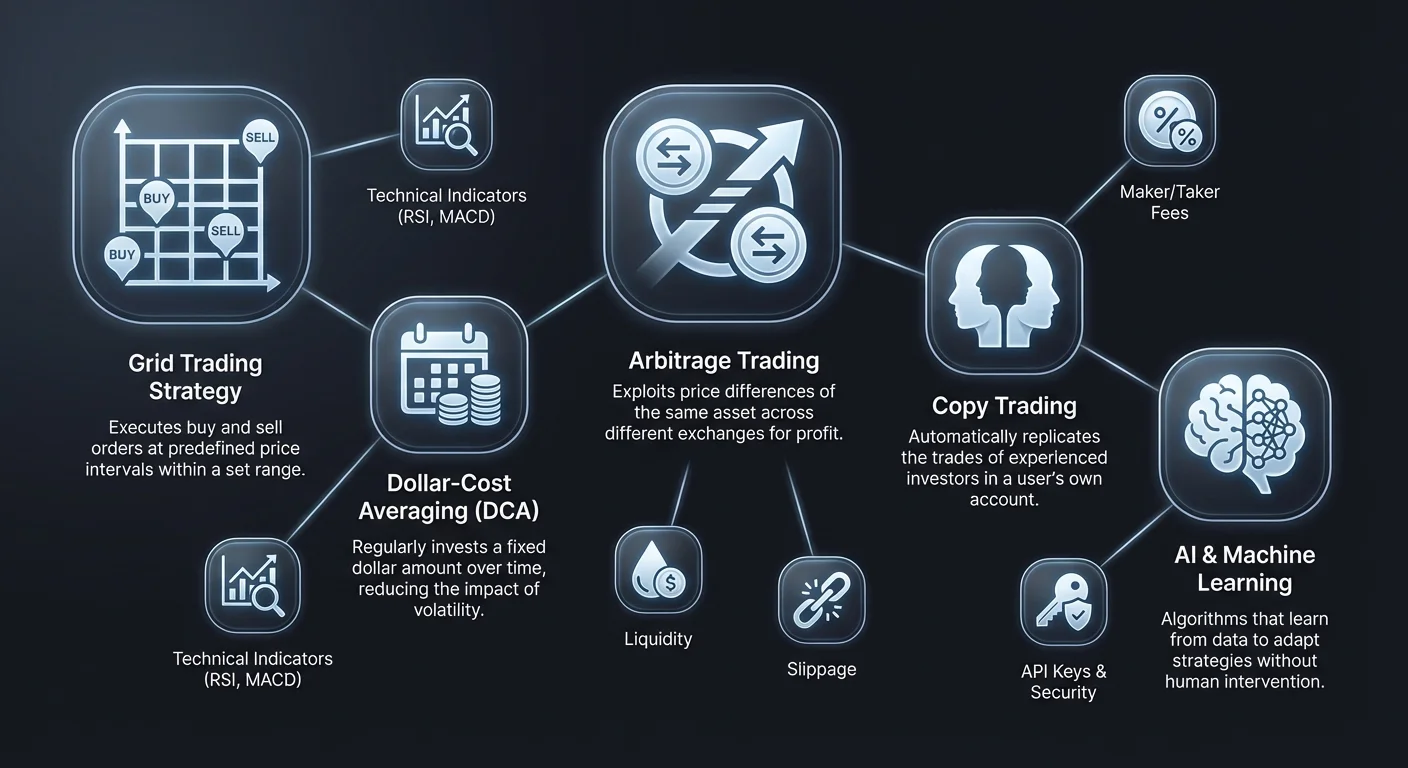
The concept of grid trading is straightforward. The trader sets a price range for a specific asset. Within this range, the bot creates a series of buy and sell orders at specific intervals. These intervals create a "grid" of orders. When the price drops to a certain level, the bot executes a buy order. When the price rises to the next level, it sells the asset for a profit.
This strategy thrives on volatility. Every time the price wiggles up and down, the bot captures a small profit. In a market that moves flat for weeks, a manual trader might make zero profit. A grid bot, however, could execute hundreds of trades, accumulating small gains that add up to a significant return.
Setting Up a Grid
To deploy a grid strategy, a trader must first identify the trading range. This involves technical analysis to find support and resistance levels. Support is the price level where an asset historically has difficulty falling below. Resistance is the ceiling it struggles to break through.
Once the range is set, the user determines the number of grids. This dictates the spacing between orders. More grids mean smaller gaps between orders. This results in more frequent trades but smaller profits per trade. Fewer grids result in larger profits per trade but fewer executions. Finding the right balance is key to optimizing the strategy.
There is a risk to grid trading. If the price breaks out of the defined range, the strategy becomes less effective. If the price drops below the lower limit, the bot will have bought the asset all the way down and will be left holding a bag of depreciating coins. It will stop trading until the price returns to the grid. Conversely, if the price skyrockets above the upper limit, the bot will sell all holdings early. The trader misses out on the continued upside.
Market Conditions for Grid Bots
Grid bots are not "set and forget" money printers. They require monitoring. They perform best when the market is indecisive. In a strong bull run, a simple buy-and-hold strategy often outperforms a grid bot. The bot sells too early as the price climbs. In a bear market, the bot keeps buying as the price falls, potentially leading to unrealized losses.
Advanced grid bots offer features to mitigate these risks. "Trailing up" features allow the grid to move upward with the price. This helps capture profits during a trend while still trading the volatility. Stop-loss mechanisms can also be integrated. These automatically shut down the bot and sell positions if the price falls below a critical level, preventing catastrophic losses.
Arbitrage Trading
Arbitrage is a trading strategy that exploits price discrepancies for the same asset across different markets. In an efficient market, the price of Bitcoin should be identical on every exchange. However, the crypto market is fragmented. Liquidity varies from platform to platform. Regional demand can cause price spikes in one area while prices remain flat elsewhere.
An arbitrage bot constantly monitors the prices of assets on multiple exchanges. When it detects a difference, it acts. For example, if Bitcoin is trading at $50,000 on Exchange A and $50,200 on Exchange B, the bot buys on Exchange A and instantly sells on Exchange B. The $200 difference, minus fees, is profit.
This strategy is considered low risk compared to directional trading. The trader is not betting on the price going up or down. They are simply capturing a market inefficiency. However, speed is critical. These price gaps often exist for only seconds. Human traders cannot react fast enough to capture them. Automated bots are essential for this strategy.
Types of Arbitrage
There are several forms of arbitrage. Cross-Exchange Arbitrage is the standard method described above. It requires the trader to hold funds on both exchanges involved. Transferring funds between exchanges takes too long. The trader must already have fiat or stablecoins on the buying exchange and the crypto asset on the selling exchange to execute the trade instantly.
Triangular Arbitrage occurs within a single exchange. It involves trading three different assets. For instance, a trader might exchange Bitcoin for Ethereum, then Ethereum for XRP, and finally XRP back to Bitcoin. If there are price misalignments between these pairs, the trader ends up with more Bitcoin than they started with.
This method avoids the need to transfer funds between platforms. It also eliminates the risk of withdrawal delays. However, it requires high liquidity on all three trading pairs. If one leg of the triangle takes too long to fill, the profit margin can vanish.
Risks in Arbitrage
While theoretically low risk, arbitrage has practical challenges. The primary enemy is execution fees. Every trade incurs a fee. In cross-exchange arbitrage, there are withdrawal fees to consider when rebalancing funds. If the price spread is smaller than the combined fees, the trade results in a loss.
Slippage is another danger. If the bot spots a price difference but the available liquidity at that price is small, the order may not fill completely. The remaining portion might fill at a worse price, erasing the profit. Additionally, during times of high network congestion, transfers between exchanges can be delayed. This can leave a trader exposed if they need to move funds to cover a position.
Finally, competition is fierce. Large institutional traders use sophisticated arbitrage bots with direct connections to exchange servers. Retail traders using standard API connections may find themselves beaten to the trade by milliseconds.
Copy Trading
Copy trading creates a bridge between social networking and financial markets. It allows users to automatically replicate the trades of experienced investors. This is an attractive option for beginners who lack the time or expertise to analyze charts themselves. Instead of programming a bot with a specific strategy, the user selects a "Master Trader" to follow.
When the Master Trader opens a position, the follower's account automatically opens the same position. The size of the trade is adjusted proportionally to the follower's account balance. If the Master Trader allocates 5% of their portfolio to a Bitcoin buy, the follower's account will also allocate 5%.
This creates a passive investment vehicle. The follower relies entirely on the skill of another person. It is distinct from "social trading," where users merely discuss ideas. Copy trading is executable action. It binds the financial results of the follower to the leader.
Selecting a Trader to Copy
The success of copy trading depends on choosing the right leader. Platforms provide detailed statistics to help with this decision. Key metrics include Return on Investment (ROI), win rate, and maximum drawdown. ROI indicates profitability over a specific period. However, a high ROI can be misleading if it was achieved through excessive risk.
Maximum drawdown is a crucial metric. It measures the largest decline in the trader's portfolio from peak to trough. A trader with 500% ROI but a 90% drawdown is extremely risky. It suggests they gamble with high leverage. A consistent trader with lower ROI but minimal drawdown is often a safer bet for long-term growth.
Diversification applies here as well. Copying a single trader puts all capital at risk of one person's judgment. Spreading capital across multiple traders with different strategies can smooth out volatility. One trader might focus on Bitcoin, while another specializes in altcoins or scalping strategies.
The Cost of Copying
Copy trading is rarely free. The Master Traders need an incentive to share their strategies. Platforms typically use a profit-sharing model. A percentage of the follower's profits is deducted and given to the Master Trader. This aligns the interests of both parties. The leader only gets paid if the followers make money.
However, users must also account for standard exchange fees. Every trade executed by the copy software incurs trading fees. In a high-frequency strategy, these fees accumulate quickly. It is possible for a Master Trader to show a small profit while the follower shows a loss after fees are deducted. Users should verify if the reported performance statistics are net of fees or gross.
Razumevanje provizij za izmenjave
Provizije so trenje v katerem koli avtomatiziranem trgovalnem sistemu. Razumevanje strukture provizij izmenjave je ključno za donosnost. Večina centraliziranih izmenjav uporablja model Maker-Taker. Ta model loči med naročili, ki zagotavljajo likvidnost, in naročili, ki jo odvzemajo.
Naročilo „Maker“ je limitno naročilo, ki je postavljeno v knjigo naročil. Ne izpolni se takoj. Ostane tam, dodaja globino trgu in čaka, da nekdo sprejme ceno. Makerji pogosto dobijo nižje provizije, ker pomagajo stabilizirati trg.
Naročilo „Taker“ je tržno naročilo, ki se izpolni takoj proti obstoječemu naročilu v knjigi. Odvzema likvidnost. Takerji običajno plačajo višje provizije. Trgovalni roboti se lahko konfigurirajo, da delujejo kot makerji ali takerji. Na primer, mrežni bot postavlja limitna naročila, ki pogosto kvalificirajo za maker provizije. Arbitražni bot običajno zahteva takojšnjo izvedbo, kar prinaša taker provizije.
Provizije za dvige in omrežne provizije
Poleg trgovalnih provizij morajo uporabniki upoštevati stroške premikanja sredstev. Provizije za dvig se močno razlikujejo glede na izmenjavo in sredstvo. Nekatere platforme zaračunajo fiksno provizijo za dvig Bitcoina, ne glede na znesek. Druge morda ponujajo brezplačne dvige do določenega limita.
Ti stroški so posebej pomembni za arbitražne strategije, ki vključujejo premikanje sredstev med platformami. Če bot ustvari 10 USD dobička na trgovanju, vendar premik sredstev nazaj v začetni položaj stane 15 USD, je strategija izvedljiva samo na papirju.
Trgovci z visokim obsegom pogosto kvalificirajo za popuste na provizije. Izmenjave imajo VIP stopnje na podlagi 30-dnevnega trgovalnega obsega. Avtomatizirano trgovanje naravno generira visok obseg. Trgovci bi morali preveriti, ali lahko zmanjšajo stroške z držanjem lastnega žetona izmenjave ali doseganjem višje stopnje obsega. Tudi 0,01-odstotno zmanjšanje provizij lahko bistveno vpliva na končni rezultat pri tisočih trgovanj.
Upravljanje tveganj v avtomatizaciji
Avtomatizacija ne odpravi tveganja. Spremeni le naravo tveganja. Ena največjih nevarnosti je tehnična napaka. Izpadi interneta, prekinitve API-ja ali izpadi borze lahko pustijo bota osamljenega. Če bot odpre pozicijo in nato izgubi povezavo, je ne more zapreti, če se trg obrne proti njej.
Napake v programski opremi so še ena skrb. Napaka v logiki bota lahko povzroči izvedbo nenamernih poslov. Morda bo večkrat kupoval brez prodaje, kar bo izčrpalo stanje na računu. Bistveno je uporabljati ugledno programsko opremo, ki je bila temeljito testirana.
Dogodki "Črni labod" so nepredvidljivi tržni zrušitve. Med ekstremno nihanjem se lahko likvidnost izsuši. Bot, programiran za prodajo pri določeni ceni stop-lossa, morda ne bo našel kupcev na tej ravni. Cena se lahko močno zniža (gap down), kar bo povzročilo veliko večjo izgubo, kot je bilo pričakovano. Algoritmi najbolje delujejo v normalnih tržnih razmerah. Med kaotičnimi dogodki imajo težave.
Spremljanje in intervencija
Izraz "pasivni dohodek" je pogosto povezan z boti, vendar je zavajajoč. Avtomatizirani sistemi zahtevajo nadzor. Trgovci bi morali dnevno preverjati svoje bote. Morajo zagotoviti, da strategija ostaja veljavna za trenutno tržno fazo.
Če grid bot izvaja nevtralno strategijo in trg nenadoma vstopi v parabolični bikovskega teka, mora trgovec intervenirati. Morda bo moral ustaviti bota, prilagoditi obseg mreže ali preklopiti na strategijo sledenja trendu. Pustiti bota brez nadzora tedne je recept za nepričakovane izgube.
Nastavitev trdih omejitev je najboljša praksa. Večina platform za bote omogoča uporabnikom, da definirajo maksimalno izgubo. Če lastna vrednost bota pade za določen odstotek, se samodejno izklopi. To deluje kot varovalka, ki ohrani preostali kapital.
Dollar-Cost Averaging (DCA)
Dollar-Cost Averaging is perhaps the simplest form of automation. It removes the pressure of timing the market entry. Instead of investing a lump sum all at once, the investor divides the capital into smaller amounts. The system then buys the asset at regular intervals, regardless of the price.
For example, instead of buying $12,000 of Bitcoin today, a DCA bot buys $1,000 every month for a year. When the price is high, the bot buys fewer coins. When the price is low, the bot buys more coins. Over time, this lowers the average cost per coin compared to trying to catch a bottom and missing.
DCA is a powerful psychological tool. It transforms price dips from stressful events into opportunities to accumulate more assets. It is particularly effective in the crypto market, where bear markets can last for a year or more. An automated DCA bot ensures the investor stays disciplined and continues to build their position during the boring or fearful phases of the market cycle.
DCA Risks and Variations
While safer than lump-sum investing during a downtrend, DCA is not risk-free. In a continuously rising market, DCA results in a higher average entry price than buying immediately. The investor ends up paying more for the asset as it climbs.
Advanced DCA bots offer "Smart DCA" features. These adjust the purchase amount based on technical indicators. For instance, the bot might double the purchase amount if the RSI indicates the asset is oversold. It might pause purchases if the market is overbought. This attempts to optimize the entry price while maintaining the disciplined schedule of standard DCA.
Technical Analysis Indicators in Automation
Most trading bots rely on technical analysis to make decisions. They do not read news headlines or analyze fundamental project data. They read numbers. Understanding the indicators used by bots helps traders configure them correctly.
Moving Averages (MA) are foundational. A Simple Moving Average (SMA) calculates the average price over a set number of days. Bots often use the "Golden Cross" strategy. This triggers a buy signal when a short-term moving average crosses above a long-term moving average. It signals upward momentum.
The Relative Strength Index (RSI) measures the speed and change of price movements. It oscillates between 0 and 100. An RSI above 70 is typically considered overbought, suggesting a price drop may occur. An RSI below 30 is oversold, suggesting a bounce. Mean-reversion bots use RSI to buy the dip and sell the rip.
MACD and Bollinger Bands
The Moving Average Convergence Divergence (MACD) is a trend-following momentum indicator. Bots use the convergence and divergence of two moving averages to identify buy and sell signals. It is useful for confirming the strength of a trend.
Bollinger Bands consist of a middle band (usually an SMA) and two outer bands. The outer bands expand and contract based on volatility. When the price touches the lower band, it is often considered a buy signal. When it touches the upper band, it is a sell signal. Grid bots can utilize Bollinger Bands to dynamically adjust their grid range based on current market volatility.
Izbira prave kripto borze
Izbira prave borze je enako ključna kot izbira pravega bota. Niso vse borze podpirajo vsako vrsto avtomatizacije. Nekatere imajo omejitve API, ki preprečujejo visokofrekvenčno trgovanje. Druge nimajo specifičnih trgovalnih parov, ki jih uporabnik želi ciljati.
Varnost bi morala biti primarni filter. Borz z zgodovino vdorov ali slabih varnostnih praks je treba izogibati. Uporabniki bi morali iskati platforme, ki ponujajo hladno shranjevanje, zavarovalne sklade in regulativno skladnost. Varna platforma zagotavlja, da dobički, ustvarjeni s botom, niso izgubljeni zaradi kraje.
Uporabniški vmesnik (UI) je pomemben za konfiguracijo. Čeprav bot opravlja trgovanje, mora človek nastaviti. Jasna, intuitivna nadzorna plošča olajša spremljanje uspešnosti in prilagajanje nastavitev. Kompleksni, zmedeni vmesniki povečajo možnost uporabniške napake med nastavitvijo.
Primerjava lastnosti borz
Pri ocenjevanju borz za avtomatizacijo je likvidnost ključni kazalnik. Visok trgovalni volumen zagotavlja hitro izpolnitev naročil po pričakovani ceni. Nizka likvidnost vodi do zdrsa, ki pojé tanke marže algoritmičnega trgovanja.
Raznolikost razpoložljivih sredstev je tudi pomembna. Trgovci, ki želijo zagnati bote na obskurnih altcoinih, potrebujejo borzo, ki jih navaja. Vendar imajo velike borze pogosto strožje zahteve za navajanje, kar pomeni manj, vendar bolj uglednih sredstev. Manjše borze morda navajajo stotine kovancev, vendar nimajo likvidnosti za učinkovito trgovanje z botom.
| Lastnost | Pomen za avtomatizacijo | Opis |
|---|---|---|
| Likvidnost | Visoka | Zagotavlja takojšnjo izpolnitev naročil brez zdrsa cen. |
| Kakovost API | Visoka | Stabilne povezave preprečujejo izpade in napake bota. |
| Struktura provizij | Visoka | Nizke maker/taker provizije so bistvene za marže dobička. |
Prihodnost kripto avtomatizacije
Ko se premikamo skozi leto 2025, umetna inteligenca (UI) začne preoblikovati kripto avtomatizacijo. Tradicionalni boti sledijo statičnim pravilom. UI boti uporabljajo strojno učenje. Lahko se prilagodijo spreminjajočim se pogojem trga brez človeškega posega.
Algoritmi strojnega učenja analizirajo ogromne količine zgodovinskih podatkov za iskanje vzorcev, nevidnih človeškemu očesu. Lahko prilagodijo lastne parametre. Če se volatilnost trga poveča, lahko UI bot samodejno razširi razmik mreže. Če se trend obrne, lahko preklopi iz dolge strategije na kratko.
Ta evolucija prinaša nove izzive. UI modeli so kompleksne neprozorne škatle. Težko je razumeti, zakaj je bot sprejel specifično odločitev. Ta pomanjkanje preglednosti je lahko neprijetno za trgovce. Poleg tega se UI modeli lahko "preoblikujejo" na pretekle podatke, delujejo popolno v backtestih, vendar odpovejo v živih trgih.
Regulatorna pokrajina
Regulativa dohiteva avtomatizacijo. V nekaterih jurisdikcijah je uporaba trgovalnih botov pod drobnogledom. Regulatorji so zaskrbljeni zaradi manipulacije trga. Strategije, kot je "spoofing", kjer bot postavlja lažna naročila za zavajanje drugih trgovcev, so nezakonite v tradicionalnih financah in vse bolj nadzorovane v kriptu.
Uporabniki morajo biti pozorni na pravne posledice svojih strategij. Borze uvajajo strožje protokole Poznaj svojega stranko (KYC). Prav tako spremljajo sumljive vzorce trgovanja. Uporaba bota za manipulacijo nizkolikvidnih trgov lahko rezultira v prepovedi računa ali pravnih ukrepih.
Skladnost postaja lastnost uglednih bot platform. Gradijo varovalke za preprečevanje nezakonitih trgovalnih dejavnosti. To legitimira industrijo in tlako pot za institucionalno uvedbo avtomatiziranih strategij.
Security Best Practices for Bot Users
Running a bot involves giving a third-party application access to your funds. This requires strict security hygiene. The first rule is API management. When creating an API key, users should whitelist IP addresses. This restricts access to the API key to only the specific server hosting the bot. If the key is stolen, it is useless from any other computer.
Two-Factor Authentication (2FA) should be enabled on both the exchange account and the bot platform account. Authenticator apps are more secure than SMS codes, which are vulnerable to SIM swapping attacks.
Regularly auditing API keys is recommended. If a bot is no longer in use, the API key should be deleted immediately. Leaving old, unused keys active increases the attack surface. Users should also be wary of downloading bot software from unverified sources. Malware disguised as a trading bot is a common method for stealing credentials.
Hardware Wallets and Profits
A common mistake is leaving all profits on the exchange. While the trading capital needs to be online, the profits do not. Traders should regularly skim profits and move them to a hardware wallet.
A hardware wallet is a physical device that stores private keys offline. It is immune to online hacks. By regularly moving profits to cold storage, the trader limits their exposure. In the worst-case scenario of an exchange hack, they only lose the active trading capital, not their accumulated wealth.
Conclusion
Crypto automation offers a powerful toolkit for navigating the complexities of the 2025 market. It provides the speed, discipline, and efficiency necessary to compete in a 24/7 environment. From the steady accumulation of Dollar-Cost Averaging to the rapid-fire execution of arbitrage and the systematic approach of grid trading, there is a strategy for every risk profile. However, these tools are not magic wands. They require understanding, monitoring, and respect for the underlying risks.
Success in automated trading comes from a blend of technology and strategy. It requires selecting the right exchange with deep liquidity and robust security. It demands a clear understanding of fees and how they impact profitability. Most importantly, it requires the trader to remain educated and vigilant. The market is dynamic, and the strategies that work today may need adjustment tomorrow. By combining the precision of machines with human oversight, traders can unlock the full potential of their digital asset portfolios.
Automation amplifies your strategy, so ensure your underlying plan is sound before letting the code take over.