
Welcome to the cutting edge of digital asset trading. For those beginning their journey in cryptocurrency, the process often starts with simple market orders on a user-friendly centralized exchange (CEX) like Coinbase or Kraken. However, to evolve into a serious, efficient, or automated trader, you must look beneath the glossy interface and understand the powerful infrastructure that fuels sophisticated execution.
This guide moves beyond generic comparisons of exchange fees and focuses on the technical features that serious traders rely on: Application Programming Interfaces (APIs), specialized order types, and robust security protocols. We will analyze the core CEX capabilities required for running automated strategies—whether you are implementing simple arbitrage bots or complex time-weighted execution algorithms. Understanding these advanced features is essential for optimizing speed, minimizing market impact, and ensuring the highest level of security for your capital.
By the end of this analysis, you will have a comprehensive understanding of the structural elements that define a high-performance CEX, enabling you to select platforms based on functional capability rather than simply popularity.

Understanding the Engine: Centralized Exchange APIs for Automated Trading
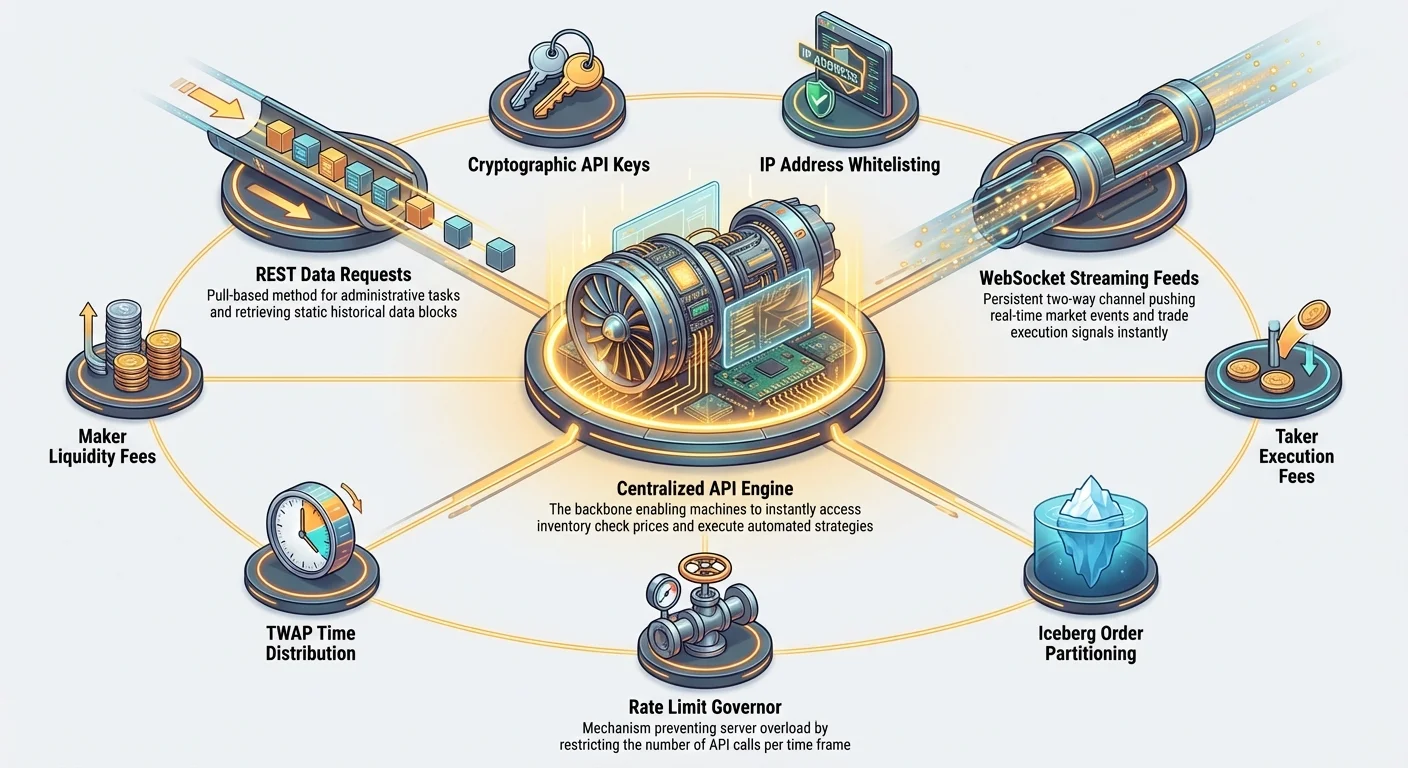
The backbone of modern automated trading is the Application Programming Interface, or API. If a CEX is a massive supermarket, the website or app is the checkout counter for retail shoppers. The API, however, is the dedicated back entrance and service elevator, allowing machines (your trading bots) to instantly access inventory, check prices, and place massive orders without waiting in line.
A CEX’s API quality dictates the speed, reliability, and complexity of any automated strategy.
What is an API and Why It Matters for Trading?
An API is a set of rules that allows two software programs to communicate. In the context of a CEX, the API allows your external program (a Python script, a dedicated trading bot, or a custom application) to send instructions to the exchange’s servers and receive real-time data back.
For manual traders, this process happens visually through the website. For automated traders, the API performs three critical functions:
- Data Retrieval (Market Data): Getting the current price (ticker), order book depth, recent trade history, and candlestick data—all necessary for strategy calculations.
- Account Information: Checking current balances, open positions, order status, and trade history.
- Order Management: Placing, modifying, or canceling orders instantly.
Practical Impact: If your bot detects an arbitrage opportunity lasting 50 milliseconds, it needs an API connection that can place the order in less time than that. Low latency (speed) and high throughput (volume of requests) are non-negotiable for competitive automation.
Navigating CEX API Documentation Standards
Not all CEX APIs are built the same, and understanding the differences is crucial before committing resources to development. The primary distinction lies in how data is requested and delivered:
1. REST APIs (Request-Response)
Representational State Transfer (REST) is the standard method for most administrative tasks and static data retrieval. You send a request (e.g., "What is the Bitcoin balance in my account?"), and the server sends a response.
- Use Cases: Checking account balances, placing simple orders, fetching historical data.
- Limitation: It is pull-based. You must repeatedly ask for new data, which introduces latency and consumes your API request limit.
2. WebSocket APIs (Streaming Data)
WebSocket connections establish a persistent, two-way communication channel. Instead of you constantly asking for data, the exchange pushes data to you instantly when a relevant event occurs (e.g., a new trade or a price change).
- Use Cases: Real-time order book monitoring, instant trade execution signals, high-frequency trading (HFT).
- Advantage: Minimal latency and far more efficient for real-time strategy monitoring.
A serious automated trading platform must offer robust WebSocket feeds for market data and REST endpoints for order management. Checking the quality and clarity of the exchange’s public API documentation is the first essential step for any developer.
Managing CEX API Limits and Throttling
A major constraint for automated trading is the mechanism exchanges use to prevent server overload: API rate limits (the core target keyword: CEX API limits).
Rate limits define how many requests (API calls) your specific key can make within a defined time frame (e.g., 60 requests per second). Exceeding this limit results in throttling, where the exchange temporarily rejects your requests, often with an HTTP 429 error ("Too Many Requests").
This is fatal for a trading bot. If a trade signal fires but the order is rejected due to throttling, the opportunity is lost, and the bot may enter a harmful, unsynchronized state.
Strategies for Managing Limits:
- Prioritize Requests: Only use the API for essential actions. For market data, switch from frequent REST polls to a single WebSocket connection.
- Understand Weighting: Exchanges often assign "weights" to different endpoints. Placing a new order might consume 5 units of your limit, while checking the account balance might consume 1 unit. Structure your code to minimize high-weight calls.
- Implement Exponential Backoff: If you receive a 429 error, your bot should not immediately retry. It must wait an increasing amount of time (e.g., 1 second, then 2 seconds, then 4 seconds) before retrying the call. This is a standard defensive coding practice.
- Utilize Sub-Accounts: If you are running multiple independent strategies, distributing them across separate API keys linked to separate sub-accounts can effectively multiply your overall rate limit (if the CEX allows shared limits among sub-accounts).
Essential API Keys and Security Best Practices
Connecting a trading bot requires generating two crucial cryptographic keys:
- Public Key (API Key): Identifies your account to the exchange.
- Secret Key: A private key used to cryptographically sign every transaction request, proving that the request genuinely came from your account.
Warning: The Secret Key grants complete control over your assets on the exchange. If it is compromised, a malicious actor can withdraw all your funds.
To mitigate this catastrophic risk, CEXs provide critical security features:
- IP Whitelisting: You restrict the API key’s usage to a specific set of Internet Protocol (IP) addresses (e.g., the static IP of your dedicated cloud server). If a hacker steals your key but attempts to use it from their home IP address, the request is automatically rejected.
- Permissions Management: When generating the API key, you should grant the minimum required permissions. If your bot only needs to trade, revoke the "Withdrawal" permission. Even if the key is compromised, funds cannot be moved off the exchange.
- Secure Storage: Never store secret keys in plain text, commit them to a public code repository (like GitHub), or keep them on a non-secure local device. Use encrypted environment variables or dedicated secret management services.
Precision Execution: Mastering Advanced Order Types
While a standard market order or limit order is sufficient for manual trading, automated strategies often require sophisticated order types to minimize price slippage, conceal intentions, and precisely manage risk. These advanced centralized exchange features are the core tools for sophisticated trade execution.
Beyond Market and Limit: Conditional Orders
Conditional orders allow traders to set rules that trigger an action only when a specific market price is met.
1. Stop-Loss Orders
A fundamental risk management tool. A stop-loss is an instruction to the exchange to place a market or limit order once a trigger price is hit.
- Use Case: If you buy Bitcoin at $60,000, you set a stop trigger at $58,000. If the price falls to $58,000, a sell order is automatically placed to limit your losses.
2. Take-Profit Orders
The counterpart to stop-loss, this order automatically sells an asset once it reaches a predetermined profitable price target.
- Use Case: If you buy Bitcoin at $60,000, you set a take-profit trigger at $65,000. When the target is hit, the position is automatically closed, ensuring profits are realized without requiring manual intervention.
3. Trailing Stop Orders
This is a dynamic risk management tool where the stop price is not fixed but instead "trails" the market price by a specific percentage or dollar amount.
- Use Case: If you set a 5% trailing stop on an asset that rises 20%, the stop price moves up with the asset. If the asset then begins to fall, the stop remains at the highest point achieved, minus 5%, locking in the majority of the gain before a major reversal occurs. Trailing stops are essential for automated strategies designed to capture major trends.
Obfuscating Large Orders: The Iceberg Order
Placing a massive buy or sell order for an illiquid asset can cause immediate and significant market movement against the trader—this is known as market impact. If a bot tries to sell $10 million of a mid-cap altcoin, simply listing a limit order for the full amount signals the market, often pushing the price down before the order is fully filled.
The Iceberg Order solves this by breaking a large order (the "total size," which is hidden) into many smaller, manageable chunks (the "visible size," or "tip of the iceberg").
Mechanism:
- The trader places a large order (Total: 100 BTC).
- They specify the visible portion (Tip: 5 BTC).
- Only 5 BTC appears on the public order book.
- Once that 5 BTC is filled, the exchange automatically places the next 5 BTC chunk, repeating the process until the entire 100 BTC is executed.
Automated Trading Advantage: Bots use Iceberg orders to execute large volume trades discreetly. Advanced bots can dynamically adjust the size of the tip based on current market volatility and liquidity, further optimizing execution speed and minimizing market awareness of the large volume being moved.
Minimizing Market Impact: Time-Weighted Average Price (TWAP) Orders
TWAP is a fundamental algorithmic trading strategy offered as a native order type by many advanced CEX platforms. Its goal is to execute a large order over a defined period of time such that the average fill price achieved is close to the time-weighted average price of the asset during that interval.
Mechanism:
- The trader specifies the total volume (V) and the duration (T).
- The exchange automatically slices the volume (V) into many small market orders and distributes their execution evenly over the time (T).
- The bot's goal is to minimize its footprint by trading in tiny increments, blending into the normal market flow.
Use Case: A fund needs to acquire $5 million worth of Ethereum but wants to avoid spiking the price. They set a TWAP order for 8 hours. The exchange will then execute small purchases every 30 seconds for 8 hours, ensuring a smooth, low-impact acquisition.
Good-Till-Canceled (GTC) and Fill-or-Kill (FOK) Instructions
These are "Time-in-Force" (TIF) modifiers that instruct the exchange on how long and under what conditions an order should remain active. They are essential for precision in algorithmic execution.
1. Good-Till-Canceled (GTC)
The default instruction: The order remains active in the order book until the trader manually cancels it, or until it is fully executed. GTC is ideal for long-term limit orders designed to catch specific price levels.
2. Fill-or-Kill (FOK)
The most stringent instruction: The order must be executed immediately and in its entirety, or it is instantly canceled.
- Use Case: FOK is critical for arbitrage strategies or complex hedges where partial execution is useless or detrimental. If a bot needs 100 ETH to lock in a profit and the order book only has 99 ETH available at the required price, the FOK instruction ensures the entire 100 ETH order is rejected, preventing a potentially risky partial fill.
3. Immediate-or-Cancel (IOC)
The middle ground: Any portion of the order that can be filled immediately is filled, and the remaining, unfilled portion is immediately canceled.
- Use Case: Used when a trader prioritizes speed and requires the maximum possible volume at the current price, but does not want to leave residual orders sitting on the book that could be filled later at an unfavorable price.
Scaling Operations: Sub-Accounts, Permissions, and Fee Structures
As traders move beyond single-strategy execution, they need infrastructure to manage complexity, separate risk, and optimize costs. Advanced CEXs provide account management features designed for scalability.
The Power of Sub-Account Management
For professional traders, institutional desks, or those running multiple bots, managing all activity under one master account is risky and inefficient. Sub-accounts allow traders to segment their capital and strategies logically.
Key Benefits of Sub-Accounts:
- Risk Segregation: If one trading bot running a risky strategy loses money, the capital in that sub-account is isolated from the main holdings and other, more conservative strategies. This compartmentalization is vital for risk containment.
- Strategy Optimization: Different sub-accounts can be dedicated to different asset classes (e.g., one for BTC/USD spot trading, one for perpetual futures, one for altcoin pairs). This simplifies performance tracking and accounting.
- API Limit Management: As mentioned earlier, while limits are often tied to the master account, using dedicated API keys for each sub-account can improve organization and, on some exchanges, provide greater overall request capacity.
Actionable Tip for Automation: Configure your bot to only have access to the funds within its specific sub-account. This prevents a bug in one bot from accidentally draining funds designated for a different strategy.
Role-Based Access Control (RBAC) and Permissioning
For institutional or team-based setups, a master account holder (the administrator) needs to delegate specific permissions to various users or bots without granting full control. This is achieved through Role-Based Access Control (RBAC).
RBAC ensures that users or API keys are only granted the specific access rights necessary to perform their duties.
| Role/Permission | Description | Use Case |
|---|---|---|
| View-Only | Can see market data, account balances, and order history, but cannot trade or withdraw. | Monitoring bots, auditors, risk analysts. |
| Trading Access | Can place, modify, and cancel orders, but cannot deposit or withdraw funds. | Automated trading bots (standard configuration). |
| Withdrawal Access | Can initiate asset transfers out of the exchange. (Should never be granted to a trading bot’s API key). | Treasury managers or primary account owners only. |
The granular control offered by advanced CEXs ensures robust crypto order execution security, as unauthorized actions are systematically blocked at the API level.
Understanding Tiered Fee Structures
Trading fees are the largest operational cost for high-frequency or high-volume traders. CEXs utilize tiered systems that dramatically reduce fees as trading volume increases. This system incentivizes large-scale automated trading.
Maker vs. Taker Fees
Fees are typically split based on whether the order adds liquidity (Maker) or removes liquidity (Taker) from the order book:
- Maker Fees: Paid when you place a limit order that is not immediately matched, meaning it sits on the order book and makes liquidity available. These fees are always lower, sometimes even negative (meaning the trader receives a small rebate).
- Taker Fees: Paid when you place a market order or a limit order that immediately matches an existing order, thus taking liquidity away. Taker fees are higher.
Impact on Automation: Automated trading strategies are constantly optimized to be market makers—placing small limit orders close to the current price to earn the lower fee tier. Even a difference of 0.01% in fees can translate into millions of dollars annually for high-volume execution.
Volume Discounts
CEXs reward high-volume traders by placing them into escalating tiers (e.g., VIP 1, VIP 2, Institutional). To move up a tier, a trader must maintain a minimum trading volume (e.g., $50 million USD equivalent over 30 days) and/or hold a minimum amount of the exchange’s native token.
Sophisticated traders monitor their volume constantly, using internal sub-accounts to aggregate volume across all strategies to ensure they remain in the lowest possible fee tier.
Margin, Derivatives, and Cross-Collateralization
While many beginners stick to spot trading (buying and selling the asset directly), automated traders often utilize CEXs for more advanced financial products, relying on the exchange infrastructure for complex risk management.
- Derivatives Trading (Futures & Perpetual Swaps): These instruments allow traders to speculate on the future price of an asset without owning the underlying coin. CEXs provide the margin accounts and robust liquidation engines required for these leveraged products.
- Cross-Collateralization: Advanced CEXs allow traders to use various assets (BTC, ETH, stablecoins) held across multiple sub-accounts as collateral for derivative positions. This dramatically increases capital efficiency, allowing a bot to hedge risks or open positions using capital spread across the entire ecosystem of sub-accounts. The exchange manages the margin requirements and liquidations centrally.
Protecting Your Capital: CEX Security Protocols and Custody
The most advanced API and the fastest order types are meaningless if the underlying capital is not secure. For automated traders handing over API keys with trading permissions, the security posture of the CEX—and the security practices implemented by the user—are paramount. This section directly addresses the challenge of ensuring crypto order execution security.
Hot Wallets vs. Cold Storage: Custody Fundamentals
Centralized exchanges act as custodians, holding funds on behalf of their users. Their fundamental security protocol revolves around managing the risk associated with different types of digital wallets:
- Cold Storage: Wallets that are entirely disconnected from the internet. Private keys are stored offline, often in secure vaults. This is the safest way to store the vast majority (typically 90% or more) of user assets. Cold storage requires multi-signature authorization and manual processing, making it immune to online hacking attempts.
- Hot Wallets: Wallets that are connected to the internet and are used to process immediate withdrawal requests and fund day-to-day trading activity. These wallets must be accessible and are secured by internal network segregation, sophisticated intrusion detection systems, and advanced encryption.
When you deposit funds, they initially land in a hot wallet. The CEX’s automated processes then sweep the bulk of the funds into highly secure cold storage, leaving only a small, operational amount in the hot wallet. This minimized exposure is the core of CEX asset protection.
The Role of CEX Insurance Funds
In the early days of crypto, an exchange hack often meant users lost everything. Today, most major CEXs maintain a substantial Insurance Fund—a reserve pool of cryptocurrency (often held in BTC or the exchange's native token) funded by a small portion of trading fees.
Purpose: The insurance fund serves as a backstop primarily for:
- System Failures: Covering unexpected losses resulting from technical glitches within the exchange's own trading or liquidation engine.
- Solvency During Extreme Events: Ensuring that leveraged positions that fail to be liquidated quickly enough during extreme volatility do not drain the exchange’s capital, thus protecting the general solvent user base.
Important Note: CEX insurance funds generally do not cover user-side errors (like a user having their API key hacked due to poor security practices) or regulatory losses. They are an internal protection mechanism against exchange-specific catastrophic operational failures. Traders should understand the terms of the insurance (which are usually opaque and reserved for specific derivative market failures) and should not rely on it as a substitute for user-side API security.
Advanced API Security: IP Whitelisting and Withdrawal Locks
For automated traders, maximizing control over the API key is the single most important action to ensure crypto order execution security.
Mandatory IP Whitelisting
As discussed in the API section, IP whitelisting is a required security measure. If your bot runs on a cloud server (like Amazon AWS or Google Cloud), you must obtain the server's static outbound IP address and register it with the CEX. Any API call originating from an unregistered IP is instantly rejected.
Withdrawal Whitelisting
Beyond simply revoking the API key’s withdrawal permission, the primary user account should implement withdrawal whitelisting. This feature restricts all withdrawals (manual or API-based) to only pre-approved wallet addresses.
- Use Case: If a hacker gains master account access, they still cannot send funds to their own wallet unless that address has been previously approved by the user, often requiring a 24-hour waiting period and manual confirmation via email and MFA.
Anti-Phishing Codes
A simple but effective security feature is the anti-phishing code. This is a custom word or phrase you set on the CEX platform. Every official email from the exchange (e.g., withdrawal confirmation, security alert) will contain this code. If you receive an email that looks official but lacks your specific code, you know it is a phishing attempt, protecting you from responding to malicious withdrawal requests.
User-Side Security: Multi-Factor Authentication (MFA)
While CEXs provide the platform, the trader is responsible for securing their access to that platform. Multi-Factor Authentication (MFA) should be universally applied.
- Traditional 2FA: The user requires two factors to log in (e.g., password + a code from a phone app like Google Authenticator).
- Hardware Security Keys (The Gold Standard): Devices like YubiKey provide the highest level of security. They connect physically to the computer (via USB) and use complex cryptography to prove identity. Hardware keys are resistant to the most common attack vectors, including SIM-swap attacks and phishing websites.
Automated traders using sub-accounts should protect the master account with a hardware key, while protecting the API keys associated with the trading bots with strong IP whitelisting and permissions restrictions. This layered approach ensures that even if one layer is compromised, the capital remains safe.
Conclusion
The world of centralized crypto trading, when viewed through the lens of automated execution, reveals a sophisticated landscape far removed from the basic buy/sell options marketed to beginners. For the serious retail or institutional trader, success hinges not on finding the exchange with the lowest basic fee, but on utilizing advanced centralized exchange features—specifically, the quality of the API, the breadth of sophisticated order types, and the rigor of the platform's security and custody protocols.
Mastering CEX API limits through disciplined coding and resource management is essential for strategy reliability. Leveraging advanced execution tools like Iceberg and TWAP orders ensures large-scale execution with minimal market impact. Crucially, safeguarding this entire operation requires an ironclad commitment to crypto order execution security, relying on IP whitelisting, permission control, and robust custody practices.
By adopting this functional analysis, traders can select and utilize CEXs as powerful, integrated tools capable of supporting high-frequency, complex, and scalable automated trading workflows. The future of trading is automated; a deep understanding of these foundational features is the key to unlocking that potential.