
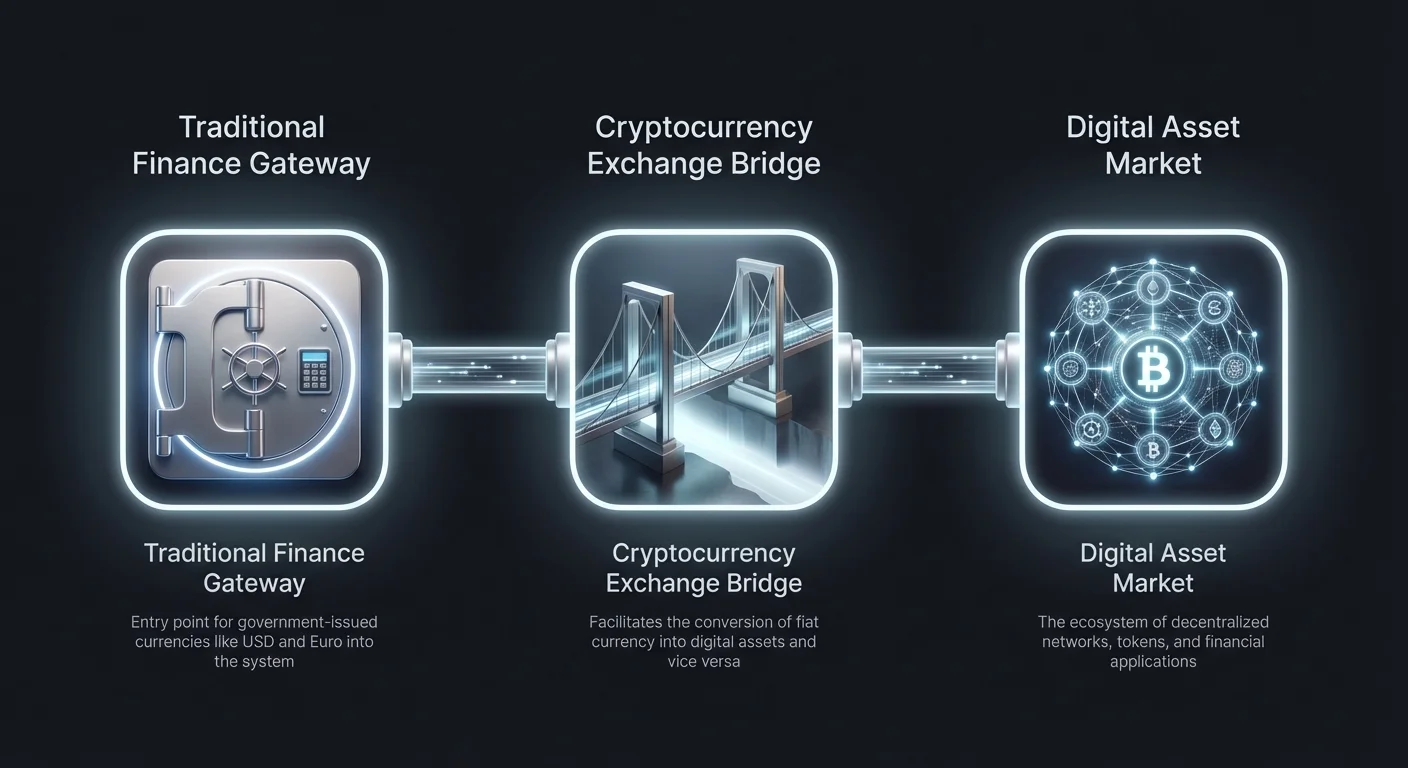
Entering the cryptocurrency market requires a bridge between traditional finance and the digital asset economy. This bridge is built upon fiat access methods, which allow users to exchange government-issued currencies like the US Dollar, Euro, or Great British Pound for Bitcoin and altcoins. The efficiency, cost, and speed of this transition depend heavily on the method chosen.
Investors typically rely on three primary channels to fund their accounts: bank transfers, credit or debit cards, and digital payment processors like PayPal. Each method carries distinct advantages regarding speed and convenience, but they also come with varying cost structures and security implications. Understanding the mechanics of these funding sources is essential for optimizing entry into the market.
Furthermore, the choice of exchange platform plays a pivotal role in how these payment methods are processed. Centralized exchanges, peer-to-peer (P2P) marketplaces, and brokerage apps all handle fiat deposits differently. Some prioritize speed and user experience, while others focus on low fees and high security standards. Navigating these options requires a clear understanding of how fiat money moves through the crypto ecosystem.
Understanding Fiat On-Ramps
A fiat on-ramp serves as the entry point for capital flowing from the traditional banking system into the blockchain network. This infrastructure is critical for market liquidity, as it enables new capital to enter the ecosystem. Without these gateways, the crypto market would effectively be a closed loop, accessible only to those who already possess digital assets.
When a user initiates a deposit, they are essentially instructing a third-party custodian to accept their legal tender and credit their digital account with an equivalent value. This process involves complex regulatory compliance, including Know Your Customer (KYC) protocols and Anti-Money Laundering (AML) checks. These layers of verification ensure that the exchange remains compliant with local financial laws.
The "on-ramping" process varies significantly depending on the technological infrastructure of the chosen exchange. Top-tier platforms integrate directly with banking networks to facilitate smooth transfers. Others rely on third-party payment processors to handle the transaction, which can sometimes introduce additional fees or slight delays in fund availability.
The Role of Liquidity Providers
Behind the scenes of any fiat deposit, liquidity providers play a crucial role. When a user deposits USD to buy Bitcoin, the exchange must have immediate access to that Bitcoin to fulfill the order. Exchanges with high liquidity can execute these conversions instantly without significant price slippage.
Slippage occurs when the price of an asset changes between the moment an order is placed and when it is executed. In low-liquidity environments, a large fiat purchase could drive the price up before the order is filled. Major centralized exchanges mitigate this by maintaining deep order books and vast reserves of assets.
Settlement Times and Availability
The concept of settlement time is vital when comparing access methods. While a transaction may appear instant on the user interface, the actual movement of funds between banks and exchanges can take time. Instant buying power is often a credit extended by the exchange while they wait for the actual cash to settle.
Different methods have different settlement speeds. Bank wires may take days, while card transactions settles relatively quickly. However, some exchanges may lock withdrawals until the fiat deposit has fully cleared to prevent fraud. Understanding these hold periods is important for traders who need to move assets quickly.
Bank Transfers: The Cost-Effective Standard
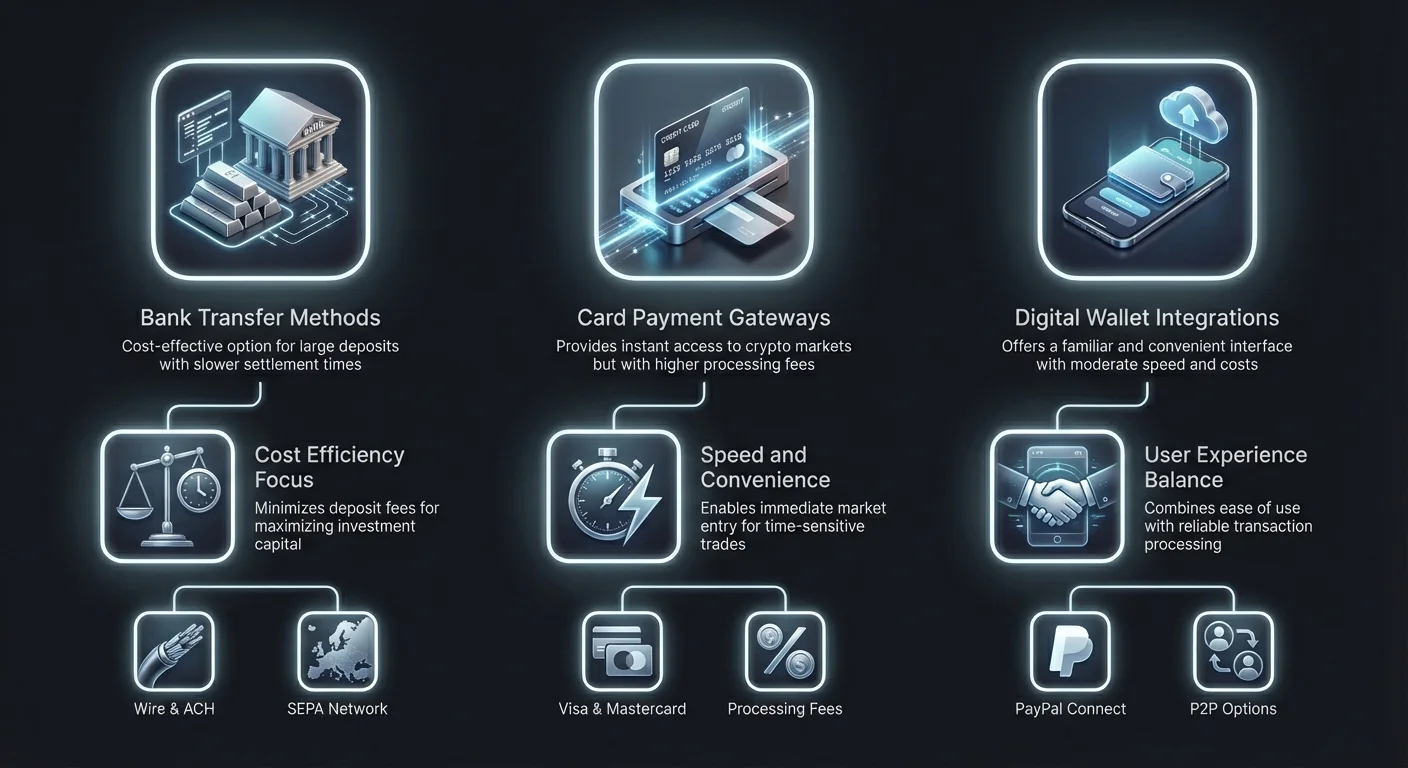
Bank transfers remain the most common method for moving substantial amounts of capital into cryptocurrency exchanges. This method includes wire transfers, ACH (Automated Clearing House) transfers in the US, and SEPA (Single Euro Payments Area) transfers in Europe. The primary appeal of bank transfers lies in their cost efficiency and high deposit limits.
Most exchanges incentivize the use of bank transfers by offering zero or very low deposit fees. Because these transactions are reversible only under strict conditions and are directly tied to verified bank accounts, exchanges face lower fraud risks. Consequently, they pass these savings on to the user in the form of reduced fees.
However, the trade-off for low costs is often speed. Traditional banking networks operate during business hours and can be slow to process cross-border transactions. While some modern systems allow for near-instant transfers, many users still experience delays ranging from one to three business days before their funds are available for trading.
Wire Transfers vs. ACH
Wire transfers are typically used for large sums of money. They are processed individually and often come with fees charged by the sending bank, though the exchange itself might not charge a receiving fee. Wires are generally faster than ACH transfers but are less convenient for frequent, small deposits.
ACH transfers are the standard for automated, smaller payments. They are often free but slower than wires. Many exchanges offer "instant trading" for ACH deposits, allowing users to buy crypto immediately, though they cannot withdraw the assets until the bank transfer finalizes.
SEPA for European Traders
For users in Europe, SEPA transfers offer a distinct advantage. SEPA is designed to make cross-border Euro transfers as easy as domestic ones. Exchanges supporting SEPA often provide extremely fast settlement times, sometimes within hours or minutes, usually at no cost to the user.
This efficiency makes SEPA one of the most effective fiat access methods globally. It combines the high limits and security of a bank transfer with speeds that rival card transactions. Exchanges operating in the EU prioritize SEPA integration to serve their regional customer base effectively.
Credit and Debit Cards: Speed at a Premium
Using a credit or debit card is arguably the fastest way to acquire cryptocurrency. The transaction is processed almost instantly, allowing users to react to market volatility in real-time. For beginners, this method feels the most familiar, mirroring the experience of traditional online shopping.
However, this convenience comes with a significant cost structure. Card networks like Visa and Mastercard charge processing fees to merchants (in this case, the exchange). Because crypto transactions are considered "high risk" by card issuers, these fees are often higher than standard retail transactions.
Exchanges almost universally pass these costs on to the user. It is common to see fees ranging from 2% to 5% on card purchases. For a trader looking to maximize their investment, losing a percentage of their capital to fees before entering the market can be a substantial drawback.
Issuer Restrictions and Cash Advances
Beyond exchange fees, card users must be aware of their bank's policies. Some credit card issuers classify cryptocurrency purchases as "cash advances" rather than standard purchases. This classification triggers a separate, often higher, interest rate that begins accruing immediately, with no grace period.
Additionally, cash advance fees charged by the bank are separate from the transaction fees charged by the exchange. This double-layering of costs can make credit card purchases the most expensive way to buy crypto. Debit cards usually avoid the cash advance issue but are still subject to the exchange's processing fees.
Security Protocols for Cards
To mitigate fraud, exchanges implement 3D Secure technology and strict address verification systems (AVS) for card transactions. 3D Secure adds an authentication step, often requiring the user to enter a code sent to their phone by their bank.
This added layer helps prevent the use of stolen card details on crypto platforms. Despite these measures, the risk of chargebacks—where a user disputes a transaction—remains a concern for exchanges. This risk is another factor contributing to the higher fees associated with card payments.
PayPal in digitalne denarnice
PayPal se je razvil v pomembnega igralca na področju kriptovalut, ki ponuja srednjo pot med počasnostjo bank in visokimi stroški kartic. Za milijone uporabnikov PayPal predstavlja zaupanja vreden, znan vmesnik za upravljanje denarja. Njegova integracija v kripto menjalnice poenostavi proces financiranja za tiste, ki že hranijo sredstva v svojih digitalnih denarnicah.
Pri uporabi PayPala za financiranje računa menjalnice je transakcija običajno takojšnja. Uporabniki lahko prenesejo sredstva iz svojega PayPal stanja ali povezanih bančnih računov neposredno na platformo. Ta hitrost je velika prednost za uporabnike, ki želijo izogniti vnosu občutljivih podatkov kartic ali bank neposredno v menjalnico.
Vendar ne vse menjalnice podpirajo neposrednih PayPal vlog zaradi tveganja chargebackov. Politike zaščite kupca PayPala, ki so odlične za maloprodajne izdelke, lahko zapletejo nepovratne kripto transakcije. Posledično menjalnice, ki sprejemajo PayPal, pogosto uvajajo specifične protokole ali višje provizije za obvladovanje tega tveganja.
Mehanizmi integracije
Na platformah, kot sta Coinbase ali Bitget, je povezava PayPal računa enostaven postopek. Ko je povezan, deluje podobno kot povezan bančni račun, vendar z hitrejšim obračunom. Uporabnik pooblasti transakcijo prek PayPal vmesnika, kar doda plast ločitve med njihovim primarnim bančnim računom in kripto menjalnico.
Nekatere platforme dovoljujejo PayPal samo za izplačila ali omejujejo njegovo uporabo na nakup specifičnih sredstev. Druge morda podpirajo PayPal samo za uporabnike v določenih jurisdikcijah. Preverjanje specifičnih pogojev uporabe za integracijo PayPala na izbrani menjalnici je ključno pred poskusom vloge.
Obvozi vrstnik-do-vrstnika
Na menjalnicah, kjer neposredne PayPal vloge niso podprte, se uporabniki pogosto obrnejo na trge vrstnik-do-vrstnika (P2P). Platforme, kot je Binance P2P, olajšajo trgovanje, kjer en uporabnik pošlje PayPal sredstva neposredno drugemu uporabniku, ki nato sprosti kripto iz escrow storitve.
Ta metoda zaobide potrebo po neposredni obdelavi PayPal transakcije s strani menjalnice. Čeprav je učinkovita, se zanaša na P2P infrastrukturo in zahteva, da so uporabniki budni pred prevarami. Platforma v tem scenariju deluje kot posrednik namesto kot procesor plačil.
Centralized Exchanges: The Primary Gateways
Centralized exchanges (CEXs) act as the primary hubs for fiat-to-crypto conversion. Platforms like Coinbase, Kraken, and Gemini have built robust infrastructures to support multiple payment methods. They maintain relationships with banking partners to ensure liquidity and regulatory compliance.
Coinbase is renowned for its accessibility, offering seamless integration for banks, cards, and PayPal. Its focus on user experience makes it a top choice for beginners who want a frictionless entry. The platform handles the complexity of the transaction in the background, presenting the user with a simple "buy" interface.
Kraken is frequently highlighted for its security and banking relationships. It supports a wide array of fiat currencies and funding methods. Kraken's emphasis on security features, such as strict audit trails and cold storage, provides assurance to users depositing large sums via bank wire.
Security Measures on Major Platforms
Security is the bedrock of any centralized exchange handling fiat. Top-tier platforms employ cold storage, where the vast majority of digital assets are kept offline, away from potential hackers. This ensures that even if the online "hot wallet" is compromised, user funds remain safe.
Two-factor authentication (2FA) is a standard requirement for fiat transactions on these platforms. Whether depositing or withdrawing, users must verify their identity through a secondary device. This prevents unauthorized access to linked bank accounts or cards.
Regulatory Compliance and Safety
Exchanges like Gemini place a heavy emphasis on regulation. Being regulated by entities like the New York Department of Financial Services (NYDFS) means the exchange must adhere to strict capital reserve requirements and banking standards. This compliance ensures that fiat funds held on the exchange are managed responsibly.
For the user, this means rigorous identity verification is required before any fiat method can be used. While some may view this as an inconvenience, it is a necessary component of a secure, regulated fiat on-ramp. It protects both the exchange and the user from illicit financial activities.
Tržnice med vrstniki
P2P borze nudijo decentralizirano alternativo za dostop do fiat valut. Namesto trgovanja proti knjigi naročil, ki jo upravlja podjetje, uporabniki trgujejo neposredno med seboj. Ta model odpira široko paleto plačilnih metod, ki jih centralizirane borze ne morejo podpirati zaradi logističnih ali regulativnih omejitev.
V P2P transakciji lahko kupec privoli, da pošlje sredstva prek lokalnega bančnega nakazila, gotovinskega pologa ali specifične e-denarnice. Ko prodajalec potrdi prejemanje fiat valut, se kripto sprosti. Ta prilagodljivost omogoča tisoče kombinacij plačil, prilagojenih lokalnim gospodarstvom.
Escrow storitve
Ključni sestavni del varne P2P trgovine je escrow storitev. Ko se trgovina začne, se kripto prodajalca zaklene s strani platforme. Ni sproščena kupcu, dokler prodajalec ne potrdi plačila, niti se ne vrne prodajalcu, razen če je trgovina preklicana ali sporna.
Ta mehanizem ščiti obe strani. Kupec je zagotovljen, da kripto obstaja in je rezervirana zanje. Prodajalec je zagotovljen, da ne bo izgubil svojih sredstev brez prejema plačila. Spore obravnava podporna ekipa platforme, ki pregleda dokaze o plačilu.
Zasebnost in raznolikost plačil
P2P platforme pogosto ponujajo večjo zasebnost kot centralizirane borze. Čeprav mnoge zdaj zahtevajo osnovno preverjanje, neposredna narava plačila pomeni, da bančni izpiski kažejo nakazilo posamezniku namesto znani kripto borzi. To je lahko za uporabnike, ki cenijo diskretnost, boljše.
Vendar P2P trgovanje zahteva bolj aktivno upravljanje. Uporabniki morajo izbrati ugledne trgovce, preveriti potrdila o plačilih in komunicirati neposredno s protistrankami. Cene na P2P trgih se lahko močneje nihajo kot na centraliziranih spot trgih, saj prodajalci določajo lastne tečaje za pokritje tveganj različnih plačilnih metod.
Brokerage Platforms
Cryptocurrency brokers operate differently from standard exchanges. Platforms like Uphold or PrimeXBT act as intermediaries, buying and selling assets on behalf of the user. They often simplify the interface to a significant degree, removing complex charts and order books in favor of a simple swap mechanic.
Brokers are excellent for users who want to trade multiple asset classes. For example, a user might fund their account with a credit card and then trade not just crypto, but also forex or commodities within the same interface. This "all-in-one" approach appeals to generalist investors.
Fee Structures in Brokerages
The cost model for brokers is often based on spreads rather than explicit trading fees. The spread is the difference between the buying price and the selling price. While a broker might advertise "zero fees," the cost is built into the price of the asset.
For fiat deposits, brokers typically support cards and bank transfers. Because they aim for simplicity, the deposit process is usually very streamlined. However, users should calculate the "spread" cost combined with any deposit fees to understand the true cost of their acquisition.
Fee Structures Compared
Understanding the total cost of a transaction involves analyzing three distinct fee types: deposit fees, trading fees, and withdrawal fees. Each payment method impacts these costs differently. Being aware of the full fee schedule helps investors preserve their capital.
Bank transfers generally incur the lowest deposit fees, often zero, but may have a fixed withdrawal fee. Credit cards have high deposit fees but allow for immediate trading. PayPal fees vary but usually fall somewhere between banks and cards.
| Payment Method | Typical Speed | Fee Range | Best Use Case |
|---|---|---|---|
| Bank Transfer (Wire/ACH/SEPA) | 1-3 Days | 0% - 1% | Large investments, DCA |
| Credit/Debit Card | Instant | 2% - 5% | Small, urgent purchases |
| PayPal / E-Wallet | Instant | 1% - 4% | Convenience, medium amounts |
Network Fees
It is important to distinguish exchange fees from network fees. When withdrawing crypto purchased with fiat to a private wallet, the user must pay the blockchain network fee (gas). This is unrelated to how the crypto was purchased.
However, some exchanges batch transactions to lower these withdrawal costs for users. Others charge a flat fee that covers the network cost and includes a small margin for the platform.
Hidden Conversion Costs
When using a payment method denominated in a different currency than the exchange's base currency, banks or card issuers may charge a foreign exchange (FX) fee. This is often overlooked.
For example, using a USD-based credit card on a European exchange might trigger a currency conversion fee from the card issuer, on top of the exchange's processing fee. Users should always try to match their deposit currency with the exchange's accepted fiat options.
Security Considerations for Fiat Connections
Connecting a bank account or credit card to a crypto exchange requires a high degree of trust. The security of the user's financial data is just as important as the security of their digital assets. Reputable exchanges use encryption standards similar to major banks to protect this link.
Users should prioritize exchanges that do not store sensitive payment data in plain text. Tokenization is a method where the exchange stores a secure token representing the card, rather than the card details themselves. This limits the damage if a database is breached.
Two-Factor Authentication (2FA)
2FA is the most effective defense against unauthorized fiat use. By requiring a time-sensitive code or a hardware key approval for every deposit or withdrawal, the risk of a remote attacker draining a bank account via the exchange is minimized.
Exchanges like Kraken and Coinbase enforce strict 2FA protocols. They may also employ "whitelisting," where withdrawals are only permitted to pre-approved bank accounts or crypto addresses. This ensures that even if an account is compromised, the funds cannot be sent to a hacker's wallet.
Cold Storage and Asset Protection
While cold storage primarily protects crypto assets, it indirectly secures fiat liquidity. If an exchange's hot wallet is hacked, the platform might face insolvency, endangering user fiat balances. A robust cold storage policy ensures the exchange remains solvent and operational.
Furthermore, some exchanges hold user fiat funds in dedicated custodial accounts at regulated banks, separate from the exchange's operating funds. This separation protects user money in the event of the exchange facing financial difficulties.
KYC and Regulatory Compliance
Access to fiat markets is inextricably linked to identity verification. To accept government-issued currency, exchanges must comply with the regulations of the jurisdictions in which they operate. This means users cannot buy crypto with fiat anonymously on major centralized platforms.
The Know Your Customer (KYC) process typically involves uploading a government ID, a selfie, and sometimes proof of address. This creates a link between a real-world identity and the blockchain addresses used.
The Necessity of Verification
While privacy advocates may view KYC as a drawback, it provides legal recourse and security. If funds are stolen from a bank account and used on a KYC-compliant exchange, law enforcement can track the perpetrator.
For the exchange, compliance allows them to maintain banking relationships. Without these relationships, they could not process wire transfers or card payments. Therefore, robust KYC is the price of admission for convenient fiat access.
Tiers of Access
Many exchanges offer tiered verification levels. Lower levels might allow for small crypto-to-crypto trades, while higher levels are required for fiat deposits and withdrawals. Higher verification tiers also typically come with higher daily or monthly transaction limits.
Users planning to move large amounts of fiat should complete the highest level of verification immediately. This prevents potential freezes or delays if a transaction triggers a security review due to its size.
Geografske skrbi
Razpoložljivost fiatnih metod dostopa je močno odvisna od lokacije. Metoda, ki deluje brezhibno v Združenih državah, morda ni na voljo v Aziji ali Južni Ameriki. Menjalnice prilagajajo svoje plačilne prehode specifičnim regionalnim bančnim infrastrukturam.
Na primer, uporabniki v ZDA se močno zanašajo na prenose ACH. Evropski uporabniki uporabljajo SEPA. V regijah, kot je Azija, so lahko norme drugačna lokalna plačilna omrežja ali prevlada P2P. Uporabniki morajo izbrati menjalnico, ki podpira specifične bančne tire njihove države bivanja.
Regionalne omejitve
Nekatere menjalnice so globalne, vendar imajo omejene funkcije za določene države. Platforma morda sprejema uporabnike iz specifične države, vendar ne podpira izplačil na banke v tej državi. To lahko uporabnike pusti s kripto, ki ga ne morejo enostavno pretvoriti nazaj v gotovino.
Pred depozitom naj uporabniki preverijo, ali so izplačilni kanali odprti in funkcionalni za njihovo specifično regijo. Pregled seznama podprtih držav menjalnice in sprejetih valut je ključni prvi korak.
Privacy Trade-offs
Using fiat on-ramps inherently reduces privacy. Traditional financial systems are surveillance-based, meaning every wire transfer and card swipe is tracked. When these methods are used to buy Bitcoin, the coins purchased are linked to the user's identity.
For investors concerned with privacy, this "taint" can be a concern. The blockchain is a public ledger; if an address is known to belong to a specific person via a KYC exchange, their future transactions can be traced.
Mitigating Privacy Loss
Users seeking privacy often prefer P2P markets where they can pay via cash deposit or other less traceable methods. However, these methods are less convenient and often more expensive.
Alternatively, some users buy on centralized exchanges and then mix or move funds through privacy-preserving protocols. However, this adds complexity and can sometimes flag the funds as "high risk" if they are ever deposited back into a compliant exchange.
Uporabniška izkušnja in vmesnik
Kakovost uporabniškega vmesnika (UI) pomembno vpliva na proces fiatnega onboardinga. Zmeden vmesnik lahko privede do napak, kot je izbira napačne mreže za izplačilo ali nerazumevanje struktur provizij. Najboljše menjalnice močno vlagajo v intuitiven tok »Kupi kripto«.
Coinbase je pogosto naveden kot zlati standard za UI. Njegova zasnova posnema standardne bančne aplikacije in zmanjšuje tesnobo, povezano s kripto transakcijami. Jasna označba provizij in tečajev pred potrditvijo je značilnost dobre uporabniške izkušnje.
Enostavnost proti naprednim lastnostim
Platforme običajno ponujajo dva vmesnika: vmesnik »Pretvori« ali »Kupi« za začetnike in vmesnik »Pro« ali »Napredno« za trgovce. Začetniški vmesnik je preprost, vendar pogosto zaračunava višje spread provizije. Napredni vmesnik se poveže neposredno s knjigo naročil, ponuja nižje provizije, vendar bolj kompleksen vizualni postavitev.
Za fiatne depozite je začetniški vmesnik običajno privzet. Vendar učenje uporabe naprednega vmesnika lahko uporabnikom dolgoročno prihrani znatne količine denarja pri trgovalnih provizijah.
Mobilna dostopnost
Ker se trgovanje vse bolj seli na mobilne naprave, je sposobnost upravljanja fiat transakcij na pametnem telefonu bistvena. Najboljše borze ponujajo popolnoma funkcionalne mobilne aplikacije, ki podpirajo povezave z bankami, skeniranje kartic in biometrično varnost.
Mobilne aplikacije prav tako omogočajo potisna obvestila o potrditvah depozitov. Natančno poznavanje, kdaj je bančni prenos prispel, omogoča trgovcu takojšnjo izvedbo strategije. Platforme, kot sta Crypto.com in Binance, so optimizirale svoje mobilne izkušnje, da so tako robustne kot njihove namizne različice.
Varnost na mobilnih napravah
Mobilno trgovanje prinaša edinstvene varnostne izzive. Če je telefon ukraden, lahko pride do ogroženosti dostopa do aplikacije borze. Ugledne aplikacije uporabljajo biometrične podatke (FaceID ali prstni odtis) za zaščito aplikacije, tudi če je telefon odklenjen.
Poleg tega mnoge aplikacije začasno onemogočijo funkcije dvigov za določen čas po spremembi gesla ali prijavi z nove naprave. To »obdobje ohlajanja« je ključna zaščitna mera za mobilne uporabnike.
Conclusion
The landscape of fiat access methods is diverse, offering options tailored to speed, cost, and convenience. Bank transfers provide the most economical route for substantial investments, despite their slower settlement times. Credit and debit cards offer instant access for those willing to pay a premium for speed. PayPal and digital wallets serve as a convenient middle ground for users seeking a familiar interface.
Choosing the right exchange involves balancing these payment preferences with security and fee considerations. Platforms like Coinbase and Kraken excel in providing secure, regulated gateways, while P2P markets offer flexibility. Ultimately, the best method depends on an individual's specific trading goals, location, and sensitivity to fees versus speed.
The optimal path for most investors combines bank transfers for large deposits with established, regulated exchanges for security.